


The Role of Battery in Winch Systems: 2026 Guide
The battery in an electric winch system does one thing above all else: it absorbs the violent initial current spike when the winch motor engages, delivering hundreds of amps on demand before the alternator can catch up. Without a battery sized and matched to that demand, voltage collapses, the motor stalls, and you are stuck twice over. Understanding how batteries power winching systems, what specs actually matter, and where most operators go wrong is the difference between a clean recovery and a dead rig in the middle of nowhere.
The battery does not run your winch alone. Think of it as a sprinter handing off to a marathon runner. The battery absorbs the initial surge, and the alternator, spinning off the running engine, relentlessly recharges it during the pull. Cut the engine, and you sever that recharge loop. You are then drawing down a finite reserve with no way to replenish it.
Key roles the battery plays in a winch system:
- Delivers the initial high-current burst (often 400+ amps) to start the winch motor
- Acts as a voltage buffer, smoothing demand peaks the alternator cannot instantly match
- Stores reserve energy for multi-stage or extended recovery pulls
- Protects the alternator from instantaneous overload by absorbing current spikes
- Maintains system voltage above the threshold (~11V at the solenoid) needed to keep the motor running
How to determine the correct battery size for your winch
Getting battery sizing right starts with two numbers: Cold Cranking Amps (CCA) and reserve capacity (RC). CCA measures the battery’s ability to deliver a large burst of current instantly, which is exactly what a winch motor demands at startup. RC measures how long the battery can sustain a moderate load before it drops below a usable voltage, giving you a proxy for staying power during a long pull.
A 12,000 lb winch requires at least a 12-volt battery rated at 650 CCA as a baseline. That number assumes a healthy alternator running throughout the pull. If you are winching with the engine off, or if your alternator is aging, that baseline becomes dangerously thin. For CCA requirements and safety margins, the standard guidance is to add a 30% buffer above your calculated minimum, so a system that calculates to 50Ah should be configured with a 65Ah battery.
Battery sizing checklist:
- Look up your winch’s rated stall current (the peak draw under maximum load)
- Match or exceed that figure with your battery’s CCA rating
- Calculate minimum Ah using: Winch Power (W) ÷ Voltage (V) × Estimated Pull Duration (h) = Minimum Ah
- Add 30% to the calculated Ah figure as a safety margin
- Verify reserve capacity (RC) rating; higher RC means thicker internal plates and better deep-cycle resilience
- For winches in the 9,500–17,500 lb range, target 800–1,100+ CCA or plan for a dual-battery setup
- Always account for cold weather, which reduces effective CCA and Ah capacity
Which battery types actually work well in winch setups?
Not every battery chemistry handles the abuse of winching equally. The choice comes down to how often you winch, how hard you push it, and what your vehicle’s mounting constraints look like.
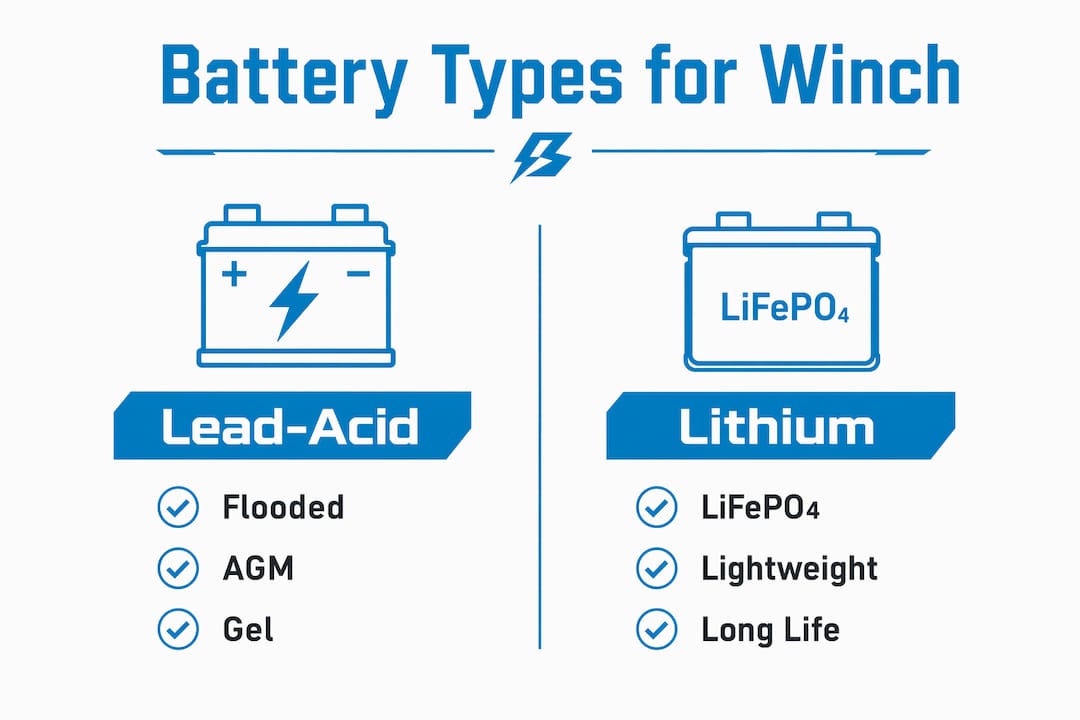
| Battery Type | CCA | Maintenance | Weight | Cycle Life | Best For |
|---|---|---|---|---|---|
| Flooded lead-acid | Good | Regular (check fluid) | Heavy | 200–400 cycles | Budget builds, infrequent use |
| AGM (starting) | Excellent | None | Moderate | 800 cycles | Most winching applications |
| Deep-cycle AGM | Good–Excellent | None | Moderate | 800 cycles | Dedicated winch battery, dual setups |
| LiFePO4 lithium | BMS-limited | None | ~40% lighter | — | Weight-sensitive, frequent use |
| Gel | Fair | None | Moderate | 500 cycles | Not recommended for heavy winching |
AGM batteries are the default choice for serious winching. They are sealed, so mounting orientation is flexible, and their vibration resistance holds up on rough terrain where a flooded battery would shed plates and fail early. High CCA ratings and maintenance-free operation make them the practical pick for the majority of builds.
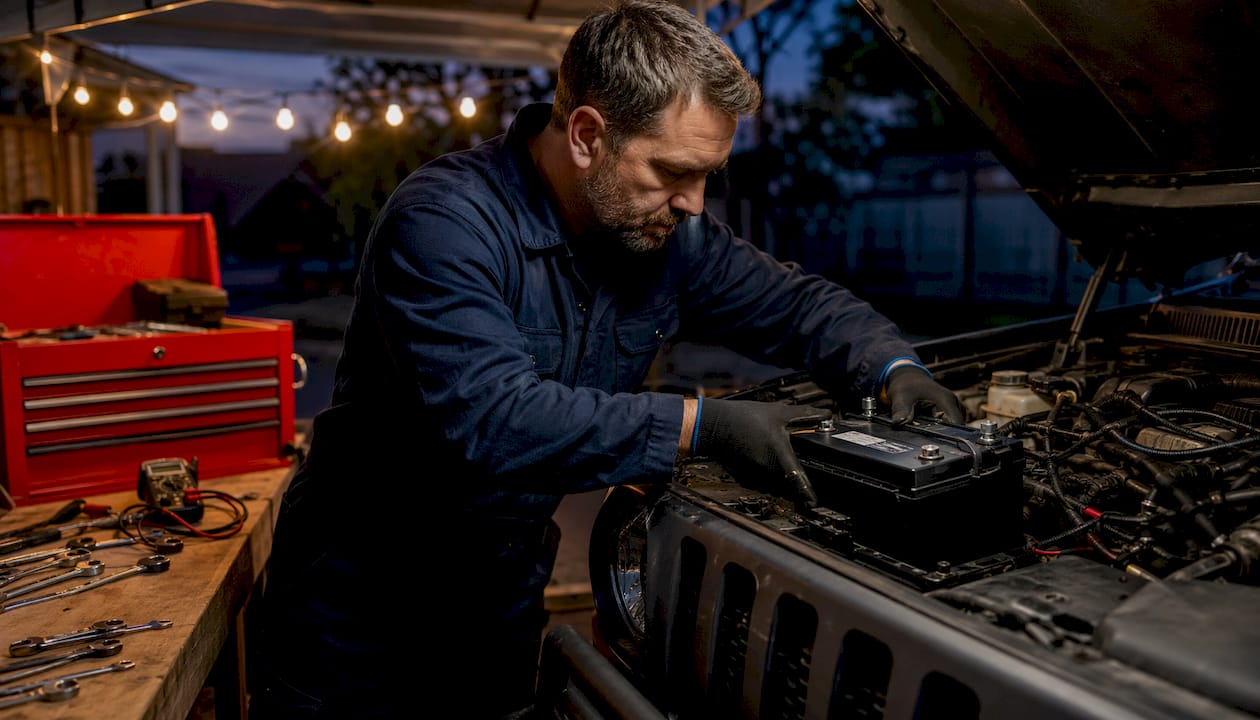
Flooded lead-acid batteries work, but they must be mounted upright. A sideways installation causes electrolyte leakage and immediate failure. They are also less tolerant of the deep discharge cycles that extended winching demands.
Deep-cycle AGM batteries use thicker internal plates specifically designed for repeated deep discharges without rapid degradation. If you are running a dedicated winch battery in a dual setup, this is the chemistry to use.
LiFePO4 lithium batteries weigh roughly 40% less than lead-acid equivalents and deliver outstanding cycle life. The tradeoff is the battery management system (BMS), which enforces a peak discharge limit to protect the cells. A winch pulling 400+ amps can trip that BMS cutoff mid-pull, killing power at the worst possible moment. Qualified installation and careful system design are not optional with lithium.
Gel batteries share the sealed construction of AGM but deliver lower CCA and slower charge acceptance. For heavy-duty winching, they fall short of AGM in almost every relevant metric.
Should you use your vehicle’s primary battery or a dedicated winch battery?
Your vehicle’s starter battery is engineered for one job: a short, sharp burst of current to crank the engine, followed by immediate recharge from the alternator. Winching asks it to do something fundamentally different: sustain high current draw over minutes, not seconds, while repeatedly cycling deep into its capacity.
Running a winch straight from the starter battery with the engine running works for occasional, short-duration recoveries. The alternator keeps the battery from collapsing, and a quality AGM starter battery handles the stress without permanent damage. The danger comes when you winch hard, winch long, or winch with the engine off. Deep discharge a starter battery repeatedly and its plate structure degrades fast.
A dual-battery setup solves this cleanly. A secondary battery, ideally a deep-cycle AGM, handles the winch load while an isolator relay keeps the starter battery protected. Dual battery isolator systems like REDARC combine smart voltage sensing with DC-DC charging, which is especially useful when the auxiliary battery is a LiFePO4 unit that requires a different charge profile than a standard alternator delivers.
Pros and cons of each approach:
- Single starter battery: simpler wiring, lower cost, adequate for rare short pulls with engine running
- Single starter battery risk: deep discharge shortens battery life; engine non-start if drained
- Dual-battery setup: protects starter battery, extends winching duration, adds redundancy
- Dual-battery requirement: additional cost, more complex wiring, isolator relay needed
- Recommendation for frequent or remote use: always run a dual setup with a quality isolator
How battery condition, maintenance, and wiring affect winch performance
The most common hidden cause of winch slowdown is not a failing motor. It is voltage drop from a weak battery or undersized cables. When voltage at the solenoid input falls below approximately 11V under load, the motor slows, draws even more current to compensate, generates heat, and risks permanent damage. Measuring voltage directly at the solenoid during a pull tells you immediately whether the battery or the motor is the problem.
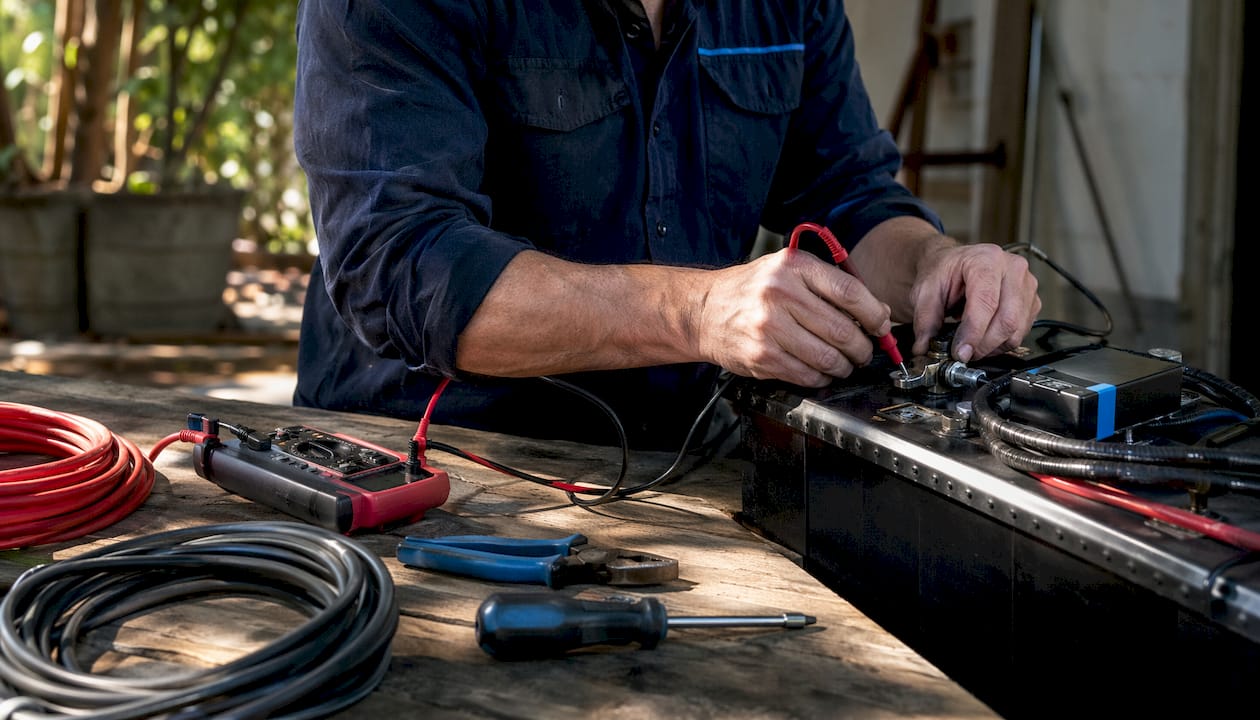
Cable gauge matters as much as battery chemistry. For 12V winches, 2/0 AWG is the standard for both positive and ground runs up to 10 feet. Runs longer than 10 feet should step up to 3/0 AWG to keep voltage drop within safe limits during a 400+ amp draw. Ground cables carry the full motor current back to the battery; a corroded or undersized ground produces identical symptoms to a weak positive cable.
Maintenance tips and common failure modes:
- Check battery terminal connections before every trip; corrosion adds resistance and causes voltage drop
- For flooded batteries, check electrolyte levels monthly and top up with distilled water only
- For AGM batteries, avoid charging above the manufacturer’s specified voltage to prevent cell damage
- Store lead-acid batteries fully charged; store LiFePO4 at approximately 50% charge for extended periods
- Avoid discharging flooded lead-acid batteries below 50% state of charge; for lithium, keep within the 20%–80% range for longevity
- Replace any battery showing more than 0.5V sag under moderate load; that sag multiplies under winch current
- Inspect cable insulation for heat damage after heavy pulls; overheated cables indicate undersized gauge
Pro Tip: Measure voltage at the solenoid input during an actual pull, not just at the battery terminals. The difference between those two readings tells you exactly how much resistance your wiring is adding to the circuit.
Advanced insights on winch battery technology from Bansheebatteries
The “power triangle” framing is the most useful mental model for understanding how batteries power winching systems. The battery is the sprinter: explosive, immediate, but limited in endurance. The alternator is the marathon runner: steady, sustained, and the true power source for any pull lasting more than a minute or two. The winch motor sits at the apex, demanding from both simultaneously. Weakness in any leg of that triangle shows up as a stall, a blown fuse, or a dead battery at the end of the trail.
For most builds, a high-CCA AGM battery is the right answer. The AGM advantages for powersports apply directly to winching: sealed construction, flexible mounting, no maintenance, and the ability to handle the kind of vibration that destroys flooded batteries over a single season of hard wheeling. Dual-purpose deep-cycle AGM models add better cycle life without sacrificing the CCA needed for engine cranking.
LiFePO4 lithium deserves serious consideration for operators who winch frequently or run significant auxiliary loads. The weight savings and cycle life are real advantages, but the BMS peak discharge limit requires careful system design. A lithium battery management system that trips mid-pull is not a theoretical risk; it happens when the winch current exceeds the BMS’s rated output. Most experienced builders address this by using LiFePO4 as the auxiliary battery in a dual setup, with an AGM starter battery providing the initial surge.
Key considerations for advanced winch battery builds:
- High-output alternators (200A+) reduce battery depletion rate during extended pulls and speed recharge after
- LiFePO4 requires a DC-DC charger or compatible alternator management system for correct charge profile
- Dual-purpose AGM is the best single-battery option when one unit must handle both starting and winching
- For a comparison of lithium and AGM in demanding applications, the chemistry choice depends on usage frequency and budget
Pro Tip: If you upgrade to a LiFePO4 auxiliary battery, verify the BMS continuous discharge rating against your winch’s rated stall current before purchasing. A BMS rated at 100A continuous will trip on a winch pulling 400A.
Charging strategies that keep your winch battery ready
A winch battery that sits discharged between trips degrades faster than one that is maintained at proper charge. The charging strategy depends on the battery chemistry.
For AGM batteries, a smart multi-stage charger that delivers a bulk charge phase, an absorption phase, and a float maintenance phase is the right tool. Bansheebatteries’ fully automatic 12V charger handles all lead-acid types up to 230Ah and includes overcharge and short-circuit protection, which matters when you are charging a battery that took a hard pull on the trail. Never charge an AGM battery with a standard flooded-battery charger set to a high voltage; it will damage the cells.
For LiFePO4 batteries, a charger specifically designed for lithium chemistry is required. Standard lead-acid chargers apply the wrong voltage profile and either undercharge the battery or trigger the BMS protection circuit. After a heavy winching session, allow the battery to cool before charging; heat accelerates cell degradation in both AGM and lithium chemistries.
After any extended winching session, run the engine at a slightly elevated idle for 15–20 minutes before shutting down. This gives the alternator time to push meaningful charge back into the battery before it sits overnight. A battery left at 50% state of charge is more vulnerable to sulfation (in lead-acid) or capacity loss (in lithium) than one that is brought back to 80% or higher before storage.
Cold weather effects on battery performance in winch applications
Cold temperatures hit battery performance hard, and winching in winter conditions compounds the problem. A lead-acid battery at 0°F delivers roughly half the CCA it would at 77°F. That means a battery that comfortably handled a 12,000 lb winch in summer may struggle to maintain voltage above the 11V threshold in a January recovery scenario.
AGM batteries handle cold better than flooded lead-acid units because the electrolyte is absorbed in glass mats rather than free-flowing liquid. They are less susceptible to freezing and maintain better voltage stability at low temperatures. LiFePO4 batteries have a different cold-weather vulnerability: their charge acceptance drops sharply below freezing, and charging a lithium battery at temperatures below 32°F can cause lithium plating on the anode, permanently reducing capacity. Most quality LiFePO4 batteries include a low-temperature charge cutoff in the BMS for exactly this reason.
For cold-climate winching, size up. If your baseline calculation calls for 650 CCA, plan for 800 CCA or more to account for the capacity reduction. Keep the battery insulated when possible, and always run the engine before attempting a pull to let the alternator warm the electrical system. In temperatures below approximately -4°F (the equivalent of -20°C), preheating the battery before use is the only reliable way to restore full capacity.
Safety considerations when handling batteries in winch setups
Winch batteries operate at currents that can weld metal, ignite fuel, and cause severe burns. The safety margin for error is small.
Always disconnect the negative terminal before working on any battery connection in a winch circuit. A short across a 12V battery capable of delivering 400+ amps generates enough heat to melt cable insulation and ignite nearby materials almost instantly. Use properly rated fuses or circuit breakers within 18 inches of the battery on the positive cable; a 300–500A fuse is standard for most 12V winch circuits. Never skip the fuse to simplify the installation.
Flooded batteries produce hydrogen gas during charging. Working near a flooded battery with an open flame or a spark source is a genuine explosion risk. AGM and LiFePO4 batteries are sealed and do not off-gas under normal conditions, which is one practical reason they dominate serious winch builds. If you are running a flooded battery, charge it in a ventilated space and keep ignition sources away.
When mounting any battery in a winch vehicle, secure it against movement. A battery that shifts under hard off-road use can crack its case, short its terminals against the vehicle chassis, or in the case of a flooded unit, spill electrolyte. AGM batteries allow flexible mounting angles without leakage risk, which is why AGM installation flexibility is a genuine practical advantage over flooded units in off-road applications.
Upgrade your winch power with Bansheebatteries
Bansheebatteries has spent over 20 years engineering AGM and LiFePO4 batteries for the exact conditions that destroy ordinary batteries: vibration, deep discharge, extreme temperatures, and the kind of high-current abuse that winching demands. Every battery in the lineup is built to a standard that matches what serious operators actually need, backed by a 4-year warranty on AGM and a 5-year warranty on lithium marine batteries.
For weight-sensitive builds or operators who winch frequently, the Bansheebatteries LiFePO4 marine batteries deliver the cycle life and weight savings that make a real difference over a full season. For the majority of builds where a single high-CCA AGM handles both starting and winching, the full battery range covers every size and application. When you need expert guidance on matching a battery to your specific winch and vehicle setup, Bansheebatteries’ team is the resource to use before you buy.
Key Takeaways
The battery in a winch system functions as a high-current buffer that initiates each pull, while the running alternator sustains power and prevents voltage collapse during extended winching.
| Point | Details |
|---|---|
| Battery sizing baseline | A 12,000 lb winch requires at least 650 CCA; always add a 30% capacity margin above your calculated minimum for safety. |
| AGM is the default choice | AGM batteries offer high CCA, sealed construction, and vibration resistance that flooded units cannot match in off-road use. |
| LiFePO4 weight advantage | LiFePO4 batteries weigh approximately 40% less than lead-acid equivalents but require BMS protection and qualified installation. |
| Engine must run during winching | Operating with the engine off severs the alternator recharge loop, draining the battery to collapse within minutes. |
| Cable gauge is critical | Use 2/0 AWG for runs under 10 feet; step up to 3/0 AWG for longer runs to keep voltage drop safe at 400+ amp draw. |