


How Battery Powers Trail Lighting Systems in 2026
Battery power is the essential component that enables trail lighting systems to function independently during off-grid outdoor activities. Understanding how battery powers trail lighting systems means knowing more than just which battery to buy. It means understanding chemistry, capacity, thermal behavior, and the Battery Management System (BMS) that ties everything together. Lithium-ion and LiFePO4 (lithium iron phosphate) chemistries dominate modern trail lighting because they deliver superior energy density, long cycle life, and stable voltage output. Bansheebatteries builds its off-grid power solutions around these same principles, making them a natural reference point for outdoor enthusiasts who need reliable light when the grid is nowhere in sight.
How battery powers trail lighting systems: chemistry and capacity
The battery type you choose determines everything about your trail lighting setup, from runtime to cold-weather reliability. Most trail lighting systems as of 2026 use lithium-ion or LiFePO4 batteries because of their superior energy density and lifespan. That matters on a multi-day trip where you cannot afford a dead light at 2:00 AM.
Comparing the main battery chemistries
Each battery chemistry brings a different set of trade-offs for trail use:
- LiFePO4 (lithium iron phosphate): The top choice for trail lighting. It operates safely between -20°C and 60°C, delivers 3,000 or more charge cycles, and resists thermal extremes better than any other portable chemistry. Bansheebatteries’ LiFePO4 marine batteries are built around this chemistry for exactly these reasons.
- Lithium-ion: High energy density and lighter than lead-acid, but slightly more sensitive to temperature swings and overcharging without a quality BMS.
- NiMH (nickel-metal hydride): Safer than older chemistries but only lasts 1–2 years in solar and outdoor lighting applications. Not worth the trade-off for serious trail use.
- Lead-acid (AGM): Heavier and lower energy density, but proven, affordable, and widely available. AGM variants are maintenance-free and handle deep cycling better than flooded lead-acid types.
Pro Tip: If weight is your primary concern on a backpacking trip, LiFePO4 wins every time. If you are powering a fixed camp setup or a vehicle-mounted trail light, a quality AGM battery gives you solid performance at a lower upfront cost.
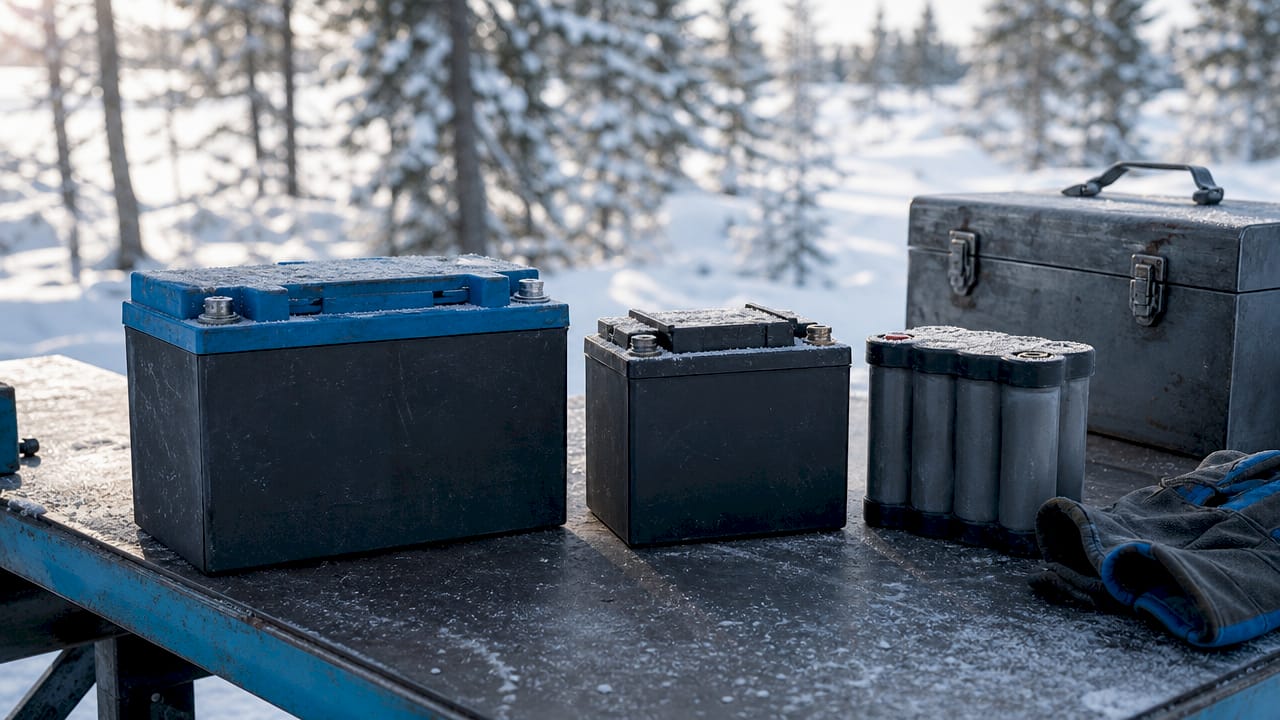
Lithium batteries maintain about 70% capacity at -20°C, while NiMH drops off far more sharply in the same conditions. That 70% figure is the floor, not the average, which means lithium still delivers usable light when temperatures drop hard overnight.
How do battery management systems optimize trail light performance?
A Battery Management System is not optional equipment. It is the circuit that keeps your battery alive and your lights on. BMS functions include cell balancing, overcharge protection, deep discharge prevention, and temperature monitoring. Without it, the weakest cell in a lithium pack sets the ceiling for the entire battery’s performance and lifespan.
Here is what a properly functioning BMS does for your trail lighting setup:
- Cell balancing: Equalizes voltage across all cells so no single cell degrades faster than the others.
- Overcharge protection: Cuts charging current before voltage exceeds safe limits, preventing heat buildup and cell damage.
- Deep discharge protection: Stops discharge before the battery reaches a damaging low voltage, directly extending cycle life.
- Temperature monitoring: Adjusts charge and discharge rates based on ambient temperature, protecting the pack in cold or hot conditions.
LED lights are inherently low-voltage DC devices, which means they connect directly to battery output without needing an AC-to-DC converter. That compatibility removes a major failure point from the system. Off-grid LED lighting achieves about 80% higher efficiency than incandescent bulbs, which means your battery stretches much further per charge. A Bansheebatteries 500A Bluetooth battery monitor pairs with LiFePO4 packs to give you real-time state-of-charge data, so you know exactly how much runtime you have left.
Pro Tip: Never buy a lithium battery pack without confirming it has an integrated BMS. A bare lithium cell with no management circuit is a fire risk and a short-lived investment.
The battery also acts as a voltage regulator, protecting delicate electronics from power spikes and delivering consistent voltage to your LEDs. Consistent voltage means consistent light output, which matters when you are navigating a technical trail section after dark.
How to calculate the right battery capacity for your setup
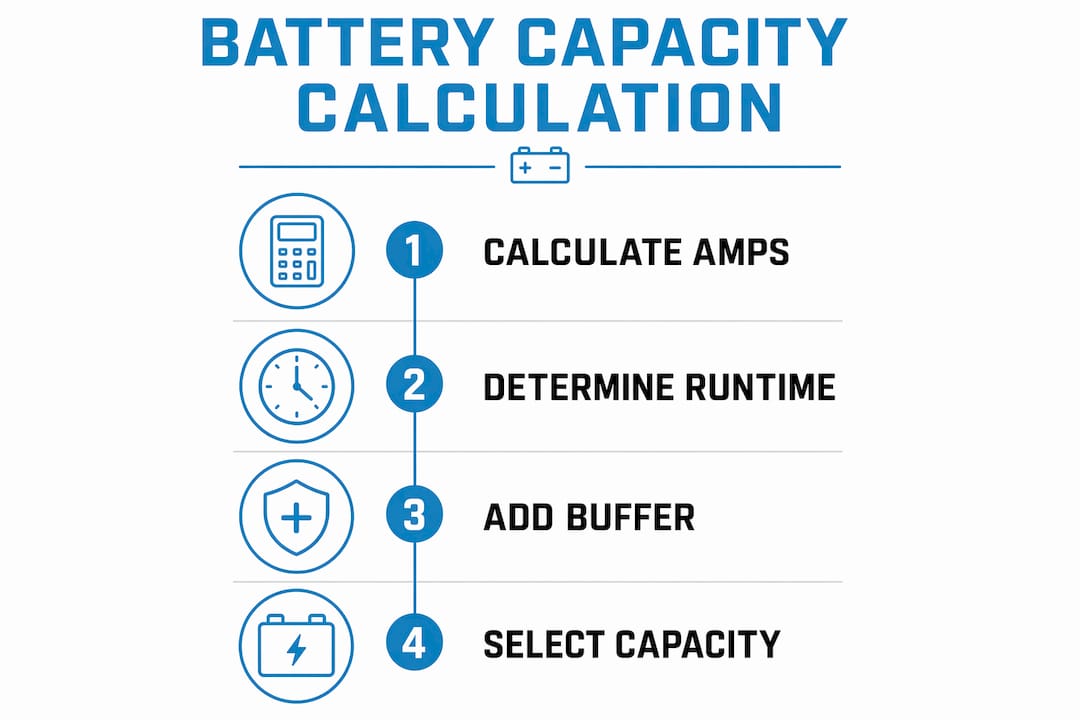
Sizing your battery correctly is the step most outdoor enthusiasts skip, and it is the reason lights die mid-trip. The math is straightforward once you know the formula.
- Find your current draw. Divide wattage by voltage. A 24W LED strip running on 12V draws 2 amps (Watts ÷ Volts = Amps).
- Calculate amp-hours needed. Multiply amps by your desired runtime. A 2-amp system needs a 20Ah battery to run for 10 hours.
- Add the reliability buffer. Add 20–30% extra capacity above your calculated requirement. This accounts for battery aging, temperature losses, and efficiency drops over time.
- Check your fuse rating. Always fuse the circuit at or just above the maximum expected current draw. A 2-amp system uses a 3-amp or 5-amp fuse, not a 20-amp fuse.
- Verify wire gauge. Undersized wire creates resistance, heat, and voltage drop. Match wire gauge to current draw using a standard AWG chart.
| System wattage | Voltage | Current draw | 10-hour runtime | Recommended capacity (with 25% buffer) |
|---|---|---|---|---|
| 12W | 12V | 1A | 10Ah | 12.5Ah |
| 24W | 12V | 2A | 20Ah | 25Ah |
| 48W | 12V | 4A | 40Ah | 50Ah |
| 60W | 12V | 5A | 50Ah | 62.5Ah |
The 20–30% capacity buffer is not optional padding. It is the margin that prevents unexpected shutdowns during multi-day adventures when battery aging and cold temperatures have already eaten into your usable capacity. Lithium options like the Bansheebatteries 12V 100Ah LiFePO4 deep cycle battery give you that headroom for extended camp or vehicle-mounted trail lighting setups.
What environmental factors affect battery performance on the trail?
Temperature is the single biggest variable that separates a battery that performs from one that fails. Cold is the primary threat for most trail users in North America.
- Below -20°C: Lithium battery capacity can drop to 50–55% of rated capacity. A 20Ah battery effectively becomes a 10–11Ah battery. Plan your sizing around this reality if you operate in alpine or winter conditions.
- Thermal placement: Store your battery pack inside your sleeping bag or inside a vehicle cab overnight. Body heat or cabin warmth keeps the cells closer to their rated operating temperature.
- Deep discharge cycles: Repeatedly draining a lithium battery below its BMS cutoff threshold accelerates degradation. Avoid running lights until they flicker and die. Recharge when the battery monitor shows 20% remaining.
- Moisture and vibration: Waterproof enclosures and secure mounting reduce connector corrosion and physical damage on rough terrain. Silicone-sealed battery boxes add meaningful protection on ATV or UTV setups.
- Storage between trips: Store lithium batteries at 50–60% charge in a cool, dry location. Storing at full charge or fully depleted shortens cycle life.
Lithium batteries used in outdoor recreation, including those covered in lithium trolling motor applications, face similar thermal and discharge challenges as trail lighting batteries. The mitigation strategies transfer directly: insulate, monitor, and never deep-discharge.
Key Takeaways
Battery-powered trail lighting systems perform reliably when you match LiFePO4 chemistry, a quality BMS, and correctly sized capacity to your specific runtime and temperature conditions.
| Point | Details |
|---|---|
| LiFePO4 leads for trail use | It operates from -20°C to 60°C and lasts 3,000+ cycles, outperforming all other portable chemistries. |
| BMS is non-negotiable | A Battery Management System balances cells, prevents overcharge, and stops deep discharge to extend pack life. |
| Size with a 25% buffer | Always add 20–30% above your calculated amp-hour requirement to account for aging and cold-weather losses. |
| Cold cuts capacity sharply | Below -20°C, lithium capacity can drop to 50–55%, so insulate or warm your battery pack overnight. |
| LEDs and batteries are a natural match | LED lights run on low-voltage DC, connecting directly to battery output without converters or extra failure points. |
What I’ve learned after years of powering lights off the grid
The most common mistake I see outdoor enthusiasts make is treating the battery as an afterthought. They spend hours choosing the right LED fixture and then grab whatever battery is cheapest and closest to the right voltage. That approach fails, usually on night two of a three-day trip.
The BMS is where I focus first. A lithium pack without a quality integrated BMS is not a battery. It is a liability. I have seen packs without proper cell balancing degrade to half their rated capacity within a single season of regular use. The weakest cell drags the entire pack down, and you never see it coming until your lights go dark.
I also think the outdoor community underestimates cold. Most people test their setup in the garage in October and assume it will perform the same in january at 9,000 feet. It will not. I now size every trail lighting battery at 30% above my calculated need and keep the pack inside the tent or vehicle overnight. That habit alone has eliminated cold-weather failures for me.
The technology is genuinely getting better. Integrated BMS circuits are smaller, smarter, and more reliable than they were even five years ago. Bluetooth battery monitors let you check state of charge from your phone without opening a panel. These tools make off-grid lighting more dependable than ever, but they do not replace the fundamentals: right chemistry, right size, right management.
— Donald
Bansheebatteries for dependable off-grid trail lighting
Outdoor enthusiasts who want reliable trail lighting need a battery built for the conditions, not a general-purpose cell that happens to fit.
Bansheebatteries designs its LiFePO4 lithium battery lineup specifically for deep-cycle, off-grid, and high-demand applications. Every pack includes an integrated BMS for overcharge, deep discharge, and temperature protection. The 5-year warranty on lithium marine batteries reflects the durability built into each unit. For outdoor enthusiasts who need a compact, portable option, the 12V 18Ah LiFePO4 battery delivers 3,000+ cycles with a 20A BMS, making it a practical trail lighting power source for multi-day adventures.
FAQ
What is the best battery type for trail lighting?
LiFePO4 (lithium iron phosphate) is the best battery type for trail lighting. It operates safely from -20°C to 60°C, lasts 3,000 or more cycles, and delivers stable voltage output throughout the discharge cycle.
How do I calculate how many amp-hours I need?
Divide your light’s wattage by its voltage to get amps, then multiply amps by your desired runtime in hours. Add 20–30% to that total to account for battery aging and temperature losses.
Does cold weather affect battery-powered trail lights?
Cold weather significantly reduces usable battery capacity. Below -20°C, lithium batteries can drop to 50–55% of their rated capacity, so insulating or warming your battery pack overnight is a practical necessity in alpine or winter conditions.
What does a BMS do in a trail lighting battery?
A Battery Management System balances cell voltages, prevents overcharging, stops deep discharge before damage occurs, and monitors temperature. Without a BMS, lithium packs degrade rapidly as the weakest cell limits the entire pack’s performance.
Can I connect LED trail lights directly to a battery?
LED lights run on low-voltage DC and connect directly to battery output without an AC-to-DC converter. This direct compatibility simplifies the circuit, reduces failure points, and increases overall system efficiency.