


Why Your UTV Battery Needs High CCA to Start
Cold cranking amps (CCA) is defined as the number of amps a battery can deliver at 0°F for 30 seconds while maintaining at least 7.2 volts. Understanding why a UTV battery needs high CCA is the difference between a reliable start on a frozen trail and a dead machine miles from the trailhead. UTVs face conditions that push batteries harder than almost any other vehicle: cold temperatures, rough terrain, large displacement engines, and heavy accessory loads. Bansheebatteries has spent over 20 years building batteries specifically for these demands, and CCA sits at the center of every powersports battery decision.
Why UTV battery needs high CCA: cold and engine demands
Cold temperatures are the primary reason CCA matters so much for UTVs. Batteries lose approximately 35% of their starting strength at 32°F and up to 60% at 0°F. That means a battery rated at 300 CCA effectively delivers only 120 CCA on a hard winter morning. At the same time, cold engines can require double the starting current of a warm engine because cold oil is thicker and creates far more internal friction. These two forces hit simultaneously, which is exactly why undersized CCA leaves riders stranded.
The mechanical side of the equation is just as important as the chemistry. A UTV engine with a larger displacement needs more current to turn over its crankshaft against compression. Add a winch, LED light bar, or heated grips to the electrical load, and the battery faces a surge demand before the engine even fires. CCA testing at 0°F provides a standardized worst-case benchmark, which is why OEM specifications use it as the baseline for battery selection.
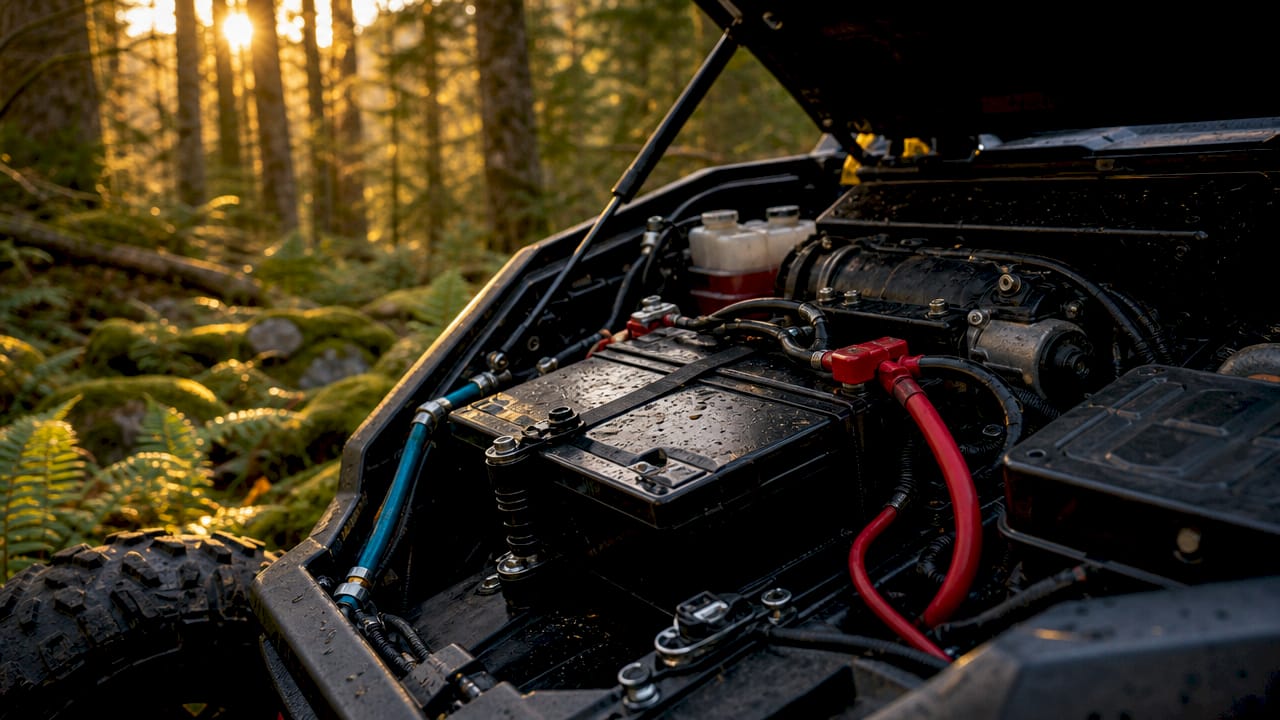
Off-road terrain adds one more layer of stress. Constant vibration, steep inclines, and unpredictable weather mean a UTV battery never gets the easy life of a garage-kept car battery. A battery with a thin CCA margin has no buffer when conditions stack against it.
Pro Tip: If you ride in temperatures below 32°F even occasionally, treat your CCA requirement as if you live in a colder climate full time. The cost of a higher-rated battery is far less than a recovery tow.
Here is a quick summary of the forces working against your battery at startup:
- Battery output drops 35%–60% in cold weather
- Cold engine oil increases mechanical resistance to cranking
- Large displacement engines draw more starting current
- Accessories add electrical load before the engine fires
- Vibration and rough terrain accelerate battery wear
What CCA rating does your UTV actually need?
Selecting the right CCA rating starts with engine size and climate. Entry-level UTVs need 200–300 CCA, while larger engines or machines used in extreme cold or with high electrical loads require 400 to 700+ CCA. These are not arbitrary numbers. They reflect the real current draw of different engine displacements under cold-start conditions.
Experts recommend meeting or exceeding the OEM-specified CCA rating by 15–20% to prevent starting failures in cold and rugged conditions. That buffer accounts for battery aging, accessory load, and the occasional brutal morning. Checking your owner’s manual for the OEM CCA spec is the fastest way to set your baseline.
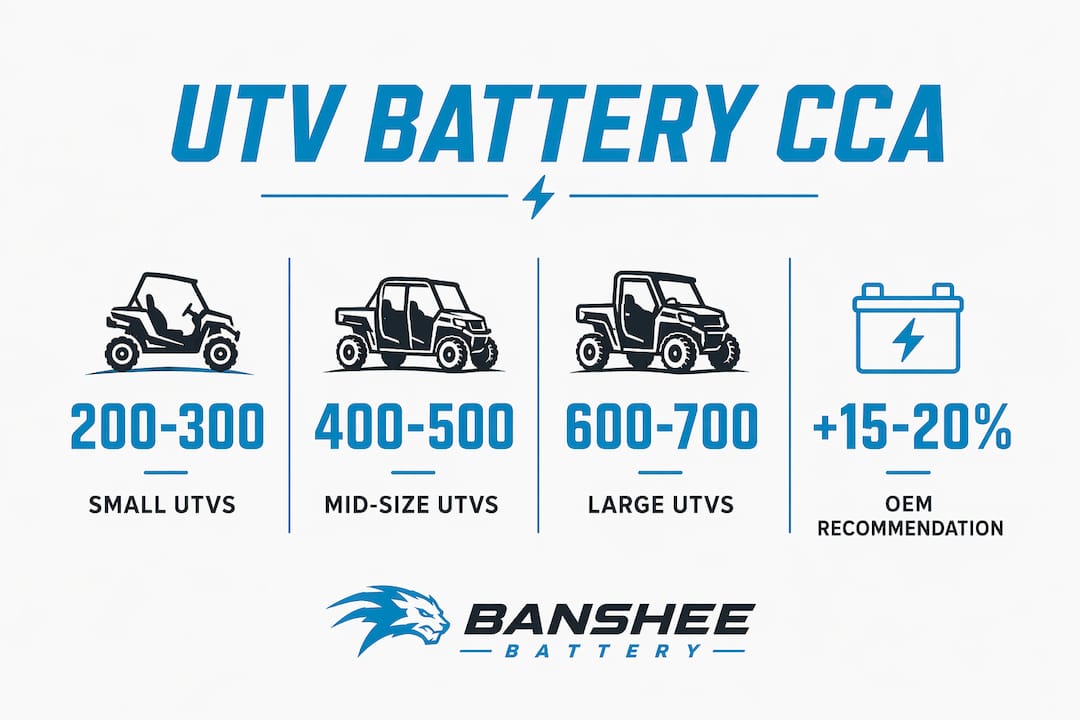
The table below maps CCA ranges to common UTV types and conditions.
| UTV type and condition | Recommended CCA range |
|---|---|
| Small engine (under 500cc), mild climate | 200–300 CCA |
| Mid-size engine (500–800cc), moderate climate | 300–450 CCA |
| Large engine (800cc+), cold climate | 450–600 CCA |
| High-displacement, extreme cold, heavy accessories | 600–700+ CCA |
When selecting a battery, also account for:
- Winch usage (a winch alone can draw 200+ amps under load)
- Heated accessories running during startup
- Age of the battery (older batteries deliver less than their rated CCA)
- Frequency of cold-weather riding
For a deeper look at matching battery specs to your specific machine, the UTV battery selection guide from Bansheebatteries covers engine-specific recommendations in detail.
Does high CCA damage your starter motor?
High CCA batteries do not damage starter motors. The engine draws only the current it needs. A battery with 600 CCA installed in a machine that only requires 350 CCA at startup will simply deliver 350 CCA. The extra capacity sits unused unless conditions demand it.
The real benefit of oversizing CCA is the safety margin it creates. A battery running near its rated limit every cold morning degrades faster and fails sooner. A battery with headroom delivers consistent power, supports heavy accessory use without voltage sag, and holds up better as it ages.
There are a few specific advantages worth knowing:
- Cold start reliability: Extra CCA means the battery can still fire the engine even when cold has reduced its output by 40–60%.
- Accessory support: High CCA batteries handle simultaneous loads from winches, lights, and electronics without dropping voltage.
- Longer service life: Batteries that operate well within their rated capacity experience less stress per cycle.
- Aging buffer: As a battery ages and its effective CCA drops, a higher-rated battery still meets the engine’s minimum requirement longer.
Pro Tip: When replacing a battery on a machine that is 3 or more years old, size up by 20–25% above OEM spec. The starter and wiring have accumulated wear, and the extra CCA margin compensates for increased resistance in the circuit.
For riders in warm climates who never see freezing temperatures, a battery matched exactly to OEM spec is adequate. For everyone else, the cost difference between a 300 CCA and a 450 CCA battery is small compared to the reliability gain.
AGM vs. lithium: which technology delivers better CCA for UTVs?
Battery technology determines how well a UTV battery holds its CCA rating under real-world abuse. Two technologies dominate the powersports market: AGM (Absorbent Glass Mat) and lithium (LiFePO4). Each has a distinct performance profile.
AGM batteries are preferred for off-roading because of their superior vibration resistance and sealed design. The glass mat construction holds electrolyte in place, so constant trail vibration does not cause internal damage or electrolyte loss. AGM batteries deliver consistent CCA across a wide temperature range and require no maintenance. Bansheebatteries backs its AGM powersport batteries with a 4-year warranty, which reflects how well the technology holds up under sustained abuse. For more on how AGM handles trail conditions, the AGM vibration performance guide explains the construction in detail.
Lithium batteries deliver higher CCA-to-weight ratios and, with an integrated Battery Management System (BMS), offer maintenance-free use and protection against overcharge and deep discharge. A lithium battery that weighs half as much as an AGM unit can match or exceed its CCA output. That weight savings matters on a performance UTV where every pound affects handling.
The cold-weather limitation of lithium is real and worth understanding. Lithium batteries require an integrated BMS with low-temperature protection to avoid damage from charging in freezing conditions. Without self-heating capability, a lithium battery in extreme cold can refuse to accept a charge even if it still delivers enough CCA to start the engine. Quality lithium batteries designed for powersports include this protection as standard.
| Feature | AGM | Lithium (LiFePO4) |
|---|---|---|
| Vibration resistance | Excellent | Good |
| CCA-to-weight ratio | Moderate | High |
| Cold-weather charging | No restriction | Requires BMS with low-temp protection |
| Maintenance | None | None |
| Typical warranty (Bansheebatteries) | 4 years | 5 years (marine) |
For a direct comparison of both technologies in powersports applications, the AGM vs. LiFePO4 breakdown from Bansheebatteries covers the trade-offs in detail.
How to maintain CCA performance and extend battery life
Powersports batteries last 3–5 years when properly maintained. CCA output declines gradually over that period, which is why maintenance habits directly affect how long a battery stays reliable.
Follow these steps to preserve starting power:
- Keep terminals clean. Corrosion at the terminal increases resistance and reduces effective CCA delivery. Clean terminals with a wire brush and apply a corrosion-inhibiting spray. For a detailed routine, the battery corrosion prevention guide covers the process step by step.
- Use a smart charger during storage. A battery left discharged over winter sulfates internally and loses CCA permanently. A maintenance charger keeps it at full capacity.
- Test CCA annually. Most auto parts stores and battery shops test CCA for free. A battery delivering less than 80% of its rated CCA is approaching replacement territory.
- Avoid deep discharges. Running accessories with the engine off drains the battery below safe voltage and accelerates capacity loss.
- Store in a cool, dry place. Heat accelerates self-discharge and internal degradation. A garage or shed is far better than leaving the machine outside in summer heat.
Signs that CCA has declined to a critical level include slow cranking on warm mornings, a starter that hesitates before engaging, and a battery that needs frequent recharging. When you see these signs, replacement is more reliable than waiting. The UTV battery upgrade guide from Bansheebatteries walks through the full replacement decision process.
Pro Tip: Test your battery’s CCA before the first cold ride of the season, not after it fails. A battery that tests at 75% of rated CCA in october will likely fail by january.
Key Takeaways
A UTV battery needs a high CCA rating because cold temperatures cut battery output by up to 60% while simultaneously doubling engine starting current demands, leaving a low-rated battery with no margin to fire the engine.
| Point | Details |
|---|---|
| CCA drops sharply in cold | Batteries lose 35%–60% of starting strength between 32°F and 0°F. |
| Match or exceed OEM spec | Size your CCA 15–20% above OEM rating to account for cold, aging, and accessories. |
| High CCA does not harm starters | Engines draw only the current they need; extra CCA is a safety buffer, not a risk. |
| AGM and lithium both work | AGM excels in vibration resistance; lithium wins on weight and CCA-to-weight ratio. |
| Maintain to preserve CCA | Clean terminals, smart charging, and annual CCA testing extend reliable battery life to 3–5 years. |
What I have learned from years of cold-start failures
The undersized battery problem is more common than riders admit
Riders often buy the cheapest battery that physically fits the tray and matches the voltage. That approach works fine in July. It fails in january at 6:00 AM when you are 40 miles from the nearest road. I have seen this pattern repeat more times than I can count, and it almost always traces back to a battery that met the OEM minimum CCA spec but had no margin left after a few seasons of use.
The counterintuitive lesson is that a higher CCA battery is often the more economical choice over a 3-year period. A battery with headroom lasts longer, fails less often, and does not strand you at the worst possible moment. The price difference between a 300 CCA and a 450 CCA battery in the same form factor is rarely more than $20–$30. The cost of a recovery tow or a ruined trip is far higher.
My practical advice: if you ride in cold weather at all, buy the highest CCA battery that fits your tray and matches your voltage. If you run a winch or any significant accessory load, go even higher. Bansheebatteries offers AGM options with a 4-year warranty and lithium options with a 5-year warranty on marine units, which tells you something about how confident they are in the longevity of a properly sized battery. Prioritize brands that publish actual CCA ratings, back them with real warranties, and build batteries specifically for powersports abuse rather than adapting automotive designs.
— Donald
Bansheebatteries high-CCA options for your UTV
Choosing the right battery is straightforward when the specs are honest and the warranty is real. Bansheebatteries designs its AGM and lithium powersport batteries specifically for the demands of off-road use: high CCA ratings, sealed construction, vibration resistance, and maintenance-free operation.
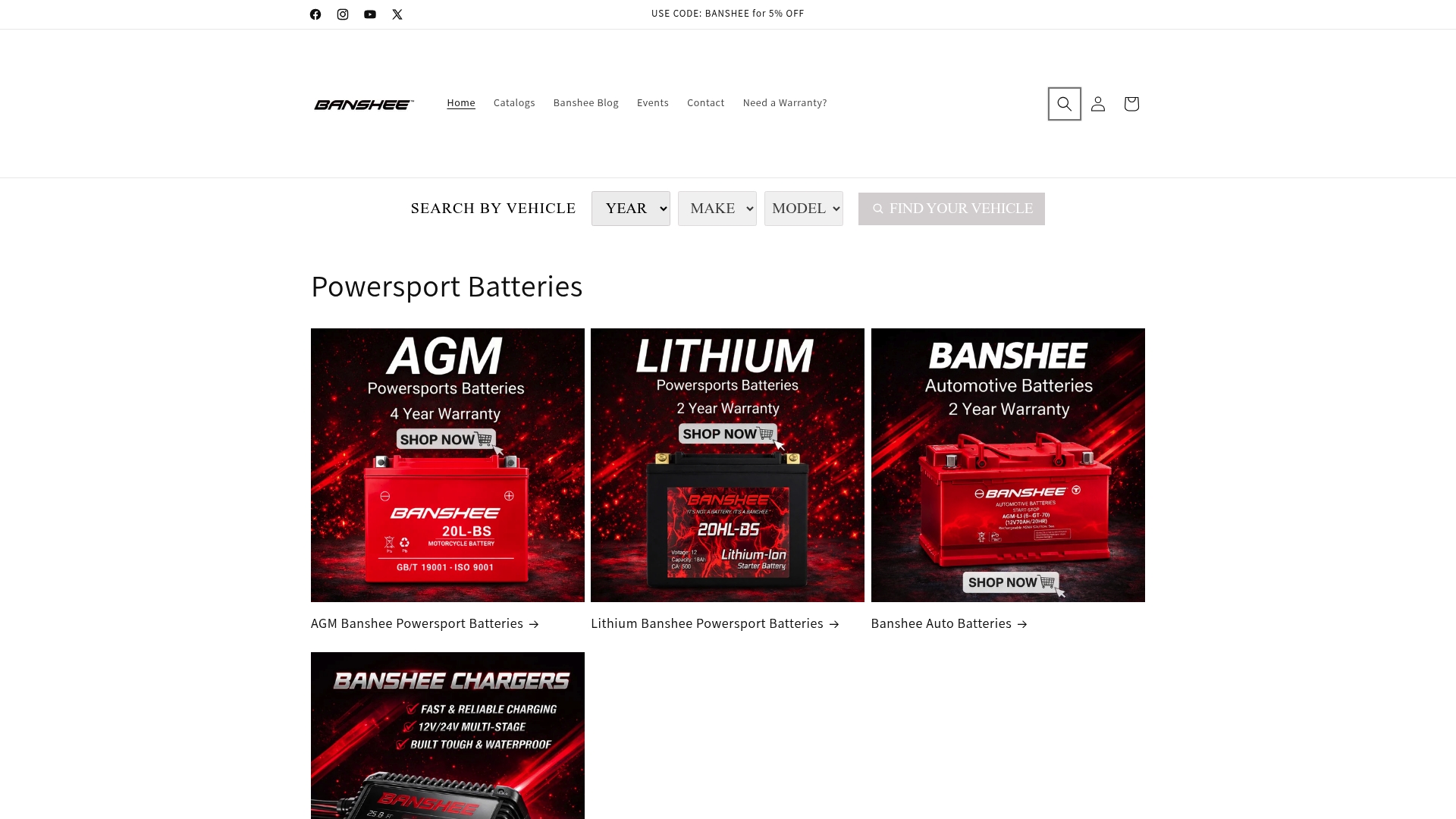
The Lithium Banshee Powersport Batteries collection includes LiFePO4 options with high CCA-to-weight ratios and integrated BMS protection for cold-weather reliability. For riders who prefer AGM, Bansheebatteries offers proven options backed by a 4-year warranty. Every battery in the lineup is built to meet or exceed OEM CCA specs so your UTV starts when it needs to, regardless of the temperature or terrain.
FAQ
What does CCA mean on a UTV battery?
CCA stands for cold cranking amps. It measures how many amps a battery can deliver at 0°F for 30 seconds while maintaining at least 7.2 volts, which is the industry standard for rating battery starting power.
How many CCA does a UTV battery need?
Most UTVs need between 200 and 700+ CCA depending on engine size, climate, and accessory load. Experts recommend matching or exceeding the OEM CCA spec by 15–20% for reliable cold-weather starting.
Will a higher CCA battery damage my UTV’s starter?
No. The engine draws only the current it needs at startup. A battery with a higher CCA rating than required simply provides a safety margin without sending excess current through the starter motor.
What is the difference between AGM and lithium CCA performance?
AGM batteries deliver consistent CCA with excellent vibration resistance and no cold-charging restrictions. Lithium batteries offer a higher CCA-to-weight ratio but require an integrated BMS with low-temperature protection to charge safely in freezing conditions.
How long does a UTV battery maintain its CCA rating?
A well-maintained powersports battery lasts 3–5 years. CCA output declines gradually with age, so annual CCA testing and proper charging habits are the best way to catch a failing battery before it leaves you stranded.