


AGM Battery Explained: Powersports Guide for Riders
An AGM battery is a sealed, absorbent glass mat lead-acid battery designed to deliver reliable starting power in the demanding conditions powersports riders face every day. The industry term is VRLA, or valve-regulated lead-acid, and AGM is the most common type used in motorcycles, ATVs, UTVs, snowmobiles, and personal watercraft. Unlike flooded batteries, AGM units are maintenance-free, spill-proof, and built to handle the punishment of off-road riding and cold-weather starts. Bansheebatteries has built its product lineup around this technology for over 20 years, and the reasons are straightforward: AGM batteries last 3–7 years, resist vibration at levels flooded batteries cannot match, and work with most OEM charging systems right out of the box.
What is an AGM battery in powersports vehicles?
AGM technology works by immobilizing the electrolyte inside tightly packed fiberglass mats rather than letting it slosh freely as in a flooded battery. Those mats do two jobs at once. First, they hold the sulfuric acid solution in direct contact with the lead plates, which keeps internal resistance low and cranking amps high. Second, they act as a mechanical buffer against vibration, preventing the plate material from shedding and causing internal shorts.
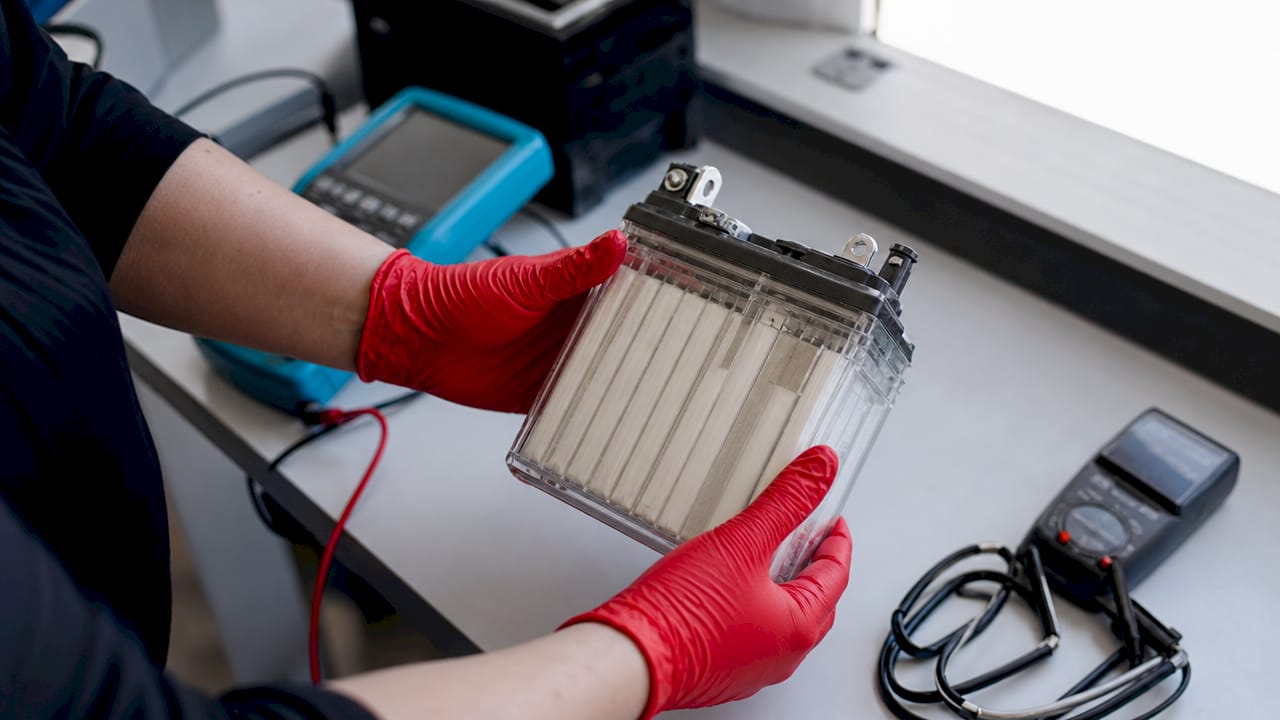
The sealed housing includes a pressure-relief valve, which is the “valve-regulated” part of the VRLA designation. During normal charging, oxygen produced at the positive plate travels through the fiberglass mat and recombines with hydrogen at the negative plate. This oxygen recombination cycle keeps water loss near zero, which is why you never need to top off an AGM battery with distilled water.
The construction also gives AGM batteries their mounting flexibility. Because the electrolyte is fully absorbed, you can install the battery on its side or at steep angles. Safe mounting angles extend up to 90 degrees, though upside-down installation is not permitted because the pressure-relief valves require gravity to function correctly. That flexibility matters for custom sportbike builds and compact ATV battery boxes where space is tight.
Pro Tip: When installing a new AGM battery, let it rest for 30 minutes after connecting it before the first start. This soak time allows the electrolyte to fully saturate the plates and gives you accurate initial voltage readings.
- Fiberglass mats immobilize electrolyte and prevent spills
- Valve-regulated sealed design eliminates water maintenance
- Oxygen recombination cycle reduces water loss to near zero
- Low internal resistance supports high cold cranking amps
- Mounting flexibility up to 90 degrees suits custom builds
How do AGM batteries compare to flooded and lithium options?
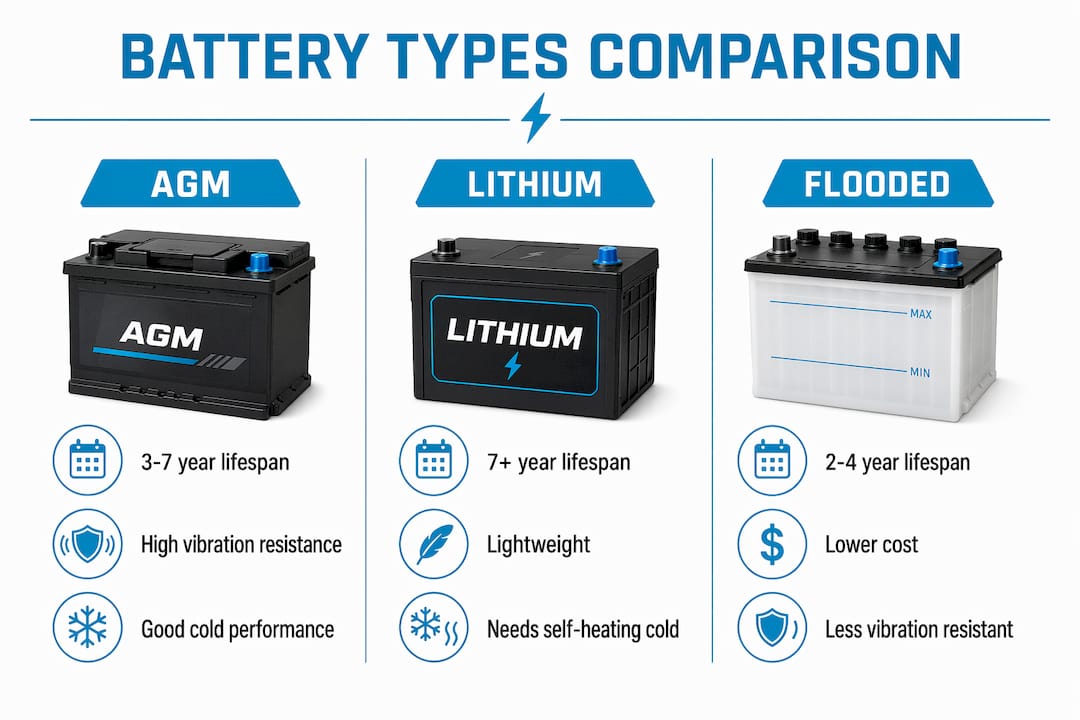
AGM batteries withstand up to 20 times more vibration than traditional flooded batteries. That number is not a marketing claim. It reflects the structural difference between a battery with loose electrolyte and one with compressed fiberglass mats holding everything in place. For a V-twin motorcycle or a hard-charging UTV, that difference determines whether your battery survives a full season or fails at the trailhead.
Lifespan and cost
AGM batteries last 3–7 years, compared to 2–4 years for flooded batteries and 7 or more years for lithium. The longer lifespan of lithium sounds compelling until you factor in the price difference and the compatibility requirements. Lithium batteries often need specialized chargers and can cause issues with older OEM charging systems. AGM is largely plug-and-play for current powersports vehicles, which means no additional investment in charging equipment.
Cold weather performance
AGM batteries perform better in extreme cold than lithium batteries, which often require self-heating to deliver current below 32°F. That is a real problem if you ride snowmobiles or live in a northern climate where january temperatures regularly drop below freezing. AGM delivers full cranking power the moment you hit the starter, with no warm-up period required.
| Feature | AGM | Flooded lead-acid | Lithium (LiFePO4) |
|---|---|---|---|
| Lifespan | 3–7 years | 2–4 years | 7+ years |
| Vibration resistance | Up to 20x flooded | Baseline | High |
| Cold-weather starting | Excellent | Good | Requires warm-up below 32°F |
| Maintenance | None | Regular watering | None |
| Charger compatibility | Most OEM systems | Most OEM systems | Often requires specific charger |
| Weight | Moderate | Moderate | Lightest |
| Cost | Mid-range | Lowest | Highest |
Pro Tip: If you ride in a climate with hard winters, AGM is the safer default choice over lithium. The cold-start reliability alone justifies the decision for snowmobile and winter motorcycle riders.
AGM does have real limitations. It weighs more than lithium, which matters for weight-sensitive builds like racing motorcycles. It is also sensitive to overcharging. Push the charging voltage above 15V and you cause permanent damage through outgassing and electrolyte dry-out. Lithium handles a wider charging tolerance in that respect. For most riders, though, the plug-and-play convenience and cold-weather reliability of AGM make it the practical choice. You can read more about AGM durability in tough conditions to see how these batteries hold up across real-world riding environments.
How do you test and maintain an AGM powersports battery?
A healthy AGM battery shows a resting voltage of 12.6–12.8V when fully charged. A reading below 12.4V indicates partial discharge, and anything below 12.0V points to a failing battery. These thresholds give you a quick baseline, but resting voltage alone does not tell the whole story.
Load testing and voltage sag
Voltage sag under load is a more accurate indicator of battery health than resting voltage. A battery can read 12.7V at rest and still fail to start your engine if its internal resistance has climbed too high. Use a load tester or a smart charger with a diagnostic function to check how the voltage holds up when current is drawn. High internal resistance causes starting failures even when the resting voltage looks normal. That is the most common reason riders replace a battery that appears fully charged.
Charging best practices
- Use a smart charger with a dedicated AGM mode. Generic chargers without voltage regulation can push past the safe threshold and damage the battery permanently.
- Keep charging voltage between 13.5V and 14.5V during normal operation. Avoid any charger that exceeds 15V, as overcharging above 15V causes outgassing and irreversible capacity loss.
- For seasonal storage, connect the battery to a maintenance charger or tender before putting the vehicle away. Sulfation, the buildup of lead sulfate crystals on the plates, begins within weeks of a battery sitting discharged.
- Check resting voltage before the riding season starts. If it reads below 12.4V after a full charge cycle, the battery has likely lost significant capacity.
- Replace the battery proactively if it is more than five years old and showing slow cranking, even if it still starts the vehicle. Waiting for a complete failure in the field costs more than a planned replacement.
Pro Tip: Store your powersports vehicle with the battery connected to a float charger during the off-season. A quality float charger applies just enough current to offset self-discharge without overcharging. This single habit can add years to your battery’s life. You can also check signs of battery failure to know when a replacement is overdue.
Where do AGM batteries perform best across powersports applications?
AGM batteries fit a wide range of powersports vehicles, and the reasons vary by application. Understanding which factors matter most for your specific machine helps you get the most out of your battery selection. The powersport battery buying guide from Bansheebatteries covers these considerations in detail.
- Motorcycles with V-twin engines produce intense mechanical resonance at low RPM. The fiberglass mat construction absorbs that vibration directly, protecting the plates from the shedding that kills flooded batteries within a season or two.
- ATVs and UTVs take constant impact from rough terrain. An AGM battery’s sealed design means no acid spills when the vehicle tilts sharply or takes a hard landing.
- Snowmobiles demand reliable cold-weather cranking every single start. AGM delivers full power at freezing temperatures without the warm-up delay that lithium batteries require below 32°F.
- Personal watercraft and marine applications benefit from the spill-proof construction. Water exposure and constant motion make a sealed battery the only practical choice for these environments.
- Custom builds and sportbikes often require non-standard mounting positions. The 90-degree mounting flexibility of AGM suits tight battery boxes and unconventional frame placements.
Accessory loads also affect battery selection. Riders who add heated gear, GPS units, or auxiliary lighting draw more current than the stock electrical system expects. In those cases, choosing a higher-capacity AGM unit prevents chronic undercharging and extends battery life. AGM’s compatibility with most OEM charging systems means you rarely need to upgrade the stator or regulator to support a larger battery.
Key Takeaways
AGM batteries are the most practical choice for most powersports riders because they combine vibration resistance, cold-weather reliability, and plug-and-play compatibility that lithium cannot match in every condition.
| Point | Details |
|---|---|
| AGM lifespan advantage | AGM lasts 3–7 years, significantly longer than flooded batteries at 2–4 years. |
| Vibration resistance | AGM withstands up to 20x more vibration than flooded batteries, critical for off-road use. |
| Cold-weather reliability | AGM delivers full cranking power below 32°F without the warm-up lithium requires. |
| Voltage health thresholds | A resting voltage of 12.6–12.8V indicates full charge; below 12.0V signals a failing battery. |
| Charging discipline | Never exceed 15V when charging AGM; use a smart charger with an AGM-specific mode. |
Why I think riders underestimate AGM batteries
The powersports community has developed a habit of treating lithium as the automatic upgrade. I get it. Lithium is lighter, lasts longer on paper, and sounds more modern. But after years of watching riders struggle with cold-start failures and charger compatibility headaches, I have come to see AGM as the more honest choice for most people.
The riders who benefit most from lithium are those chasing weight savings on a track bike or running a vehicle that stays in a climate-controlled garage year-round. For everyone else, the cold-weather advantage of AGM is not a minor footnote. It is the difference between starting your snowmobile on a january morning and pushing it back to the truck.
The other thing I see consistently is battery damage from improper charging. Riders buy a quality AGM battery, use whatever charger came with a previous vehicle, and wonder why the battery fails in two years. A smart charger with an AGM mode is not optional equipment. It is part of the system. Get that right, store the battery properly in the off-season, and a good AGM unit will outlast most riders’ expectations.
— Donald
Bansheebatteries has the right battery for your ride
Bansheebatteries has spent over 20 years building AGM and LiFePO4 batteries specifically for powersports and marine use. Every battery in the lineup is designed to handle the vibration, temperature swings, and electrical demands that recreational vehicles put on a power source.
Whether you ride a motorcycle, ATV, UTV, or boat, Bansheebatteries offers batteries backed by a 4-year warranty on AGM units and a 5-year warranty on lithium marine batteries. The team provides expert guidance to help you match the right battery to your vehicle and riding conditions. If you are ready to find the right fit, browse the full lineup of AGM and lithium options, or check out the lithium marine battery collection if you run a boat alongside your powersports gear.
FAQ
What does AGM stand for in a powersports battery?
AGM stands for absorbent glass mat. The term describes the fiberglass mats inside the battery that hold the electrolyte in place, making the battery sealed and maintenance-free.
How long does an AGM powersports battery last?
AGM batteries typically last 3–7 years with proper maintenance, compared to 2–4 years for flooded lead-acid batteries. Charging habits and storage practices have the biggest impact on actual lifespan.
Can I use a regular charger on an AGM battery?
A regular charger without voltage regulation can damage an AGM battery by exceeding the 15V threshold and causing outgassing. Always use a smart charger with a dedicated AGM mode to stay within the safe 13.5–14.5V charging range.
Is AGM or lithium better for cold-weather powersports?
AGM is the better choice for cold climates. Lithium batteries often require self-heating to deliver current below 32°F, while AGM provides full cranking power immediately in freezing temperatures.
What voltage should a healthy AGM powersports battery show?
A fully charged AGM battery should read 12.6–12.8V at rest. A reading below 12.4V indicates partial discharge, and below 12.0V suggests the battery is failing and likely needs replacement.