


How an AGM Battery Handles Vibration in 2026
An AGM battery resists vibration by immobilizing its electrolyte inside absorbent glass mats and compressing its internal plates into a tightly packed stack. This construction is the industry standard for powersport and marine applications where constant mechanical shock is unavoidable. Traditional flooded batteries fail in these environments because free liquid electrolyte sloshes against the plates, causing progressive damage. Understanding how AGM battery handles vibration tells you exactly why sealed, mat-based construction has become the go-to choice for ATVs, motorcycles, and boats operating in punishing conditions.
How does an AGM battery handle vibration?
AGM stands for Absorbent Glass Mat. The technology works by saturating fiberglass mat separators with electrolyte, leaving no free liquid inside the battery. Those mats are then compressed tightly between the positive and negative plates, holding everything in place as a single rigid assembly.
The result is nearly zero internal movement when the battery experiences shock or vibration. That matters because movement is what kills batteries in rough environments. When plates shift or electrolyte sloshes, active material flakes off the plate surfaces, settles at the bottom, and eventually causes short circuits.

AGM construction also includes a reinforced outer casing and a valve-regulated, sealed design. The casing absorbs external impacts. The sealed valve prevents spills even when the battery is mounted at an angle, which is common in tight marine engine compartments and ATV battery boxes.
Pro Tip: When comparing battery types for off-road or marine use, ask specifically about plate compression, not just whether the battery is “sealed.” Compression is what prevents internal movement under vibration.
Why flooded batteries fail where AGM survives
A standard flooded battery holds liquid electrolyte in open contact with its plates. Every bump, wave, or rough road sends that liquid moving. Over time, plate shedding and internal shorts develop as the active material breaks down. The battery loses capacity and eventually fails entirely.
AGM eliminates this failure mode at the source. The fiberglass mats hold the electrolyte and the plates in fixed positions. There is no liquid to slosh, no loose material to migrate, and no sediment to accumulate at the bottom of the case.
| Feature | Flooded battery | AGM battery |
|---|---|---|
| Electrolyte state | Free liquid | Immobilized in glass mat |
| Plate movement under vibration | Unconstrained | Compressed, fixed |
| Risk of plate shedding | High | Very low |
| Spill risk | High | None (sealed) |
| Mounting flexibility | Upright only | Multiple orientations |
AGM battery performance under continuous vibration
Real-world powersport and marine environments do not deliver single impacts. They deliver continuous, high-frequency vibration. Think of washboard dirt roads on an ATV, the constant hull pounding of a bass boat running at speed, or the engine vibration transmitted through a motorcycle frame at highway RPMs.
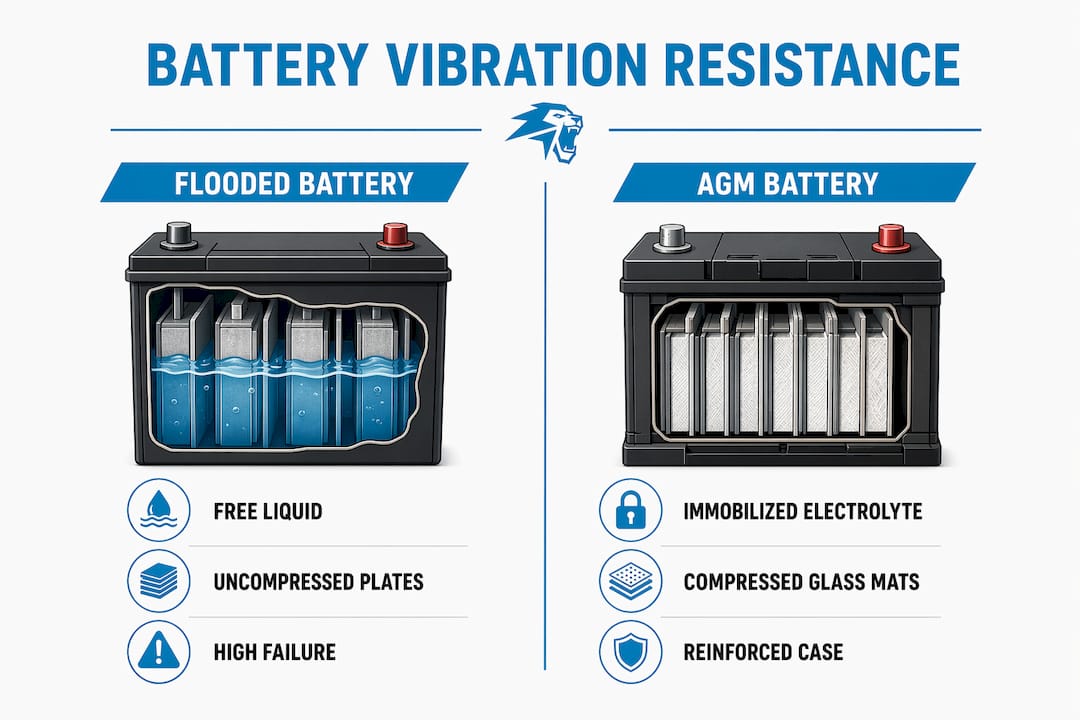
AGM batteries increase operational life in these conditions compared to standard batteries that fail early from plate breakdown. The immobilized electrolyte prevents the cumulative internal degradation that shortens flooded battery life under repeated shock.
That said, the internal design only handles part of the problem. The battery casing, terminal connections, and mounting hardware all absorb vibration too. Loose terminals are a common failure point. Vibration works threaded connections loose over time, increasing resistance and eventually causing intermittent power loss or complete disconnection.
- Check terminal torque after the first 50 hours of use in high-vibration applications.
- Inspect terminal connections at every seasonal maintenance interval.
- Look for hairline cracks in the casing near mounting points, which signal excessive mechanical stress.
- Confirm that battery cables have enough slack to flex without pulling on the terminals.
Pro Tip: Marine and powersport batteries take the most abuse at the terminal posts. Apply a thin layer of dielectric grease after tightening terminals. It prevents corrosion and reduces the micro-movement that causes terminal wear.
The sealed AGM design also allows installation closer to the load, which reduces voltage drop in vibrating environments. Shorter cable runs mean less resistance and more reliable power delivery, a real advantage in marine electronics setups where consistent voltage matters.
How to mount and charge AGM batteries for maximum durability
Mounting quality determines how much of the AGM battery’s internal vibration resistance actually translates into long service life. The battery’s construction handles internal movement. The mounting system handles external movement.
Heavy-duty rubber-damped trays and hold-down brackets are the correct solution for isolating AGM batteries from resonant frequencies that cause mechanical fatigue. A battery that shifts even a few millimeters under load will eventually develop weld fatigue at the electrode-to-terminal junction. That failure is electrical, not chemical, and it happens even in well-built AGM units.
Follow these installation steps to protect your battery:
- Choose a rubber-lined or foam-padded battery tray. Hard plastic trays transmit vibration directly into the casing. Rubber or foam absorbs it.
- Use a hold-down bracket or strap rated for your application. Marine-grade stainless steel brackets resist corrosion and hold tension under repeated shock.
- Mount the battery as close to the vehicle’s center of gravity as possible. Batteries mounted at the extremes of a frame or hull experience amplified vibration.
- Verify battery orientation. AGM batteries can be mounted on their side in most cases, but avoid mounting completely upside down long-term. Inverted mounting can interfere with the pressure relief valve, causing premature venting and electrolyte loss.
- Use an AGM-compatible charger. Chargers designed for flooded batteries deliver the wrong voltage profile. Mismatched charging profiles risk undercharging or overcharging AGM units, which accelerates internal degradation and reduces vibration resilience over time.
Charging protocol is the most overlooked factor in AGM longevity. A battery that survives years of mechanical abuse can still fail early from chronic undercharging. Use a charger with a dedicated AGM mode, and check that the absorption voltage matches the manufacturer’s specification.
How does AGM compare to flooded and lithium for vibration resistance?
Powersport and marine riders have three main battery chemistry options: flooded lead-acid, AGM, and lithium iron phosphate (LiFePO4). Each handles vibration differently.
Flooded batteries are the weakest option for vibration-heavy use. Free electrolyte and uncompressed plates make them vulnerable to the exact failure modes that AGM eliminates. They are cheaper upfront, but their shorter service life in rough environments erases that cost advantage quickly.
Lithium batteries offer even greater vibration resilience than AGM, but they come with higher cost and greater technical complexity. LiFePO4 chemistry has no liquid electrolyte at all, making it inherently immune to sloshing damage. The trade-off is price and the need for a compatible battery management system. For riders comparing options, the AGM vs lithium decision often comes down to budget and how extreme the vibration environment actually is.
AGM sits in the middle as the cost-effective standard for most powersport and marine users. It handles the vibration demands of off-road riding, boating, and motorsport reliably, without the premium price of lithium.
| Battery type | Vibration resistance | Cost | Maintenance | Best use case |
|---|---|---|---|---|
| Flooded lead-acid | Low | Lowest | High | Low-vibration, stationary use |
| AGM | High | Moderate | Very low | Powersport, marine, off-road |
| Lithium (LiFePO4) | Very high | High | Very low | Extreme applications, weight-sensitive builds |
- AGM is sealed and spill-proof, making it safe in enclosed engine bays and bilge areas.
- AGM requires no water topping or electrolyte checks.
- Lithium is lighter and cycles more times, but requires a compatible charger and BMS.
- Flooded batteries need regular maintenance and upright mounting, limiting their use in powersport applications.
For most riders and boaters running standard applications, AGM marine batteries deliver the right balance of vibration resistance, cost, and reliability without the complexity of lithium systems.
Key Takeaways
AGM batteries handle vibration by immobilizing electrolyte in compressed fiberglass mats, eliminating the plate shedding and internal shorts that destroy flooded batteries in rough environments.
| Point | Details |
|---|---|
| AGM construction prevents internal movement | Compressed glass mats hold electrolyte and plates fixed, stopping vibration damage at the source. |
| Mounting quality is equally critical | Rubber-damped trays and hold-down brackets prevent terminal fatigue that internal design alone cannot stop. |
| Charger compatibility protects longevity | AGM-specific charging profiles prevent the overcharge and undercharge that degrade vibration resilience over time. |
| AGM outperforms flooded in vibration environments | Flooded batteries fail from plate shedding; AGM eliminates this failure mode through sealed, mat-based construction. |
| Lithium offers more resilience at higher cost | AGM remains the practical standard for most powersport and marine users balancing performance and budget. |
What I’ve learned about AGM batteries after years in the field
The most common mistake I see riders and boaters make is treating AGM as a set-it-and-forget-it solution. The internal design is genuinely impressive. The compressed plates and immobilized electrolyte do most of the heavy lifting. But I have watched well-built AGM batteries fail in under two seasons because someone bolted them into a hard plastic tray with no dampening and never checked the terminals.
The second thing people get wrong is the charger. Most riders grab whatever charger is on sale and assume it works. It often does not. A charger calibrated for flooded batteries will push the wrong absorption voltage into an AGM unit, and the battery slowly degrades from the inside out. You will not notice it until the battery fails to crank on a cold morning after a long winter in storage.
My honest take on the AGM versus lithium debate is this: lithium is genuinely better for vibration resistance, and the weight savings on a motorcycle or small boat are real. But for most people running a standard ATV, bass boat, or touring bike, AGM delivers everything they need at a price that makes sense. The gap between AGM and lithium performance only matters at the extremes.
If you ride hard or run your boat in rough water regularly, spend the extra money on a quality rubber-dampened tray and an AGM-compatible smart charger. Those two investments will do more for your battery’s service life than any spec upgrade.
— Donald
Bansheebatteries AGM options for powersport and marine riders
Bansheebatteries has built its reputation over more than 20 years on batteries designed specifically for the conditions described in this article. Every AGM unit in their lineup is sealed, maintenance-free, and built to handle the vibration demands of off-road riding, motorsport, and open-water boating.

Their AGM powersport batteries cover motorcycles, ATVs, UTVs, and personal watercraft, with a 4-year warranty that reflects genuine confidence in the product’s durability. For boaters, their sealed AGM marine batteries are built for bilge-area installation and constant wave impact. If you are weighing the lithium option, Bansheebatteries also carries a full range of LiFePO4 marine batteries for riders who need maximum vibration resilience and weight savings.
FAQ
What makes AGM batteries more vibration-resistant than flooded?
AGM batteries immobilize electrolyte in compressed fiberglass mats and pack plates tightly together, eliminating the internal movement that causes plate shedding and short circuits in flooded batteries under vibration.
Can an AGM battery be mounted on its side?
Yes, AGM batteries can be mounted on their side in most applications because they are fully sealed and spill-proof. Avoid mounting completely upside down long-term, as this can interfere with the pressure relief valve and reduce battery life.
How does vibration affect AGM battery terminal connections?
Continuous vibration can loosen terminal connections and cause weld fatigue at the electrode-to-terminal junction over time. Checking terminal torque regularly and using rubber-dampened mounting trays prevents this type of failure.
Do AGM batteries need a special charger?
Yes. AGM batteries require a charger with a dedicated AGM charging profile. Chargers designed for flooded batteries deliver incorrect voltage levels that can undercharge or overcharge AGM units, accelerating internal degradation.
How do AGM batteries compare to lithium for marine and powersport use?
Lithium (LiFePO4) batteries offer greater vibration resistance and weigh less, but cost significantly more. AGM batteries deliver reliable vibration resistance at a moderate price, making them the practical standard for most powersport and marine applications.