


The Role of Battery in Your Solar Camp Setup
A battery in a solar camp setup is the energy storage unit that makes off-grid power possible after the sun goes down. Solar panels convert sunlight into electricity, but they stop producing the moment clouds roll in or daylight fades. The battery stores that surplus energy and releases it on demand, covering your refrigerator, lights, phone charger, and any other gear running through the night. Without adequate battery storage, even a well-sized solar array leaves you powerless by dusk. Getting the battery right is the single most important decision in any camping solar system.
What is the role of battery in a solar camp setup?
The battery’s core function in any solar energy system is to act as a buffer between generation and consumption. Solar panels produce power in peaks and valleys depending on sun angle, cloud cover, and shading. The battery absorbs that variable output and delivers steady, consistent power to your devices regardless of what the panels are doing at any given moment.
This buffering role matters more than most campers realize. Battery capacity stabilizes power supply during solar production fluctuations caused by weather or shading. That means a well-sized battery keeps your camp running smoothly even on a partly cloudy afternoon when your panels are underperforming.
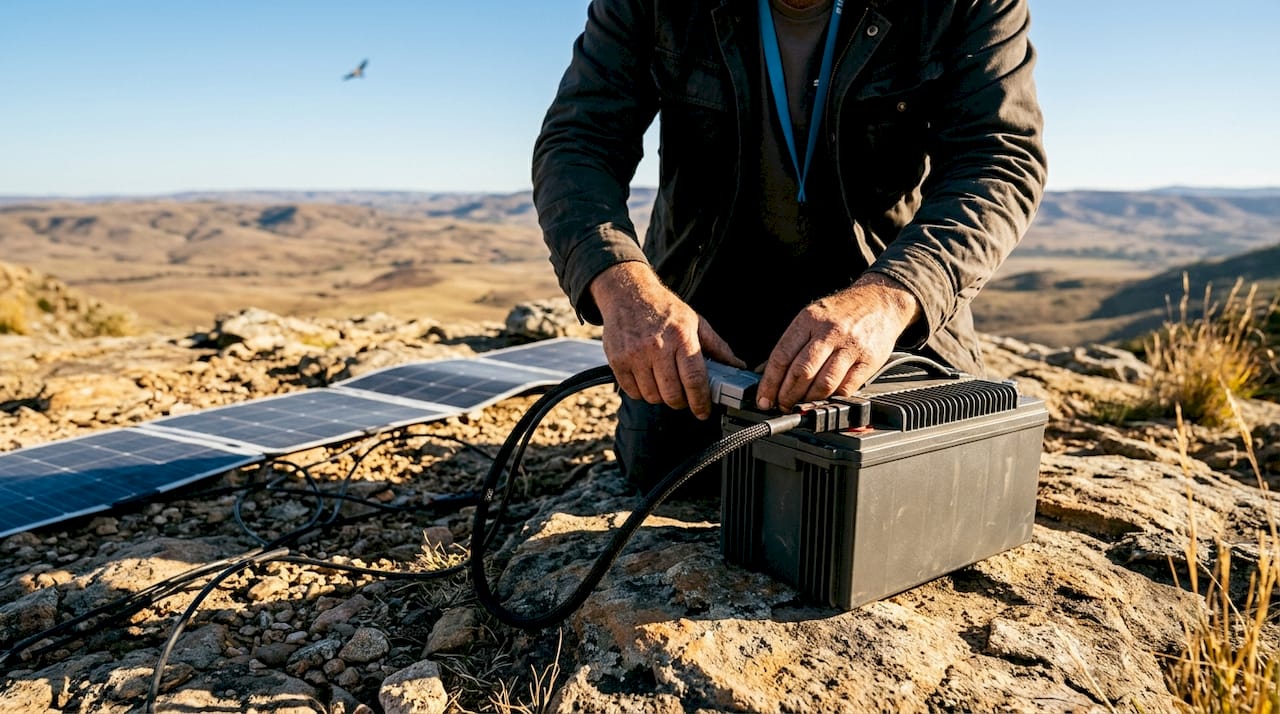
Batteries also provide what engineers call “night-time stability.” Batteries store energy for refrigeration and other essential devices during hours when solar panels produce zero power. For a camper running a 12V fridge overnight, that stored energy is not optional. It is the entire point of the system.
How do batteries complement solar panels in camping systems?
Solar panels and batteries are not interchangeable parts. They serve completely different functions, and neither works well without the other being properly sized.
Solar panels are generators. They produce power only when sunlight hits them, and their output drops sharply under clouds or shade. Batteries are reservoirs. They collect whatever the panels produce during peak hours and hold it for later use. The two components work together in a cycle: generate during the day, store, then draw down through the night.
Several factors reduce how much energy actually reaches your battery:
- Wiring losses reduce the power traveling from panel to battery.
- Charge controller inefficiency adds another layer of loss between the panel and battery terminals.
- Panel temperature affects output, with hot panels producing less than their rated wattage.
- Shading is the biggest hidden threat. Partial shading can cut panel output by 50% or more, even when only a small portion of the panel is blocked.
System inefficiencies typically reduce charging efficiency by 15–25%. That loss comes directly out of your battery’s daily recharge. A battery that should be full by 3:00 PM may still be at 70% capacity because of these combined losses.
The practical fix is to oversize both components. Oversizing to 250W of solar panels is recommended for a campsite consuming 1,000Wh daily, precisely because of these efficiency losses. The battery should be sized to cover at least one full day of consumption without any solar input at all.
Pro Tip: When setting up your campsite, position panels facing south at an angle matching your latitude. A 10-degree adjustment can recover more usable energy than adding an extra 50W panel.
What battery types work best for solar camping?
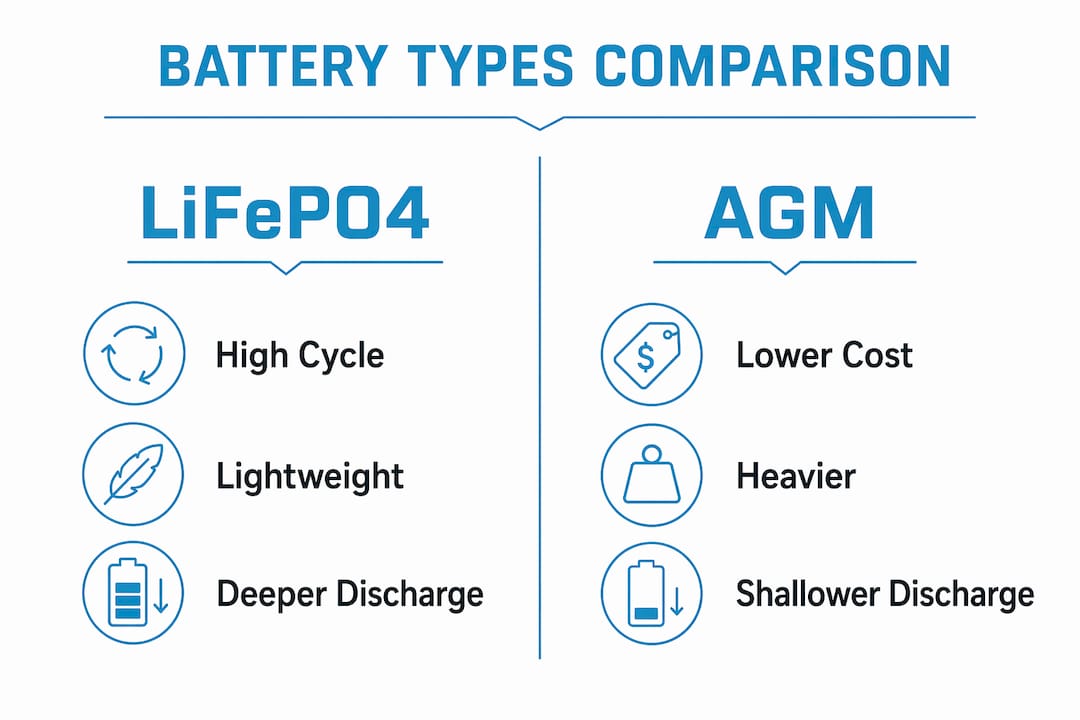
Two battery chemistries dominate solar camping setups: lithium iron phosphate (LiFePO4) and absorbed glass mat (AGM). Each has a distinct profile that suits different types of campers.
LiFePO4 batteries
LiFePO4 batteries are the preferred choice for frequent campers in 2026. LiFePO4 batteries offer 2,000+ cycles and can be discharged 80–90% without shortening their lifespan. That deep discharge capability means you actually use most of the energy you store, rather than protecting a large portion of the battery from damage.
Weight is another major advantage. LiFePO4 batteries are significantly lighter than AGM units of equivalent capacity, which matters when you are loading a truck bed or a trailer. They also charge faster, which is critical when your solar window is limited to six or seven hours. For a deeper look at how the chemistry compares, the LiFePO4 vs lithium-ion breakdown from Bansheebatteries explains the key differences in practical terms.
A 100Ah LiFePO4 battery at 12V provides roughly 1,280Wh total and 1,000–1,150Wh of usable energy. That aligns almost exactly with the average 1,000Wh daily consumption at a typical campsite, making it a natural starting point for sizing.
AGM batteries
AGM batteries cost less upfront and remain a practical choice for occasional campers who prioritize budget over performance. The tradeoff is significant: AGM batteries should not be discharged below 50% of their capacity without accelerating wear. That means a 100Ah AGM battery delivers only about 50Ah of usable energy, effectively cutting your storage in half compared to the rated number on the label.
AGM batteries suit occasional campers who can tolerate the extra weight and shallower discharge. For weekend trips once a month, the lower purchase price makes sense. For extended trips or regular use, the math shifts quickly toward LiFePO4. The AGM vs. LiFePO4 comparison from Bansheebatteries walks through the long-term cost difference in detail.
Pro Tip: Calculate your total cost per usable watt-hour over the battery’s lifespan, not just the sticker price. LiFePO4 batteries almost always win that calculation for campers who go out more than a few times per year.
How do you size a battery bank for your camping solar system?
Sizing a battery bank starts with your daily watt-hour consumption, not with your solar panel wattage. Prioritizing battery size over panel size is the foundation of dependable off-grid power. Panels can always be added later, but an undersized battery will fail you every single night.
Follow these steps to size your battery bank correctly:
- List every device you plan to run. Note its wattage and the number of hours you use it daily. A 12V fridge running 24 hours at 40W consumes 960Wh. A phone charger running two hours at 10W adds 20Wh.
- Add up your total daily watt-hours. Most campers land between 500Wh and 1,500Wh per day depending on their gear.
- Add a buffer for cloudy days. Size your battery to cover at least 1.5 days of consumption without any solar input. For a 1,000Wh daily load, that means 1,500Wh of usable battery capacity.
- Account for battery chemistry. If you use AGM, multiply your usable capacity target by two to get the rated capacity you need. LiFePO4 batteries need only a 10–20% overhead.
- Match your solar recharge capacity. A 1,000Wh daily draw requires roughly 200W of solar panels under ideal conditions. With system losses factored in, 250W is the safer target.
For longer trips, add battery capacity incrementally rather than buying one oversized bank. Two 100Ah LiFePO4 batteries wired in parallel give you flexibility and redundancy. If one battery develops a problem on a week-long trip, you still have half your storage intact.
How should you maintain and place batteries in a camping setup?
Battery placement and maintenance directly determine how long your battery lasts and how reliably it performs in the field.
Temperature is the most overlooked factor in camping battery care. LiFePO4 batteries will not accept a charge below 32°F without built-in heating elements. Charging a cold lithium battery forces current into a cell that cannot absorb it properly, causing permanent damage over time. If you camp in cold climates, choose a LiFePO4 battery with an integrated battery management system (BMS) that includes a low-temperature charge cutoff.
Key maintenance and placement practices include:
- Mount batteries in a ventilated compartment. Heat buildup shortens battery life. A shaded, ventilated space inside a trailer or truck bed works well.
- Avoid deep discharging AGM batteries. Keeping AGM batteries above 50% state of charge extends their cycle life significantly.
- Store batteries at partial charge during the off-season. A 50–80% charge level is ideal for long-term storage. Storing at 100% or 0% accelerates degradation.
- Inspect terminals regularly. Corrosion at the terminals increases resistance and reduces charging efficiency. Clean terminals with a wire brush and apply a thin layer of dielectric grease.
- Use a quality charge controller. A MPPT (maximum power point tracking) charge controller extracts more energy from your panels than a basic PWM unit and protects your battery from overcharging.
Pro Tip: If you camp in temperatures below 40°F regularly, invest in a LiFePO4 battery with a self-heating BMS. The added cost is far less than replacing a damaged battery after one cold-weather trip.
Key Takeaways
The battery in a solar camp setup determines system reliability more than any other single component, because it bridges the gap between when power is generated and when it is needed.
| Point | Details |
|---|---|
| Battery is the system’s core | Without adequate storage, solar panels cannot power a camp after dark or during clouds. |
| Size battery before panels | Match battery capacity to daily watt-hour consumption first, then size panels to recharge it. |
| LiFePO4 outperforms AGM long-term | LiFePO4 batteries offer 2,000+ cycles and 80–90% usable depth, making them better for frequent campers. |
| Temperature affects charging | LiFePO4 batteries stop accepting charge below 32°F without a heating-equipped BMS. |
| Shading and placement matter | Partial shading can cut panel output by 50%, directly reducing how much energy reaches your battery. |
What I’ve learned about batteries that most solar guides get wrong
Most solar camping guides tell you to buy more panels. That advice misses the point entirely. I’ve watched campers show up with 400W of solar on the roof and a battery bank that runs dry by 10:00 PM. The panels are fine. The battery is undersized. More sunlight cannot fix that problem.
The real calculation is about storage, not generation. Battery capacity matters more than panel wattage for consistent off-grid power, because solar generation is variable by nature. Weather changes. Trees cast shadows. You park in a canyon for two days. A battery large enough to carry you through those gaps is worth more than any extra panel you could add.
I’ve also seen campers underestimate how much campsite selection affects their battery. Unobstructed sun exposure significantly impacts how well your panels recharge your battery each day. Parking under a tree to stay cool costs you hours of charging time. Sometimes the tradeoff is worth it. But you need to know you are making it.
The other thing guides rarely say: invest in lithium once and stop thinking about your battery. Frequent campers who switch from AGM to LiFePO4 almost universally say they wish they had done it sooner. The weight savings alone change how you pack. The deeper usable capacity changes how you plan your power. And the longer cycle life means you are not replacing the battery every two or three seasons.
— Donald
Bansheebatteries has the power for your next off-grid trip
Reliable off-grid power starts with the right battery, and Bansheebatteries has built its reputation on exactly that for over 20 years. Their lithium LiFePO4 marine batteries are engineered for demanding outdoor environments, with the deep cycle performance and durability that solar camping setups require. The 5-year warranty on lithium marine batteries reflects the confidence behind every unit.
Whether you are powering a weekend basecamp or a month-long overland trip, Bansheebatteries offers AGM and LiFePO4 options sized for real-world energy needs. Their team provides expert guidance to match you with the right battery for your specific setup, so you are not guessing at capacity or chemistry. Browse the full range at Bansheebatteries and find the battery your solar system actually needs.
FAQ
What does a battery do in a solar camping system?
A battery stores energy generated by solar panels during daylight and releases it when the panels are not producing power, such as at night or during cloudy periods. Without a battery, a solar camping system cannot provide power beyond active sunlight hours.
How big a battery do I need for a 1,000Wh daily camping load?
A 100Ah 12V LiFePO4 battery provides approximately 1,000–1,150Wh of usable energy, which closely matches a typical 1,000Wh daily campsite consumption. For added security on cloudy days, sizing up to 150–200Ah of capacity is recommended.
Is LiFePO4 or AGM better for solar camping?
LiFePO4 batteries are better for frequent campers because they offer 2,000+ cycles, deeper usable discharge of 80–90%, and faster charging. AGM batteries cost less upfront and suit occasional campers who prioritize budget over long-term performance.
Can I charge a LiFePO4 battery in cold weather?
LiFePO4 batteries will not accept a charge below 32°F without built-in heating elements. Campers in cold climates should choose a battery with an integrated BMS that includes a low-temperature charge protection circuit.
How does shading affect my battery’s charge level?
Partial shading on solar panels can reduce their output by 50% or more, which directly cuts the amount of energy reaching your battery each day. Choosing a campsite with unobstructed southern exposure is one of the most effective ways to maximize daily battery recharge.