


Marine Battery Charging System Types: 2026 Boat Guide
A marine battery charging system is the complete set of hardware and wiring that converts available power sources into regulated current to maintain your boat’s batteries. Choosing the wrong marine battery charging system type is the single fastest way to kill an expensive battery bank. Shore power chargers, alternator systems, DC-DC chargers, and solar setups each serve a distinct role, and each interacts differently with lead-acid, AGM, and LiFePO4 chemistries. The ABYC electrical standards and UL 1236 certification exist precisely because the wrong charger in a marine environment creates both electrical and safety risks. This guide breaks down every major system type so you can match the right charger to your boat, your battery, and how you actually use them.
What are the main marine battery charging system types?
Four primary charging systems cover the full range of marine power management. Each fits a different operational scenario, and most serious boat owners end up combining at least two.
-
Shore power chargers are AC-powered, multi-stage onboard chargers that plug into marina dockside power. They deliver the most consistent and complete charge cycle available, making them the gold standard for boats that spend time at the dock. Most modern units support 12V, 24V, and 48V banks and include chemistry-specific profiles for flooded lead-acid, AGM, gel, and LiFePO4.
-
Alternator charging uses the engine’s alternator to charge batteries while the motor runs. It works well for starting batteries but alternators alone rarely provide optimal charge for deep-cycle house banks. Alternators are built for short bursts, not the sustained multi-stage cycles that deep-cycle batteries need.
-
DC-DC chargers (also called battery-to-battery chargers) sit between the alternator output and the house bank. They regulate and convert the alternator’s raw DC output into a proper multi-stage charge. This makes them the right tool for charging a secondary bank from the engine’s charging circuit without damaging either battery.
-
Solar charging systems pair photovoltaic panels with an MPPT (Maximum Power Point Tracking) controller to deliver regulated charge from sunlight. Solar is the top choice for boats on a mooring or anchored off-grid for extended periods. MPPT controllers are more efficient than older PWM types and work well with both AGM and LiFePO4 banks.
Understanding which system fits your situation is the first step. Sizing it correctly is the second.
How to properly size and select a marine battery charger
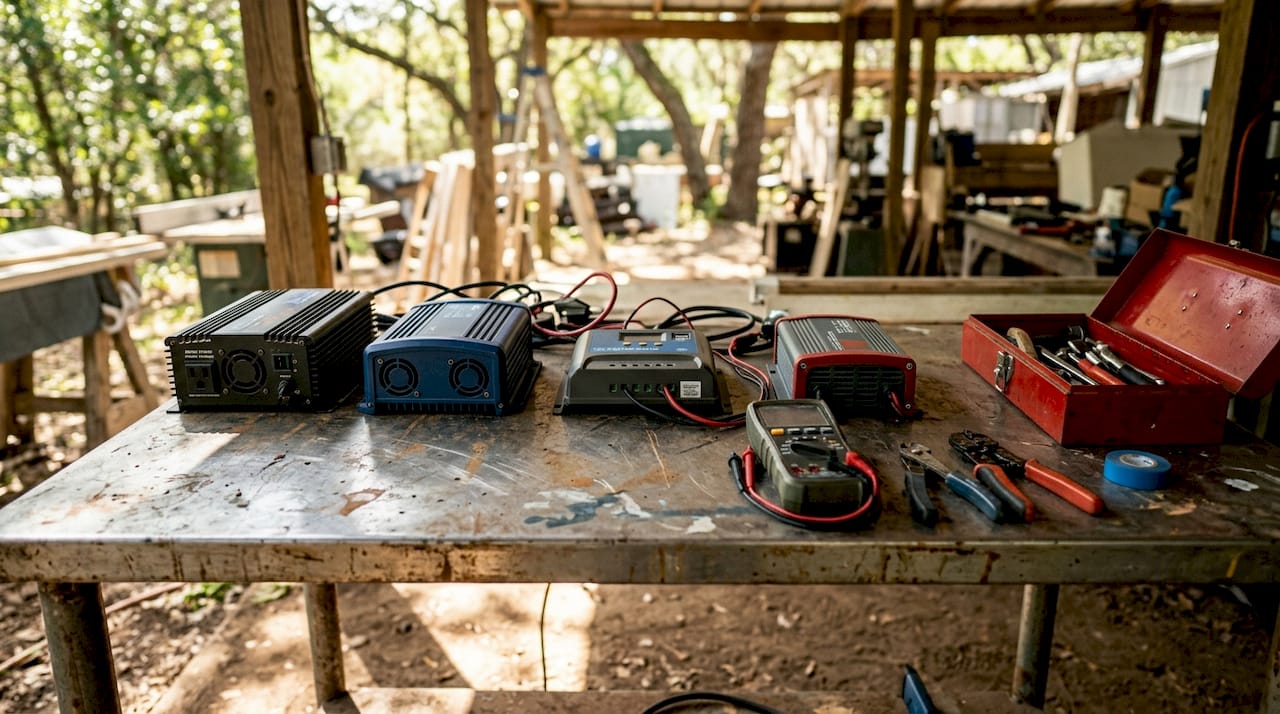
Charger sizing is the most commonly mishandled part of marine electrical planning. Get it wrong and you either undercharge the bank or stress the batteries with excessive current.
The industry standard rule is straightforward: charger output should be 10%–25% of the total battery bank amp-hour capacity. That means a 200Ah bank needs a charger rated between 20A and 50A. Staying within that range protects battery chemistry while keeping charge times reasonable.
Here is how to apply that rule in practice:
- Calculate your total bank capacity. Add up the amp-hour ratings of every battery in the bank. Two 100Ah AGM batteries wired in parallel give you 200Ah total.
- Apply the 10%–25% formula. For a 200Ah bank, target a charger in the 20A–50A range. For a 400Ah lithium bank, that means 40A–100A of charger output.
- Match charger voltage to bank voltage. A 24V bank requires a 24V charger. Using a 12V charger on a 24V bank will not charge it at all and may damage the charger.
- Account for battery chemistry. LiFePO4 banks accept higher charge rates than flooded lead-acid. Check your battery manufacturer’s maximum charge current spec before selecting the upper end of the range.
- Plan for multi-bank setups. If you run separate starting and house banks, use a charger with isolated output banks or install a dedicated charger for each bank. Mixing banks on a single output causes uneven charging and shortens battery life.
Pro Tip: For a lithium bank paired with a solar system, size the charger at the higher end of the range (20%–25%) to take advantage of LiFePO4’s faster acceptance rate and cut your recharge time significantly.
Proper sizing also applies to your marine battery bank setup as a whole. A well-designed bank and a correctly sized charger work together to extend service life.
Multi-stage charging profiles and battery chemistry compatibility
The charging profile your charger uses matters as much as its output amperage. A mismatched profile causes real damage over time, and the chemistry differences between lead-acid and LiFePO4 are significant enough that the two types cannot share the same charger settings.
The three standard charging stages
Battery charging uses three stages: bulk, absorption, and float. Bulk delivers maximum current until the battery reaches roughly 80% capacity. Absorption holds voltage steady while current tapers, completing the charge. Float maintains a lower holding voltage to prevent self-discharge without overcharging.
Lead-acid types, including flooded, AGM, and gel batteries, all depend on these three stages for a full, safe charge. Skipping absorption on an AGM battery leaves it chronically undercharged. Running float voltage too high on a gel battery causes electrolyte damage.
“Using standard automotive chargers on marine deep-cycle batteries often causes premature failure due to improper multi-stage charging profiles. Automotive chargers lack the staged voltage control that marine chemistries require, and the damage accumulates silently over dozens of charge cycles.”
LiFePO4 batteries operate differently. They generally skip absorption and float to prolong battery life. They charge in bulk until full, then stop. Running a float stage on a LiFePO4 bank is unnecessary and, depending on the charger, can trigger the battery’s built-in Battery Management System (BMS) to shut down. That shutdown is often mistaken for a battery fault when the real problem is an incompatible charger profile.
| Feature | Lead-acid / AGM / Gel | LiFePO4 |
|---|---|---|
| Bulk stage | Yes | Yes |
| Absorption stage | Yes | No (or minimal) |
| Float stage | Yes | Not required |
| Charge voltage (12V) | 14.4–14.8V | 14.2–14.6V |
| Charge time at 50% depth | 6–10 hours | 3–5 hours |
| Charger compatibility | Standard multi-stage | Dedicated LiFePO4 profile required |
LiFePO4 batteries require specific charging voltages in the 14.2–14.6V range and cannot tolerate trickle or desulfation modes common in lead-acid chargers. Running desulfation pulses through a lithium battery will trigger BMS protection and can permanently reduce capacity. A programmable smart charger with a dedicated LiFePO4 mode is not optional for lithium banks. It is the minimum requirement. For a full breakdown of LiFePO4 charging requirements, the chemistry differences go deeper than voltage alone.
Installation best practices and safety standards for marine charging systems
A correctly sized charger installed badly is still a hazard. Marine electrical environments are uniquely demanding because of moisture, vibration, and the presence of fuel vapors.
- Use only UL 1236 certified chargers. UL 1236 marine-rated chargers with inline fuses within 7 inches of each battery positive terminal are mandatory for safe marine installations. Non-marine chargers lack the ignition protection required in enclosed bilge spaces.
- Place inline fuses correctly. The fuse must sit within 7 inches of the battery positive terminal, not at the charger end of the wire. This placement protects the full length of cable from a short circuit.
- Ventilate the installation space. Marine chargers generate heat and require at least 12 inches of clearance around the unit, plus active ventilation to prevent heat buildup and gas accumulation from charging lead-acid batteries.
- Use tinned marine wire. Standard automotive wire corrodes rapidly in marine environments. Tinned copper wire resists corrosion and maintains conductivity over years of exposure to salt air and moisture.
- Configure charger settings to match battery chemistry. Manual charger configuration to match battery chemistry is often overlooked but prevents underperformance and protective shutdowns. Always set the charger profile to match the battery manufacturer’s specifications exactly.
Pro Tip: Mount your charger as high in the compartment as practical. Heat rises, and a charger mounted near the floor of a bilge space runs hotter and fails sooner than one mounted at mid-height with airflow on all sides.
Choosing the best marine battery charging system for different boating scenarios
The right charging setup depends on how and where you use your boat. No single system covers every situation perfectly.
-
Docked or marina-based boats get the most from a shore power charger. Marine battery charging at dock is the most complete charging method available. A multi-stage onboard charger connected to 30A or 50A shore power can fully condition a large house bank overnight and hold it in float until you cast off.
-
Day boats and weekend cruisers that run their engines regularly can rely on alternator charging for the starting battery. Adding a DC-DC charger between the alternator and the house bank gives the house batteries a proper multi-stage charge during engine operation without pulling the starting battery down.
-
Off-grid and moored boats benefit most from solar charging systems for boats. An MPPT controller paired with adequate panel wattage keeps the house bank topped off without running the engine. This setup works especially well with LiFePO4 banks because lithium accepts solar charge efficiently and holds voltage well between charges. The Banshee 36V 100Ah lithium battery is a strong example of a lithium pack designed for exactly this kind of solar-integrated marine setup.
-
Long-range cruisers and liveaboards need all three sources working together. Combining shore power, DC-DC charging, and solar offers the most complete marine battery management system by maintaining consistent charge states regardless of whether the boat is motoring, anchored, or docked.
-
Boats with mixed battery banks (starting battery plus deep-cycle house bank) require chargers with isolated output banks or separate dedicated chargers. Running both banks on a single output without isolation causes the stronger bank to backfeed the weaker one, creating chronic undercharging and accelerated wear.
Matching your charging system to your actual usage pattern is what separates boats that always start from boats that leave you stranded.
Key takeaways
Matching charger type, output size, and chemistry profile to your specific battery bank is the single most important factor in marine battery longevity and reliable operation.
| Point | Details |
|---|---|
| Size charger to bank capacity | Target 10%–25% of total Ah for output amperage to avoid damage or undercharging. |
| Match profile to chemistry | LiFePO4 requires a dedicated charger profile; lead-acid profiles will trigger BMS shutdowns. |
| Use UL 1236 certified chargers | Non-marine chargers lack ignition protection required in enclosed bilge spaces. |
| Combine charging sources | Shore power, DC-DC, and solar together give the most reliable marine power management. |
| Ventilate and fuse correctly | Place fuses within 7 inches of the positive terminal and maintain 12 inches of clearance around chargers. |
What I’ve learned after years of watching marine charging setups fail
The most common mistake I see is boat owners treating charger selection as an afterthought. They spend weeks researching batteries and then grab whatever charger is on sale. That decision costs them a battery bank within two seasons.
The second mistake is assuming all 12V chargers are interchangeable. Specialized marine smart chargers with adjustable voltage curves extend battery life in ways that a fixed-profile charger simply cannot. The voltage difference between a proper LiFePO4 absorption ceiling and a standard lead-acid float voltage seems small on paper. In practice, it is the difference between a battery that lasts a decade and one that fails in three years.
The trend I am most excited about in 2026 is the wider adoption of integrated multi-source charging. Modern marine power management works best when shore power, DC-DC, and solar all feed the same bank through a battery management hub. These systems automatically prioritize sources and prevent overcharge from simultaneous inputs. They used to be expensive specialty installs. Now they are accessible for mid-range cruisers.
My practical advice: buy the charger that matches your battery chemistry first, size it correctly second, and install it with proper ventilation and fusing third. In that order. Skipping any step creates a problem you will pay for later, either in a dead battery or a dangerous installation.
— Donald
Bansheebatteries lithium marine batteries and compatible chargers
Bansheebatteries has spent over 20 years building AGM and LiFePO4 batteries for the conditions that end lesser batteries early: salt air, vibration, deep discharge, and fast recharge cycles.
The Bansheebatteries lithium marine battery collection covers 12V, 24V, and 36V configurations with chemistry-specific charging profiles built in. Every lithium marine battery carries a 5-year warranty, and every AGM carries 4 years. If you are building or upgrading a marine charging system and want batteries that are matched to the charger profiles covered in this guide, the Bansheebatteries marine battery range is the right starting point. The product pages include chemistry specs, recommended charger settings, and sizing guidance so you can build the system correctly from the start.
FAQ
What is the best marine battery charging system for a docked boat?
A shore power multi-stage onboard charger is the best option for marine battery charging at dock. It delivers a complete bulk, absorption, and float cycle and holds the bank in optimal condition until departure.
Can I use a car charger on my boat’s deep-cycle battery?
Using a standard automotive charger on a marine deep-cycle battery causes premature failure because automotive chargers lack the multi-stage profiles that marine chemistries require.
How do I know what size charger my boat needs?
The industry standard is to size charger output at 10%–25% of your total battery bank amp-hour capacity. A 200Ah bank needs a charger rated between 20A and 50A.
Do LiFePO4 marine batteries need a special charger?
Yes. LiFePO4 batteries require a dedicated charger profile with voltages in the 14.2–14.6V range and no trickle or desulfation modes. Using a lead-acid charger profile on a lithium bank will trigger BMS shutdowns and reduce battery life.
Is solar charging enough to maintain a marine battery bank?
Solar charging works well as a primary source for moored or off-grid boats with modest loads, especially with LiFePO4 banks and an MPPT controller. For high-load boats or extended cloudy periods, pairing solar with a shore power charger or DC-DC charger gives full redundancy.