


The Role of Battery in Engine Management Systems
The role of battery in engine management is to supply stable voltage to the engine control unit (ECU), sensors, and ignition systems before and during every drive cycle. Without that stable foundation, modern vehicles cannot function reliably. ECUs in vehicles built after 2010 manage over 100 sensors, and every one of those sensors depends on consistent voltage to deliver accurate data. A weak or failing battery does not just cause a slow crank. It corrupts fuel trims, destabilizes ignition timing, and can trigger cascading electronic faults across the entire drivetrain. Automotive technicians who understand battery voltage stability as a system requirement, not just a maintenance item, diagnose faster and prevent far more failures.
How does the battery power engine management during startup?
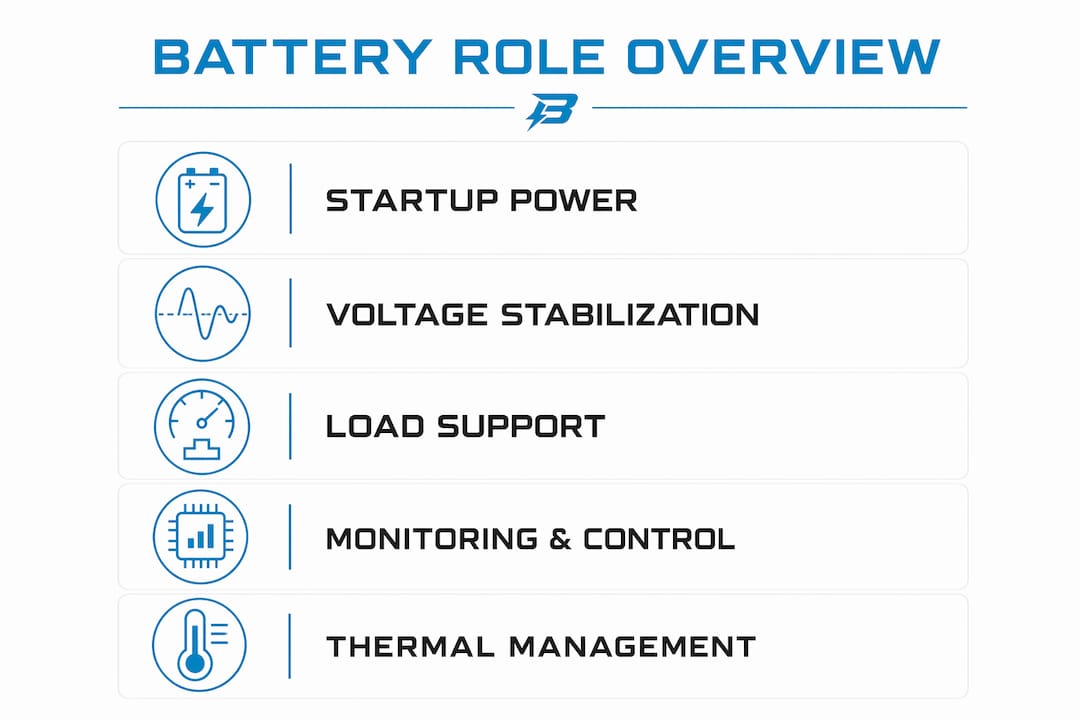
The battery’s first job is delivering a high-current burst to the starter motor, but that is only part of the story. Before the engine cranks, the battery powers the fuel pump, the ECU, and the ignition system so every component is initialized and ready. The ECU runs self-checks, the fuel system builds pressure, and sensors begin reporting. All of that happens in the seconds before the starter even engages.
Cold Cranking Amps (CCA) is the industry standard rating that measures how much current a battery can deliver at 0°F for 30 seconds while maintaining at least 7.2V. CCA directly determines whether the starter motor receives enough current to spin the engine under cold conditions. A battery with insufficient CCA for its application will drop voltage too quickly during cranking, starving the ECU and causing start failures that look like ignition or fuel problems.
The operational voltage range for starter motor testing runs from 8V to 28V depending on the system. Passenger vehicles use 12V nominal systems, with the alternator maintaining output between 13.5V and 14.5V once the engine runs. That transition from battery-powered startup to alternator-sustained operation is where many technicians miss voltage-related faults. If the battery cannot hold voltage through the cranking sequence, the ECU may log phantom codes before the alternator takes over.
- CCA rating: Match to the manufacturer’s specification for your climate and engine displacement.
- Fuel pump priming: The battery powers this before cranking. A weak battery causes low fuel pressure at startup.
- ECU initialization: The control unit runs diagnostics on battery power alone. Voltage below spec here causes false fault codes.
- Starter motor draw: High current demand during cranking can drop system voltage below 10V briefly. The battery must recover quickly.
Pro Tip: Test battery voltage under load, not just at rest. A battery reading 12.6V at rest can collapse to 9V under starter load, which is enough to corrupt ECU initialization and trigger misfire codes.
Why does voltage stability matter for ECU and sensor accuracy?
Voltage instability is a leading cause of unexpected ECU failures because it directly interferes with fuel injection timing and ignition control. That is not a gradual degradation. A drop of just 0.5V can disrupt key engine management systems within milliseconds. That speed means the ECU cannot compensate before damage to sensor data or fuel delivery calculations occurs.

Modern fuel injectors open and close based on precise electrical signals. When voltage fluctuates, injector pulse width changes unpredictably, causing rich or lean conditions that no fuel trim correction can fully fix. Ignition coils face the same problem. Inconsistent voltage changes dwell time and spark energy, which directly affects combustion efficiency and emissions output.
Vehicles built after 2015 using CAN bus architecture are especially vulnerable. Voltage dips below 0.5V can cause data loss across the entire CAN bus network, triggering limp mode and disabling traction control, ABS, and transmission management simultaneously. Technicians often chase individual module faults without realizing a degraded battery is the single root cause.
| Voltage Level | System Status | Likely Symptom |
|---|---|---|
| 12.6V (resting) | Fully charged | Normal operation |
| 12.0V (resting) | 50% charge | Marginal ECU stability |
| 11.5V (resting) | Discharged | Sensor errors, rough idle |
| Below 10V (under load) | Critical | Limp mode, stall risk |
Oxygen sensors, mass airflow sensors, and throttle position sensors all output analog voltage signals that the ECU interprets relative to a reference voltage. When supply voltage shifts, those reference points shift too. The ECU reads a false lean condition, adds fuel, and the engine runs rich. That cycle repeats until the battery is replaced or the technician catches the real fault.
Pro Tip: When diagnosing intermittent misfires or sensor codes on a post-2015 vehicle, load-test the battery first. A CAN bus fault caused by low voltage will clear itself once the battery is replaced, saving hours of module diagnostics.
What is the battery’s role during engine operation and high electrical load?
The battery does not go idle once the alternator takes over. The battery acts as a large electrical shock absorber, smoothing voltage spikes that the alternator generates during load changes. Without that buffering, every time the AC compressor cycles or the cooling fan kicks on, the voltage spike would hit the ECU and sensitive control modules directly.
Active voltage conditioning protects the ECU and sensitive electronics during vehicle operation. The battery absorbs electrical noise from the alternator’s rectifier, from ignition coils firing, and from high-draw accessories switching on and off. This is a function most technicians overlook because it happens invisibly when the system is healthy.
High electrical load periods stress this buffering function the most. Running headlights, climate control, heated seats, and infotainment simultaneously can push alternator demand close to its rated output. When demand spikes beyond what the alternator can instantly supply, the battery fills the gap. A battery with reduced capacity due to age or sulfation cannot fill that gap effectively, and voltage sags reach the ECU.
- Voltage spike absorption: The battery clamps transient spikes from inductive loads like motors and solenoids.
- Alternator noise filtering: The battery’s internal resistance smooths high-frequency electrical noise from the charging system.
- Peak demand support: During simultaneous high-load events, the battery supplements alternator output to prevent voltage sag.
- ECU protection: Stable voltage prevents write errors in ECU memory and protects adaptive fuel trim data.
The automotive aftermarket has seen growing demand for higher-capacity batteries in stock vehicles precisely because modern electrical loads have increased faster than alternator output ratings. Vehicles with start-stop systems face this challenge constantly, since the battery must support full electrical load during every engine-off phase at traffic lights.
How do battery management systems improve engine control reliability?
Battery management systems (BMS) monitor voltage, temperature, and state of charge in real time. BMS technology controls charging and discharging cycles to protect battery health and maintain the stable output that engine management systems require. In hybrid and electric vehicles, the BMS is as critical to engine control as the ECU itself.
Thermal management is the next frontier. Nanofluid thermal management improves heat transfer in battery systems, keeping cells within their optimal temperature range during heavy use. Temperature directly affects internal resistance, and internal resistance directly affects the battery’s ability to deliver stable voltage under load. A battery running too hot or too cold delivers inconsistent output, which the ECU reads as sensor noise.
Hybrid energy storage systems pair high-energy-density cells with high-power-density supercapacitors to handle peak demand without stressing the primary battery. This approach keeps voltage stable during the rapid load changes that engine management systems encounter during acceleration, regenerative braking, and accessory cycling. The result is more consistent ECU data and fewer adaptive corrections.
For conventional 12V systems, AGM (Absorbent Glass Mat) batteries offer lower internal resistance and better charge acceptance than flooded lead-acid batteries. Lower internal resistance means less voltage drop under load, which translates directly to more stable ECU and sensor supply voltage. Technicians replacing a flooded battery with an AGM battery in a modern vehicle often see immediate improvements in idle quality and sensor consistency.
Pro Tip: On vehicles with start-stop systems, always replace with the OEM-specified AGM or EFB battery type. Installing a standard flooded battery in a start-stop application will cause premature failure within months and trigger BMS fault codes.
Key Takeaways
Battery voltage stability is the single most critical factor connecting battery health to engine management system reliability in modern vehicles.
| Point | Details |
|---|---|
| Startup power sequence | The battery powers the ECU, fuel pump, and ignition before cranking begins. |
| Voltage stability threshold | A 0.5V drop can disrupt fuel injection, ignition timing, and CAN bus sensor data. |
| Shock absorber function | The battery smooths alternator noise and voltage spikes during engine operation. |
| BMS and thermal management | Battery management systems protect cell health and maintain stable output for ECU reliability. |
| Battery type matters | AGM batteries deliver lower internal resistance and better voltage stability than flooded alternatives in modern vehicles. |
What I’ve learned after years of watching batteries fail engines
The most common mistake I see is treating a battery as a commodity. Technicians and enthusiasts spend thousands on ECU tuning, injector upgrades, and ignition systems, then install the cheapest battery that fits the tray. That decision undermines every other investment.
A degraded battery running at 70% capacity will pass a basic voltage test at rest. It will fail under load, and that failure shows up as intermittent misfires, lean codes, and throttle response issues that send technicians chasing ghosts. I have watched shops replace oxygen sensors, MAF sensors, and even ECUs before someone finally load-tested the battery and found the real problem.
The other thing worth saying plainly: battery maintenance is not glamorous, but it is foundational. Regular voltage stability checks and load testing catch degradation before it corrupts engine management data. Keeping terminals clean and connections tight costs nothing and prevents the kind of intermittent voltage drop that CAN bus systems cannot tolerate.
The shift toward lithium iron phosphate (LiFePO4) batteries in powersports and performance applications is not just about weight savings. LiFePO4 chemistry holds voltage flatter across its discharge curve than lead-acid, which means the ECU sees a more consistent supply voltage throughout the drive cycle. That consistency pays dividends in fuel economy, emissions compliance, and long-term ECU health.
— Donald
Bansheebatteries builds batteries that engine management systems can count on
Engine management systems demand voltage stability that most stock batteries struggle to maintain as they age. Bansheebatteries designs AGM and LiFePO4 batteries specifically for applications where electrical reliability is non-negotiable.

The Bansheebatteries AGM lineup includes options like the 94R H7 with 800CCA and 80Ah capacity, built for vehicles with high electrical demands and start-stop systems. For technicians and enthusiasts who want the flattest voltage curve available, the lithium powersport battery range delivers LiFePO4 chemistry with a 5-year warranty on marine lithium batteries and 4-year coverage on AGM units. Every product is backed by expert guidance to match the right battery to your vehicle’s engine management requirements.
FAQ
What voltage does an ECU need to operate correctly?
Modern ECUs require a steady 12V supply, with the alternator maintaining system voltage between 13.5V and 14.5V during operation. Voltage below 11.5V at rest indicates a discharged battery that can cause sensor errors and ECU instability.
Can a weak battery cause engine misfires?
Yes. A battery that drops voltage under load disrupts ignition coil dwell time and fuel injector pulse width, both of which cause misfires. Technicians should load-test the battery before replacing ignition or fuel components.
What is Cold Cranking Amps and why does it matter?
CCA measures the current a battery delivers at 0°F for 30 seconds while maintaining at least 7.2V. A battery with insufficient CCA for its application will drop voltage too low during cranking, preventing proper ECU initialization.
How does a BMS protect engine management systems?
A battery management system monitors voltage, temperature, and charge state in real time, controlling charge and discharge cycles to prevent the voltage swings that disrupt ECU and sensor accuracy.
Why do start-stop vehicles need AGM batteries?
Start-stop systems cycle the engine off at every traffic stop, placing the full electrical load on the battery during engine-off phases. AGM batteries handle this repeated partial discharge without the capacity loss that would cause voltage sag and ECU faults.