


How Bilge Pumps Affect Battery Life: 2026 Boat Owner's Guide
How bilge pump operation affects your marine battery
Your bilge pump is one of the most battery-hungry devices on the boat, and most owners don’t realize it until they come back to a dead battery at the dock. The core issue is simple: every time the pump cycles on, it pulls current from your battery bank, and that drain adds up fast depending on pump size, cycling frequency, and how well your wiring is set up.
Standard 12V automatic bilge pumps draw a range of current during active operation, with sensing-style pumps drawing very low standby current. A high-draw pump running continuously on a modest battery bank can exhaust it in a matter of hours. Frequent short cycles from a small leak are just as damaging over time, pulling the battery through repeated partial discharges that accelerate sulfation and reduce overall capacity.
Key factors that determine how much your pump hurts your battery:
- Pump amp draw: Higher-GPH pumps pull more current. A 500 GPH pump draws around 1.6A; larger models can hit 8A or more.
- Duty cycle: A pump cycling every few minutes due to a slow leak drains a battery far faster than one that runs briefly once a day.
- Battery capacity and health: An aging battery with reduced effective capacity will fail sooner under the same pump load.
- Wiring quality: Undersized wire causes voltage drop, forcing the pump motor to draw more current to compensate.
- Automatic vs. manual operation: Automatic float-switch pumps run unattended, which is convenient but creates risk if the switch sticks on.
Marine electrical standards cap voltage drop at 3% to protect both pump efficiency and battery life. Exceed that threshold and you’re burning extra amps for less pumping output.
Understanding bilge pump power consumption and battery capacity
Pump current draw varies widely by model and installation. Active draw ranges from 1.6A to 8A, while sensing-style automatic pumps consume as little as 0.2A per day on standby.
Battery capacity is measured in amp-hours (Ah). Marine batteries have usable capacity limits to protect battery life. Run time estimates depend on dividing usable Ah by the pump’s amp draw.
Those theoretical numbers can be misleading in practice, as real-world conditions such as pump cycling, battery age, and partial state of charge reduce effective endurance. Battery aging also reduces reliable capacity, affecting pump performance when needed most.
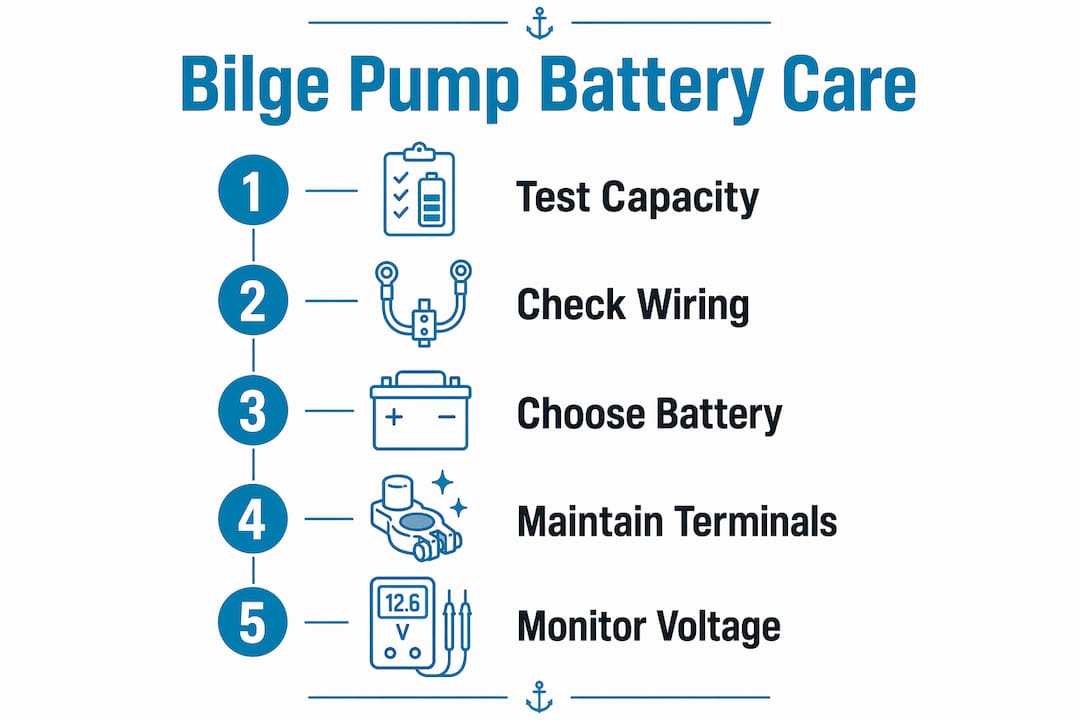
Pro Tip: Test your battery’s actual capacity with a load tester at the start of each season. A battery showing 70% or less of its rated capacity should be replaced before it fails during an unattended stretch.
Electrical system best practices to reduce battery drain
Wiring is where most bilge pump installations quietly fail. Undersized wire causes voltage drop that forces pumps to work harder at reduced motor speed, pulling more current for less pumping output. The result is faster battery depletion and accelerated pump wear, a combination most boat owners never trace back to the wire gauge.
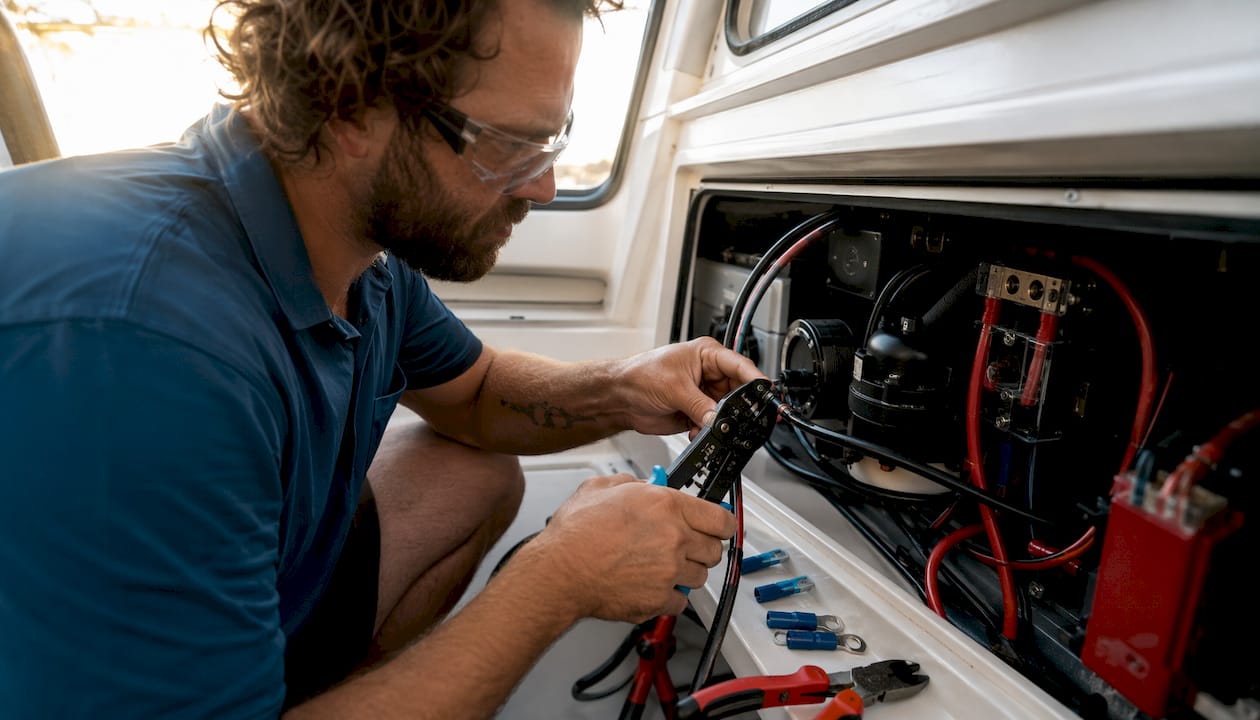
The fix is straightforward. A 1,000 GPH pump drawing 5A located 25 feet from the battery requires 10-gauge duplex wire to stay within the 3% voltage drop limit. Most factory installations use smaller wire. Upgrading the wire gauge on an existing installation often delivers more real-world pumping capacity than swapping in a higher-rated pump.
Additional wiring and system practices that protect your battery:
- Dedicated circuit: Run the bilge pump on its own fused or breaker-protected circuit, separate from other loads. Each pump needs its own overcurrent protection device, not a shared breaker with other equipment.
- Independent power supply: Wire the pump circuit so it stays live regardless of the main battery switch position. This keeps the pump active even when you’ve shut down other systems.
- Inspect float switches regularly: A stuck float switch causes continuous pump operation and rapid battery drain. Replace corroded or debris-fouled switches before they become a problem.
- Avoid daisy-chaining: Multiple pumps on a single circuit create cumulative drain and complicate fault diagnosis.
- Shore power and solar backup: For boats left unattended, a dedicated house battery bank with solar or wind charging keeps the pump powered without risking your starting battery.
Proper marine electrical work on the bilge pump circuit pays for itself the first time it prevents a dead battery at the dock.
Pro Tip: Upgrading wire gauge is cheaper than a new pump and often delivers better results. Run the numbers on voltage drop before buying hardware.
Optimizing your battery setup for reliable bilge pump operation
Battery choice matters as much as wiring. Deep-cycle AGM and LiFePO4 batteries handle the repeated partial discharges that bilge pump cycling creates far better than standard starting batteries. A starting battery discharged to 50% is effectively dead for practical purposes; a quality deep-cycle AGM or lithium battery tolerates that same discharge routinely without the same capacity loss.
LiFePO4 batteries offer a meaningful advantage for boats with active bilge systems. They maintain stable voltage across a much wider state of charge, which means the pump gets consistent power even as the battery depletes. They also tolerate more charge-discharge cycles before capacity degrades. Bansheebatteries’ LiFePO4 marine batteries carry a 5-year warranty, reflecting the chemistry’s durability under demanding marine conditions. Their AGM line backs a 4-year warranty, making either option a stronger long-term investment than a generic automotive battery.
Maintenance practices that extend battery life under regular pump load:
- Clean terminals at the start and end of each season to prevent corrosion-driven resistance.
- Monitor resting voltage regularly. A fully charged 12V AGM should read around 12.7V; consistent readings below 12.4V at rest signal declining health.
- Avoid deep discharges. Pulling a lead-acid battery below 50% repeatedly accelerates sulfation and permanent capacity loss.
- Use a compatible smart charger. A charger that matches your battery chemistry applies the correct charge profile and avoids overcharging.
- Disconnect and store in a cool, dry location during extended layups. A battery left connected to a dormant boat loses charge through parasitic loads and self-discharge.
Separating your house bank from your starting battery is the single most practical upgrade for boats that sit unattended. The bilge pump draws from the house bank while solar or wind charging keeps it topped up, and your engine start battery stays untouched. For a deeper look at configuring this setup, Bansheebatteries covers the specifics in their marine battery bank setup guide.
Common pitfalls that cause unexpected battery drain from bilge pumps
The most common cause of a dead boat battery is a bilge pump running continuously because a float switch stuck in the on position. Debris, corrosion, or a simple mechanical failure keeps the switch closed, the pump runs all night, and you return to a dead battery and possibly a flooded bilge. Regular float switch inspection and cleaning is the cheapest insurance available.
Faulty wiring and corroded connections cause parasitic drain even when the pump isn’t running. A corroded terminal or damaged wire insulation creates resistance that bleeds current continuously. If your battery is consistently low after a few days at the dock with no obvious pump activity, check every connection in the bilge pump circuit before assuming the battery is failing.
Small, undetected leaks are another silent killer. A slow drip through a hose fitting or shaft seal keeps the float switch cycling the pump every few minutes. Over 48 hours, that adds up to hundreds of short discharge cycles, exactly the pattern that accelerates sulfation in lead-acid batteries and degrades capacity faster than any single deep discharge would.
Signs your battery is degrading from bilge pump stress:
- Voltage drops quickly under pump load and recovers slowly after the pump stops.
- The pump starts sluggishly or runs at reduced speed despite a “charged” battery.
- Battery reaches full charge faster than it used to, a sign of reduced capacity.
- Resting voltage reads low even after a full charge cycle.
Adding a manual pump as a backup to your automatic system gives you a power-independent failsafe when automatic pump failures leave you without protection. It also helps during electrical troubleshooting when you need to isolate the automatic circuit. For boats prone to automatic pump switch faults, a bilge alarm wired independently of the pump circuit gives you early warning before the battery is exhausted.
Regular maintenance including terminal cleaning and voltage monitoring is the most reliable way to catch these issues before they strand you.
Bansheebatteries has the marine batteries your bilge pump demands
Frequent bilge pump cycling puts real stress on a battery. Generic automotive batteries aren’t built for it. Bansheebatteries designs AGM and LiFePO4 batteries specifically for marine deep-cycle use, with the cycle life and voltage stability that bilge pump systems require.

Their marine battery lineup covers both AGM and lithium options, backed by a 4-year AGM warranty and a 5-year lithium warranty. The 12V 100Ah LiFePO4 handles the repeated partial discharges that bilge pump cycling creates without the capacity loss that plagues lead-acid alternatives. If you want a battery that won’t leave you stranded after four days of rain, Bansheebatteries is the place to start.
Key Takeaways
A bilge pump’s effect on battery life comes down to amp draw, duty cycle, wiring quality, and battery chemistry — get all four right and your system will run reliably for seasons.
| Point | Details |
|---|---|
| Pump draw range | Active draw runs 1.6A–8A; standby sensing pumps use as little as 0.2A per day. |
| Battery endurance | A 90Ah battery can theoretically power a 1.5A pump for about 50 hours at 85% discharge, but real-world endurance is usually a few days to a week due to pump cycling and battery health. |
| Wiring standard | Marine standards cap voltage drop at 3%; undersized wire forces higher current draw and faster battery depletion. |
| Battery type matters | Deep-cycle AGM or LiFePO4 batteries handle repeated partial discharges far better than starting batteries. |
| Bansheebatteries | AGM and LiFePO4 marine batteries with 4- and 5-year warranties, built for the deep-cycle demands of active bilge systems. |