


Why Your ATV Battery Drains Overnight: Fix It Fast
An ATV battery drains overnight primarily because of two forces working against it at the same time: natural self-discharge from battery chemistry and parasitic electrical draws from components that stay active when the ignition is off. Standard lead-acid batteries self-discharge around 1% per day at room temperature, which adds up to roughly 30% capacity loss in a single month. Drop below 12.0 volts and you trigger sulfation, a process that permanently damages battery plates. Understanding why ATV battery drains overnight is the first step toward fixing it for good.
Why does an ATV battery drain overnight due to self-discharge?
Self-discharge is a chemical process built into every battery. It happens whether you ride your ATV or not, and it never fully stops. The rate depends heavily on battery technology.
Traditional flooded lead-acid batteries lose up to 13% charge per month, even sitting untouched in a garage. That rate is high enough to cause measurable voltage drop in a single night, especially in a battery that is already partially depleted. AGM and lithium LiFePO4 batteries, by contrast, lose only 1–3% per month. That difference is significant for any ATV owner who stores their machine for weeks at a time.
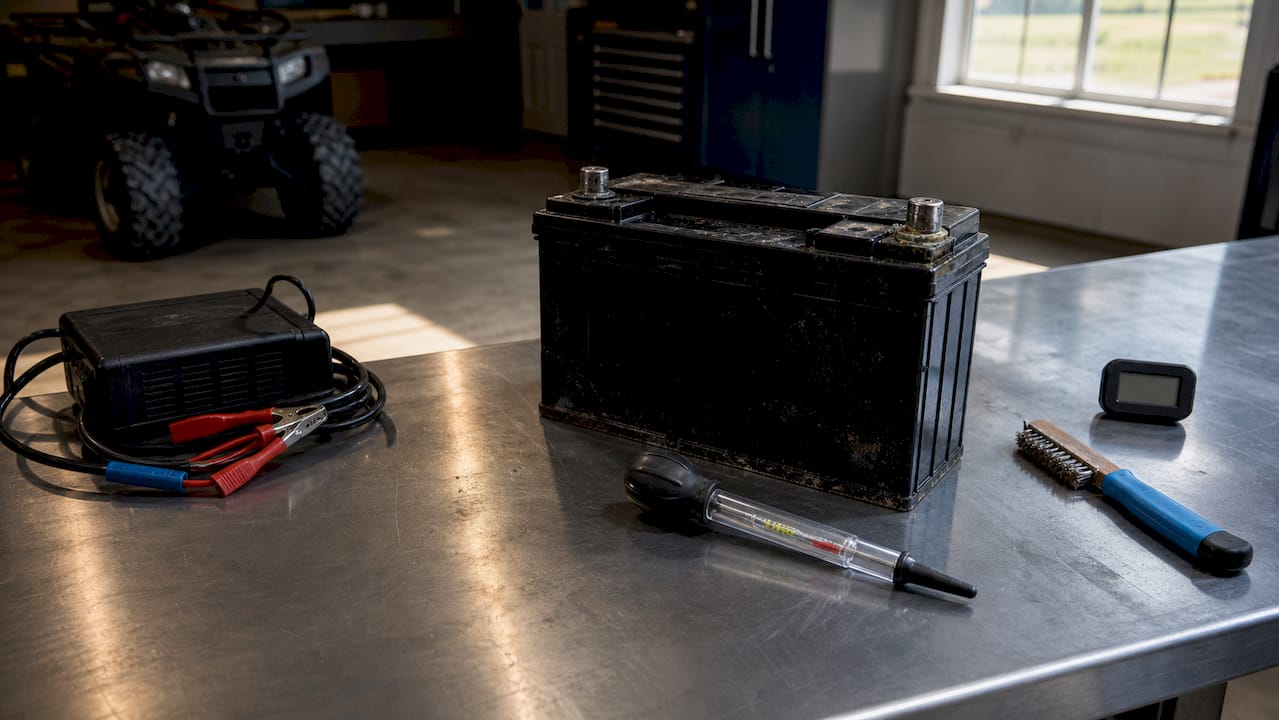
The real danger is sulfation. When a lead-acid battery sits below 12.0 volts, lead sulfate crystals form on the battery plates. Those crystals reduce the battery’s ability to hold a charge, and in most cases the damage is permanent. Heat accelerates sulfation, so a battery left discharged in a warm garage degrades faster than one stored in a cool space.
The table below shows how the three main ATV battery types compare on self-discharge rate and sulfation risk.
| Battery type | Monthly self-discharge | Sulfation risk |
|---|---|---|
| Flooded lead-acid | Up to 13% | High |
| AGM | 1–3% | Moderate |
| Lithium LiFePO4 | 1–3% | Very low |
Pro Tip: If you own a flooded lead-acid battery, check the voltage every two weeks during storage. A reading below 12.4 volts means it is time to charge.
For a detailed breakdown of how AGM and lithium technologies differ in powersports applications, the AGM vs. LiFePO4 comparison from Bansheebatteries covers the key tradeoffs clearly.
What role does parasitic drain play in overnight ATV battery loss?
Parasitic drain is the electrical current your ATV draws when the ignition is off. It is one of the most common and overlooked causes of ATV battery dying quickly overnight. Unlike self-discharge, parasitic drain is not a chemical process. It is a wiring and electronics problem.
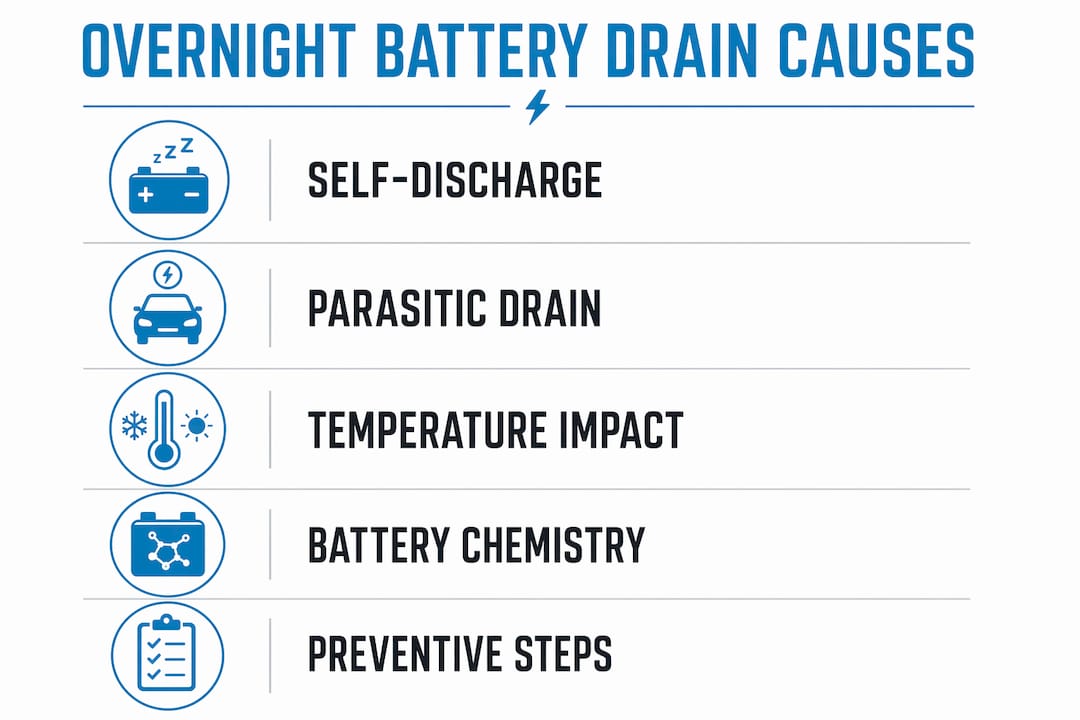
Parasitic drain comes from components like alarms, clocks, fuel injection sensors, and aftermarket accessories that stay powered even when the ATV is parked. Each component draws a small current. Combined, they can deplete a battery significantly faster than self-discharge alone. A battery that would last weeks through natural self-discharge can go dead in a single night if a faulty relay or an aftermarket light kit is pulling continuous current.
Common sources of parasitic drain on ATVs include:
- Alarm systems and immobilizers: These stay active by design and draw continuous current.
- Digital clocks and instrument clusters: Small draw, but constant.
- Fuel injection control modules: Some ECUs draw power even in standby mode.
- Aftermarket accessories: LED light bars, GPS units, and USB chargers left wired directly to the battery are frequent culprits.
- Faulty relays or switches: A relay that fails to fully open keeps a circuit energized indefinitely.
Pro Tip: Use a multimeter set to DC amps and place it in series between the negative battery terminal and the cable. A reading above 50 milliamps with everything off points to a parasitic draw worth investigating.
How do environmental factors affect ATV battery drain and longevity?
Temperature is one of the most underestimated ATV battery life factors. The chemistry inside a battery reacts differently depending on whether it is stored in a heated workshop or left in a cold, uninsulated shed.
The following conditions each affect battery performance in a distinct way:
-
Cold temperatures: Cold slows the self-discharge rate, which sounds like a benefit. The problem is that flooded batteries risk electrolyte freezing when the charge drops too low. A discharged flooded battery can freeze at temperatures just below 32°F, cracking the case and destroying the battery entirely.
-
Heat above 77°F: Heat accelerates internal corrosion and causes electrolyte evaporation in flooded batteries. The result is faster capacity loss and a shorter overall lifespan. A battery stored in a hot garage through summer degrades noticeably faster than one kept in a climate-controlled space.
-
Humidity and moisture: High humidity promotes corrosion on battery terminals and cable connectors. Corroded terminals increase resistance, which means the battery works harder to deliver the same starting power. Over time, terminal corrosion can mimic the symptoms of a failing battery.
-
Unconditioned storage spaces: Cold, unconditioned garages are the most common environment where irreversible sulfation occurs. The combination of low temperature, no charging source, and extended storage time creates ideal conditions for permanent battery damage within three months.
The optimal storage temperature for ATV batteries sits between 50°F and 77°F. Keeping a battery within that range, whether in a basement, climate-controlled garage, or heated storage unit, extends its usable life considerably.
What steps prevent overnight battery drain in ATVs?
Preventing overnight battery drain is straightforward once you know the causes. The right combination of battery technology, charging habits, and storage practices eliminates most of the risk.
Use a smart charger or battery tender
A battery tender or float charger maintains full charge during storage without overcharging. Smart chargers monitor voltage and only charge when the battery drops below a set threshold. The Battery Council International recommends smart maintainers for seasonal storage as the single most effective way to prevent sulfation damage. This is the easiest and most reliable prevention method available.
Disconnect or remove the battery during long storage
Disconnecting the battery terminal stops parasitic drain immediately. It does not stop natural self-discharge, but it eliminates the electrical draw from alarms, sensors, and accessories. For storage longer than a month, removing the battery entirely and keeping it indoors on a maintenance charger is the better approach.
Switch to AGM or lithium LiFePO4
Upgrading from a flooded lead-acid battery to an AGM or lithium unit cuts the monthly self-discharge rate from up to 13% down to 1–3%. That single change dramatically reduces the risk of waking up to a dead battery after a few days of inactivity. Lithium LiFePO4 batteries also carry no sulfation risk, which removes one of the most common causes of permanent battery failure.
The table below summarizes the main prevention methods and their tradeoffs.
| Prevention method | Benefit | Limitation |
|---|---|---|
| Smart charger / battery tender | Prevents sulfation, maintains full charge | Requires power outlet access |
| Disconnect battery terminal | Stops parasitic drain | Does not stop self-discharge |
| Remove battery, store indoors | Eliminates both drain types | Requires reinstallation before riding |
| Upgrade to AGM or lithium | Lower self-discharge, longer life | Higher upfront cost |
| Fix parasitic drain sources | Eliminates hidden current draws | Requires electrical diagnosis |
Pro Tip: Before storing your ATV for winter, run a parasitic draw test with a multimeter. Fixing a single faulty relay now can save you from a dead battery and a missed spring ride.
For a full walkthrough of ATV battery maintenance practices, Bansheebatteries has a detailed guide covering seasonal care from charge levels to terminal cleaning.
Key Takeaways
Overnight ATV battery drain comes from two sources: natural self-discharge accelerated by battery chemistry and temperature, and parasitic electrical draws from components that stay active when the ignition is off.
| Point | Details |
|---|---|
| Self-discharge is unavoidable | Flooded lead-acid batteries lose up to 13% charge monthly; AGM and lithium lose only 1–3%. |
| Sulfation causes permanent damage | Voltage below 12.0 volts triggers lead sulfate crystal formation that reduces capacity irreversibly. |
| Parasitic drain compounds the problem | Alarms, sensors, and aftermarket accessories draw current continuously with the ignition off. |
| Temperature controls battery life | Store batteries between 50°F and 77°F to avoid freezing, corrosion, and accelerated degradation. |
| Smart chargers are the best prevention | Battery Council International recommends float chargers for seasonal storage to prevent sulfation entirely. |
What I’ve learned after years of watching ATV batteries fail
Most ATV owners I talk to assume a dead battery means the battery is old or defective. That assumption costs them money. The battery is usually fine. The storage habits are the problem.
The most common mistake is leaving the ATV connected in an unheated garage through winter with no charger attached. Three months of cold, no charging, and continuous parasitic draw from a clock or alarm module is enough to push a flooded battery past the sulfation threshold. At that point, no charger in the world brings it back fully.
The second mistake is assuming that disconnecting the battery solves everything. It stops parasitic drain, which is good. But a disconnected flooded battery still self-discharges at roughly 1% per day. Left alone for 60 to 90 days, it will drop below 12.0 volts and start sulfating. Disconnecting buys time. It does not replace a maintenance charger.
Switching to lithium LiFePO4 changes the equation significantly. The self-discharge rate drops to a fraction of what flooded lead-acid produces, and there is no sulfation risk at all. For ATV owners who store their machines for months at a time, that upgrade pays for itself in avoided battery replacements. Proper LiFePO4 battery storage is still worth learning, but the margin for error is much wider than with flooded batteries.
The simplest habit that prevents most overnight drain problems: plug in a smart charger every time the ATV sits for more than two weeks. That one routine eliminates sulfation risk, keeps the battery at full capacity, and means your machine starts every time you need it.
— Donald
Bansheebatteries has the right battery and charger for your ATV
If overnight battery drain has become a recurring problem, the fix often starts with the battery itself. Bansheebatteries designs AGM and lithium LiFePO4 batteries specifically for powersports applications, built to handle the storage conditions and electrical demands that kill standard flooded batteries.

The lithium powersport battery lineup from Bansheebatteries delivers the low self-discharge rates and zero sulfation risk that make overnight drain a non-issue. Pair any battery with a smart maintenance charger from Bansheebatteries and your ATV will start reliably whether it has been sitting for two weeks or two months. Bansheebatteries backs its AGM batteries with a 4-year warranty and its lithium marine batteries with a 5-year warranty, so the investment holds up season after season.
FAQ
Why is my ATV battery dead after one night?
A battery that dies overnight is almost always losing charge to a parasitic draw from an alarm, sensor, or aftermarket accessory. A flooded lead-acid battery already below 12.4 volts is especially vulnerable to this type of rapid discharge.
Does cold weather cause ATV battery drain?
Cold slows the self-discharge rate slightly, but a discharged flooded battery risks electrolyte freezing below 32°F, which causes permanent physical damage. Storing batteries between 50°F and 77°F protects against both freezing and heat-related degradation.
How do I stop parasitic drain on my ATV?
Disconnect the negative battery terminal when the ATV is parked for more than a few days, or use a smart charger to offset the draw. For a permanent fix, use a multimeter to identify and eliminate the specific component pulling current with the ignition off.
What is the best battery type to prevent overnight drain?
AGM and lithium LiFePO4 batteries both self-discharge at only 1–3% per month, compared to up to 13% for flooded lead-acid. Lithium LiFePO4 also carries no sulfation risk, making it the most reliable choice for ATV owners who store their machines for extended periods.
How long can an ATV battery sit before it goes bad?
A standard flooded lead-acid battery left without a charger can reach damaging sulfation levels within 60 to 90 days. AGM and lithium batteries tolerate longer storage periods, but a smart maintenance charger remains the safest option for any battery type.