


Why Battery Temperature Range Matters for Outdoor Use
Keep lithium cells near their 15°C–35°C sweet spot: outside that band, you lose usable capacity in cold and accelerate irreversible aging in heat. That single rule covers the majority of outdoor battery failures, from a dead motorcycle on a January trail ride to a swollen marine pack baking on a summer dock.
The PMC review on all-temperature battery applications confirms that cells operating within 15°C–35°C with pack temperature deviation under ~5°C deliver higher efficiency and longer cycle life. A 2025 IOP study using NASA datasets found a strong inverse relationship between temperature and remaining useful life, making temperature the single most predictive variable for how long your pack lasts.
Three things you can do right now:
- Never charge below 0°C. Charging at subzero temperatures causes lithium plating, a form of permanent damage. Block it with a BMS low-temp lockout or a self-heating enclosure.
- Shade and vent in heat. A pack sitting in direct sun on a boat or ATV can reach temperatures well above ambient. Physical shading and airflow cost nothing.
- Add a capacity buffer for cold climates to maintain usable capacity when temperatures drop. Real-world installers routinely undersize winter packs; that buffer keeps usable capacity where you need it when temperatures drop.
Key Takeaways
Temperature is the single most important variable in outdoor battery performance and longevity: keep lithium cells in the 15°C–35°C range, never charge below 0°C, and use insulation or active heating to stay within those limits in the field.
| Point | Details |
|---|---|
| Optimal temperature window | Keep lithium cells between 15°C and 35°C for peak efficiency and longest cycle life. |
| Cold charging is permanent damage | Never charge below 0°C; lithium plating is irreversible and voids most warranties. |
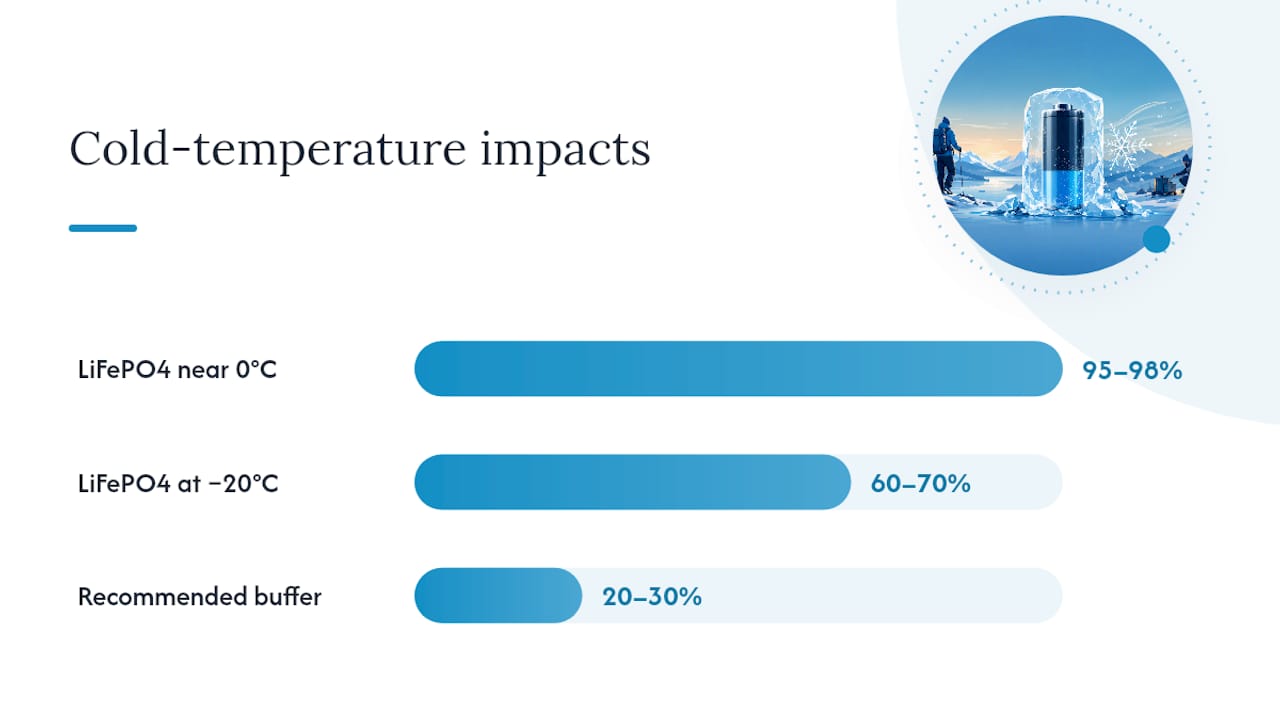
| LiFePO4 cold capacity | LiFePO4 retains 95–98% capacity near 0°C but drops to 60–70% at −20°C. |
| Heat accelerates aging | Sustained operation above 40–45°C shortens cycle life; above 60°C raises safety risk. |
| Size up for cold climates | Add a 20–30% capacity buffer in cold climates to maintain usable output year-round. |
Always confirm charge temperature limits, IP ratings, and BMS lockout settings in your product’s datasheet before outdoor deployment.
Table of Contents
- How temperature changes what happens inside lithium cells
- What cold does to your battery outdoors
- How high temperature damages lithium batteries
- Typical operating, charging, and storage ranges for lithium chemistries
- How BMS and thermal management protect batteries from temperature extremes
- Your outdoor battery checklist by scenario
- How to recognize temperature-related battery problems
- What manufacturers recommend and what it means for your warranty
- The tradeoffs no one talks about in the field
- Ready to power your next outdoor adventure?
- Sources
How temperature changes what happens inside lithium cells
Every lithium battery is an electrochemical engine, and like any engine, it has an operating range where it runs cleanly. Temperature controls three things simultaneously: how fast lithium ions move through the electrolyte, how easily they transfer across electrode interfaces, and how quickly unwanted side reactions consume active material.
Ion mobility and electrolyte viscosity are the cold-side story. Drop the temperature and the electrolyte thickens. Ions slow down. Charge-transfer resistance at the electrode surface rises sharply, which means the cell has to work harder to deliver the same current. The practical result is reduced available capacity and reduced peak power, even if the cell is nominally “full.”
Heat tells the opposite story. Elevated temperatures thin the electrolyte and speed ion movement, which sounds helpful until you realize those same conditions accelerate parasitic side reactions: electrolyte decomposition, solid-electrolyte interphase (SEI) growth, and gas generation inside the cell. These reactions consume active lithium permanently. Aging studies on NMC/LMO pouch cells show that medium-to-high temperatures produce non-linear aging trajectories, with a pronounced “knee” in capacity loss that arrives earlier the hotter the cell runs.
Key figure: A 2025 data-driven analysis confirmed that battery temperature is the dominant predictor of remaining useful life, outweighing cycle count in datasets spanning thousands of charge cycles.
The takeaway for outdoor users is that temperature does not just affect today’s performance. It shapes how many tomorrows the pack has left.
What cold does to your battery outdoors
Cold is the more immediately disruptive extreme for most outdoor users because its effects show up fast and without warning.
Primary cold-weather failure modes:
- Reduced capacity and power. Internal resistance rises as temperature falls, limiting how much energy the cell can deliver per discharge.
- Slower reaction kinetics. The electrochemical reactions that move charge simply take longer, cutting peak power output.
- Lithium plating. Below ~0°C, lithium ions can deposit as metallic lithium on the anode surface instead of intercalating cleanly. That metallic lithium is irreversible damage and a safety risk.
- Failure to accept charge. A cold pack may refuse a charge entirely, or accept it so slowly that the charger times out.
Capacity at low temperatures: LiFePO4 numbers
LiFePO4 (lithium iron phosphate) handles cold better than most lithium chemistries, but it is not immune. According to Insum Energy’s 2026 climate sizing guide, LiFePO4 retains most of its rated capacity near 0°C but experiences a significant drop at around −20°C. Standard NMC and consumer Li-ion cells typically fall harder and faster at the same temperatures.
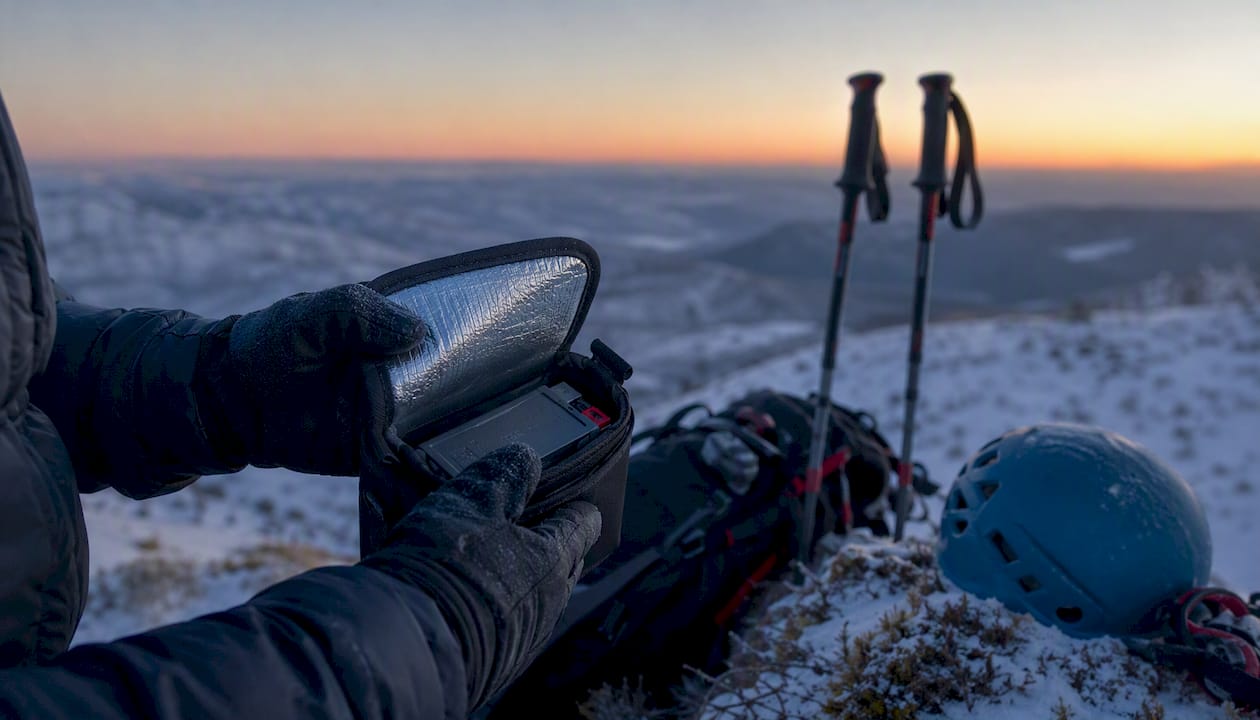
Field symptoms to watch for: a powersports battery that cranks slowly or fails to start in the first 30 seconds of a cold morning; a drone pack that shows full charge indoors but cuts out after two minutes outside; a solar storage system that stops accepting charge overnight. All of these point to cold-related capacity or charging restriction.
Pro Tip: Before heading into freezing conditions, run a brief discharge cycle to warm the cells through their own internal resistance. Even 5–10 minutes of moderate load raises cell temperature several degrees and meaningfully improves both capacity and charging acceptance.
For powersports-specific cold-start strategies, Bansheebatteries covers the mechanics in detail in their AGM cold weather guide.
How high temperature damages lithium batteries
Heat is the slow killer. Unlike cold, which announces itself immediately through sluggish performance, heat damage accumulates quietly over weeks and months before you notice capacity loss.
Above ~40°C, side reactions inside the cell accelerate. The SEI layer grows faster, consuming active lithium. Electrolyte oxidizes at the cathode. Internal pressure builds as gases form. The PMC all-temperature review documents marked cycle-life reduction when cells operate above ~60°C and evidence of accelerated aging beginning above ~40–45°C across multiple chemistries.
Aging acceleration: Research on NMC/LMO cells shows that high aging temperatures produce a knee in the capacity-loss curve, meaning the pack appears fine until it suddenly isn’t. That non-linear drop is what makes heat damage so deceptive.
For LiFePO4 packs, sustained operation above 35–45°C noticeably reduces cycle life, and the effect compounds with charge rate. A marine battery charging at high current on a hot afternoon is under double stress.
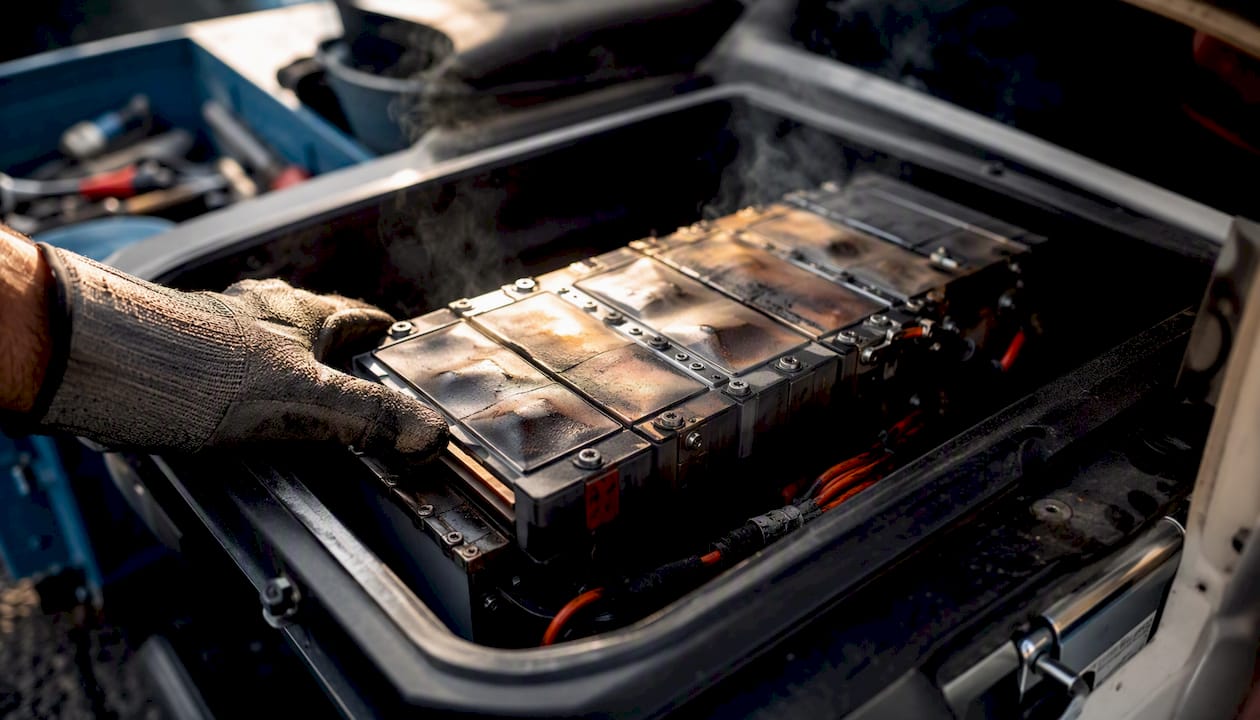
Safety threshold: above ~60°C, thermal runaway becomes a real concern. Warning signs include the pack feeling hot to the touch (not just warm), swelling or bulging of the case, a hissing or crackling sound, or a sharp chemical smell. If you observe any of these, stop use immediately, move the pack away from flammable materials, and do not attempt to charge it.
Typical operating, charging, and storage ranges for lithium chemistries
Understanding the difference between discharge tolerance and charging constraints is the most practically useful thing an outdoor user can know. Discharge is forgiving; charging is not.
A few important caveats:
- Pack temperature vs. cell temperature. Manufacturers often specify limits at the cell level. A pack with poor thermal management can have cells running 5–10°C hotter than the case surface suggests.
- Charging is the constrained direction. The outdoor solar storage guide is direct on this: charging below 0°C risks lithium plating, while discharging in the same conditions is merely inefficient. Design your system around the charging constraint, not the discharge tolerance.
- Storage temperature matters more than most users realize. Storing a pack at 25°C vs. 40°C over a season can represent months of equivalent calendar aging. A cool, dry location is not just a suggestion.
Quick datasheet checks before buying an outdoor pack:
- Confirm the charge temperature floor (should be 0°C or above, ideally with a low-temp lockout built in).
- Check whether the pack has an IP rating for moisture and dust if it will be exposed to the elements.
- Look for a stated storage temperature range, not just an operating range.
How BMS and thermal management protect batteries from temperature extremes
A Battery Management System (BMS) is the pack’s first line of defense. At its core, it monitors cell voltages and temperatures, then acts: cutting off charge when cells are too cold, derating current when cells are too hot, and balancing charge across cells to prevent hot spots.
For outdoor use, the most critical BMS feature is the low-temperature charge lockout. This is a hard cutoff that prevents charging below a set threshold, typically 0°C. Without it, a solar controller or charger will happily push current into a frozen pack and cause lithium plating. Most quality outdoor-rated packs include this; budget packs often do not.
A Battery Thermal Management System (BTMS) goes further. Where a BMS reacts to temperature, a BTMS actively controls it: resistive heaters warm cells before charging in cold conditions, and liquid or air cooling removes heat during high-rate discharge in summer. Nature’s 2026 EV battery research models BTMS behavior and finds that systems that heat below ~15°C and cool above ~50°C materially extend battery lifetime, with cell temperature identified as the dominant driver of lifetime changes.
Common hardware solutions for outdoor thermal management:
- Self-heating pads: thin resistive elements bonded to the cell surface, activated by the BMS when temperature drops below threshold. Low cost, effective for moderate cold.
- Insulated enclosures: closed-cell foam or rigid insulated boxes slow temperature change in both directions. Passive, zero power draw, adequate for mild to moderate climates.
- Liquid cooling loops: used in high-rate applications (marine thrusters, performance powersports). Effective but adds weight and complexity.
- Thermal breaks: mounting isolators that prevent heat transfer from a hot engine bay or deck surface into the pack.
Pro Tip: When configuring a BMS for outdoor use, set the low-temp charge lockout at 5°C rather than 0°C. That 5-degree buffer accounts for sensor lag and ensures the cells themselves are above freezing before charging begins, even if the sensor reads right at the threshold.
Your outdoor battery checklist by scenario
Camping and off-grid solar
- Store the battery in an insulated box or inside the tent overnight when temperatures drop below 5°C.
- Set your solar charge controller’s low-temp cutoff if it supports it, or use a pack with a built-in BMS lockout.
- Size the pack 20–30% larger than your calculated need for winter trips to account for cold-related capacity loss.
- Avoid placing the pack directly on frozen ground; use a foam pad as a thermal break.
Pro Tip: A small solar panel can trickle-charge and gently warm a pack during daylight hours, raising cell temperature before the main charge cycle begins. This is a cost-free preheat strategy for off-grid setups.
Marine use
Boats present a unique challenge: the battery may sit in a bilge that is cold in winter and hot in summer, with moisture throughout. Use only packs with an appropriate IP rating (IP65 or higher for exposed locations). Mount away from engine heat. Shade the battery compartment where possible on hot days, and verify that ventilation is adequate to prevent heat buildup during charging.
Bansheebatteries’s LiFePO4 marine batteries are built for exactly these conditions, with a 5-year warranty that reflects their durability in demanding outdoor environments.
Powersports (motorcycles, ATVs, UTVs)
Cold starts are the primary concern. A battery that sat overnight at −10°C will have reduced cranking power. Warm the garage if possible, or use a battery tender with a temperature-compensated charging mode. For winter riding, consider a battery with integrated heating or keep the pack indoors until just before use.
Bansheebatteries covers the cold-start failure modes specific to motorcycles in their winter battery guide. For Tarrant County and similar cold-climate regions, winter vehicle prep is worth reviewing before the first hard freeze.
Drones and portable devices
Drone packs are small, discharge at high rates, and are often used in temperature extremes. Keep packs in an insulated pouch between flights. Never charge a pack that is cold to the touch after a winter flight; let it return to room temperature first. In summer, land before the pack feels hot, not after.
Numbered setup checklist for any outdoor scenario:
- Verify the pack’s charge temperature floor in the datasheet before purchase.
- Confirm BMS low-temp lockout is active and set correctly.
- Add 20–30% capacity buffer for cold-climate use.
- Use an insulated enclosure or thermal break for storage and transport.
- Shade and ventilate in high-heat environments.
- Never charge immediately after extreme cold or heat exposure; allow the pack to stabilize first.
- Log any unusual behavior (slow charge, sudden cutoff, swelling) for trend tracking.
How to recognize temperature-related battery problems
Most temperature damage gives you warning signs before it becomes a safety issue. The key is knowing what to look for.
Warning signs of temperature-related failure:
- Swelling or bulging of the battery case: gas generation from side reactions, almost always heat-related.
- Hissing or crackling sounds during charge or discharge: electrolyte venting, a precursor to thermal runaway.
- Failure to accept charge in moderate temperatures: may indicate lithium plating from previous cold charging, which raises internal resistance permanently.
- Sudden voltage collapse under load: the pack reads 80% state of charge but cuts out under moderate draw, a classic sign of cold-related capacity loss or internal damage.
- Extreme surface heat during charging: normal packs run warm, not hot. If you cannot hold your hand on the case comfortably, something is wrong.
- Persistent capacity loss that does not recover after the pack returns to normal temperature: permanent degradation, not a temporary cold effect.
Immediate safety steps:
- Stop charging or discharging immediately.
- Move the pack away from flammable materials and to an open, ventilated area.
- Do not attempt to cool a hot pack with water; let it cool naturally.
- Do not puncture, crush, or disassemble the pack.
- Contact the manufacturer if you observe swelling, hissing, or extreme heat.
- Retire a pack that shows persistent capacity loss below ~70–80% of rated capacity, or any evidence of physical deformation.
For LiFePO4-specific safety characteristics, Bansheebatteries has a detailed breakdown at their LiFePO4 safety guide.
What manufacturers recommend and what it means for your warranty
Most lithium battery manufacturers publish temperature limits in their datasheets, but those limits are not always prominently displayed at point of sale. The standard charge floor is 0°C; the standard charge ceiling is 45°C; storage is typically 10°C–30°C for long-term. Operating outside these ranges, especially charging below freezing, is the most common warranty-voiding condition.
From manufacturer guidance: Charging a lithium pack below 0°C is not a gray area. It causes lithium plating, which is permanent and cumulative. A single cold-charge event may not destroy the pack, but repeated exposure shortens its life measurably and voids most manufacturers’ warranties. Always verify the charge temperature window in your product’s datasheet, and treat that floor as a hard limit, not a suggestion.
Pro installation checks before any outdoor deployment:
- Confirm the pack’s IP rating matches the installation environment (IP65 minimum for exposed outdoor locations).
- Verify the BMS low-temp charge lockout is enabled and set at or above 0°C.
- Check mounting orientation requirements; some packs specify upright or horizontal mounting for thermal management reasons.
- Review the warranty terms for temperature-related exclusions before installation.
Bansheebatteries backs their AGM batteries with a 4-year warranty and their lithium marine batteries with a 5-year warranty, reflecting confidence in their thermal engineering for demanding outdoor conditions. Their 12V 100Ah LiFePO4 deep-cycle pack is built for RV, marine, and off-grid applications where temperature management is non-negotiable.
The tradeoffs no one talks about in the field
There is a tension in outdoor battery use that most guides skip: the measures that protect your pack in the short term can stress it in other ways over the long term.
Heating a cold pack to accept a charge is the right call. But if you are running a resistive heater every morning for six months of winter, that heater draws energy, adds thermal cycling stress, and introduces one more component that can fail. For occasional cold-weather users, a well-insulated enclosure and a conservative charge schedule may be the smarter tradeoff. For daily winter users, a pack with integrated heating and a BTMS is worth the added cost and complexity.
The Nature 2026 research on EV battery lifetime makes the case clearly: cell temperature, not cycle count, is the primary driver of lifetime outcomes. That finding should shift how you prioritize. Getting the temperature right matters more than optimizing charge rate or depth of discharge.
My practical rule: lock in the safe charging thresholds first, then choose thermal aids that match how often and how severely you push the temperature limits. A drone pilot flying twice a month in mild winters needs an insulated pouch. A marine installer running daily in the Gulf of Mexico needs active cooling. The outdoor solar storage guide puts it well: active thermal management is necessary in severe climates, while passive approaches are adequate for mild ones.
Test your pack at the temperature extremes you actually expect to encounter, before you need it in the field. Log the results. A pack that shows 75% capacity at −15°C in a controlled test tells you exactly how much buffer you need to build into your system. That data is worth more than any spec sheet.
Ready to power your next outdoor adventure?
Whether you are rigging a marine vessel, prepping a motorcycle for winter, or building an off-grid solar system, the battery you choose needs to handle real-world temperature swings, not just lab conditions. Bansheebatteries designs AGM and LiFePO4 packs specifically for powersports and marine environments, backed by a 4-year AGM warranty and a 5-year lithium marine warranty.
Browse LiFePO4 marine batteries or explore the full lithium powersport battery lineup to find the right pack for your conditions.
Sources
- All-temperature area battery application mechanism, performance, and strategies - PMC
- Temperature-dependent cyclic aging study on NMC111-LMO graphite pouch cells - IOP
- Data-driven thermal impact on battery performance and RUL estimation - IOP
- Outdoor Solar Battery Storage 2026: IP Ratings, Temperature, Enclosures
- LiFePO4 Battery Sizing for Cold & Hot Climates: 2026 Guide - Insum Energy