


Trickle Charging Explained: How It Really Protects Batteries
Trickle charging is a low, steady current fed into a battery to replace the charge it naturally loses when it sits unused. That’s the whole concept. The verdict: it’s the right call for maintaining lead-acid family batteries (wet, SLA, AGM) sitting in storage, but it’s the wrong default for most lithium-ion cells unless the charger and battery management system are built to handle it.
A few quick clarifiers before you connect anything:
- If you’re storing a car, motorcycle, boat, or generator for weeks or months, a regulated trickle charger or maintainer solves the classic “dead battery in spring” problem.
- Lithium batteries, including LiFePO4, generally don’t need or want the same low, constant drip. Many self-discharge so slowly that trickle charging is unnecessary and, without a compatible battery management system, risky.
- If you plan to leave a charger connected for weeks at a time, use a smart maintainer with float mode, not a bare-bones unregulated trickle charger you have to babysit.
Key Takeaways
Trickle charging keeps lead-acid family batteries at full charge during storage by matching a small current to their natural self-discharge, but lithium chemistries need BMS-aware chargers instead.
| Point | Details |
|---|---|
| Match current to chemistry | Lead-acid tolerates 0.5 to 3 amp trickle current; lithium needs BMS-compatible charging instead. |
| Smart maintainers beat unregulated chargers | Multi-stage float logic allows safe, indefinite connection without supervision. |
| Watch for gassing and heat | Flooded lead-acid batteries need ventilation; lithium cells need BMS protection against overcharge. |
| Scale amperage to capacity | Small batteries pair with lower trickle currents; larger batteries can handle the higher end of the range. |
| Follow manufacturer guidance | When chemistry compatibility is unclear, use a maintainer built for that specific battery type. |
Table of Contents
- What Is Trickle Charging and How Does It Work?
- Which Battery Chemistries Actually Suit Trickle Charging?
- Trickle Charging vs. Float Charging vs. Smart Maintainers
- When Should You Actually Use Trickle Charging?
- The Real Risks of Trickle Charging (and How to Avoid Them)
- How to Safely Connect and Monitor a Trickle Charger
- What Two Decades of Battery Work Has Taught Us About Charging Right
- Why the “Just Trickle Charge It” Advice Misses the Point
- Sources
What Is Trickle Charging and How Does It Work?
Trickle charging works by matching the incoming current to a battery’s rate of self-discharge, the slow bleed of stored energy that happens even when nothing is drawing power from it. Every battery loses charge sitting on a shelf. Lead-acid batteries typically lose a small percentage of their charge each week due to self-discharge, with rates affected by temperature. A trickle charger just replaces that lost trickle with an equal trickle, so the battery hovers near full instead of slowly dying.
The mechanics come down to internal resistance and voltage. As a lead-acid battery approaches full charge, its internal resistance rises, which naturally throttles how much current it accepts. A well-designed trickle charger works with that behavior, not against it, feeding in just enough to offset self-discharge without pushing the battery past its saturation point. Push too much current in for too long, though, and you get electrolysis, the process that generates hydrogen and oxygen gas inside a flooded lead-acid cell.
Here’s the numeric intuition that trips people up: trickle current usually falls in the range of 0.5 to 3 amps, according to guidance from Lifewire, which is nowhere near what a fast charger or jump-starter delivers. This isn’t a bug. Trickle charging was never meant to bring a dead battery back to life quickly. It’s meant to hold a healthy battery at full charge over days, weeks, or months.
- A trickle charger replaces lost charge; it doesn’t restore a deeply discharged battery in any reasonable time.
- Amperage in the 0.5 to 3 amp range is standard for small to mid-size batteries.
- Internal resistance rises as charge increases, which is part of what keeps a well-matched trickle current from overwhelming the battery.
- Heat and high ambient temperatures accelerate self-discharge, so trickle needs can shift seasonally.
What actually separates a basic trickle charger from a “smart” one is the regulator. An unregulated trickle charger keeps pushing current whether the battery needs it or not, which is fine for a few hours but becomes a liability over weeks. A smart charger senses the battery’s state and tapers or cuts current automatically, which is the difference between “maintenance tool” and “thing you have to remember to unplug.”
Which Battery Chemistries Actually Suit Trickle Charging?
Trickle charging was essentially built around lead-acid chemistry, and that’s still where it does its best work. Wet cell, sealed lead-acid (SLA), and AGM batteries all tolerate a low, continuous current reasonably well because their chemistry is forgiving of slight overcharge, up to a point. AGM batteries in particular handle trickle maintenance cleanly since they’re sealed and recombine gases internally, though even AGM batteries can vent and dry out if fed too much current for too long. Flooded lead-acid batteries are the ones to watch most closely for gassing and water loss, since their vents let gas escape rather than recombine.
NiCd and NiMH batteries, common in older cordless tools and some backup equipment, have historically tolerated trickle charging too, though at very low, chemistry-specific rates. They’re less common now, and most modern replacements have moved to lithium chemistries, which changes the rules entirely.
Lithium-ion and LiFePO4 batteries are where a lot of people get trickle charging wrong. As Wikipedia’s overview of trickle charging explains, many lithium-ion cells are not well suited to traditional trickle charging without battery management system (BMS) support, because sustained low-level current at full charge can stress the cell chemistry differently than it does lead-acid. LiFePO4 batteries self-discharge far more slowly than lead-acid to begin with, often holding charge for months, so the constant-drip approach that lead-acid needs is frequently unnecessary for lithium.
- Wet and flooded lead-acid: trickle charging works, but watch for gassing and water loss.
- AGM: handles trickle maintenance well when the charger is regulated correctly.
- NiCd/NiMH: low-rate trickle is tolerated but increasingly a legacy use case.
- Lithium-ion/LiFePO4: needs a BMS-compatible charger; don’t assume a lead-acid trickle charger is safe to use.
Pro Tip: Check your battery’s own documentation before assuming any charger is safe. A charger built for AGM won’t necessarily know how to talk to a LiFePO4 cell’s BMS, and using the wrong one is one of the most common ways people damage a perfectly good lithium battery. Our guide on charging LiFePO4 batteries correctly breaks down exactly what a compatible charger looks like.
The rule that covers almost every edge case: follow what the battery manufacturer specifies, and when you’re not sure, use a smart maintainer designed for that exact chemistry rather than guessing.
Trickle Charging vs. Float Charging vs. Smart Maintainers
These three terms get used interchangeably, and that’s exactly why so many people misuse chargers. They’re related but not identical.
- Trickle charging in the strict sense means a constant low current fed into the battery regardless of its actual state of charge. It’s the oldest, simplest approach, and it’s also the one most prone to overcharging if left unattended too long.
- Float charging holds the battery at a fixed voltage rather than a fixed current, letting the battery itself draw only what it needs to stay topped off. This is gentler and is the backbone of most modern maintenance charging.
- Battery maintainers (smart chargers) combine multiple stages, bulk charge, absorption, then float or maintenance mode, adjusting both voltage and current automatically. According to the Battery Tender blog, this multi-stage logic is what allows a charger to sit connected indefinitely without risking overcharge.
The practical differences matter more than the labels:
- Unregulated trickle chargers are cheap and simple but require you to watch the clock.
- Float chargers are gentler and safer for longer attachment, though basic float-only units still lack the full staged logic of a true maintainer.
- Smart maintainers cost more up front but are the only category genuinely safe for months-long, hands-off attachment.
If you’re topping off a battery for a weekend, a basic trickle charger is fine as long as someone’s watching it. If you’re storing a boat or motorcycle over winter with nobody checking in, a smart maintainer with float mode is the only option worth trusting. Our breakdown of smart chargers versus trickle chargers goes deeper into which category fits which storage scenario, and our page on float voltage settings covers the voltage side of the equation for different chemistries.
When Should You Actually Use Trickle Charging?
Amperage should scale to the battery’s capacity, not just its chemistry. A small motorcycle battery rated around 10 amp-hours pairs well with the lower end of that 0.5 to 3 amp range that Lifewire cites as typical, while a larger marine or automotive battery in the 50 to 100 amp-hour range can handle current toward the higher end without issue, assuming the charger is regulated.
Duration depends entirely on what kind of charger you’re using. A smart maintainer with float mode can stay connected for weeks or months with no supervision, since it senses when the battery is full and throttles itself down. An unregulated trickle charger is a different story. Leave that connected too long unattended, and you’re gambling on electrolyte loss and heat buildup.
- Check open-circuit voltage periodically, roughly 12.6 to 12.8 volts for a healthy fully charged 12V lead-acid battery.
- Watch for excessive warmth at the terminals or case, a sign something’s off.
- Visible gassing or a sulfur smell from a flooded battery means stop and ventilate immediately.
- Run an occasional load test every few months to confirm the battery still holds capacity, not just voltage.
The classic use cases are winter-stored motorcycles, seasonal boats sitting on a trailer, backup generators that run once a year, and RVs parked for months between trips. In every one of these, the battery isn’t being used, but it’s still bleeding charge, and a trickle setup is what keeps it from being a dead brick the day you need it.
The Real Risks of Trickle Charging (and How to Avoid Them)
Overcharging is the headline risk, and with flooded lead-acid batteries it shows up as gassing, the release of hydrogen and oxygen from electrolysis, which is both a fire hazard in an enclosed space and a slow drain on the battery’s water content. Left unchecked, that gassing dries out the plates and shortens the battery’s life significantly. Heat buildup follows a similar path: an unregulated charger pushing current into an already full battery generates warmth that accelerates degradation.
Lithium batteries carry a different and more serious risk profile. Overcharging a lithium cell without proper BMS protection can lead to thermal runaway, a much more dangerous failure mode than anything you’d see with lead-acid.
- Charge lead-acid batteries in a ventilated area, never in a sealed compartment.
- Match the charger’s voltage and chemistry setting to the battery before you connect anything.
- Use a smart maintainer or set a timer and check back if you’re using an unregulated charger.
- Fuse the charging circuit where the setup calls for it, particularly on permanent installations.
Pro Tip: If a battery feels warm to the touch, looks swollen, or keeps gassing well past what seems normal, disconnect it immediately and don’t reconnect until you’ve had it checked. Those are signs the cell itself may be failing, not just a charging quirk.
How to Safely Connect and Monitor a Trickle Charger
- Inspect first. Check the battery for corrosion, swelling, or leaks, and clean the terminals before connecting anything. Work in a dry, ventilated space, as recommended by SlashGear’s safety walkthrough.
- Connect in the right order. Positive terminal first, negative second, or use a quick-disconnect harness if your vehicle has one already wired in. Double-check polarity before power goes on.
- Set the charger correctly. Match voltage and chemistry, 6V or 12V, AGM or standard flooded, before starting the charge.
- Watch the first 15 to 30 minutes. Confirm the charger indicator behaves normally and there’s no unusual heat or smell, then check back periodically after that.
- Know when to stop. If you see continuous gassing, swelling, or overheating, disconnect right away, ventilate the area, and test or replace the battery as needed.
| Step | What to check |
|---|---|
| Before connecting | Clean terminals, dry ventilated space, no visible damage |
| During connection | Correct polarity, secure clamps or harness |
| Charger setup | Voltage and chemistry setting matched to the battery |
| First half hour | No unusual heat, smell, or excessive gassing |
What Two Decades of Battery Work Has Taught Us About Charging Right
Bansheebatteries has spent more than 20 years building AGM and lithium batteries for powersports and marine use, and the single most common failure we see isn’t a bad battery. It’s the wrong charger paired with the right one. AGM batteries backed by our 4-year warranty and lithium marine batteries backed by a 5-year warranty are both built to last, but that lifespan depends on using a charger that actually understands the chemistry it’s feeding.
If you’re running AGM, a compatible smart charger protects the investment. If you’ve moved to lithium, a LiFePO4-specific charger with proper BMS communication is not optional, it’s the difference between years of reliable starts and a battery that fails early. Pairing the wrong maintainer with the wrong chemistry is the single most preventable mistake we see in the field, and it’s an easy one to avoid once you know what to look for.
Why the “Just Trickle Charge It” Advice Misses the Point
The conventional wisdom treats trickle charging as a universal fix for any battery sitting idle, and that’s exactly where it falls short. The research is clear that trickle charging was built for lead-acid chemistry’s forgiving overcharge tolerance, not for lithium’s tighter margins.
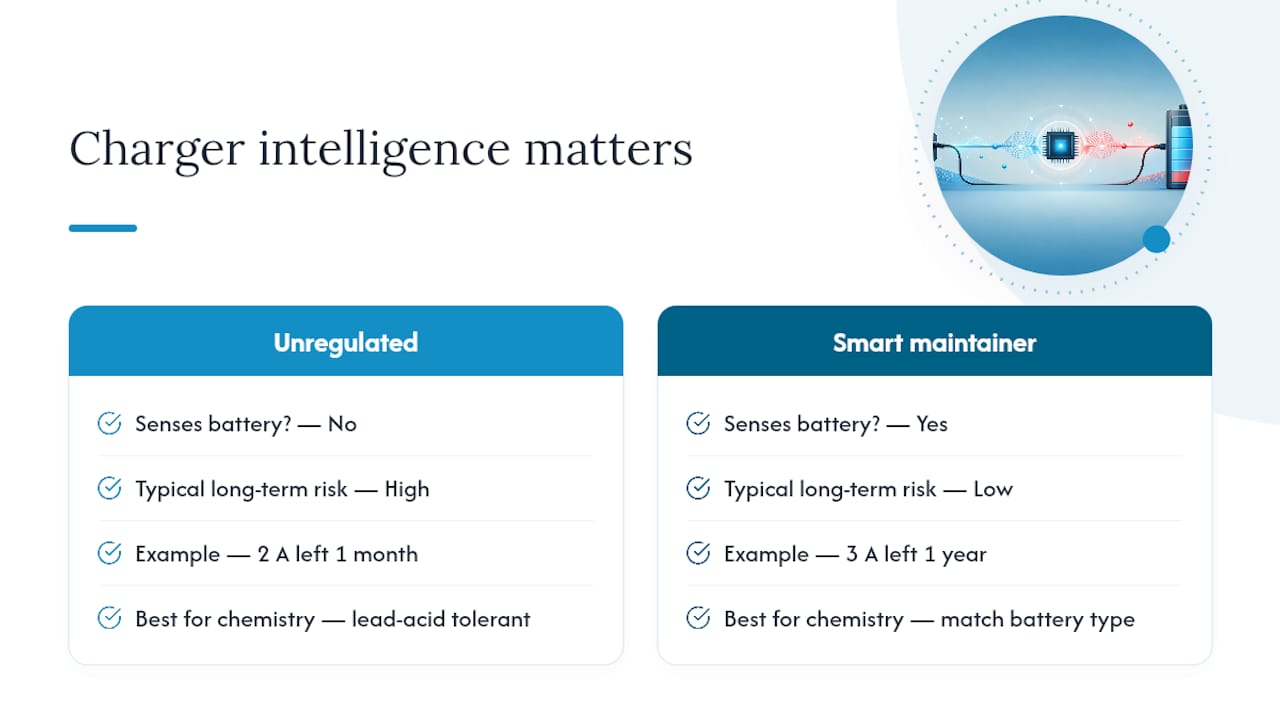
What gets overlooked most is the regulator, not the current itself. People fixate on amperage numbers when the real variable that determines safety is whether the charger senses the battery’s state or just pushes current blindly. A 2-amp unregulated charger left connected for a month is a bigger risk than a 3-amp smart maintainer left connected for a year.
If you take one thing from this, prioritize matching charger intelligence to chemistry before you worry about exact amperage. Buy the maintainer built for your battery type first. Everything else, current levels, connection order, monitoring schedule, is secondary to getting that first decision right.
— Donald
Sources
- What is a trickle charger? How to use one safely
- Trickle charging — Wikipedia
- What Is a Trickle Charger? - Lifewire