


Lithium Iron Phosphate Explained: Chemistry and Battery Guide
Lithium iron phosphate (LiFePO4, often abbreviated LFP) is a lithium-ion cathode material that trades peak energy density for exceptional safety, long cycle life, and predictable raw-material costs. The bottom line: if your application demands a battery that lasts a decade of hard use without catching fire, LFP is the chemistry to choose. When you need the absolute maximum range squeezed into the smallest possible pack, nickel-based chemistries still hold the edge.
Three things to know before reading further:
- Nominal voltage: ~3.2–3.3 V per cell (roughly 12.8 V for a four-cell 12V pack)
- Typical cycle life: 3,000+ cycles under normal conditions, with many manufacturer-rated cells reaching 4,000–6,000+ cycles
- Best applications: solar energy storage, marine and RV deep-cycle use, powersports, backup power, and entry-level EVs
Key Takeaways
LFP is the chemistry of choice when safety, long cycle life, and predictable cost matter more than squeezing maximum energy into minimum weight.
| Point | Details |
|---|---|
| Chemistry and voltage | LiFePO4 uses an olivine crystal structure; nominal cell voltage is 3.2–3.3 V, giving a 12V pack four cells. |
| Cycle life advantage | Quality LFP cells deliver 3,000–6,000+ cycles to 80% capacity, far exceeding most alternative chemistries. |
| Main trade-off | Practical energy density of 90–160 Wh/kg is lower than NMC or NCA, meaning heavier packs for the same stored energy. |
| BMS is required | A compatible BMS handles cell balancing, charge limits, and low-temperature protection; it is not optional for safe operation. |
| Best applications | Solar storage, marine, RV, powersports, backup power, and entry-level EVs where longevity and safety outweigh weight. |
Table of Contents
- What is lithium iron phosphate, and why does the chemistry matter?
- How does an LFP battery actually work?
- What are the key performance numbers for LFP batteries?
- What are the real advantages and disadvantages of LFP?
- How does LFP compare to NMC, NCA, LCO, and LMO?
- Where is LFP actually used, and why does it fit those applications?
- How do manufacturing choices change LFP performance?
- How should you charge and maintain an LFP battery?
- Is LFP actually safe, and what happens at end of life?
- What does LFP cost, and how is the U.S. market evolving?
- A note from Bansheebatteries on practical LFP guidance
- Where to read more
- Sources
What is lithium iron phosphate, and why does the chemistry matter?
LiFePO4 is an inorganic compound built from lithium (Li), iron (Fe), phosphorus (P), and oxygen (O). Its mineral analog is triphylite, a naturally occurring phosphate. The formula tells you something important right away: iron and phosphate are both abundant, non-toxic, and cheap compared with the cobalt and nickel that dominate other lithium-ion cathode chemistries.
The crystal structure is the real story. LFP adopts an olivine (orthorhombic) framework, where iron sits inside FeO6 octahedra and phosphorus occupies PO4 tetrahedra. Those PO4 units form exceptionally strong covalent P–O bonds, and those bonds are what make LFP so stable. Unlike layered nickel-cobalt oxides, the oxygen in LFP’s lattice is tightly held and does not release easily under heat or abuse. That structural fact is the root cause of LFP’s safety advantage, as detailed in Wevolver’s engineering guide to LiFePO4.
Key structural implications for buyers:
- Thermal stability: The olivine framework resists the oxygen-release cascade that triggers thermal runaway in layered cathodes.
- Non-toxic materials: Iron replaces cobalt and nickel, eliminating the ethical sourcing concerns tied to those metals.
- Theoretical specific capacity: ~170 mAh/g, per Wikipedia’s lithium iron phosphate battery entry, with a nominal cell voltage of ~3.2–3.45 V versus Li/Li+.
- Chemical stability: The phosphate group makes the cathode resistant to degradation from overcharge or deep discharge.
The 170 mAh/g theoretical capacity is lower than NMC or NCA cathodes, which is why LFP packs are heavier for the same stored energy. That is the trade-off you accept in exchange for everything else.
How does an LFP battery actually work?
Every LFP cell has four core components: the LiFePO4 cathode, a graphitic carbon anode, a porous polymer separator, and an organic liquid electrolyte (typically a lithium salt dissolved in an organic solvent). The separator keeps the electrodes apart physically while letting lithium ions pass through.
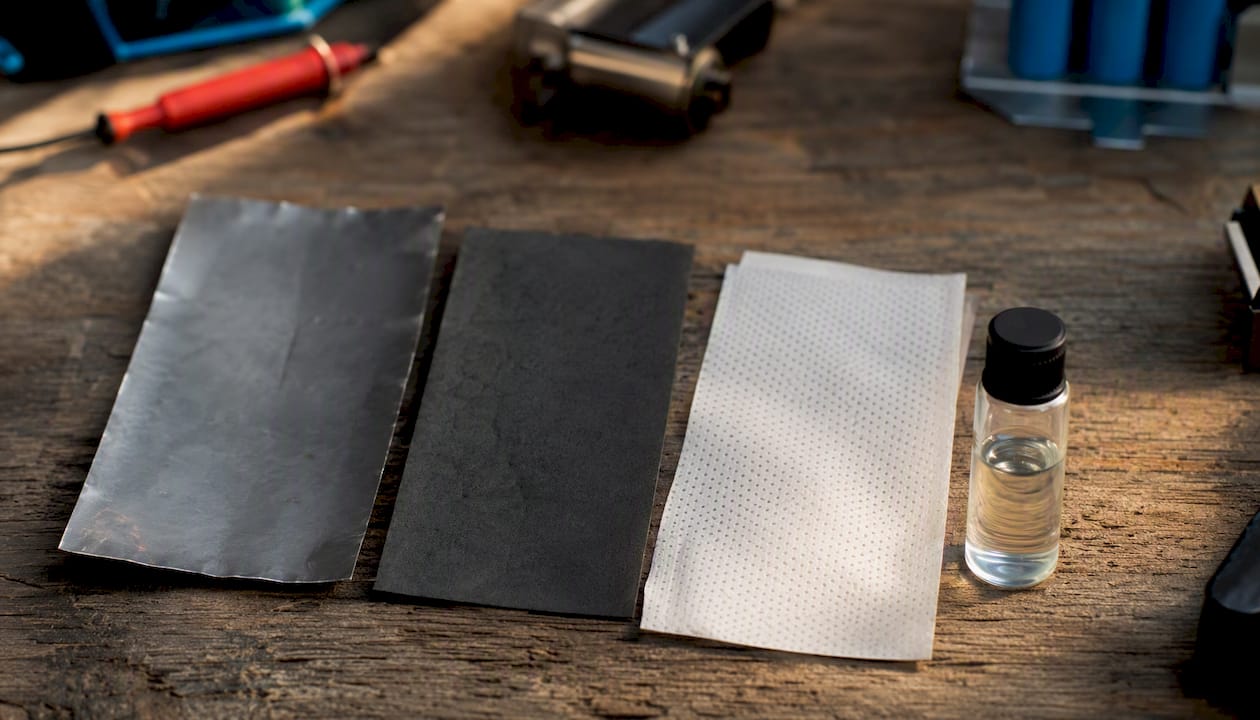
During charging, an external power source forces electrons out of the cathode and through the external circuit to the anode. Simultaneously, lithium ions leave the LiFePO4 lattice, travel through the electrolyte, and intercalate into the graphite layers. The cathode transitions from LiFePO4 toward FePO4 as lithium is extracted. During discharge, the process reverses: lithium ions migrate back from graphite to the cathode, electrons flow through the external circuit to power your device, and the cathode returns toward LiFePO4.
This (de)lithiation process is highly reversible, which is the structural reason LFP outlasts most other chemistries in cycle count.
The flat voltage curve is one of LFP’s most distinctive traits. Where NMC cells show a sloping discharge voltage that drops steadily as the pack depletes, LFP holds close to 3.2–3.3 V per cell for most of its discharge, then drops sharply near the end. That consistency means your device sees stable power until almost nothing is left. Reliable state-of-charge monitoring requires amp-hour counting or a dedicated battery management system, as Wevolver’s LiFePO4 guide explains.
The Battery Management System (BMS) is not optional. It handles:
- Cell balancing: Keeps individual cells in a multi-cell pack at matched voltages to prevent one weak cell from limiting the whole pack.
- Charge voltage limits: Cuts off charging at the correct upper voltage (~3.65 V per cell) to prevent overcharge damage.
- Low-voltage cutoff: Disconnects the load before cells drop below the safe minimum (~2.5 V per cell).
- Temperature monitoring: Suspends charging below freezing to prevent lithium plating on the anode.
A well-designed BMS can meaningfully extend usable range and efficiency in real-world deployments. Ars Technica’s reporting on BMS innovation notes that improved BMS designs have been reported to boost effective EV range by up to 20%, a figure that reflects how much the management layer matters beyond the chemistry itself.
What are the key performance numbers for LFP batteries?
| Parameter | LFP Typical Range |
|---|---|
| Nominal cell voltage | 3.2–3.3 V |
| Max charge voltage (per cell) | ~3.65 V |
| Theoretical specific capacity | ~170 mAh/g |
| Practical energy density | 90–160 Wh/kg |
| Cycle life (to 80% capacity) | 3,000–6,000+ cycles |
| Continuous discharge rate | 1C–3C (some cells higher) |
| Operating temperature (discharge) | -20°C to 60°C |
3,000 to 6,000+ cycles. That is the cycle-life range manufacturers commonly cite for quality LFP cells discharged to 80% depth of discharge, per Leoch Lithium America’s engineering guide. At one full cycle per day, 3,000 cycles equals more than eight years of daily use.
What those numbers mean in practice:
- 90–160 Wh/kg is meaningfully lower than NMC’s 150–250 Wh/kg range, so an LFP pack for the same energy capacity weighs more. For a marine or RV application where weight is manageable, that is a minor concern. For a long-range EV, it matters a lot.
- 3,000–6,000+ cycles translates to a battery that outlasts most vehicles and installations it powers, especially in stationary storage where daily cycling is the norm.
- 1C–3C continuous discharge covers the vast majority of real-world loads. High-performance applications that need 5C+ bursts may need a different chemistry or a larger pack.
- The -20°C lower discharge limit is workable for most U.S. climates, but charging below 0°C requires BMS protection to prevent damage. Cold-weather performance is LFP’s most notable operational weakness.
What are the real advantages and disadvantages of LFP?
Advantages
- Safety. The olivine structure’s strong P–O bonds dramatically reduce the risk of oxygen release and the thermal runaway cascade. LFP is the safest mainstream lithium-ion cathode chemistry available. See Bansheebatteries’ safety explainer for a practical breakdown.
- Long cycle life. Thousands of cycles to 80% capacity is standard for quality cells, far exceeding lead-acid and most NMC chemistries at comparable depth of discharge.
- No cobalt or nickel. Iron and phosphate are abundant, geopolitically stable, and ethically straightforward to source. That translates to lower and more predictable raw-material costs, as noted by Wevolver’s analysis of LFP supply chains.
- Near-100% usable depth of discharge. With a proper BMS, you can regularly draw LFP cells down to near-empty without accelerating degradation. Lead-acid batteries typically need to stay above 50% DoD to achieve reasonable cycle life.
- Flat discharge voltage. Consistent power delivery until near depletion, which is valuable for electronics and motors that need stable voltage.
- Fast charging potential. Quality LFP cells with a compatible BMS can accept 1C–2C charge rates, meaning a full charge in 30–60 minutes under the right conditions.
Disadvantages
- Lower energy density. At 90–160 Wh/kg practical, LFP packs are heavier and larger than NMC equivalents for the same stored energy. Weight-sensitive applications feel this penalty.
- Reduced low-temperature performance. Capacity drops noticeably below 0°C, and charging below freezing requires BMS intervention to prevent lithium plating.
- Lower cell voltage. At 3.2–3.3 V nominal, LFP cells produce less voltage per cell than NMC (~3.6–3.7 V) or NCA (~3.6 V). A 12V LFP pack uses four cells; a 12V NMC pack uses three. That affects charger and alternator compatibility.
- State-of-charge sensing difficulty. The flat discharge curve makes voltage-based fuel gauges unreliable without amp-hour counting or a dedicated BMS.
When LFP is the right call: solar storage, marine, RV, backup power, powersports, and entry-level EVs where safety and longevity outweigh the weight penalty. When a nickel chemistry makes more sense: long-range EVs, aerospace, or any application where energy density per kilogram is the primary constraint. For a deeper look at LFP benefits in powersports applications, Bansheebatteries covers the practical case in detail.
How does LFP compare to NMC, NCA, LCO, and LMO?
Sources for ranges: Wikipedia’s LFP battery entry, Leoch Lithium America’s engineering guide, and MDPI’s comprehensive LFP review. Ranges vary by cell design, electrode loading, and manufacturer.
The practical choice logic breaks down clearly:
- Pick LFP when the battery will cycle daily for years (solar, backup power), when safety is non-negotiable (marine, enclosed spaces), or when cobalt-free sourcing matters for cost or ethics.
- Pick NMC or NCA when energy density per kilogram is the primary constraint, such as long-range EVs or weight-critical portable devices.
- LCO is largely confined to consumer electronics where its high energy density justifies the cost and safety trade-offs.
- LMO offers a middle ground but its cycle life is the weakest of the group, limiting it to applications with infrequent cycling.
Two scenarios where LFP’s advantages are clearest: stationary energy storage (where weight is irrelevant and daily cycling demands longevity) and short-range mass-market EVs (where lower pack cost matters more than maximum range). For a head-to-head breakdown of lithium-ion vs. LiFePO4 chemistry, Bansheebatteries has a practical explainer worth reading alongside this comparison.
Where is LFP actually used, and why does it fit those applications?
LFP’s combination of safety, long cycle life, and cobalt-free sourcing maps cleanly onto several high-demand application categories, per Wikipedia’s survey of LFP usage:
- Solar energy storage: Deep-cycle daily use demands high cycle life. LFP’s high cycle rating and near-100% usable depth of discharge make it the default choice for residential and commercial solar installations.
- Marine and RV: Vibration resistance, tolerance for partial states of charge, and long service life matter more than weight savings on a boat or motorhome. LFP handles all three well. The Bansheebatteries marine battery guide covers application-specific considerations for boat owners.
- Powersports (motorcycles, ATVs, UTVs): Lightweight relative to lead-acid, high cold-cranking capability with a proper BMS, and long shelf life between seasonal uses.
- Backup and UPS power: Telecom towers, data centers, and home backup systems benefit from LFP’s calendar life and safety profile in enclosed installations.
- Entry-level and short-range EVs: Lower pack cost per kWh and longer cycle life offset the weight penalty for city vehicles and shorter-range platforms. TechCrunch’s analysis of LFP in EVs links wider LFP adoption directly to falling entry-level EV prices.
- Forklifts and industrial equipment: Multi-shift daily cycling in warehouse environments is exactly where LFP’s longevity pays off.
Before buying an LFP battery for any application, check three things: the BMS specifications (continuous current rating, balancing type, low-temperature cutoff), the charge voltage compatibility with your existing charger or alternator, and whether the pack’s rated capacity is at 0.2C or 1C discharge (capacity drops at higher rates).
How do manufacturing choices change LFP performance?
Raw LFP powder has one persistent problem: poor electronic conductivity. Iron phosphate is not a great conductor of electrons, which limits how fast the battery can charge and discharge. Manufacturers address this through several production techniques, and the differences show up in real-world performance.
- Carbon coating: Applying a thin carbon layer to each LFP particle dramatically improves electronic conductivity. Carbon-coated LFP is now the industry standard; uncoated material is rarely used in quality cells. The coating thickness and uniformity affect both rate capability and cycle life.
- Particle size reduction (nanosizing): Smaller particles shorten the distance lithium ions must travel within the cathode, which raises power density and improves high-rate performance. Nano-LFP can support higher C-rates than conventional micron-scale particles, though it comes with higher manufacturing cost and slightly lower volumetric energy density.
- Conductive additives: Carbon black, carbon nanotubes, or graphene mixed into the electrode further improve conductivity at the electrode level, complementing the particle-level carbon coating.
- Doping: Substituting small amounts of other elements (magnesium, titanium, niobium) into the LFP lattice can improve ionic and electronic conductivity. This is an active area of R&D, with MDPI’s comprehensive review of recent LFP advances covering the latest electrode engineering and doping strategies.
- Electrode loading and thickness: Thicker electrodes store more energy per unit area but slow ion transport, reducing rate capability. Manufacturers balance loading against the target application’s power demands.
Pro Tip: When reading an LFP spec sheet, look for “carbon-coated LFP” or “C-LFP” in the cathode description, and check whether the rated capacity is measured at 0.2C or 1C. A cell rated at 100 Ah at 0.2C may deliver only 90–95 Ah at 1C. That gap matters for high-drain applications like trolling motors or power inverters.
How should you charge and maintain an LFP battery?
Getting the charging right is where most owners either extend their battery’s life significantly or shorten it unnecessarily. LFP has specific voltage requirements that differ from lead-acid and from other lithium-ion chemistries.
Charge voltage targets for a 12V (4-cell) LFP system:
- Bulk/absorption charge: 14.2–14.6 V (3.55–3.65 V per cell)
- Float voltage: 13.6 V or lower (3.4 V per cell); many LFP systems skip float entirely
- Low-voltage cutoff: 10.0–10.5 V (2.5–2.625 V per cell)
These differ from lead-acid (14.4–14.8 V bulk, 13.2–13.8 V float) and from NMC lithium (16.8 V for a 4S pack). Using a lead-acid charger profile on an LFP pack can prevent the battery from reaching full charge or, in some cases, cause overcharge if the profile pushes above 14.6 V.
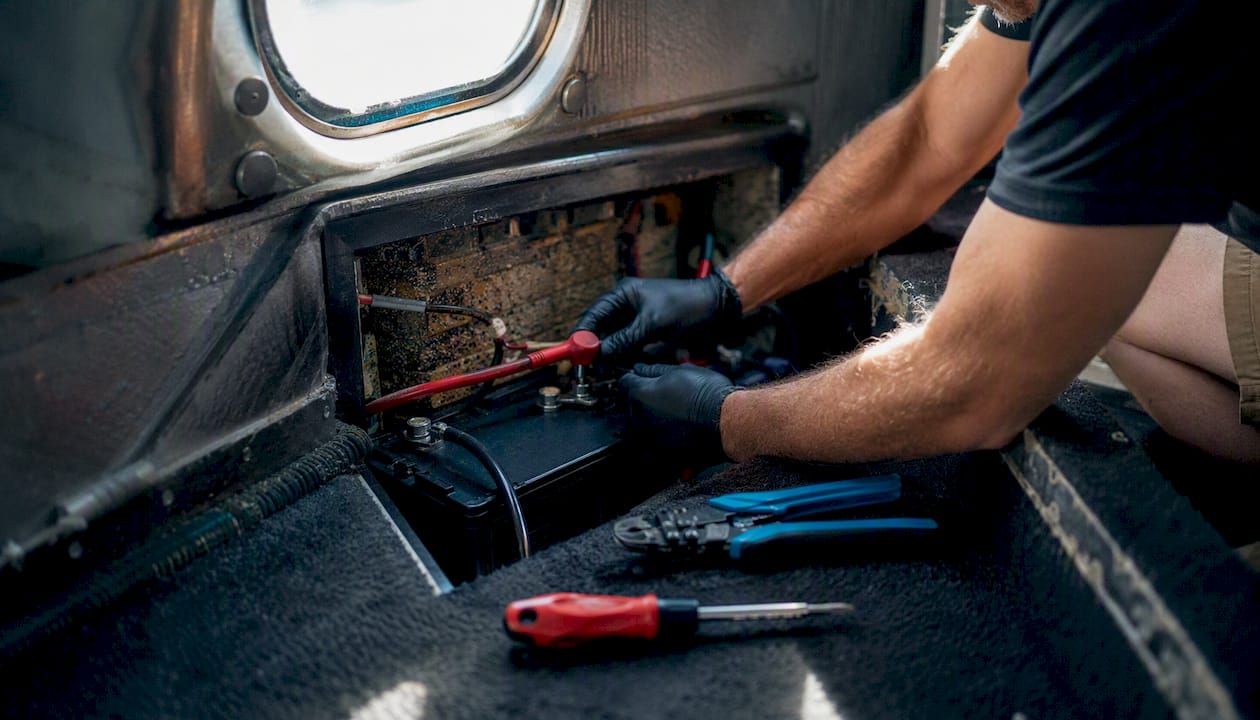
BMS compatibility is mandatory. The BMS protects the cells from overcharge, over-discharge, and charging below freezing. A quality BMS also handles cell balancing, which keeps all four cells in a 12V pack at matched voltages. Without balancing, one weak cell limits the entire pack’s capacity. Wevolver’s LiFePO4 engineering guide covers BMS requirements in detail.
Storage best practices:
- Store at 50–60% state of charge, not fully charged or fully depleted.
- Keep the battery between 32°F and 77°F (0°C–25°C) during storage.
- Check voltage every three to six months and top up if it drops below 12.8 V.
- Avoid leaving the battery connected to a load that draws parasitic current during long storage periods.
For a real-world product reference, Bansheebatteries’ 12V 100Ah LiFePO4 deep-cycle battery for RV and marine use ships with a built-in BMS and is rated for 3,000+ cycles, which illustrates how these specs translate to an actual product.
Pro Tip: Before swapping a lead-acid battery for LFP in a vehicle with a standard alternator, verify that the alternator’s output voltage does not exceed 14.6 V and that it does not rely on the battery’s internal resistance to regulate charging. Many older alternators push voltage high enough to stress LFP cells without a DC-DC charger or LFP-compatible voltage regulator in the circuit. This is the single most common installation mistake Bansheebatteries sees with marine and powersports conversions.
Is LFP actually safe, and what happens at end of life?
LFP’s safety reputation is well-earned but needs a precise framing. The cathode itself is genuinely resistant to the oxygen-release mechanism that drives thermal runaway in NMC and NCA cells. When an LFP cathode is overheated or overcharged, the olivine structure holds its oxygen rather than releasing it into the cell, which eliminates the fuel-oxidizer combination that makes other lithium-ion fires so difficult to extinguish.
The important caveat: the organic electrolyte is still flammable. A severe mechanical failure, a puncture, or a catastrophic BMS failure can still result in electrolyte ignition. LFP is substantially safer than other lithium-ion chemistries, not unconditionally non-combustible. That distinction matters for installation decisions, especially in enclosed marine or RV spaces. Bansheebatteries addresses this nuance directly in their LiFePO4 safety guide.
Safety in numbers: LFP cells have a significantly higher thermal runaway onset temperature than NMC or NCA cells, which is why they are increasingly specified for applications where fire risk is a primary concern, from grid storage installations to passenger vehicles.
Recycling and end-of-life considerations:
- LFP cells contain iron, phosphate, lithium, carbon, aluminum, and copper. None of these are acutely toxic, which simplifies handling compared with cobalt-containing chemistries.
- The absence of cobalt and nickel reduces the economic incentive for recycling (those metals drive recycling economics for NMC/NCA), but it also means LFP cells are less hazardous in landfill scenarios. Recycling infrastructure for LFP is developing, with lithium recovery being the primary economic target.
- In the U.S., the EPA’s Universal Waste rules cover lithium batteries, and most major retailers and battery manufacturers offer take-back programs. Call2Recycle operates drop-off locations nationally for consumer lithium batteries.
- LFP’s long cycle life means fewer batteries reach end-of-life per unit of energy delivered, which is itself an environmental advantage over shorter-lived chemistries.
What does LFP cost, and how is the U.S. market evolving?
LFP’s cost advantage over nickel-based chemistries comes directly from its materials and automotive energy storage overview. Iron and phosphate are globally abundant and geopolitically stable commodities. Cobalt, by contrast, is concentrated in the Democratic Republic of Congo and subject to significant price volatility and ethical sourcing concerns. Nickel supply is more distributed but still subject to market swings. LFP sidesteps both.
- Lower raw-material cost: Iron and phosphate cost a fraction of cobalt or nickel per kilogram, which flows through to lower cell and pack pricing at scale.
- Predictable pricing: Without cobalt exposure, LFP pack prices are less volatile quarter to quarter, which matters for manufacturers and buyers planning multi-year deployments.
- Total cost of ownership: A 6,000-cycle LFP pack that costs 20% more upfront than a 1,500-cycle NMC alternative delivers four times the cycle life. Over a 10-year solar installation, the LFP pack may never need replacement while the NMC pack requires two or three replacements.
Market momentum: TechCrunch’s analysis of LFP adoption in EVs links the chemistry’s growing market share directly to its ability to reduce entry-level EV prices, with manufacturers scaling LFP production to bring down pack costs across the board.
In the U.S. market, LFP is now the dominant chemistry for stationary storage (residential solar systems, grid-scale installations) and is gaining ground in short-range EVs and commercial vehicles. For powersports and marine buyers, LFP packs at the 12V 18–100Ah range have become the standard upgrade path from lead-acid, with prices continuing to fall as production scales.
Buyer advice: Compare total cost of ownership, not sticker price. Factor in cycle life, warranty length, and replacement cost. A 5-year warranty on an LFP marine battery, like the one Bansheebatteries offers, is a meaningful signal of the manufacturer’s confidence in the chemistry’s longevity.
A note from Bansheebatteries on practical LFP guidance
The charging and maintenance guidance in this article reflects what Bansheebatteries has learned over more than 20 years of designing and supplying LiFePO4 batteries for marine, powersports, and recreational vehicle applications. The most common owner mistakes, overcharging with a lead-acid profile, skipping BMS verification, and storing at full charge through winter, are preventable with the right information upfront.
Bansheebatteries backs its LiFePO4 marine batteries with a 5-year warranty, which reflects genuine confidence in the chemistry and the build quality. If you are ready to make the switch, the LiFePO4 marine battery lineup covers the most common size and capacity needs for boat owners, and the powersports lithium battery collection handles motorcycles, ATVs, and UTVs.
Where to read more
- What Is LiFePO4? Engineering Guide to Lithium Iron Phosphate Batteries — Wevolver: detailed engineering overview covering olivine structure, BMS requirements, and charging guidance.
- Lithium iron phosphate battery — Wikipedia: accessible summary of chemistry, nominal voltage, theoretical capacity, and application survey.
- Recent Advances in Lithium Iron Phosphate Battery Technology: A Comprehensive Review — MDPI: peer-reviewed literature review of electrode engineering, doping strategies, and electrolyte improvements.
- What Is a Lithium Iron Phosphate Battery? The Complete 2026 Engineering Guide — Leoch Lithium America: practical performance figures, cycle-life ranges, and deep-cycle application guidance.
- Why LFP batteries are poised to bring down entry-level EV prices — TechCrunch: market analysis linking LFP adoption to EV cost reduction and broader market share trends.
- A new battery management system could boost EV range by 20 percent — Ars Technica: reporting on BMS innovation and its practical impact on range and efficiency.
- LiFePO4 Powersports Batteries: Benefits Worth Knowing — Bansheebatteries: practical buyer guidance for powersports LFP applications.
- LiFePO4 Marine Battery Guide for Boat Owners — Bansheebatteries: application-specific guidance for marine LFP installations.
Sources
- What Is LiFePO4? Engineering Guide to Lithium Iron Phosphate Batteries
- Lithium iron phosphate battery
- Recent Advances in Lithium Iron Phosphate Battery Technology: A Comprehensive Review
- What Is a Lithium Iron Phosphate Battery? The Complete 2026 Engineering Guide | Leoch Lithium America