


What Is a Heating Element for a Lithium Battery?
A heating element for a lithium battery is a resistive device that converts electrical energy into heat so cells reach a safe temperature for charging and reliable discharge in cold conditions. It works like a small electric blanket wired directly to (or built into) the battery pack, warming the cells until they clear the temperature the battery management system requires.
- Converts electricity to heat through electrical resistance, the same principle behind a toaster coil
- Warms cells above the safe charging threshold, usually around 32°F (0°C)
- Runs under thermostat or BMS control so it never overheats the pack
That last point matters more than most people assume. A heater with no cutoff is a liability, not a safety feature.
Key Takeaways
A lithium battery heating element uses electrical resistance to raise cell temperature above roughly 32°F (0°C), preventing lithium plating and restoring safe charging and full power output in cold conditions.
| Point | Details |
|---|---|
| Definition | A heating element is a resistive device (often nichrome or FeCrAl) that generates heat through Joule heating. |
| Charging threshold | Charging below 32°F (0°C) risks irreversible lithium plating and permanent capacity loss. |
| Upper safety limit | Internal temperatures above roughly 140°F to 150°F risk thermal runaway, so heaters need hard cutoffs. |
| Heater type trade-off | PTC films and silicone pads are simpler retrofits; internal self-heating warms the core fastest but needs sophisticated BMS control. |
| Control matters most | A verified thermostat or BMS interlock prevents more failures than upgrading heater hardware alone. |
Table of Contents
- How a Lithium Battery Heating Element Actually Works
- Why Cold Batteries Need Heat Before You Charge Them
- Comparing PTC, Silicone, Nichrome, and Self-Heating Methods
- Installing a Heater Without Creating a Hotspot
- Diagnosing a Heater That Isn’t Working Right
- What Banshee Batteries Recommends for Cold-Weather Reliability
- Cold Batteries Don’t Fail Randomly, They Fail Predictably
- Sources
How a Lithium Battery Heating Element Actually Works
The heat comes from Joule heating, the same effect that makes an incandescent bulb filament glow. Electrical current passes through a resistive material, the material resists that flow, and the resistance dissipates energy as heat. Most battery heaters use nichrome wire or FeCrAl alloy for this job because both hold up under repeated heating cycles without breaking down.
Getting heat onto the surface of a battery is easy. Getting it evenly into the core is the harder engineering problem, since a pack that’s warm on the outside and still cold at the center can still suffer damage during charging. That’s why heater placement and thermal contact quality often matter more than raw wattage.
Three systems typically govern how heat gets applied and stopped:
- Joule heating source — the resistive element itself, generating heat proportional to current squared times resistance
- PTC self-limiting behavior — positive temperature coefficient materials that raise their own resistance as they warm, naturally throttling output without a separate sensor
- BMS temperature lockout — the battery management system reads cell temperature and blocks charging current until the pack clears its minimum threshold
Statistic to know: Most lithium chemistries block or restrict charging once internal temperature drops below 32°F (0°C). That single number drives almost every design decision in a heating system, from thermostat setpoints to how long a heater needs to run before you plug in a charger.
Why Cold Batteries Need Heat Before You Charge Them
Charge a lithium cell below freezing and you’re not just charging slowly. You’re risking permanent damage. Cold electrolyte moves lithium ions more sluggishly, and when charge current arrives faster than ions can intercalate into the anode, metallic lithium plates onto the surface instead. That plating doesn’t reverse. It reduces capacity permanently and can create sharp dendrites that raise the risk of an internal short.
- Charging below 32°F (0°C) risks lithium plating, which is irreversible
- Cold thickens the internal chemistry, raising resistance and cutting usable power output right when you need it most, like a cold start on a snowmobile
- Preheating to that threshold before charging restores full charge rates and protects long-term capacity
The fix isn’t complicated in concept. Warm the cells first, then charge. What trips people up is assuming a battery that discharges fine in the cold is also safe to charge in the cold. Those are two different thresholds, and only one of them forgives you for guessing wrong.
Comparing PTC, Silicone, Nichrome, and Self-Heating Methods
Not every heater does the job the same way, and the differences matter once you’re choosing equipment or troubleshooting a pack that won’t warm evenly.
- PTC heating films regulate their own output as temperature rises, which makes them a common choice for pack-level warming where uniform coverage matters more than raw speed. Many are printed as dot arrays, so each small zone self-limits independently, cutting down on hotspots across a large surface.
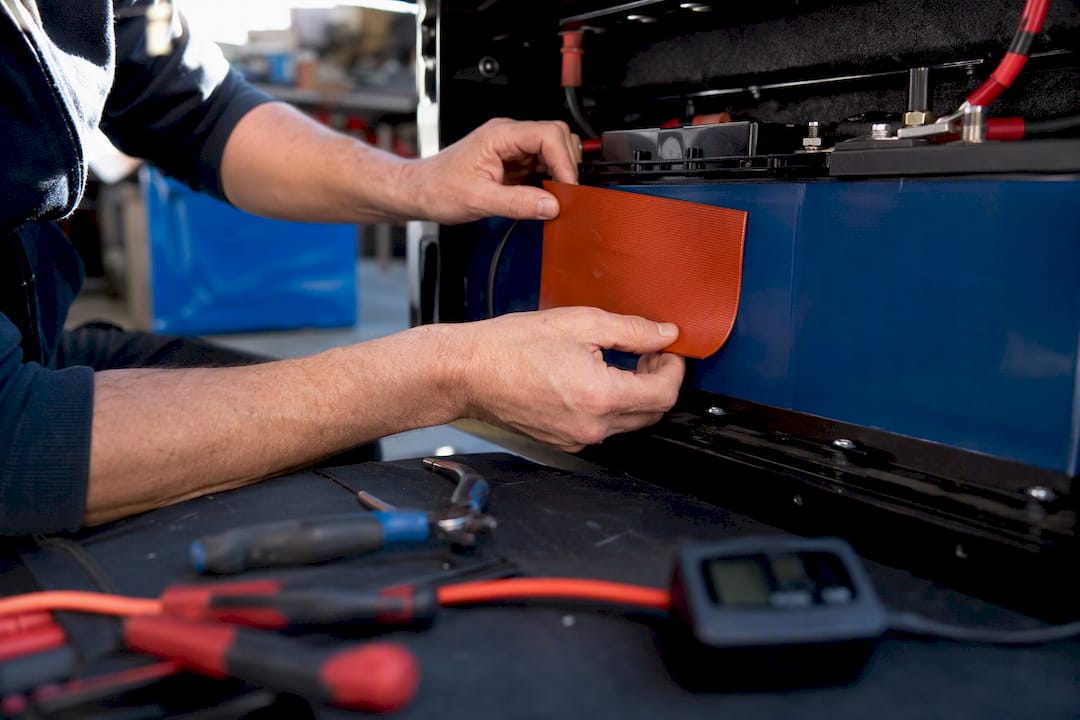
- Silicone rubber and Kapton polyimide pads are the easiest retrofit option for a single battery. They’re flexible, widely used in battery warming applications, and simple to wire into an existing thermostat circuit. Their performance depends almost entirely on how well they’re bonded to the case, since an air gap anywhere under the pad becomes a cold spot.
- Embedded nichrome wires or foil elements get built directly into a pack during manufacturing rather than added afterward. They heat faster than an external pad because there’s no case wall or adhesive layer slowing heat transfer, which is why you see them more often in engineered packs than in aftermarket kits.
- AC or pulse internal self-heating pushes an alternating or pulsed current through the cells themselves, generating heat from the inside using the cell’s own internal resistance. Academic research on sinusoidal AC preheating shows this method can raise core temperature faster than any external heater, since it skips the surface-to-core lag entirely.
The trade-off across all four options is speed and evenness versus complexity and cost. External pads are cheap and simple but slower to reach the core. Internal self-heating is fastest and most uniform but demands sophisticated power electronics and tight BMS oversight to keep the current from aging the cells.
Pro Tip: If you’re retrofitting a single battery rather than designing a pack from scratch, a silicone or Kapton pad wired to a thermostat is almost always the more practical choice over trying to add internal self-heating after the fact.
Installing a Heater Without Creating a Hotspot
Good heater performance depends on the install as much as the heater itself. A great heating element mounted poorly will still leave you with cold spots and a shortened lifespan.
- Confirm full-surface contact. Use the adhesive the manufacturer specifies and prep the case surface first. Trapped air under a pad is the single most common cause of uneven heating.
- Wire through a thermostat or BMS interlock, not a manual switch. The control point should allow charging only once the pack clears roughly 32°F (0°C), and should cut power automatically once that threshold is reached.
- Respect the upper limit. Lithium cells face real thermal runaway risk once internal temperature climbs past roughly 140°F to 150°F, so any heater without a hard cutoff near that range is a design flaw, not a feature.
- Size the wiring and fuse for the heater’s actual draw. A small pad might pull under an amp; larger installations draw more, and undersized wire or an unfused circuit turns a heating fix into a fire risk.
Pro Tip: Test your thermostat setpoint outdoors in actual cold, not on the bench at room temperature. Some control circuits only trigger correctly once the whole assembly is genuinely cold, and bench testing at 70°F can hide a bad connection.
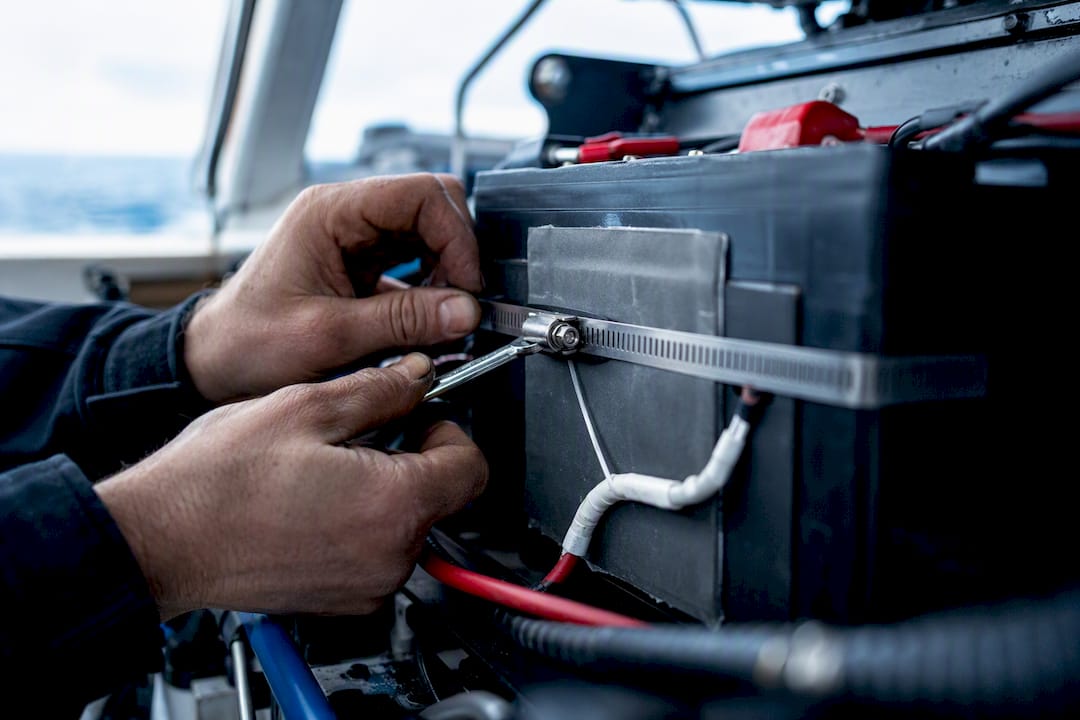
Proper mounting hardware, including clamps and mounting accessories built for heating-element installs, makes the difference between a heater that lasts one winter and one that lasts five.
Diagnosing a Heater That Isn’t Working Right
Most heating-element problems trace back to one of three failure modes, and none of them require a shop visit to check.
- Adhesive delamination shows up as one section of the pad or pack running noticeably colder than the rest, usually where the bond has lifted.
- Connector corrosion, especially in marine or powersport applications exposed to moisture, causes intermittent heating or a heater that stops working entirely with no visible damage.
- A miscalibrated thermostat either never triggers, leaving the pack cold, or trips too early and wastes power warming a battery that’s already fine.
Check for these with an infrared thermometer across the pack surface, a basic continuity test on the heater circuit, and a fuse inspection. If the heater element itself tests fine but the pack still won’t warm evenly, the problem is almost always the bond, not the heater. Replace a delaminated pad rather than trying to reglue it. Call in a professional if you’re dealing with an embedded internal heater or anything wired directly into pack-level BMS control, since those repairs involve opening a sealed system.
What Banshee Batteries Recommends for Cold-Weather Reliability
Bansheebatteries builds LiFePO4 batteries for powersports and marine use specifically because that gear sits outside in weather most consumer electronics never see. Every lithium marine battery in the lineup carries a 5-year warranty, and that warranty assumes the battery is charged within its rated temperature window, not forced through a cold charge cycle.
- Store batteries above freezing when possible, and precondition with a heater before charging in genuinely cold weather
- Match your charger to your battery’s BMS specifications rather than assuming any charger works with any lithium pack, a point covered in Banshee’s lithium charging guide
- Review seasonal storage habits using Banshee’s cold weather battery guide before the first freeze, not after
If you’re shopping for a heater or evaluating one already installed, ask your supplier three things: whether the heater voids the battery warranty if installed aftermarket, what temperature the thermostat is set to trigger at, and whether the BMS itself already includes charge lockout below freezing, which some LiFePO4 packs do without any external heater at all.
Cold Batteries Don’t Fail Randomly, They Fail Predictably
A lithium battery heating element works by using electrical resistance to raise cell temperature above the safe charging threshold, typically 32°F (0°C), before current flows into the pack. Skip that step in genuinely cold weather and you’re not gambling on bad luck. You’re triggering a known chemical failure mode.
Most advice on this topic focuses on the heater hardware itself, PTC versus silicone, wattage versus wire gauge, and that’s useful information. But the more common failure isn’t a bad heater. It’s a good heater with no real control logic behind it, or a thermostat setpoint nobody verified in actual field conditions. The hardware rarely fails first. The control strategy does.
If you own one lithium pack for a snowmobile or a boat, prioritize the control side before you obsess over heater type: a working thermostat wired to a genuine cold cutoff beats a premium heater running on a guess. Internal self-heating and embedded nichrome are genuinely superior for core uniformity, but they’re overkill for most single-battery owners and add failure points a simple external pad doesn’t have. Start simple, verify it works cold, and only add complexity once you understand exactly what your BMS is already doing on its own.
— Donald
Sources
- Nichrome wire product guide — Temco Industrial
- Why you should not charge a lithium battery below 0°C (32°F) — Redarc Electronics
- Batterydesign
- A pre-heating method based on sinusoidal alternating current for lithium-ion battery — AIP/Journal DOI