


What Is Battery Voltage Sag? A Straight Answer for Lithium Systems
Battery voltage sag is the temporary drop in a battery’s terminal voltage when current demand spikes, and it happens mainly because of the battery’s own internal resistance. Push a heavy load through any cell, from a LiFePO4 e-bike pack to a hobby LiPo, and some of that voltage gets lost inside the battery itself before it ever reaches your motor or controller.
You’ll feel it before you measure it. A motor that hesitates on a hard acceleration, a display that flickers or resets, an inverter that trips on startup. All of that is voltage sag doing its thing.
Here’s the good news: sag is usually temporary. Ease off the throttle or cut the load, and the voltage climbs back toward normal within seconds. That recovery pattern is exactly what separates ordinary sag from a battery that’s actually failing.
A few things worth knowing right away:
- Sag is not the same as running low on charge. A full battery can still sag hard under a big enough load.
- Higher current draw always produces more sag. It’s proportional, not random.
- Cold weather and an aging pack both make sag worse.
- If you want to know how bad your sag really is, you can measure it yourself with a multimeter and a stopwatch. We’ll walk through that method later in this article.
Key Takeaways
Voltage sag is a temporary, load-driven voltage drop caused by internal resistance, and its severity and recovery speed, not its mere presence, determine whether your battery is healthy or failing.
| Point | Details |
|---|---|
| Definition | Sag is a temporary voltage drop under load caused mainly by internal resistance, following V = I×R. |
| Healthy threshold | Under 10% voltage drop under moderate load is normal for a healthy lithium pack. |
| Warning zone | 12% to 18% sag, or recovery slower than 30 seconds, signals developing degradation. |
| Critical threshold | Sag above 20%, or sag that keeps worsening over months, points to a failing pack. |
| Fastest fix | Check wiring gauge and clean connectors before assuming the battery itself is bad. |
| Chemistry matters | LiFePO4 generally sags less under high current than lead-acid or standard lithium-ion. |
Table of Contents
- How Voltage Sag Happens: Resistance, Chemistry, and Temperature
- How to Measure Voltage Sag Yourself
- What Counts as Normal Sag for Lithium Packs?
- Sag in the Real World: E-Bikes, FPV Drones, and Portable Power
- How to Reduce or Prevent Voltage Sag
- When Sag Means the Battery Is Actually Failing
- An Expert Note From Banshee Batteries
- Are There Testing Standards for Voltage Sag?
- Common Misconceptions About Voltage Sag
- Ready to Stop Fighting Sag?
- The Editorial Take: What Actually Matters Here
- Frequently Asked Questions
- Sources
How Voltage Sag Happens: Resistance, Chemistry, and Temperature
Every battery has some internal resistance, often written as Ri. Think of it as friction inside the cell. Ohm’s Law explains the whole phenomenon in one equation: V = I × R. As current (I) rises, the voltage drop across that internal resistance rises with it, and that drop subtracts directly from the voltage your device actually sees.
Here’s what drives that resistance up or down in real-world packs:
- Chemistry. LiFePO4 cells generally carry lower internal resistance and hold voltage more steadily under load than many lead-acid alternatives, which is part of why LiFePO4 has become the default choice for powersports batteries that need to deliver strong cranking or acceleration current without collapsing. Standard lithium-ion cells sit somewhere in between, with resistance that varies a lot by cell design and manufacturer.
- State of charge. A cell near empty has less lithium available to move, so its instantaneous voltage response to a load gets worse even before the cell hits its low cutoff.
- Cell balance. In a multi-cell pack, one weak or unbalanced cell can sag disproportionately and drag the whole pack’s voltage down under load, even if the other cells are healthy.
- Temperature. Cold is brutal on internal resistance. Dropping temperatures can double or even triple a cell’s internal resistance, which is why the same pack that performs fine in summer can sag dramatically on a cold morning and temporarily lose usable capacity along with it.
- Wiring and connectors. None of this is limited to what’s happening inside the cells. Thin gauge wire, corroded terminals, and loose connectors all add resistance in series with the battery, and that resistance sags voltage exactly the same way internal cell resistance does.
- BMS and current limiting. A battery management system will often throttle or cut current before the raw chemistry even reaches its limit, which can look like sag but is actually a protective response.
The practical benchmark to remember: a healthy lithium system typically shows less than a 10% voltage drop under a moderate, steady load. Anything sagging well past that under normal conditions is telling you something, whether that’s a chemistry mismatch, bad wiring, or a pack that’s starting to age out.
One more wrinkle worth understanding: a battery management system will disconnect the pack if voltage under load falls below a safety threshold, which means what feels like the battery “dying” mid-ride might actually be the BMS doing exactly what it’s designed to do.
How to Measure Voltage Sag Yourself
You don’t need a lab to get real numbers. A multimeter, a stopwatch, and a consistent load are enough to turn “it feels weak” into an actual measurement you can track over time.
- Charge the pack fully, then let it rest for 30 minutes before testing. This clears surface charge, which can otherwise mask the pack’s true resting voltage.
- Measure open-circuit voltage with no load connected. Write this number down. It’s your baseline.
- Apply a defined load. This could be the actual motor or device you’re testing, a battery inflator, or a resistor bank if you want a repeatable, controlled current draw.
- Record the immediate dip the instant the load hits. This captures inrush sag, the sharpest and often most dramatic drop.
- Record voltage again at 10 seconds and 30 seconds under the same load. This is your steady-state sag, and it tells you how the pack settles once the initial current spike passes.
- Remove the load and time the recovery back to near your baseline voltage. Seconds is normal. Minutes is a warning sign.
- Repeat the test periodically under the same conditions and log the results, since a single reading tells you far less than a trend line does.
Inrush sag and steady-state sag are not the same thing, and mixing them up leads to bad conclusions. A pack that dips hard for half a second and then recovers is behaving normally. A pack that dips and stays down is a different story entirely. Fanttik’s diagnostic testing approach treats consistent, repeated load testing as the reliable go-to method for owners, reserving more advanced diagnostics like electrochemical impedance spectroscopy for cases that need lab-grade precision.
Pro Tip: Test at the same temperature every time. A pack that “sags worse” on a cold garage morning compared to a warm afternoon isn’t necessarily degrading. It might just be cold, since temperature alone can swing your numbers by a wide margin.

Keep an eye on your BMS cutoff voltage before you start. If your load test risks tripping the cutoff, dial the load back. There’s no diagnostic value in tripping a protective shutdown over and over.
What Counts as Normal Sag for Lithium Packs?
Numbers make this concrete. Scale that up to a 48V e-bike pack and a similar percentage translates to a dip of two to three volts under hard acceleration, still within normal range.
The general threshold worth memorizing: under 10% sag under moderate load is healthy, 12% to 18% is a warning zone worth watching, and anything above 20% points to real degradation. These figures apply across common pack voltages, whether you’re running a 12V accessory battery, a 24V scooter, a 36V hobby pack, or a 48V e-bike system, since the percentage matters more than the absolute voltage.
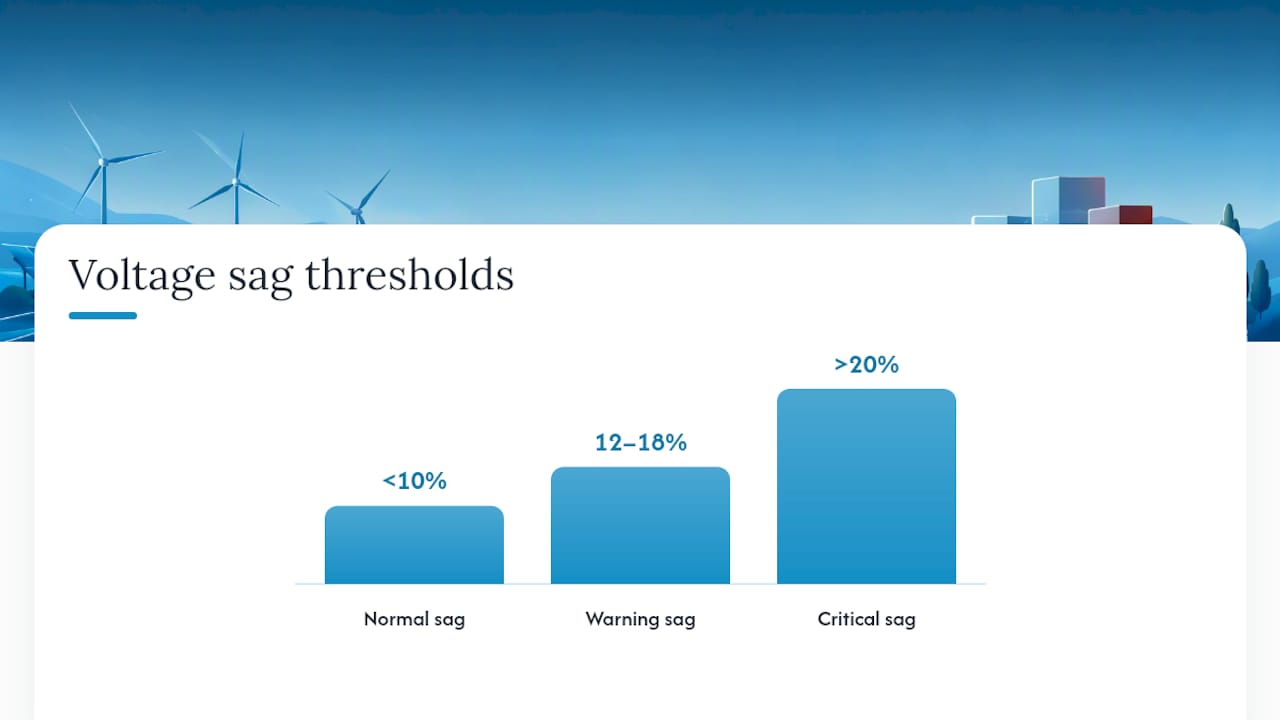
Recovery time matters just as much as the depth of the dip. A healthy pack recovers within a few seconds once the load drops. If it takes 30 seconds or longer to climb back toward baseline, that delayed recovery is often a more reliable red flag than the sag percentage itself.
Keep in mind that both temperature and age shift these numbers. A three-year-old pack in cold weather can show sag that would look alarming in a fresh cell tested at room temperature, so always compare against a baseline taken under similar conditions.
Sag in the Real World: E-Bikes, FPV Drones, and Portable Power
Different devices expose sag in different ways, and recognizing the pattern for your own gear saves a lot of guesswork.
- E-bikes: Sag shows up hardest during acceleration from a stop or on steep climbs, when the motor controller demands peak current. Riders often notice the display voltage reading drop and power assist feel weaker mid-climb. Ride1UP’s support documentation notes this typically recovers within seconds to a minute once the load eases, and switching to a lower pedal-assist level reduces how often you trigger it.
- FPV and hobby LiPo: Pilots see the sharpest voltage dip right at takeoff, when the motors draw peak current simultaneously. Matching your pack’s C-rating to your motor’s actual current draw is the single biggest lever here. An undersized C-rating on paper often turns into ugly sag in flight.
- Portable power stations and inverters: Startup inrush from motors, compressors, or anything with a start winding can cause a brief, sharp dip that trips an inverter’s low-voltage cutoff even though the battery itself is fine seconds later.
Across all three, the pattern is the same: sharp dip, quick recovery, no lasting damage. The concern only starts when that recovery stretches out or the dip keeps getting deeper test after test.
How to Reduce or Prevent Voltage Sag
Some fixes take five minutes. Others mean rethinking your whole power setup. Start at the top of this list and work down.
- Upgrade to a lower resistance chemistry. Switching from lead-acid or standard lithium-ion to LiFePO4 is usually the single biggest improvement you can make for sag under high current demand, since it holds voltage more steadily than most alternatives.
- Check your wiring gauge and connectors. Thin wire and corroded terminals add resistance that has nothing to do with your battery’s chemistry, and thicker gauge wire with clean, tight connections often fixes sag that owners wrongly blame on a “bad battery.”
- Shorten your wire runs where possible. Every extra foot of cable adds resistance, and resistance sags voltage regardless of where it lives in the circuit.
- Let the BMS or controller do its job, but understand its limits. Current limiting protects the pack, but if you’re hitting that limit constantly during normal use, you may need a higher capacity pack rather than a workaround.
- Add capacity, not just voltage. A larger Ah pack, or cells wired in parallel, spreads the same current demand across more capacity and reduces the sag each cell individually experiences.
- Pre-warm in cold climates. Since cold weather can multiply internal resistance several times over, giving a pack a few minutes to warm toward room temperature before a heavy load noticeably reduces sag.
- Know when to stop repairing and start replacing. Persistent, worsening sag that doesn’t respond to wiring fixes or capacity upgrades usually means the cells themselves have degraded, and no amount of connector cleaning will fix that.
You’re past the point where cheap fixes help.
When Sag Means the Battery Is Actually Failing
Not all sag is created equal, and the difference between “normal” and “your pack is dying” comes down to pattern, not a single reading.
- Track the trend, not one test. A single sag reading tells you little. An increase of more than 15% over your baseline across a few months is a meaningful signal worth acting on.
- Watch recovery time specifically. Recovery stretching past 30 seconds under a load that used to recover in five or ten seconds is one of the more reliable early indicators of internal degradation.
- Check for sag under light loads. A pack that used to only sag under heavy demand but now sags noticeably even during light, everyday use has lost real capacity internally.
- Cross-check with a capacity or internal resistance reading if you have access to a battery analyzer, since sag alone is a good early warning but not a full diagnosis.
- Treat heat, swelling, or unusual smell as immediate red flags, not degradation to monitor. Stop using the pack and get it inspected or replaced.
An Expert Note From Banshee Batteries
Banshee Batteries has spent more than 20 years building AGM and LiFePO4 batteries for powersports and marine use, environments where a sagging pack at the wrong moment isn’t just annoying, it’s a real safety issue on the water or the trail.
The single biggest mistake we see is owners chasing a “bad battery” diagnosis when the real culprit is a corroded connector or undersized wire. Test before you replace. If your numbers hold steady across repeated tests under real load, trust the pack. If sag keeps creeping up test after test, that’s when replacement makes sense, not repair.
For chemistry comparisons and storage practices that keep internal resistance from creeping up over time, our guides on AGM versus LiFePO4 for powersports and proper LiFePO4 storage go deeper than this article has room for.
Are There Testing Standards for Voltage Sag?
There’s no single universal certification test that every manufacturer runs and publishes the same way, but the underlying measurement principles are well established in battery engineering. Pulse discharge testing, where a battery is hit with a defined current pulse and its voltage response is recorded in milliseconds, is standard practice in labs evaluating internal resistance and state of health.
More advanced facilities use electrochemical impedance spectroscopy, a technique that measures a cell’s resistance across a range of frequencies rather than a single current pulse. It’s far more precise than a DIY load test, but it also requires specialized lab equipment most owners will never own or need. For everyday diagnostics, consistent DC load testing, the same method covered earlier in this article, remains the practical standard that manufacturers and independent testers both rely on.
Third-party comparisons, like GOLFCARTSTUFF.COM’s breakdown of lead-acid versus lithium performance, also give a useful reference point for how differently chemistries behave under identical test conditions, since standardized comparative testing is often more informative than a single spec sheet number.
Common Misconceptions About Voltage Sag
The biggest misconception is treating sag as the same thing as a dead or dying battery. It isn’t. Sag is a normal, expected response to current demand, and even a brand new, fully healthy pack will sag under a big enough load.
Another common mix-up: confusing sag with a BMS protective cutoff. A pack that suddenly disconnects mid-load might look like catastrophic sag when it’s really the BMS stepping in to prevent the voltage from dropping below a safe threshold. Those are different problems requiring different fixes.

People also confuse sag with low state of charge.
Finally, a lot of owners assume any sag at all means a wiring or connector problem. Sometimes that’s true, and it’s always worth checking first since it’s the cheapest fix. But if your wiring is solid and sag persists, the honest answer is usually the chemistry and the cell’s age, not the cables. Distinguishing between these causes is exactly why a repeatable load test, not a guess, is worth the ten minutes it takes.
Ready to Stop Fighting Sag?
If your load tests consistently indicate sag well beyond normal expected ranges, and your wiring and connectors check out clean, the pack itself may be signaling that replacement is needed. Banshee Batteries builds Lithium (LiFePO4) marine batteries and lithium powersport batteries specifically to hold voltage steady under the kind of high-current demand that punishes lead-acid and aging lithium-ion packs alike.
Every lithium marine battery ships with a 5-year warranty, and every AGM battery carries a 4-year warranty, so you’re not gambling on a pack that might sag its way into failure a year after purchase. If you’re running a larger rig and want extra headroom against sag, the 12V 100Ah LiFePO4 deep cycle battery gives you more capacity to spread current demand across, which directly reduces how hard any single cell has to work.
The Editorial Take: What Actually Matters Here
Most sag advice online treats every dip in voltage as a crisis, and that’s backward. The research is clear that sag is a normal electrical response, not a defect, and treating it as an emergency leads people to replace perfectly good batteries over readings that would pass on any properly tested pack.
Where conventional advice falls short is skipping the trend entirely. A single scary-looking reading means almost nothing without a baseline to compare it against. The percent drop matters less than whether that drop is getting worse over weeks and months, and whether recovery time is stretching out.
If you take one thing from this, prioritize building your own baseline before you ever worry about whether a number looks “bad.” Test your pack once when it’s healthy, log it, and every future test becomes meaningful by comparison. Chemistry choice and wiring matter too, but a baseline is what turns guesswork into an actual diagnosis.
Frequently Asked Questions
What is battery voltage sag, explained simply? Battery voltage sag is a temporary drop in a battery’s voltage that happens when current demand suddenly increases, caused mainly by internal resistance inside the cell. It typically recovers within seconds once the load eases.
Is voltage sag bad for my battery? Occasional, moderate sag that recovers quickly is normal and not harmful. Sag becomes a concern only when it’s severe, worsens over time, or fails to recover within a reasonable window.
How do I test for voltage sag at home? Fully charge the battery, rest it for 30 minutes, measure open-circuit voltage, then apply a defined load and record the immediate dip along with readings at 10 and 30 seconds. Repeat periodically and compare against your baseline.
What causes voltage sag in lithium batteries specifically? Internal resistance is the main driver, and it’s affected by chemistry, state of charge, temperature, and cell balance. External factors like thin wiring and corroded connectors add to it.
How much voltage drop is normal for an e-bike battery? A healthy pack generally shows less than a 10% drop under moderate acceleration, with recovery within seconds to about a minute once you ease off the throttle.
Sources
For deeper technical background, see the internal resistance and thermal behavior review and Banshee’s LiFePO4 versus lithium-ion comparison.
- What is Battery Voltage Sag? - VoltageBasics
- Voltage Sag Analysis: Diagnose Hidden Battery Degradation - Fanttik (blog)
- Lithium Battery Voltage Drop Explained - Skyenergi
- Battery Voltage Sag - Ride1UP Support