


Battery Float Voltage: Practical Settings for Every Chemistry
Battery float voltage is the constant, regulated voltage applied to a fully charged battery to offset self-discharge and keep it ready for standby use. After a full charge cycle, a battery left disconnected will slowly lose charge on its own. Float charging counters that loss with a low, steady voltage that replaces exactly what leaks away, without pushing the battery into overcharge.
The numbers that matter most, at 25°C/77°F:
- Lead-acid (flooded and AGM): 2.25–2.30 V/cell, which translates to 13.5–13.8 V for a 12 V system
- Gel lead-acid: typically lower, around 13.05 V for a 12 V pack (check your datasheet)
- LiFePO4: do not apply a standard lead-acid float profile; use the manufacturer’s storage mode or a charger with an explicit LiFePO4 float profile
Two quick action items before you read further: set your charger’s float voltage to the chemistry-specific value above, and confirm your charger either has a built-in temperature sensor or that you are applying the correct temperature-compensation offset for your environment.
Table of Contents
- What is battery float voltage and how does charging get there?
- Float voltage ranges by chemistry: the numbers to use
- How does temperature change your float voltage setting?
- What happens when float voltage is wrong?
- How to set and verify float voltage on a charger
- What charger features actually protect float accuracy?
- Practical recommendations for standby, seasonal, and cycling use
- Key Takeaways
- The part most people skip until it’s too late
- Bansheebatteries has the batteries and chargers to get float right
- Useful sources
What is battery float voltage and how does charging get there?
Every multi-stage charger runs through three distinct phases before it reaches float. Bulk delivers maximum current to push the battery up to roughly 80% state of charge. Absorption holds a higher constant voltage (typically 14.4–14.7 V for a 12 V lead-acid pack) while current tapers as the battery fills. Float begins when charging current drops to approximately C/50–C/100, meaning a 100 Ah battery transitions to float when current falls to roughly 1–2 A.

Float is a maintenance stage, not a charging stage. The charger holds a lower constant voltage and supplies only enough current to offset self-discharge. For lead-acid chemistries, that means staying below roughly 2.4 V/cell to keep charging current low enough to avoid damaging overcharge. The battery, charger, and load typically sit in parallel, so the charger supplies the load directly while keeping the battery topped off. When mains power fails, the battery takes over seamlessly.

Chemically, this matters a great deal. Lead-acid batteries left at too low a voltage develop lead sulfate crystals on the plates, a process called sulfation that permanently reduces capacity. Too high a voltage drives electrolysis, producing hydrogen and oxygen gas, which boils off electrolyte and corrodes the positive plates. Float voltage sits in the narrow band where neither failure mode occurs.
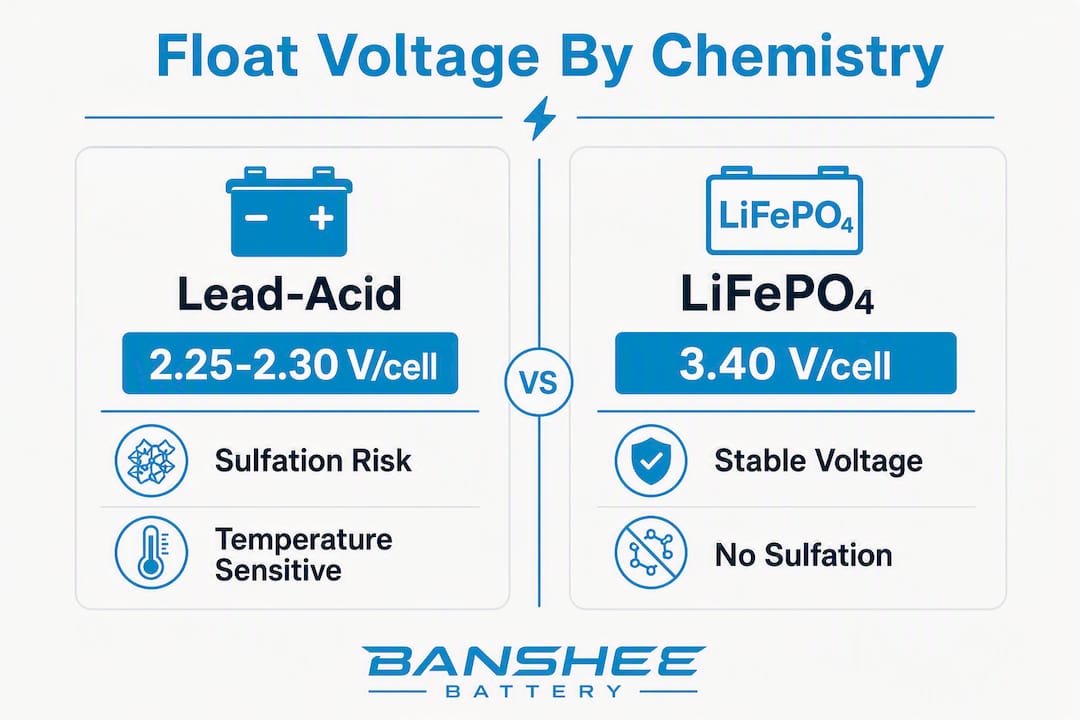
LiFePO4 cells behave differently. They have a much flatter discharge curve and do not sulfate, so the lead-acid float rationale does not apply. Indefinite high-voltage float can stress the cells and reduce cycle life over time.
Pro Tip: Smart chargers that detect the current taper automatically and switch to float without manual intervention remove the single most common cause of premature battery failure in standby applications: forgetting to reduce voltage after absorption.
Float voltage ranges by chemistry: the numbers to use
The table below gives practical float setpoints at 25°C. These are starting points; your battery manufacturer’s datasheet always takes precedence.
| Chemistry | Float V/cell | 12 V system | 24 V system |
|---|---|---|---|
| Flooded lead-acid | approximately 2.25–2.30 V | about 13.5–13.8 V | — |
| AGM (VRLA) | approximately 2.25–2.30 V | about 13.5–13.8 V | — |
| Gel (VRLA) | — | about 13.05 V | — |
| LiFePO4 | Manufacturer-specific | See datasheet | See datasheet |
A few chemistry-specific notes worth keeping in mind:
- AGM vs. flooded: Both fall in the same 2.25–2.30 V/cell range, but AGM batteries are sealed. Gassing from a slightly high float voltage escapes in a flooded cell; in an AGM it recombines internally, and sustained overvoltage accelerates plate corrosion faster than you would see in a flooded cell. For AGM float considerations in powersports applications. The AGM battery characteristics for riders article covers the practical implications in detail.
- Gel: The lower float requirement is real and frequently ignored. Applying a standard AGM float profile to a gel battery will gas it, and gel batteries cannot recombine that gas. The damage is irreversible.
- LiFePO4: Many manufacturers recommend storing LiFePO4 cells at 40–60% state of charge rather than holding them at maximum voltage indefinitely. If your charger has a dedicated LiFePO4 storage mode, use it. If it does not, the safer option for long-term storage is disconnection. The LiFePO4 storage guide from Bansheebatteries covers this in depth.
For series strings, the math is straightforward: a 24 V system built from two 12 V batteries in series uses double the 12 V float setpoint. A 48 V system uses four times the 12 V value. The charger must be rated for the full string voltage, and all batteries in the string should be matched in age and capacity.
How does temperature change your float voltage setting?
Float voltage and ambient temperature move in opposite directions. As temperature rises, the battery’s internal chemistry becomes more reactive, so a lower voltage is needed to prevent overcharge. As temperature falls, a higher voltage is required to push charge into a more sluggish electrolyte.
The standard correction factor for lead-acid is approximately -3.9 mV/°C per cell, or about -2.17 mV/°F per cell. For a 6-cell 12 V battery, that scales to -23.4 mV/°C for the full pack.
A practical example: if your nominal float is 2.30 V/cell (13.8 V for 12 V) at 25°C, and your battery compartment reaches 35°C in summer, the corrected float is:
13.8 V − (10°C × 0.0234 V/°C) = 13.8 − 0.234 = 13.566 V
In a cold garage at 5°C, the same battery needs:
13.8 V + (20°C × 0.0234 V/°C) = 13.8 + 0.468 = 14.268 V
That 0.7 V swing across a 30°C temperature range is not trivial. A charger set to a fixed 13.8 V will undercharge in winter and risk overcharging in summer without compensation.
For VRLA batteries (both AGM and gel), the stakes are higher. Elevated temperatures combined with an uncompensated float voltage can trigger thermal runaway, where heat increases current draw, which generates more heat. Temperature-compensated charging is the standard prevention method for VRLA types in warm environments.
Pro Tip: For marine and powersports installations where the battery compartment temperature swings seasonally, choose a charger with a remote temperature sensor that mounts directly on the battery case rather than inside the charger unit. The charger’s internal temperature rarely matches the battery’s actual temperature.
What happens when float voltage is wrong?
Getting float voltage wrong in either direction causes real, measurable damage. The failure modes are different, but both shorten battery life.
Too high:
- Continuous gassing in flooded cells, requiring frequent water top-ups
- Electrolyte loss in sealed batteries (AGM/gel) with no way to replenish it
- Accelerated positive-plate grid corrosion, which permanently reduces capacity
- In VRLA types, risk of thermal runaway in warm environments
Too low:
- Chronic undercharge that allows lead sulfate to crystallize on the plates
- Sulfation reduces active plate area and permanently cuts capacity
- The battery may appear charged but cannot deliver its rated current
Setting float voltage even 100–200 mV outside the correct range for your chemistry will measurably shorten battery life. Over months of continuous standby use, the cumulative effect of a slightly wrong float is often worse than a single deep discharge event.
Signs to watch for in the field:
- Flooded cell electrolyte dropping faster than expected between checks
- Resting voltage varying more than usual between cells
- Reduced run time after what should have been a full maintenance charge
- Charger that never seems to exit absorption and enter float
A quick diagnostic: measure float current at the charger output once the system is in float. A healthy battery in proper float draws a very small, steady current equal to its self-discharge rate. A sustained higher float current signals incorrect voltage or a failing battery. If you see that, check your voltage setpoint first, then test the battery under load.
How to set and verify float voltage on a charger
Step-by-step configuration
- Identify your battery chemistry and manufacturer float spec. Pull the datasheet. If you do not have it, use the chemistry-specific ranges in the table above as a starting point.
- Confirm charger compatibility. The charger must support your chemistry. A charger without a LiFePO4 profile should not be used on a LiFePO4 battery.
- Disconnect loads if possible. This gives you a clean measurement of terminal voltage without load interference.
- Select the correct chemistry profile on the charger. Most smart chargers have a selector for flooded, AGM, gel, and lithium. Choose the right one.
- Set the float voltage to the numeric value. On programmable chargers, enter the value directly. On profile-based chargers, verify the profile’s float setpoint in the manual.
- Allow the charger to complete bulk and absorption. Do not interrupt the cycle. Wait for the charger to indicate float mode.
- Measure terminal voltage with a calibrated multimeter. Probe directly at the battery terminals, not at the charger output. The reading should match your float setpoint within ±50 mV.
Verifying float current
- Set your multimeter to DC current (or use a clamp meter on the charge lead).
- In true float, current should be very low, typically well under 1% of battery capacity for a healthy battery.
- A reading significantly above that suggests the voltage is too high, the battery has an internal fault, or the charger has not fully transitioned out of absorption.
Troubleshooting flags:
- Charger stuck in absorption for hours: battery may be sulfated or have a shorted cell.
- Terminal voltage higher than float setpoint: charger may be malfunctioning or set to the wrong profile.
- Frequent current spikes during float: check for loose connections or a failing charger.
What charger features actually protect float accuracy?
Not all chargers handle float equally. A simple two-stage charger (bulk only, then a fixed voltage) will hold a constant voltage regardless of whether the battery is full, which means it can overcharge indefinitely. A proper multi-stage charger with automatic stage detection is the baseline for any battery left on float for weeks or months.
The features that matter:
- Multi-stage charging (bulk/absorption/float) with automatic transition based on current taper
- Chemistry-specific profiles for flooded, AGM, gel, and LiFePO4
- Temperature compensation via an external sensor, not just the charger’s internal thermistor
- Automatic stage detection that transitions at C/50–C/100 without manual input
- Safety cutoffs for overvoltage and overcurrent
Smart chargers that automate stage transitions and apply temperature compensation eliminate most of the guesswork that leads to premature battery failure in standby use. For marine and powersports applications where batteries sit idle for months at a time, this is not a luxury feature.
Pro Tip: For long-term marine or UPS installations using LiFePO4, verify that the charger’s lithium profile explicitly states its float or storage voltage in the manual. “Lithium compatible” on the box does not always mean the charger has a proper storage mode. Check the spec sheet.
Understanding how smart chargers detect transitions and protect automotive batteries can help you evaluate whether a charger’s lithium profile is genuinely suited for long-term float or just bulk-charge capable.
Practical recommendations for standby, seasonal, and cycling use
The right float strategy depends on how the battery is actually used.
Standby and UPS applications (battery sits connected indefinitely):
- Use a temperature-compensated smart charger with the correct chemistry profile
- Check float current monthly for the first three months after installation
- For VRLA types, verify the charger reduces float voltage as ambient temperature rises
Seasonal storage (powersports, marine vessels laid up for winter):
- Lead-acid: connect a smart maintainer set to the correct float voltage; check electrolyte level (flooded) before storage
- LiFePO4: use a storage mode charger or disconnect at 40–60% state of charge; do not leave on a continuous high-voltage float
- For off-season battery management strategies, the seasonal battery drain prevention guide covers the practical steps
Daily cycling (regular use with periodic float maintenance):
- Float is less critical here since the battery cycles regularly, but a smart charger still prevents overcharge between uses
- Confirm the charger exits float and does not restart bulk charging unnecessarily
Always default to the battery manufacturer’s datasheet for float voltage and storage voltage. Warranty coverage for Banshee AGM and LiFePO4 batteries depends on correct charging parameters; using an incompatible charger profile voids the protection.
Practical installer tip: Log float voltage and float current readings after installation for the first 30 days. A charger that holds stable voltage and low current from day one is set correctly. Drift or elevated current in that window almost always points to a configuration error, not a battery defect.
Worked examples: converting per-cell float to system voltage
Example 1: Standard 12 V lead-acid float 2.30 V/cell multiplied by 6 cells equals about 13.8 V. Set your charger to this approximate voltage, allow the cycle to complete, then confirm with a multimeter at the battery terminals.
Example 2: Temperature-compensated float at 0°C Starting from about 2.25 V/cell (approximately 13.5 V) at 25°C, applying temperature compensation increases the corrected float voltage appropriately for colder conditions.
Example 3: 24 V and 48 V series strings A 24 V system using two 12 V AGM batteries in series uses roughly double the 12 V float voltage; a 48 V system uses about four times the 12 V value. All batteries in the string must be matched in age, capacity, and chemistry. Mismatched cells in a series string will cause uneven charging, and the weakest cell will be driven into overcharge while the others remain undercharged.
Key Takeaways
Float voltage is the single most important setting for any battery kept in standby, and getting it right by chemistry, temperature, and system voltage prevents the majority of premature failures.
| Point | Details |
|---|---|
| Float voltage defined | A constant regulated voltage applied after full charge to offset self-discharge and maintain standby readiness. |
| Core lead-acid numbers | 2.25–2.30 V/cell equals 13.5–13.8 V for a 12 V system at 25°C; gel typically lower at ~13.05 V. |
| Temperature compensation | Adjust by -3.9 mV/°C per cell; a 6-cell 12 V pack needs -23.4 mV/°C correction to avoid over/undercharge. |
| LiFePO4 handling | Never apply a lead-acid float profile; use a manufacturer storage mode or disconnect at 40–60% state of charge. |
| Bansheebatteries recommendation | Bansheebatteries AGM and LiFePO4 batteries come with datasheet float specs; use a compatible smart charger and consult support for exact setpoints. |
The part most people skip until it’s too late
The conventional wisdom on float charging is essentially correct: set the right voltage, use a smart charger, done. What gets glossed over is how often the “right voltage” is applied to the wrong chemistry, or applied correctly but at the wrong temperature.
The most common field mistake is using a single static float profile for a mixed fleet. A garage with two AGM powersport batteries and one gel battery, all on the same charger bank set to 13.8 V, is slowly destroying the gel battery. The owner will not notice until the gel battery fails to start the vehicle after a season of storage, at which point the damage is done and irreversible.
The second mistake is treating LiFePO4 like a better lead-acid. It is not. The chemistry is fundamentally different, and the float strategy reflects that. Leaving a LiFePO4 battery on a continuous 13.8 V float because “that’s what the charger does” is a slow way to degrade cycle life. The differences between marine lithium and AGM go well beyond float voltage, but float is where the most preventable damage happens in storage.
Temperature compensation gets dismissed as an advanced feature. For a battery in a climate-controlled room, it is. For a battery in a boat bilge, a garage in Minnesota, or a powersport vehicle stored outdoors, it is the difference between a battery that lasts five years and one that lasts two.
Bansheebatteries has the batteries and chargers to get float right
If you are running AGM or LiFePO4 batteries in a marine vessel or powersports application, the charger profile matters as much as the battery itself. Bansheebatteries builds AGM and LiFePO4 batteries with published float and storage specifications, and carries chargers designed to match those profiles with proper multi-stage charging and temperature compensation.

For LiFePO4 marine applications, the Bansheebatteries lithium marine battery lineup includes datasheets with exact float and storage voltage recommendations. For lead-acid and AGM maintenance, the fully automatic 12V 10A charger supports all lead-acid types with overcharge protection built in. Pull the datasheet for your specific Bansheebatteries model, match it to a compatible charger, and contact Bansheebatteries support if you need help confirming the right float setpoint for your installation.
Useful sources
- Float voltage — Wikipedia: Primary reference for float voltage definitions, per-cell ranges by chemistry, and temperature compensation coefficients.
- Charging lead-acid batteries — Battery University BU-403: Authoritative source on lead-acid charging stages, float current behavior, and failure modes from incorrect float.
- Battery charger basics — Chargetek.com: Practical explanation of multi-stage charging and the C/50–C/100 transition threshold.
- Float Charging — Engineers Edge: System wiring for standby float applications and thermal runaway risk for VRLA batteries.
- Float Charging — CleanEnergyBusinessCouncil.com: Concise definition of float voltage relative to absorption and overcharge thresholds.
- Float charge — IALA International Dictionary of Marine Aids to Navigation: Official marine navigation definition of float charge as a constant-voltage maintenance charge.