


Run All Day on 12V 100Ah: Size Trolling Motor Lithium Batteries Right
Yes, LiFePO4 is the right call for most trolling motor setups in 2026. It runs lighter, delivers more usable capacity than lead-acid, holds up over thousands of cycles, and charges faster. Buy first by matching your motor’s amp draw and voltage (12V, 24V, or 36V) to a battery’s continuous current rating and Ah capacity, not just the price tag. Size it right, and skip straight to a purpose-built lithium marine unit.
TL;DR:
- Ensure the continuous current rating of the lithium battery exceeds your motor’s peak amp draw to prevent protection trips during high-thrust operation.
- Use purpose-built 12V, 24V, or 36V lithium batteries designed for marine use that include Bluetooth monitoring, IP-rated housings, and thermal protection features.
- Size your battery based on actual watt-hour capacity and the motor’s amp draw, adding 10-15% to account for accessories and higher discharge conditions.
- Prefer batteries with a reliable BMS that offers low-temperature cutoff, cell balancing, internal fusing, and a warranty of at least five years for lasting marine performance.
- When wiring multiple batteries, connect in series to raise voltage and in parallel to increase capacity, ensuring all batteries are matched and fused properly.
Table of Contents
- What Specs Actually Determine Trolling Motor Lithium Battery Fit
- How Do You Size A Lithium Battery For Your Trolling Motor?
- Should You Wire Batteries In Series Or Parallel?
- What Are The Best Charging Practices For LiFePO4 On A Boat?
- Installation And Safety Rules That Protect Your Warranty
- What Makes A Lithium Marine Battery Trustworthy?
- The Sizing Math Matters More Than The Brand Name
- Get The Right Lithium Battery For Your Motor In One Order
- Sources
What Specs Actually Determine Trolling Motor Lithium Battery Fit
Every trolling motor lithium battery spec sheet boils down to three numbers: voltage, amp hours (Ah), and watt hours (Wh). Voltage tells you which motor class it powers. Ah tells you how much charge it stores. Wh, the number that actually predicts runtime, comes from multiplying the two. A 12.8V 100Ah battery holds roughly 1,280 Wh, a figure worth memorizing because most sizing math starts there.
Continuous discharge rating matters more than the Ah number by itself. A PBO test of a dozen lithium boat batteries found that many units meet or exceed their rated Ah at moderate discharge between 25A and 100A, but real compatibility comes down to whether the battery’s continuous and pulse current ratings cover your motor’s peak draw, not the label alone.
Pro Tip: Check your trolling motor’s amp draw at full throttle, not just cruising speed. A 55 lb thrust motor can spike past 50A on high, and a battery rated for 40A continuous will trip its protection circuit right when you need power most.
What else separates a marine-grade lithium battery from a repackaged consumer cell:
- Low-temperature charge cutoff that halts charging near freezing to protect the cells
- Cell balancing inside the battery management system (BMS) for even wear across cells
- Internal fusing, ideally Class T or equivalent, as a last line of defense against a short
- An IP-rated case and sealed terminals for spray and splash exposure
- Bluetooth monitoring that reports state of charge and current draw to your phone
Battery makers now build most of these features into trolling-motor-grade lithium batteries as standard, and buyer testing from Wired2Fish confirms that Bluetooth monitoring and IP-rated housings materially change how anglers plan a day on the water.
How Do You Size A Lithium Battery For Your Trolling Motor?
Sizing starts with your motor’s amp draw, which you’ll find on the motor’s data plate or owner’s manual. A 30 lb thrust motor typically draws 18 to 22A at full speed. A 55 lb thrust motor runs 40 to 50A. An 80 lb or 101 lb thrust bow mount can pull 60A or more under load.
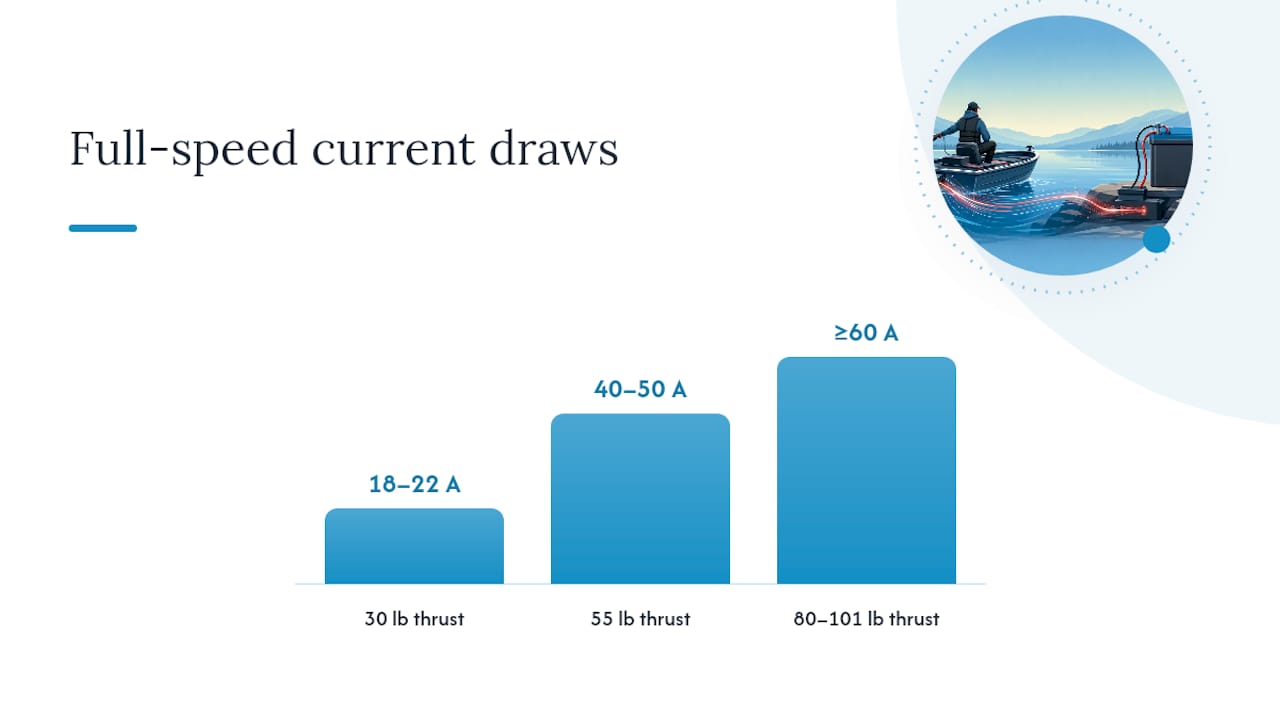
Once you know the draw, convert your battery’s Ah to usable Wh and apply a realistic depth of discharge. On a 100Ah battery with a typical usable depth of discharge, that’s roughly the equivalent of most of its rated capacity usable at 12.8V.
Divide the usable watt hours by the watt draw and you get a few hours of continuous run time at that setting. Drop to a slower speed and you’ll stretch that considerably, which lines up with field reports that a single 100Ah LiFePO4 battery covers a full day of moderate use on a 55lb-class motor when run conservatively.
Build in margin for accessories. Fish finders, livewell pumps, and running lights all pull from the same bank if you’re not isolating circuits, so add 10 to 15% to your capacity estimate before you buy.
Should You Wire Batteries In Series Or Parallel?
Most 12V LiFePO4 batteries can be wired into 24V or 36V banks, but the method matters. Here’s the practical rundown:
- Series wiring raises voltage, not capacity. Two 12.8V 100Ah batteries in series make a 25.6V bank still rated at 100Ah, not 200Ah.
- Parallel wiring raises capacity, not voltage. Two 12.8V 100Ah batteries in parallel give you 12.8V at 200Ah, and only same-model, same-age batteries should ever be paired this way.
- Never mix brands, capacities, or ages in the same bank. Mismatched internal resistance forces one battery to work harder, and that imbalance shortens the life of the whole bank.
- Fuse every leg of the bank, not just the main output, and size cable gauge for the bank’s total continuous current draw, not just one battery’s rating.
Pro Tip: If your motor runs 24V or 36V, buying a purpose-built battery at that voltage almost always beats stringing 12V units in series. It removes the cell-balancing complexity between separate batteries and cuts your point-of-failure count in half. Victron’s technical documentation on modular LiFePO4 platforms backs this up: purpose-built higher-voltage batteries simplify installation compared to series strings of smaller units.
What Are The Best Charging Practices For LiFePO4 On A Boat?
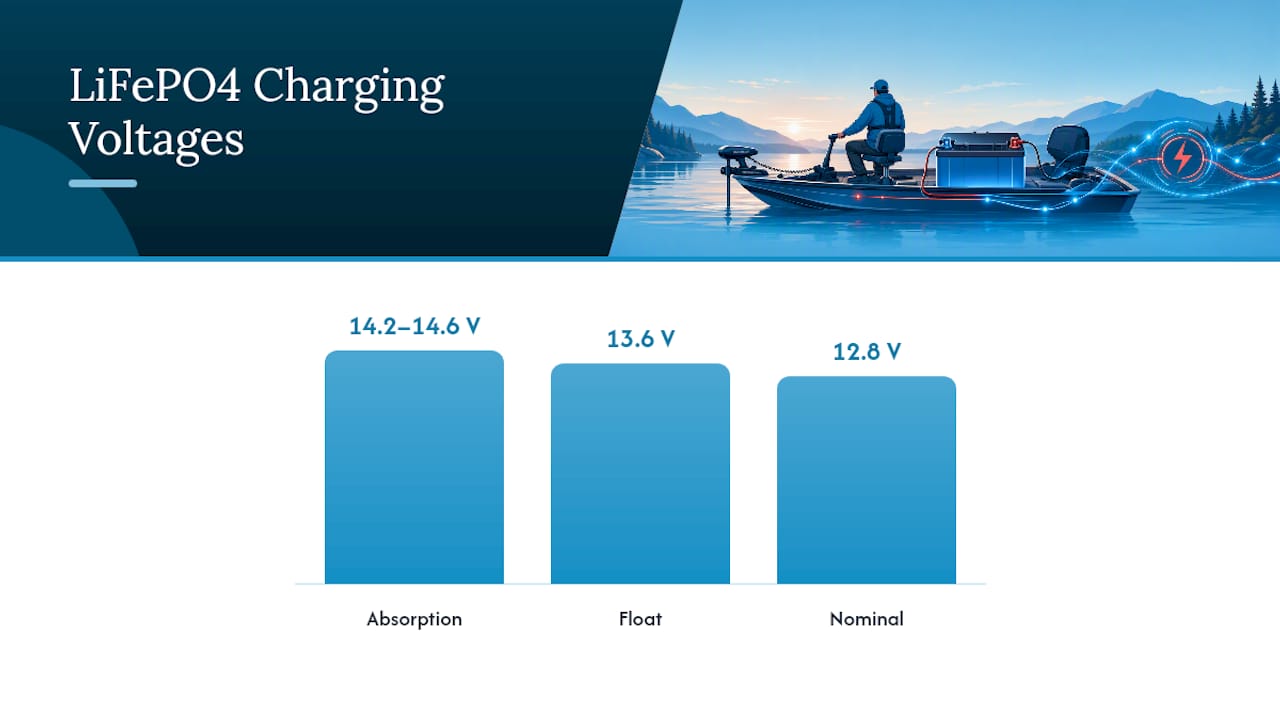
Lithium charges differently than lead-acid, and using the wrong profile either undercharges the battery or trips its protection circuit mid-charge. LiFePO4 wants a bulk and absorption stage around 14.2 to 14.6V for a 12.8V nominal battery, then drops to float near 13.6V or shuts off entirely since lithium doesn’t need trickle maintenance the way AGM does.
A few things to get right before you head out:
- Use a charger with a dedicated LiFePO4 profile. A lead-acid charger’s absorption voltage often runs too low to fully charge lithium, and its float stage can be unnecessary or even counterproductive.
- Alternator charging works fine on many boats, but high-output alternators paired directly to lithium without a DC-DC charger can overheat the alternator, since lithium accepts current far more aggressively than lead-acid.
- Add a DC-DC charger if your alternator wasn’t sized with lithium in mind, or if you’re charging from a tow vehicle while trailering.
- Watch the temperature. Minn Kota’s technical guidance notes that many BMS units lock out charging below roughly 41°F (5°C) to protect the cells, which matters for early spring or late fall trips.
- Choose batteries with an internal heater option if you regularly launch in cold weather, since a locked-out BMS means you’re stuck with a battery that reads full but won’t accept a charge.
Installation And Safety Rules That Protect Your Warranty
Get the install right and a quality lithium battery will outlast several seasons of lead-acid replacements. Get it wrong, and you risk a BMS trip mid-trip or a voided warranty.
- Fuse as close to the battery terminal as possible, sized to your continuous current draw plus headroom, never to the pulse rating.
- A BMS disconnect isn’t a failure. It’s the battery protecting itself from over-current, low temperature, or a cell imbalance. Reduce load, let it reset, and check for a wiring fault if it repeats.
- Mount the battery in a dry, secured location with terminal covers in place. Even IP-rated cases benefit from a dry mount.
- In freezing conditions, store the battery at room temperature between trips and never charge it cold. Independent testing on lithium boat batteries found that real-world continuous and pulse ratings, not marketing Ah figures, determine whether a battery survives repeated hard starts.
- Check the warranty terms before you buy. A battery backed by five years of coverage signals a manufacturer confident in its cell quality and BMS design, not just its marketing copy.
What Makes A Lithium Marine Battery Trustworthy?
Marine electricians and independent testers keep coming back to the same point: the BMS and internal fusing matter more than a few extra amp hours on the label. Marine How To’s breakdown of drop-in LiFePO4 batteries singles out thermal protection and Class T fusing as the real differentiator between batteries that survive years on the water and ones that fail early.
The batteries that hold up in real marine use aren’t the ones with the flashiest capacity number. They’re the ones with a BMS that actually protects the cells under load, heat, and cold.
Banshee Batteries builds its lithium marine lineup around that standard, backing every unit with a five-year lithium warranty and direct support for buyers sizing a battery to a specific motor.
Before you buy any trolling motor lithium battery, confirm it clears this checklist:
- BMS with documented low-temp cutoff and cell balancing
- Continuous current rating that covers your motor’s full-throttle draw
- IP-rated case and marine-grade terminals
- Bluetooth or app-based monitoring
- A warranty of at least four to five years
The Sizing Math Matters More Than The Brand Name
Most articles on this topic sell you on lithium’s benefits and stop there. The math is where anglers actually get burned. A battery rated at 100Ah sounds identical to another 100Ah battery until you compare continuous current ratings, and that’s the number that decides whether your motor runs smoothly or trips a protection circuit on the third cast of the morning.
Conventional advice treats amp hours as the whole story. It isn’t. Two of the sourced tests in this guide point at the same conclusion from different angles: real-world performance tracks the BMS and current rating, not the number printed on the case. If you take one thing from this guide, size by your motor’s actual amp draw first, then check continuous current rating against that number, and only then compare Ah and price.
Skip the temptation to buy the cheapest lithium battery with the right voltage. A weak BMS or undersized internal fuse doesn’t show up until you’re miles from the ramp with a dead motor. Buy for the sizing math and the safety hardware, and the brand choice gets a lot simpler.
— Donald
Get The Right Lithium Battery For Your Motor In One Order
Banshee Batteries is built for exactly the sizing math covered above. For most anglers running a 55 lb thrust motor on all-day trips, the 12V 100Ah LiFePO4 battery delivers the 1,280 Wh capacity and continuous current headroom this guide walks through, backed by a five-year warranty instead of the one or two years typical of lead-acid replacements.
If you’re running a higher-draw setup, a multi-day trip, or a 24V/36V bow mount, browse the full lithium marine battery collection to match capacity and voltage to your specific motor before you order. Every battery ships with the BMS protection and cold-weather charge cutoff this guide recommends checking for, so you’re buying against the checklist, not against a marketing claim.
Sources
A few sources worth bookmarking for deeper technical detail:
- Best Marine, Lithium and Trolling Motor Batteries
- Our Recommended Drop-In LifePo4 Batteries - Marine How To
- Lithium Battery Selection and Recommendations - Minn Kota
- Lithium boat batteries: 12 of the best options tested