


15–20A Typical, 50A Peak: Trolling Motor Amp Draw for Anglers
A 55 lb thrust 12V trolling motor typically draws around 15 to 20 amps at medium speed, but that number can jump to 50 amps or more at full throttle. For a standard day of fishing at moderate speeds, a 100Ah battery is usually enough. Heavy or tournament use, where you run higher speeds for hours, calls for 150 to 200Ah to avoid draining the battery past a safe depth of discharge.
TL;DR:
- A 12V trolling motor drawing 15 to 20 amps at medium speed requires a 100Ah battery for a typical day, but higher speeds demand 150 to 200Ah to prevent deep discharge.
- Real-world amp draw varies significantly based on boat weight, hull shape, prop design, and water conditions, making manufacturer max-draw figures only useful for wiring and safety margins.
- Actual runtime depends on usable capacity, with AGM batteries providing about 50% of their rated capacity, while LiFePO4 batteries can offer up to 80% usable capacity, extending runtime.
- Planning for higher speeds and longer hours suggests doubling your battery capacity, especially for tournament or extended use, with LiFePO4 batteries offering better weight savings and faster charging.
- Proper wiring and breaker sizing should be based on maximum amp draw, not average runtime, and measuring actual boat-specific amp draw is essential for accurate battery sizing.
Table of Contents
- How Amp Draw Relates to Thrust, Throttle, and Voltage
- How Do You Read a Manufacturer’s Amp-Draw Chart?
- Estimating Runtime: Formulas and Worked Examples
- Which Battery Type Actually Delivers the Runtime You Expect?
- Wiring, Breakers, and Fuses Sized for Real Amp Draw
- How Do You Measure Amp Draw on Your Own Boat?
- Three Worked Scenarios You Can Copy
- What Actually Matters When You’re Planning Battery Capacity
- Get the Right Battery for Your Trolling Motor Setup
- Sources
- FAQ
How Amp Draw Relates to Thrust, Throttle, and Voltage
Amp draw is simply how much current your trolling motor pulls from the battery at any given moment. Multiply that current by your system voltage and you get watts, the actual power the motor is producing: A × V = W. This is the relationship that governs everything else in this guide, because thrust rating (the “55 lb” or “80 lb” number stamped on the motor) tells you almost nothing about amp draw on its own.
A 55 lb thrust motor pushing a heavy, wide-beam pontoon works a lot harder than the same motor on a lightweight kayak. Prop design, hull shape, and total boat weight all change how much current is needed to hit a given speed. Two boats with identical motors can post very different amp readings under identical throttle settings.
The bigger surprise for most boaters is how non-linear throttle really is. Going from a low speed setting to medium might only add a few amps. Push from medium into the top two or three speed settings, though, and current draw can multiply several times over. Garmin’s own testing on its Force motors backs this up: at roughly 50% throttle, the motor draws somewhere between 10 and 14 amps, while full throttle pushes that to 54 to 57 amps.
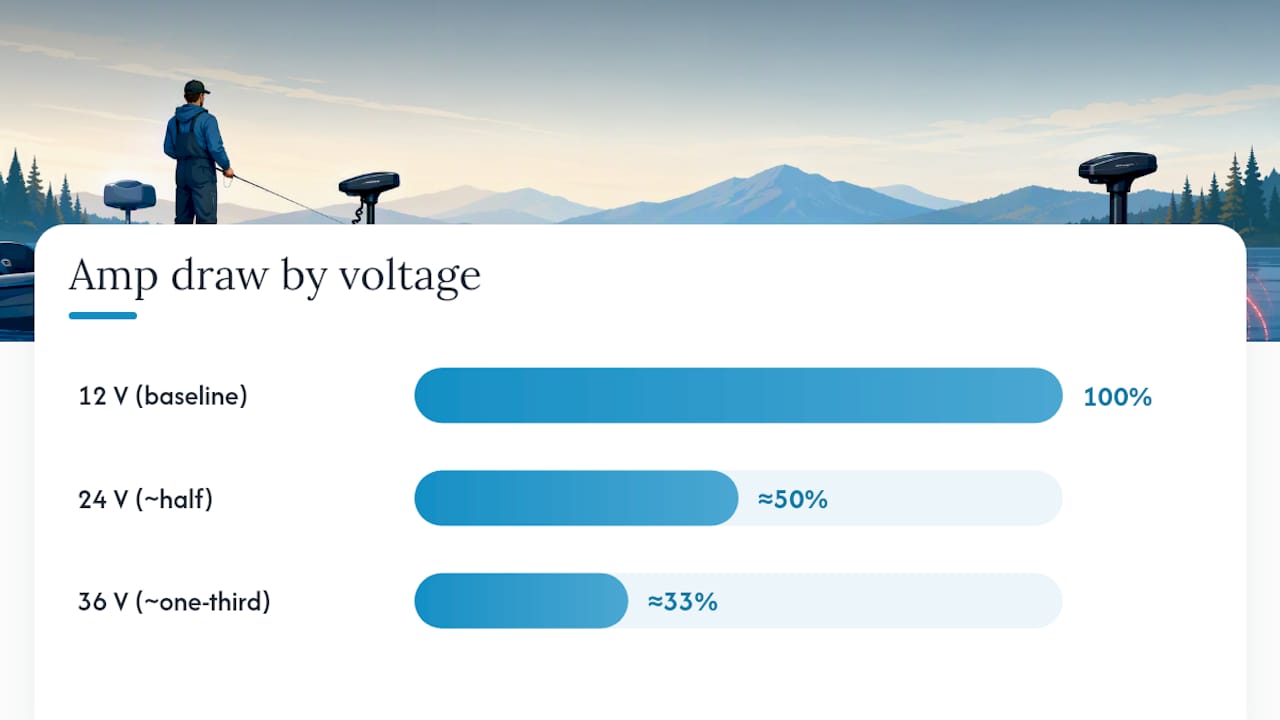
Voltage is the lever most anglers overlook. The same wattage output requires less current at higher voltage. A 24V system pulls roughly half the amps a 12V system would need to produce the same power, and a 36V setup cuts that further still. That’s why bigger boats with 24V or 36V trolling motors don’t necessarily need proportionally larger batteries. They need the right voltage architecture more than raw amp-hour capacity.
How Do You Read a Manufacturer’s Amp-Draw Chart?
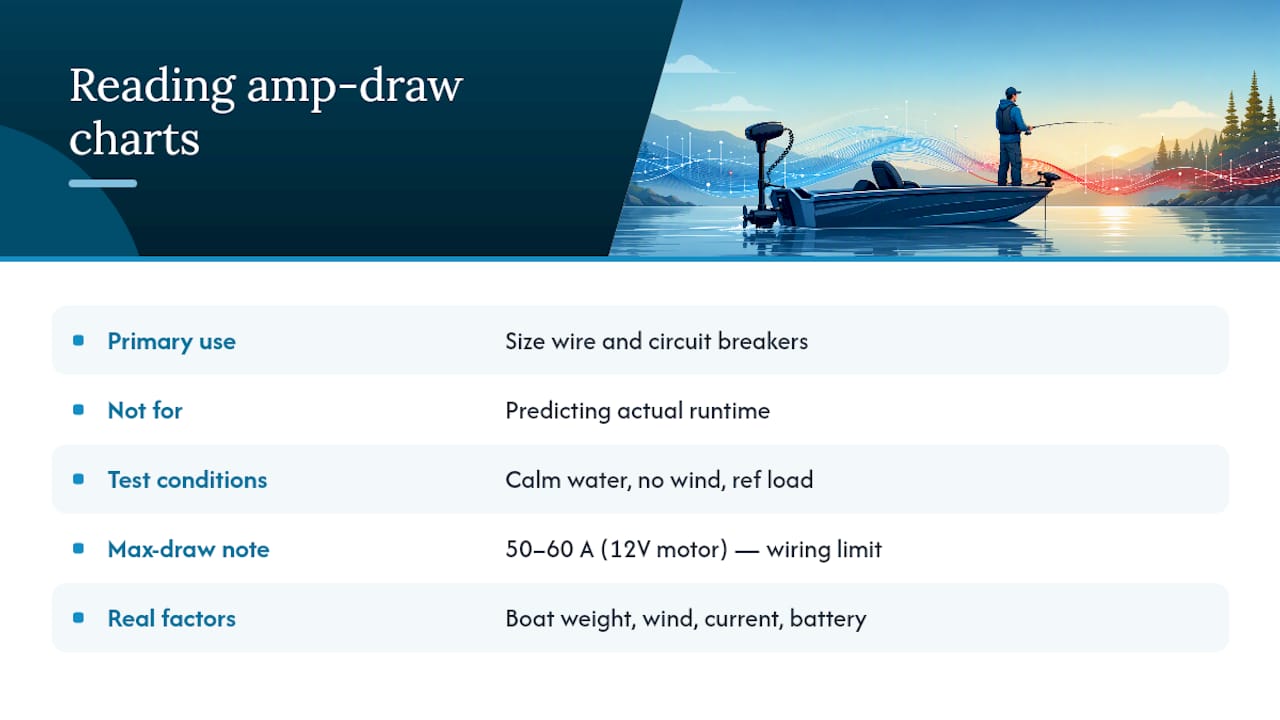
Manufacturer tables list current draw at fixed speed settings under controlled test conditions, usually calm water, no wind, and a specific reference load. That’s useful for one purpose above all others: sizing wire gauge and circuit breakers, not predicting your actual runtime on the water.
Minn Kota is explicit about this limitation: the company cannot publish a precise amp draw for anything below max power because real-world consumption depends on boat weight, wind, current, and battery condition. The max-draw figure on the spec sheet is the number the wiring has to survive, not the number your battery will see for hours at a stretch.
Here’s a representative look at how current climbs with speed setting, based on published testing data:
The jump between medium and max is the one that catches people off guard. It’s also why the max figure on a spec sheet, often 50 to 60 amps for a 12V motor at full power, is meant to size your breaker and wire gauge, not to calculate how many hours you’ll get out of a battery. Treat the chart as a wiring reference first. Runtime is a separate calculation that starts with your actual, average amp draw across a normal day, not the worst-case number.
Estimating Runtime: Formulas and Worked Examples
Runtime math starts with usable amp-hours, not the number printed on the battery label. A 100Ah AGM battery doesn’t give you 100 usable amp-hours before it’s damaged. Draining an AGM battery past roughly 50% depth of discharge repeatedly shortens its life, so the practical usable capacity is closer to 50Ah.
The core formula is straightforward:
- Runtime (hours) = Usable Ah ÷ Average amp draw
- A 100Ah AGM battery (50Ah usable) running a motor averaging 15A gives roughly 3.3 hours
- The same 100Ah battery in LiFePO4 form (80Ah usable) at the same 15A draw stretches to about 5.3 hours
- Push that same motor to a 40A average and the AGM battery’s usable runtime drops to about 75 minutes
Manufacturers generally recommend planning around 6 to 8 hours of runtime per 110Ah battery under typical mixed-speed use, which lines up closely with the medium-throttle numbers above. For tournament anglers or anyone running higher speeds for extended stretches, doubling the expected amp-hour requirement is the safer play, since a battery that dies mid-afternoon costs you more than the extra weight of a bigger bank ever will.
Which Battery Type Actually Delivers the Runtime You Expect?
Chemistry decides how much of your rated capacity you can actually use, and that gap matters more than the number printed on the case. A flooded lead-acid battery might be the cheapest option up front, but its usable capacity and cycle count both lag behind sealed alternatives, and repeated deep discharges accelerate sulfation faster than in AGM designs.
- AGM: roughly 50% usable depth of discharge for reasonable lifespan, moderate weight, no maintenance, widely available
- LiFePO4: up to 80% usable depth of discharge, roughly half the weight of an equivalent AGM battery, higher upfront cost, far longer cycle life
- Flooded: lowest cost, lowest usable depth of discharge, requires maintenance and ventilation
That weight difference matters more than most anglers expect on smaller boats, where every pound affects hull performance and fuel economy on the way to the fishing spot. LiFePO4 batteries also tolerate cold weather better and accept faster charging, though they need a charger with the correct lithium profile.
Pro Tip: Never charge a LiFePO4 battery with a straight AGM charging profile below freezing. Use a charger designed for lithium chemistry, or you risk damaging the cells over time.
Banshee Batteries builds both AGM and lithium options specifically for marine and powersport use, which is a reasonable starting point if you’re deciding between chemistries for the first time.
Wiring, Breakers, and Fuses Sized for Real Amp Draw
Wire gauge and breaker size both come from the same input: the motor’s maximum rated amp draw, not its average. Undersized wire causes voltage drop over distance, and that drop gets worse the longer your battery leads run. Minn Kota’s wiring guide maps thrust class and lead length to a specific AWG recommendation, and running thinner wire than the chart calls for isn’t just a performance issue. Undersized leads can cause the motor to trip its own protection or run hot under load.
Follow these rules when wiring a trolling motor circuit:
- Size the wire gauge to the motor’s maximum amp draw, not its typical medium-speed draw.
- Add a heavier gauge if your battery leads run longer than the manufacturer’s baseline test length.
- Install the circuit breaker as close to the battery terminal as possible, not near the motor.
- Match the breaker rating to the motor’s max draw plus a small margin, never below it.
- Check every connection annually for corrosion, since a loose or corroded terminal raises resistance and mimics undersized wire.
Manufacturers note that maximum amp draw is an intermittent, momentary figure, pulled only when you demand full power, and Minn Kota specifically frames its published max-draw charts as wiring and breaker references rather than a continuous load your battery sees for hours. Wire and breakers get sized for that worst case. Your runtime planning gets sized for the average case instead.
How Do You Measure Amp Draw on Your Own Boat?
Manufacturer charts tell you what a motor can pull under lab conditions. The only way to know what your motor pulls on your boat, with your prop, your hull, and your typical wind conditions, is to measure it directly.
You’ll need one of the following tools: a clamp meter rated for DC current, a shunt-based battery monitor, or a simple multimeter with a DC amp function wired in series.
- Fully charge the battery and note the starting voltage.
- Anchor or hold position in calm water with your normal fishing payload aboard.
- Run the motor at a fixed speed setting for a measured period, ideally 15 to 30 minutes, and record the average current.
- Repeat at two or three different speed settings to build a personal reference table.
- Multiply the average amps by the hours you expect to run at that speed to get your real amp-hour requirement.
Recording amp-hours over a controlled one-hour run at a fixed throttle gives you a per-hour consumption figure that accounts for your specific boat’s drag and prop efficiency, something no manufacturer table can do for you.
Three Worked Scenarios You Can Copy
Scenario A, day trip, small boat. A 55 lb 12V motor at medium speed draws about 15A. On a 100Ah AGM battery with 50Ah usable, that’s roughly 3.3 hours of continuous medium-speed running, plenty for a typical outing with breaks.
Scenario B, mid-size boat, 24V system. A 24V setup at an equivalent medium speed draws closer to 8 to 10A. Two 100Ah batteries wired for 24V give you a larger usable buffer and comfortably cover a full day of mixed-speed positioning.
Scenario C, tournament angler. Running higher speeds most of the day pushes average draw toward 25 to 30A. Doubling the expected amp-hour requirement points toward a 150 to 200Ah bank, ideally in LiFePO4 for the extra usable capacity per pound.
What Actually Matters When You’re Planning Battery Capacity
The biggest mistake I see anglers make isn’t underestimating amp draw. It’s trusting the max-draw number on the box as if it represents a normal fishing day, then getting surprised when the real number is a fraction of that. Measure your own setup once, and you’ll size batteries with far more confidence than any chart provides.
Three habits protect runtime more than any single battery upgrade: use a charger matched to your battery’s chemistry, avoid routinely draining past the safe depth of discharge for that chemistry, and store batteries fully charged during the off-season. Upgrading to LiFePO4 makes the most sense when weight savings or faster charging solve a specific problem you already have, not just because it’s the newer technology.
— Donald
Get the Right Battery for Your Trolling Motor Setup
Once you know your real amp draw and target runtime, picking a battery stops being a guess. Banshee Batteries builds lithium marine batteries specifically for trolling motor duty, including 12V 100Ah LiFePO4 units sized for the exact scenarios covered above, backed by a 5-year warranty on lithium marine batteries and a 4-year warranty on AGM. That warranty length matters more than most buyers realize: it’s a direct reflection of how many deep cycles the battery is built to survive.
If you’re still deciding between AGM and lithium for your boat, Banshee’s battery sizing guide walks through the same Ah math covered in this article, tailored to your motor’s thrust and voltage. Ready to size your own setup? Browse the lithium marine battery collection or reach out to Banshee’s support team with your motor’s thrust rating and typical trip length for a specific recommendation.
Sources
- Marine Battery Runtime Calc — Trolling Motor Draw | VoltCalcs
- Garmin Force trolling motor performance tables
- Trolling Motor Power Considerations - Minn Kota
FAQ
How Long Will a 100Ah Battery Last With a 40 lb Thrust Motor?
A 40 lb thrust motor draws less current than a 55 lb motor at the same speed setting, often in the 10 to 15A range at medium throttle. On a 100Ah AGM battery with roughly 50Ah usable, that translates to about 3 hours or more of medium-speed running, longer if you spend time at lower speeds.
How Many Amps Does a 55 lb Minn Kota Draw?
A 55 lb thrust motor typically draws 15 to 20A at medium speed settings and can climb toward 50A or more at maximum throttle. The exact figure depends on your boat’s weight, prop, and water conditions, which is why Minn Kota frames its published max-draw numbers as wiring references rather than guaranteed runtime figures.
Is a 100Ah Battery Enough for a Trolling Motor?
Yes, for most recreational use at moderate speeds, a 100Ah battery covers a standard day on the water. Tournament anglers or anyone running higher speeds for extended periods should plan for 150 to 200Ah instead to avoid deep discharge.
How Many Amp Hours Do I Need for a 36 Volt Trolling Motor?
A 36V system draws roughly a third of the current a 12V system needs for the same power output, so total amp-hour requirements scale down accordingly even though you’re running three batteries in series. Most 36V setups pair three 100Ah batteries, giving a comfortable buffer for a full day of mixed-speed use with the same safety margins that apply at 12V.
What Battery Does Banshee Batteries Recommend for Trolling Motors?
Banshee Batteries offers 12V LiFePO4 marine batteries built for trolling motor duty, sized for the runtime calculations covered in this guide. Current pricing and specifications are available on the lithium marine battery collection page.