


Top Batteries for Classic Car Restoration: Period Look, Modern Power
For most classic car restorations, the best battery approach is a modern AGM or LiFePO4 unit inside a period-correct reproduction casing. You get authentic engine-bay appearance without sacrificing cold-cranking amps, maintenance-free operation, or vibration resistance.
Two facts worth knowing before you go further:
- Modern reproduction AGMs commonly deliver 750 CCA in a Group 24 footprint, maintenance-free and valve-regulated.
- LiFePO4 cuts significant weight and handles deep-cycle use well, but it requires a dedicated charging profile or a compatible smart charger.
Bansheebatteries offers both AGM and LiFePO4 options purpose-built for demanding applications, with a 4-year warranty on AGM and a 5-year warranty on lithium batteries. Those are the two lines worth considering first when you’re sourcing the top batteries for classic car restoration.
Table of Contents
- Why AGM is the practical default for restored classics
- How do you pick the right battery for your specific classic?
- AGM vs. LiFePO4 vs. flooded lead-acid: which chemistry fits your build?
- How do you keep a period-correct look in the engine bay?
- Installation, charging, and long-term maintenance
- What Bansheebatteries recommends by use-case
- What does a battery swap actually cost, and how long does it take?
- Key Takeaways
- What experienced restorers actually do
- Bansheebatteries has the right battery for your restoration
- Useful sources and further reading
Why AGM is the practical default for restored classics
AGM gives the best balance of cranking power, reserve capacity, and maintenance-free use for most restored engines. That’s not a marketing claim — it’s why OEM manufacturers have been switching to AGM for years.
The core advantage is structural. AGM cells use fiberglass separator mats that hold the electrolyte in suspension, which eliminates acid leakage and reabsorbs most gases during charging. No leaks means no terminal corrosion eating through your freshly detailed engine bay. No gassing means you can mount the battery in tighter spaces without worrying about hydrogen buildup.
Vibration resistance is the other factor restorers underestimate. Classic cars — especially those running on bias-ply tires or with stiff suspensions — transmit significant vibration to the battery tray. AGM’s absorbed-glass construction keeps the plates from flexing and cracking under that stress.
Reproduction AGM units also arrive fully charged and valve-regulated, ready to drop in without the acid-filling step that some vintage-style lead-acid batteries still require. For a restorer who has spent months on a build, that plug-and-play readiness matters.
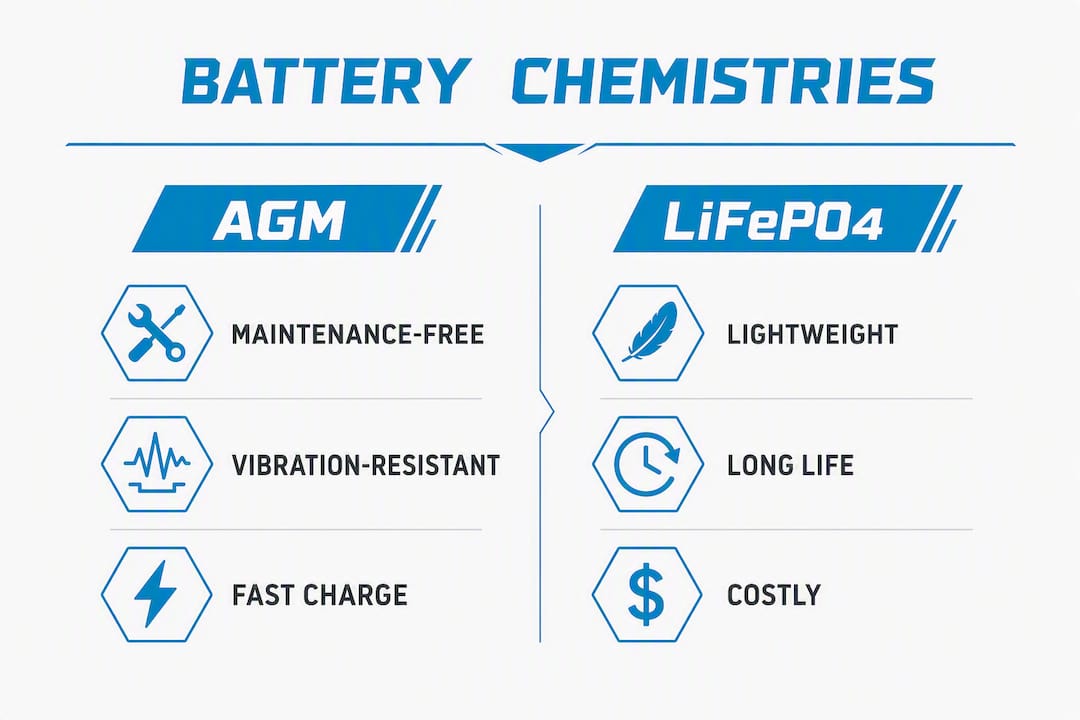
Pro Tip: AGM batteries can recharge up to 15% faster than conventional flooded lead-acid, but they are more sensitive to overcharge. Always use a charger with an AGM-specific mode.
How do you pick the right battery for your specific classic?
Start with intended use, then work backward to specs. A show car that runs twice a year needs different priorities than a daily-driven restomod.
- Determine use-case first. Show car: prioritize period-correct appearance and reserve capacity. Daily driver: prioritize CCA and cycle life. Restomod or track car: consider LiFePO4 for weight savings.
- Measure the battery tray. Length, width, and height — then confirm the hold-down style (top-clamp, J-hook, or side-bracket).
- Confirm terminal type and polarity. Top-post vs. side-post, and whether positive is left or right. Getting this wrong means fabricating new cable runs.
- Check cable condition and length. Corroded or undersized cables waste CCA before the starter even sees it.
- Verify alternator output and regulator type. Older external regulators can overcharge AGM cells. If your car still runs points and an original voltage regulator, test output before switching chemistry.
If you’re adding aftermarket accessories — upgraded lighting, an electric fan, or a sound system — factor that load into your CCA and reserve-capacity requirements. Custom lighting integration can meaningfully increase electrical draw, which affects both battery sizing and charging system demands.
| Group Size | Typical Application | Terminal Position |
|---|---|---|
| Group 24 | Full-size classics | Top-post, standard |
| — | Large-displacement trucks, wagons | Top-post, standard |
| — | Compact classics, inline-6 engines | Top-post, reversed |
| — | Small imports, 4-cylinder classics | Top-post, reversed |
Pro Tip: Before switching from flooded to AGM or LiFePO4, check your charging system compatibility. Some older charging systems need a regulator upgrade or a smart charger to safely support modern battery chemistries.
AGM vs. LiFePO4 vs. flooded lead-acid: which chemistry fits your build?
AGM is the best default. LiFePO4 wins when weight and deep-cycle life are priorities and you can manage the charging requirements. Flooded lead-acid belongs only in builds where original-equipment authenticity trumps everything else.
AGM
- Starting power: Excellent cold-cranking power in common group sizes
- Reserve capacity: Strong enough for typical usage in a Group 24
- Maintenance: None — sealed, valve-regulated
- Vibration resistance: High
- Weight: Moderate (typically 40–55 lbs for Group 24)
- Charger requirement: AGM-compatible charger or smart charger with mode selector
- Warranty (Bansheebatteries): 4 years
LiFePO4
- Starting power: Good — lighter cells can match AGM cold-cranking power in smaller packages
- Reserve capacity: Excellent deep-cycle capability; usable capacity is higher per pound
- Maintenance: None
- Vibration resistance: Very high — no liquid electrolyte
- Weight: Significantly lighter, often 60–70% less than equivalent AGM
- Charger requirement: Dedicated LiFePO4 profile required; standard AGM chargers can damage cells
- Warranty (Bansheebatteries): 5 years on lithium marine batteries
Flooded lead-acid
- Starting power: Adequate for stock engines
- Reserve capacity: Moderate
- Maintenance: Requires periodic water top-off and terminal cleaning
- Vibration resistance: Lower — plates may crack under sustained vibration
- Weight: Heavier option
- Charger requirement: Standard 12V charger
| Chemistry | Typical CCA Range | Reserve Capacity | Maintenance |
|---|---|---|---|
| Reproduction AGM | Strong cold-cranking amps in a common group size | Good reserve capacity | None |
| Standard AGM | High cold-cranking amps | Good reserve capacity | None |
| LiFePO4 | Variable cold-cranking amps | High deep-cycle capability | None |
| Flooded lead-acid | Moderate cold-cranking amps | Moderate reserve capacity | Regular |
Switching chemistries without checking charging compatibility is one of the most common and costly mistakes in restoration builds. AGM accepts charge faster but punishes overcharge; LiFePO4 needs its own profile entirely.
How do you keep a period-correct look in the engine bay?
You can have modern internals and an authentic exterior. Reproduction batteries combine vintage hard-rubber styling, correct colored caps, and period markings with true AGM technology inside. The result passes visual inspection at shows while delivering modern reliability.
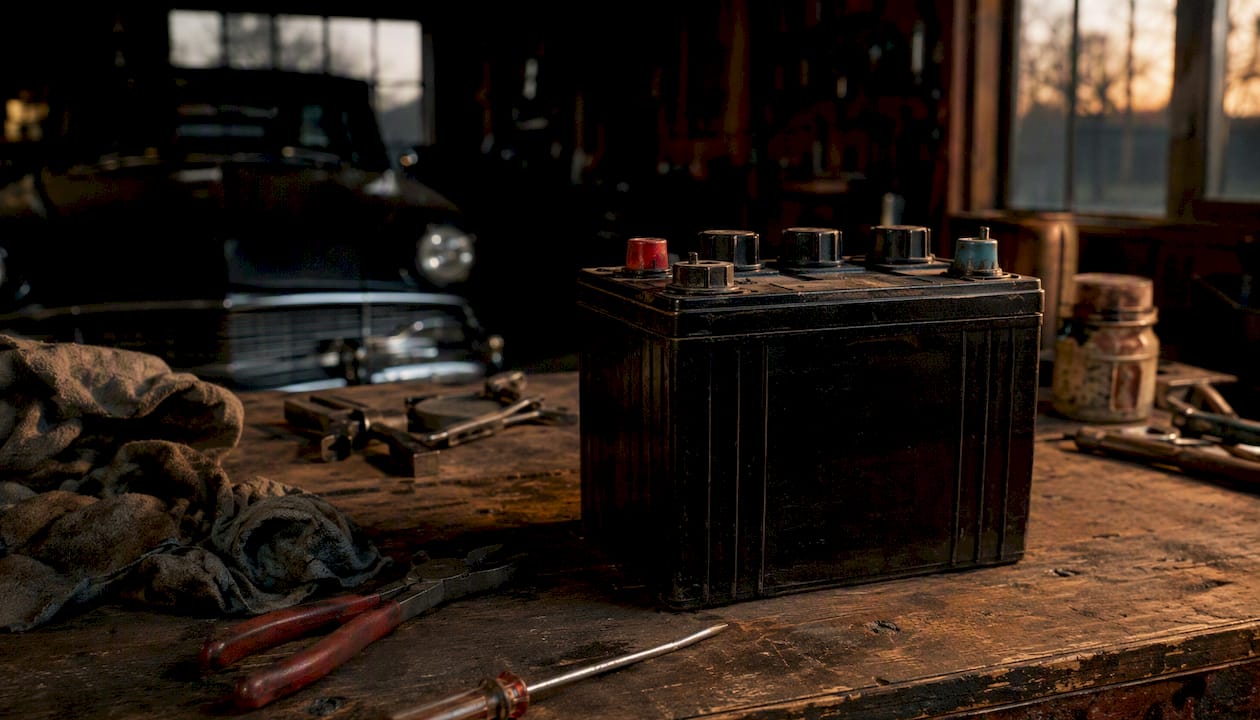
For concours-level restorations, look for reproduction AGM units that replicate historical cap colors and case markings. These aren’t cosmetic covers slipped over a modern battery — they’re complete AGM cells built inside period-style cases. The distinction matters because a loose cosmetic sleeve can shift, while a purpose-built reproduction case maintains correct dimensions and hold-down fitment.
For daily-driven restorations, a standard AGM in the correct group size is usually sufficient. The engine bay looks clean, there’s no acid residue, and nobody outside a judging panel will notice the difference.
Pro Tip: In tightly packaged engine bays, heat is the primary enemy of battery life. Keep the battery away from exhaust headers where possible, and confirm that any reproduction case includes adequate venting provisions if the design requires them.
Installation, charging, and long-term maintenance
Follow this checklist and you’ll avoid the two most common failures: a loose battery that vibrates itself to death and a charger that slowly destroys the cells.
- Clean the battery tray and remove any rust or corrosion before installing.
- Confirm the hold-down bracket fits the new battery’s case dimensions.
- Connect positive terminal first, then negative — reverse when removing.
- Inspect cable ends for corrosion and replace any cable showing cracked insulation.
- Route vent tubes (if applicable) away from the passenger compartment and electrical components.
- Torque terminal bolts to spec — loose connections cause voltage drop and heat.
For charging and storage:
- Use a smart charger with a chemistry selector to avoid overcharging AGM cells.
- LiFePO4 batteries require a dedicated lithium-compatible charger; never charge them on a standard flooded or AGM setting.
- During storage, connect a low-amp smart maintainer to prevent sulfation in AGM cells and capacity loss in lithium units.
- Never jump-start a LiFePO4 battery using a traditional jump pack set for lead-acid — the voltage spike can damage the battery management system.
- When charging flooded cells, work in a ventilated area; hydrogen gas accumulates quickly in enclosed spaces.
What Bansheebatteries recommends by use-case
| Use-Case | Recommended Chemistry | Key Reason | Warranty |
|---|---|---|---|
| Show / numbers-matching | Reproduction AGM | Period-correct casing, 750 CCA, maintenance-free | 4 years |
| Daily driver / regular use | High-CCA AGM | Best balance of cranking power and cycle life | 4 years |
| Restomod / track / weight-sensitive | LiFePO4 | Significant weight reduction, deep-cycle capability | 5 years |
Bansheebatteries carries both AGM and LiFePO4 lines with US shipping and direct online ordering. Before placing an order, use the battery finder tool on the site to confirm group size and terminal polarity for your specific vehicle. Reproduction-style AGMs ship fully charged and valve-regulated, so installation is straightforward once fitment is confirmed.
What does a battery swap actually cost, and how long does it take?
- Budget AGM (standard, no reproduction casing): moderate cost for the battery with additional cost for a quality smart charger/maintainer.
- Reproduction AGM (period-correct casing): higher cost depending on group size and brand.
- LiFePO4: higher cost for automotive-grade units plus additional cost for a compatible lithium charger.
Time-wise, a straightforward swap on a car with an accessible battery tray takes 20–30 minutes for a DIY installer. If you’re fabricating a new tray, routing new cables, or upgrading the charging system, budget 2–4 hours. An in-shop install with a charging-system check typically runs 1–2 hours of labor.
Key Takeaways
AGM is the right call for most classic car restorations: it delivers 750 CCA in a Group 24 footprint, requires no maintenance, and fits period-correct reproduction casings that satisfy both show judges and daily drivers.
| Point | Details |
|---|---|
| AGM is the default choice | Delivers 750 CCA, maintenance-free operation, and vibration resistance for most restored engines. |
| LiFePO4 for weight-sensitive builds | Cuts significant weight and handles deep-cycle use, but requires a dedicated LiFePO4 charger. |
| Confirm fitment before ordering | Measure tray dimensions, verify terminal polarity, and use Bansheebatteries’ battery finder to match group size. |
| Use a compatible charger | A smart charger with a chemistry selector protects AGM cells; a dedicated lithium charger is non-negotiable for LiFePO4. |
| Bansheebatteries AGM and LiFePO4 lines | Both available with US shipping, 4-year AGM warranty, and 5-year lithium warranty for purchase-ready fitment. |
What experienced restorers actually do
Most restoration pros don’t agonize over this decision the way first-timers do. Their default is a reproduction AGM for anything going to a show, and a high-CCA AGM or LiFePO4 for anything that actually gets driven hard.
The tradeoff they manage most carefully isn’t appearance — it’s the charging system. A car that sits six months between shows needs a smart maintainer on a timer, not a trickle charger left plugged in indefinitely. Overcharging is what kills more restoration batteries than vibration and heat combined.
On CCA spec, experienced restorers tend to go slightly above the OEM minimum, particularly for high-compression engines that are harder to crank when cold. A stock 350 small-block might have shipped with a 450 CCA battery in 1970; putting a 750 CCA reproduction AGM in the same tray costs nothing extra and starts the car more reliably in January.
Corrosion prevention is the other habit worth adopting. Even with AGM’s sealed construction, terminal grease or a felt anti-corrosion washer under each terminal keeps connections clean for years.
Bansheebatteries has the right battery for your restoration
Twenty-plus years of building high-performance AGM and LiFePO4 batteries means Bansheebatteries understands what a restored classic actually demands: reliable cold-cranking power, a battery that survives months of storage without attention, and options that fit the way the car was built.
The AGM line carries a 4-year warranty and ships fully charged. The LiFePO4 line carries a 5-year warranty and pairs with a dedicated lithium charger designed to protect the cells. Compatible automatic 12V chargers and maintainers are available directly on the site. Use the battery finder at bansheebatteries.com to confirm your group size and terminal fit, then order with confidence knowing US shipping and direct support are part of the deal.
Useful sources and further reading
- What type of battery should I choose? — Hemmings — Technical comparison of AGM, flooded, and gel chemistries; source for AGM charging speed, vibration resistance, and Jim O’Clair’s expert commentary.
- AGM Powersport Batteries That Hold Up — Bansheebatteries — Technical background on AGM durability and real-world performance in demanding applications.
- How to Maintain AGM Battery the Right Way — Bansheebatteries — Practical maintenance steps and smart-maintainer recommendations for long-term storage.
- AGM vs. Lithium Batteries — Bansheebatteries — Side-by-side comparison of AGM and LiFePO4 practical considerations including charger requirements.