


RV Battery Cost: Budget to Lithium and When It Pays Off
A single 12V deep cycle battery for an RV runs $150 to $400, while a full lithium bank with proper installation lands between $3,500 and $7,500. Chemistry decides almost everything else. Flooded lead-acid is the cheapest way into the game and the most expensive way to stay in it, since it only survives 300 to 700 cycles before it needs replacing. LiFePO4 costs more up front but often runs 3,000 to 5,000 cycles, which changes the math for anyone who camps more than a couple dozen nights a year.
Here’s the quick breakdown by chemistry, per battery:
- Flooded lead-acid: roughly $100 to $250, replace every 1 to 3 years with regular use
- AGM: roughly $200 to $400, replace every 3 to 6 years
- Gel: similar to AGM, often $250 to $450, replace every 4 to 6 years
- LiFePO4: roughly $300 to $1,500+ depending on capacity and tier, often lasting 8 to 12 years or longer
The rest of this guide walks through where those numbers come from, when lithium’s higher sticker price actually pays for itself, and how to size a bank for your own camping habits instead of guessing.
Key Takeaways
RV battery cost ranges from $150 for a basic flooded unit to $1,500 or more for a premium lithium battery, and cycle frequency, not sticker price, determines which one actually costs less over 10 years.
| Point | Details |
|---|---|
| Upfront ranges vary widely | Flooded runs $100–$250, AGM $200–$400, LiFePO4 $300–$1,500 per battery depending on tier. |
| Nights-per-year is the trigger | Past roughly 50 nights of use annually, lithium usually wins the 10-year total cost comparison. |
| Budget for installation extras | DC-DC chargers, inverter upgrades, and wiring can add $500 to $1,500 beyond the battery price. |
| Warranty length reduces risk | A full-replacement warranty of 4-5 years protects a meaningful chunk of the battery’s expected lifespan. |
| Match chemistry to your usage | Banshee Batteries offers 12V 100Ah LiFePO4 for frequent boondockers and AGM options for moderate, budget-focused campers. |
Table of Contents
- How Much Does an RV Battery Cost by Type?
- What Factors Drive RV Battery Prices Up or Down?
- Is Lithium Worth the Higher Upfront Cost?
- What Does RV Battery Installation Actually Cost?
- How Do You Choose the Right Battery Size and Type?
- What Are the Warning Signs an RV Battery Needs Replacing?
- Where Should You Buy an RV Battery and What Warranty Terms Matter?
- Why I Recommend Lithium for Anyone Who Camps Often
- Find the Right Battery for Your RV Setup
- Where These Numbers Came From
- Sources
How Much Does an RV Battery Cost by Type?
Sticker price only tells part of the story. What actually matters is how much usable power you get for that price, because usable capacity varies wildly by chemistry.
Flooded lead-acid batteries are cheap to buy but stingy with their stored energy. You can typically only draw down to 50% of rated capacity without shortening the battery’s life, meaning a 100Ah flooded battery gives you about 50Ah of real-world usable power. AGM batteries push that to roughly 50 to 60% depth of discharge.
That gap changes the real cost-per-usable-Ah picture completely:
Statistic: Retail LiFePO4 pricing has spread into distinct tiers. You can find 12V 100Ah lithium units under $300 in budget lines, while premium models with better battery management systems and cold-weather protection run $700 to $900 or more. A 200Ah lithium bank spans roughly $400 to $1,500 depending on which tier you land in.
Cold weather is where budget lithium batteries can bite you. Charging LiFePO4 below freezing without built-in heating can permanently damage the cells, so anyone camping in winter needs a battery with an internal heating element or a battery management system that blocks charging when temperatures drop too low. Flooded and AGM batteries don’t have that restriction, which is one reason cold-climate boondockers sometimes stick with AGM even when lithium would otherwise make sense.
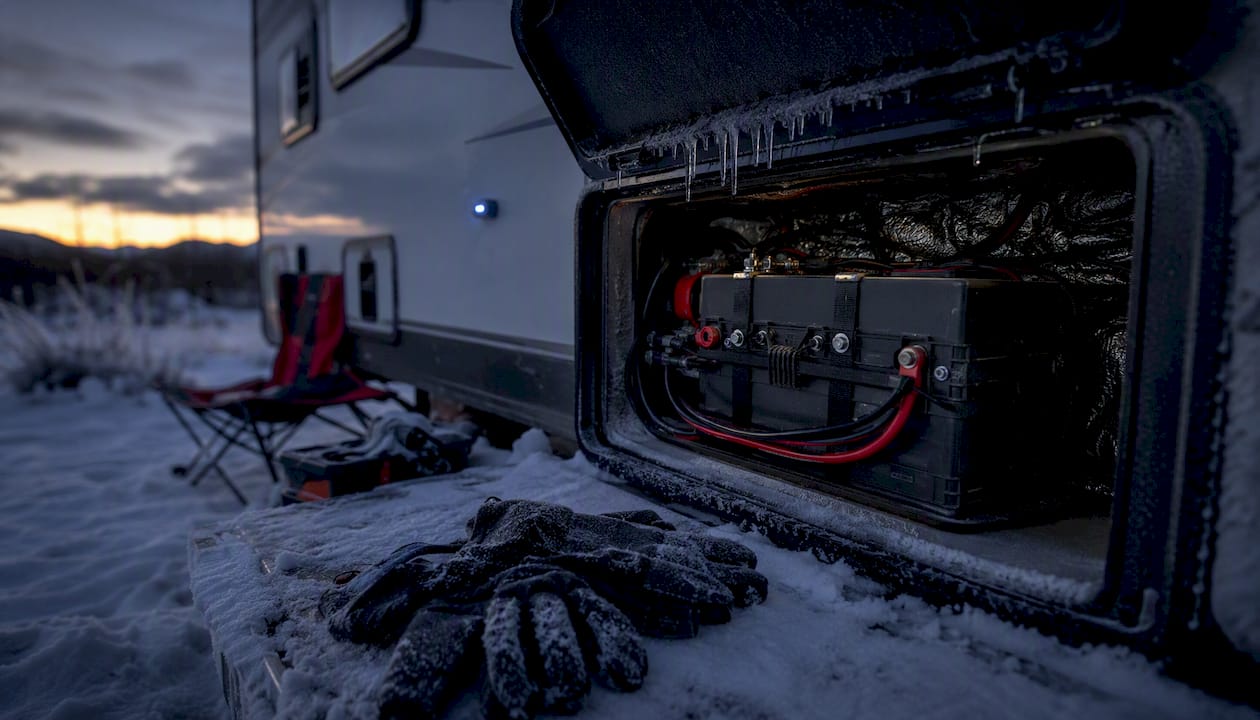
Flooded lead-acid wins on upfront price and loses on almost everything else: it needs regular watering, it off-gasses hydrogen and needs ventilation, and it degrades faster if you let it sit at a low state of charge. AGM trades a higher price for zero maintenance and better vibration tolerance, which matters if your RV spends a lot of time on rough roads. LiFePO4 costs the most per battery but delivers nearly double the usable capacity per Ah rating, tolerates hundreds more discharge cycles, and weighs less than half of an equivalent lead-acid battery.
Pro Tip: Compare batteries by usable Ah, not rated Ah. A “100Ah” flooded battery and a “100Ah” lithium battery are not delivering the same amount of power to your fridge and lights.
What Factors Drive RV Battery Prices Up or Down?
A handful of variables explain almost all the price spread you’ll see between two batteries with the same Ah rating. Knowing which ones matter for your setup keeps you from overpaying for features you’ll never use.
- Capacity and voltage: More Ah at the same voltage means more raw materials, so price scales close to linearly with rated capacity.
- Usable capacity (depth of discharge): A battery that lets you use 90% of its capacity is worth more per Ah than one that only lets you use 50%, even if the sticker price looks similar.
- Cycle life: Batteries rated for thousands of cycles cost more per unit but spread that cost across many more years of use.
- Built-in BMS and heating: A quality battery management system with low-temperature charge protection adds real cost but prevents the kind of damage that kills cheap lithium batteries in one bad winter.
- Warranty length: Longer warranties usually mean the manufacturer trusts the cell quality enough to back it, and that confidence is priced in.
- Weight and packaging: Marine-grade cases and vibration-rated terminals cost more to manufacture than a bare commodity case.
- Accessories: DC-DC chargers, inverter upgrades, and Bluetooth monitoring modules are often sold separately and can add hundreds to the real total.
Statistic: Converting rated Ah to usable Ah changes the real price comparison more than most shoppers expect. A 100Ah AGM battery at $250 with 55% usable capacity works out to roughly $4.55 per usable Ah, while a $300 lithium battery at 90% usable capacity works out to about $3.35 per usable Ah, despite costing more on the shelf.
A built-in heating element is worth paying for if you camp anywhere winters dip below freezing; skip it if you store the RV during cold months and never charge it in the cold. Bluetooth monitoring is a convenience feature, not a cost-saving one, so treat it as optional unless you genuinely want app-based state-of-charge tracking. A quality BMS, on the other hand, is close to non-negotiable on lithium. It’s the component that protects individual cells from overcharge, over-discharge, and temperature extremes, and skimping on it is how budget lithium batteries fail early.
Is Lithium Worth the Higher Upfront Cost?
The honest answer is: it depends entirely on how many nights a year you actually use the battery. Sticker price tells you almost nothing about total cost of ownership, because a cheap battery you replace three times costs more than an expensive one you replace once.
Here’s a 10-year cost comparison using a 200Ah-equivalent bank size, assuming typical usage and standard replacement cycles for each chemistry:
The methodology behind that last column is straightforward: divide your expected annual cycles by the battery’s rated cycle life to estimate how many replacements you’ll need over 10 years, then multiply by the battery’s price. A weekender who camps 20 nights a year puts roughly 20 cycles a year on the bank, so even a flooded battery rated for 400 cycles lasts about 20 years on paper (though calendar aging usually forces replacement sooner, around year 4 or 5). A frequent boondocker running 80 to 120 nights a year puts 80 to 120 cycles annually on the battery, which burns through a 500-cycle AGM in 4 to 6 years but barely dents a 3,000-cycle lithium bank. A full-timer cycling nearly every day approaches 300+ cycles a year, which can exhaust flooded lead-acid in under two years.
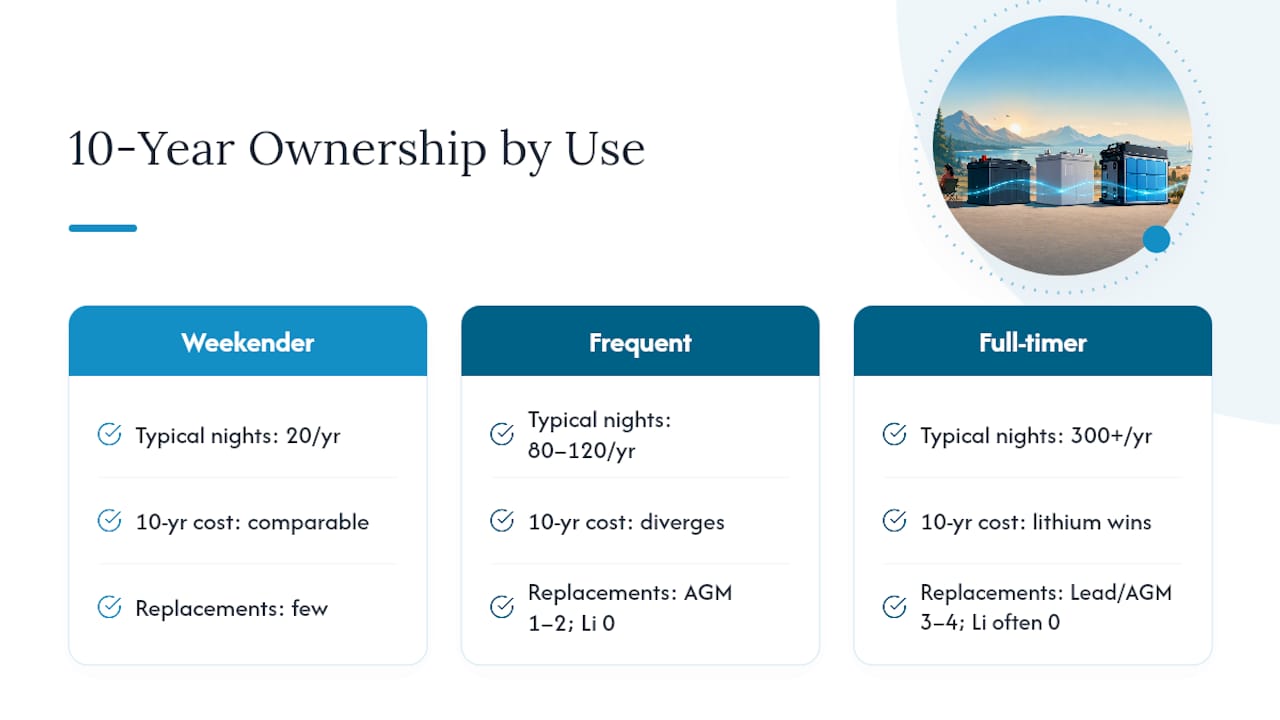
Run the numbers for all three: the weekender’s 10-year cost stays roughly comparable across chemistries because nobody’s cycling the battery hard enough to matter. The frequent boondocker starts seeing real separation, often paying for one or two AGM replacements versus zero for lithium. The full-timer sees the starkest gap, since lead-acid or AGM banks can need replacing three or four times over a decade while a well-maintained LiFePO4 bank often outlasts the RV’s other systems.
Pro Tip: If you’re cycling your battery more than 50 nights a year, run the 10-year math before you buy. That’s roughly the threshold where lithium usually wins on total cost, not just convenience.
What Does RV Battery Installation Actually Cost?
The battery itself is rarely the whole bill. Upgrading to lithium in particular tends to drag along a list of supporting purchases that catch first-time buyers off guard.
A straightforward battery swap, same chemistry for same chemistry, in an existing compartment is the cheapest scenario. DIY installation costs you nothing but time and maybe $20 to $50 in new terminal hardware or fuses. A professional shop installation for a simple swap typically runs $100 to $300 in labor.
Switching chemistries, especially moving from lead-acid to lithium, is where costs stack up:
- DC-DC charger: $250 to $400, often required to protect your alternator and properly charge a lithium bank from your engine while driving.
- Charge controller or inverter upgrade: $150 to $600, since many older solar controllers and inverters aren’t programmed with a lithium charge profile.
- Heavy-gauge wiring: $50 to $200 depending on run length, because lithium’s higher discharge rates often call for thicker cable than the old lead-acid setup used.
- Battery monitoring system: $80 to $250 for a shunt-based monitor that tracks real state of charge accurately, which matters more with lithium since voltage alone doesn’t tell you much.
- Professional installation labor: $300 to $1,000 for a full system conversion, depending on complexity and whether compartment modifications are needed.
Statistic: Add it all up and a full lithium conversion with professional installation commonly lands between $3,500 and $7,500, with the battery bank itself accounting for only $1,800 to $4,500 of that total. The rest goes to the electronics and labor most buyers don’t budget for up front.
Don’t forget the smaller line items either. Heavy batteries, especially large lithium banks, sometimes carry freight surcharges of $20 to $75 when shipped due to their weight and hazardous-material classification. Lead-acid batteries typically carry a core charge or require drop-off at a recycling center, sometimes with disposal fees of $10 to $20 if your retailer doesn’t take the old battery back for free. If your existing battery compartment wasn’t built for a different case size or shape, mounting brackets or minor carpentry work can add another $50 to $150. Our guide on charging options for RV batteries covers how to figure out whether your specific charging setup needs an upgrade before you buy.
How Do You Choose the Right Battery Size and Type?
Most people buy an RV battery based on what fits the compartment or what’s on sale. A better approach starts with your actual power usage, works through the math step by step, and lands on both the right capacity and the right chemistry tier.
Step one: estimate your daily watt-hours. Add up the wattage of everything you run off battery power and multiply by hours of use. A typical setup with a fridge, lighting, water pump, and phone charging often lands around 1,000 to 1,500 Wh per day. Adding a CPAP machine, inverter for a laptop, or a larger fridge can push that toward 2,000 Wh or more.
Step two: pick your usable-capacity target. Multiply daily Wh by the number of days you want to run without recharging, then divide by 12 volts to get your target Ah. For 1,500 Wh/day and two days of reserve, that’s 3,000 Wh, or 250 usable Ah.
Step three: convert usable Ah into rated battery size. Since flooded lead-acid only gives you 50% usable capacity, you’d need roughly 500Ah of rated lead-acid capacity to hit that 250Ah usable target, likely two or three large batteries.
Step four: check charging compatibility and weight limits. Confirm your solar charge controller, converter, and alternator charging setup support your chosen chemistry, and check your RV’s GVWR (gross vehicle weight rating) since lithium’s weight savings can matter if you’re already near your payload limit.
Step five: choose your tier. Budget lithium works fine for moderate climates and casual users. Premium tiers with heating elements and robust BMS protection make sense for winter camping, heavy daily cycling, or anyone who wants Bluetooth monitoring and a longer warranty.
Statistic: That 1,500 Wh/day example works out to roughly a 200Ah LiFePO4 battery providing about two days of reserve, or two 100Ah AGM batteries wired in parallel providing roughly the same runtime with double the weight and a shorter service life.
Pro Tip: When you call around, ask each seller three things: what’s the warranty’s pro-rata schedule, does the BMS include low-temperature charge cutoff, and what’s the return policy if the battery arrives defective. Those three answers tell you more about quality than the spec sheet does.
What Are the Warning Signs an RV Battery Needs Replacing?
Batteries rarely fail without warning. Catching the signs early saves you from a dead battery at the worst possible moment, usually the first night of a trip.
Watch for these red flags:
- Voltage drops fast under load even though it read fine at rest.
- The battery holds noticeably less charge than it used to, running your fridge for half the time it once did.
- The case looks swollen, bulging, or warm to the touch.
- A flooded battery shows visible sulfation (white crust) on the plates or stratification (you can hear sloshing that sounds uneven).
- The battery keeps sitting at a low state of charge despite a charging system that tests fine.
If you want to confirm suspicions before buying a replacement, run through this quick sequence:
- Fully charge the battery and let it rest for at least an hour with no load.
- Measure open-circuit voltage with a multimeter. A healthy 12V flooded or AGM battery should read close to 12.6 to 12.8V; lithium typically reads 13.2 to 13.6V at full charge.
- Apply a known load (like your RV’s lights and fridge running together) and watch how fast voltage drops over 10 to 15 minutes.
- Let the battery rest again after the load test and recheck voltage. A battery that recovers slowly or doesn’t climb back close to its resting voltage is losing capacity.
A voltage that crashes fast under light load, or a battery that won’t hold above 12.0V at rest after a full charge, means it’s done. If you’re unsure whether the problem is the battery or the charging system, that’s when it’s worth a shop visit for a proper load test rather than guessing and buying a replacement you might not need.
Where Should You Buy an RV Battery and What Warranty Terms Matter?
Where you buy matters almost as much as what you buy, because warranty support is worthless if the seller won’t honor it. Manufacturer-direct purchases and specialty battery retailers tend to offer better technical support and more straightforward warranty claims than big-box stores, where staff often can’t answer chemistry-specific questions. The tradeoff is usually a slightly higher price for that support.
Before buying, verify these warranty details:
- Length: AGM batteries commonly carry warranties of 2 to 4 years; lithium marine and RV batteries often carry 3 to 5 years from reputable manufacturers.
- Pro-rata vs full replacement: A full-replacement warranty covers the whole cost if the battery fails within the term; a pro-rata warranty only refunds a percentage based on how much of the warranty period has elapsed, which can leave you paying most of a replacement’s cost even under warranty.
- Deep-cycle coverage: Some warranties are voided by deep-cycle use if the battery wasn’t marketed for that purpose, so confirm the battery is rated for RV house-battery duty, not just starting duty.
- Registration requirements: Some manufacturers require online registration within 30 to 90 days of purchase to activate full warranty coverage.
- Transferability: If you sell the RV, a transferable warranty adds resale value; many are not transferable by default.
Statistic: A longer, full-replacement warranty changes your TCO math directly. A battery with a 4-year AGM warranty or a 5-year lithium warranty effectively guarantees a chunk of your usable years, removing one of the biggest cost risks in the entire purchase.
Pro Tip: Keep your receipt and register the warranty the same day you install the battery. Warranty claims get denied more often over missing paperwork than actual manufacturing defects.
For general terminal care and storage habits that extend any battery’s working life regardless of chemistry, these car battery maintenance tips apply just as well to an RV house bank.
Why I Recommend Lithium for Anyone Who Camps Often
Where the industry conversation usually goes wrong is treating “AGM vs. lithium” as a brand preference instead of a math problem. It isn’t. Run the cycle count for your actual camping calendar and the answer mostly picks itself.
If you’re camping fewer than 30 nights a year, save your money and buy AGM or even flooded lead-acid; you’ll likely replace the RV before you exhaust the battery’s cycle life either way. But once you cross into frequent boondocking territory, 60, 80, 100 nights a year off-grid, the equation flips hard. You’re not just saving on replacement costs. You’re gaining usable capacity you can actually spend, faster charging that lets you top off from solar in a fraction of the time, and roughly half the weight sitting in your battery compartment, which matters if you’re already fighting payload limits with gear and water tanks.
The payload difference is the part most buyers underweight, literally. Swapping two 100-lb AGM batteries for a single 45-lb LiFePO4 unit with equivalent usable capacity can free up 150 pounds or more, which is real gear-carrying capacity on a loaded RV. Banshee Batteries’ 12V 100Ah LiFePO4 and its AGM lineup both target this exact decision point, one built for frequent cyclers who want the weight and capacity advantage, the other for moderate users who want a maintenance-free battery without the lithium price tag or cold-charging complexity.
Run the 10-year TCO framework from earlier in this guide with your own nights-per-year number before you decide. The math doesn’t lie, even when marketing copy does.
Find the Right Battery for Your RV Setup
If you’ve worked through the math above and landed on lithium, or you’re still weighing AGM against the upfront cost, Banshee Batteries builds both categories specifically for the deep discharge cycles RV house banks go through, not repurposed automotive batteries with an RV label slapped on.
The 12V 100Ah LiFePO4 fits the frequent boondocker and full-timer scenarios from the TCO table almost exactly: roughly 90Ah of usable capacity in a package light enough to matter for payload, backed by a 5-year warranty on lithium marine batteries that removes most of the replacement-risk math discussed above. For weekenders and moderate campers who don’t need lithium’s price tag, Banshee’s marine and vehicle AGM options carry a 4-year warranty and handle vibration and temperature swings without the cold-charging restrictions lithium requires.
Not sure which capacity or chemistry fits your rig? Browse the lithium marine battery collection to compare capacity and pricing side by side, or reach out to the team for help sizing a bank to your actual watt-hour needs before you buy.
Where These Numbers Came From
Every price range in this guide comes from published RV battery pricing and installation guides, cross-checked against each other to avoid quoting an outlier as the norm.
- RV Battery Replacement Guide: Costs and Considerations supports the baseline chemistry-by-chemistry price ranges and the user-type recommendations used throughout this guide.
- Is an RV Lithium Battery Upgrade Worth It? supports the full installed lithium upgrade cost range and the battery-versus-electronics cost split.
- RV Battery Upgrade: AGM vs LiFePO4 Cost supports the cycle-life figures, the DC-DC charger cost estimate, and the nights-per-year TCO threshold.
- How Much Does an RV Lithium Battery Cost? supports the tiered retail pricing for 100Ah and 200Ah LiFePO4 banks.
- How Much Does an RV Battery Cost? Cost Guide for RV Owners supports the full battery-bank price range and per-chemistry retail estimates.
Battery prices shift often as lithium cell costs continue to change, so treat every figure here as a planning range and check current retail listings before you finalize a budget.
Sources
- Is an RV Lithium Battery Upgrade Worth It?
- RV Battery Upgrade: AGM vs LiFePO4 Cost (2026)
- How Much Does an RV Lithium Battery Cost?
- RV Battery Replacement Guide: Costs and Considerations
- How Much Does an RV Battery Cost? Cost Guide for RV Owners