


RV Battery Charging Options Compared: Hybrid Strategy Guide
The single best answer for high-performance AGM and LiFePO4 batteries is a hybrid charging strategy: use solar with an MPPT controller for daily maintenance and a high-current bulk source — shore power via inverter/charger, a generator, or an alternator with a DC-DC charger — for fast replenishment. That combination keeps batteries topped off silently between trips and recovers them quickly when you need it.
Why does chemistry matter here? LiFePO4 stores a higher percentage of input energy compared to AGM and lead-acid, which lose a notable amount of energy to heat. That efficiency gap changes how you size solar and how long a generator run actually takes. Beyond efficiency, the single biggest risk to a premium battery is a mismatched charger profile — a charger that doesn’t know it’s talking to lithium will either chronically undercharge it or stress the BMS with the wrong voltage ceiling.
- Use solar (MPPT controller) as the silent daily maintenance source.
- Use shore power, a generator, or a DC-DC charger for bulk charging when you need speed.
- Always match charger profiles to chemistry: CC/CV for LiFePO4, multi-stage for AGM.
- Bansheebatteries backs AGM batteries with a 4-year warranty and LiFePO4 marine batteries with a 5-year warranty, both designed for exactly these hybrid charging environments.
Table of Contents
- How do the main RV battery charging options compare?
- How each charging source works and when to use it
- Why charger profiles must match your battery chemistry
- Hybrid system recipes for common RV profiles
- How to size chargers and solar arrays
- Installation, wiring, and safety checklist
- How to diagnose common charging problems
- What’s the best final setup for AGM and LiFePO4 owners?
- Key Takeaways
- Why the “just plug it in” mindset costs you batteries
- Bansheebatteries has the batteries and chargers to back this strategy
- Useful sources
How do the main RV battery charging options compare?
| Charging Source | Best For | Typical Speed | AGM Compatible | LiFePO4 Compatible | Noise | Rough Equipment Cost | Role |
|---|---|---|---|---|---|---|---|
| Shore power (inverter/charger) | Full-timers, campground stays | 30–100A | Yes | Yes (lithium profile needed) | Silent | — | Primary bulk |
| Solar + MPPT | Boondockers, daily maintenance | — | Yes | Yes | Silent | — | Daily maintenance |
| Alternator + DC-DC charger | Road trippers, travel days | 20–60A | Yes | Yes (DC-DC required) | Engine noise | — | Travel bulk |
| Generator (AC-derived) | Emergency backup, fast recharge | 30–80A (via charger) | Yes | Yes (lithium profile needed) | Loud | — | Backup bulk |
| Battery maintainer / converter | Weekend storage, basic campgrounds | 5–15A | Yes | Limited | Silent | — | Float/trickle |
Quick recommendations:
- Boondockers: prioritize a 400W+ MPPT solar array and a DC-DC charger for travel days.
- Full-timers: shore power inverter/charger as the backbone, solar for daily top-off, DC-DC while driving.
- Weekend warriors: a modest solar panel plus a quality shore charger covers most needs.
- Marine and powersports rigs: LiFePO4’s charging efficiency advantage over lead-acid justifies the upfront cost when weight and cycle life matter.
How each charging source works and when to use it
Shore power via inverter/charger or converter
Shore power is the fastest and most reliable bulk charging source when a hookup is available. A basic converter delivers 5–15A and runs a simple bulk-to-float sequence — fine for weekend trips but too slow for large battery banks. An inverter/charger is a different animal: it can push 30–100A, handles multi-stage charging (bulk, absorption, float), and doubles as an inverter when you’re off-grid. Inverter/chargers deliver significantly higher charging amperage than converters and are the right choice for any bank over 100Ah.
Solar with MPPT
MPPT controllers extract more usable power from panels than older PWM designs, especially in partial shade or low-angle sun. A 200W array in five hours of good sun yields roughly 1,000 Wh; a 400W array yields around 2,000 Wh under the same conditions. Solar won’t bulk-charge a depleted bank quickly, but it’s unbeatable as a silent daily maintenance source that keeps batteries from sitting at partial state of charge between trips.
Alternator and DC-DC charging
Plugging a house bank directly into the alternator through a simple isolator works — until it doesn’t. Smart alternators reduce output voltage when they sense a large draw, which means a depleted lithium bank can pull the alternator into a protective cutback before the battery is anywhere near full. A dedicated DC-DC (B2B) charger solves this: it limits current draw, presents a stable load to the alternator, and delivers a proper charge profile to the house bank. For LiFePO4, a DC-DC charger isn’t optional — it’s the correct tool.
Generator charging
A generator feeds an AC charger or inverter/charger, which then bulk-charges the bank at whatever amperage the charger is rated for. It’s loud, burns fuel, and isn’t practical for daily use. Where it earns its place is as emergency backup when solar underperforms for several cloudy days or when you need a fast full charge before a trip.
Multi-input integration
A hybrid system combining AC, DC, and solar inputs with built-in prioritization logic lets solar take the load first, reducing alternator wear and fuel consumption. When solar input is sufficient, the DC source steps back automatically. That prioritization logic is worth understanding before you wire a multi-source system.
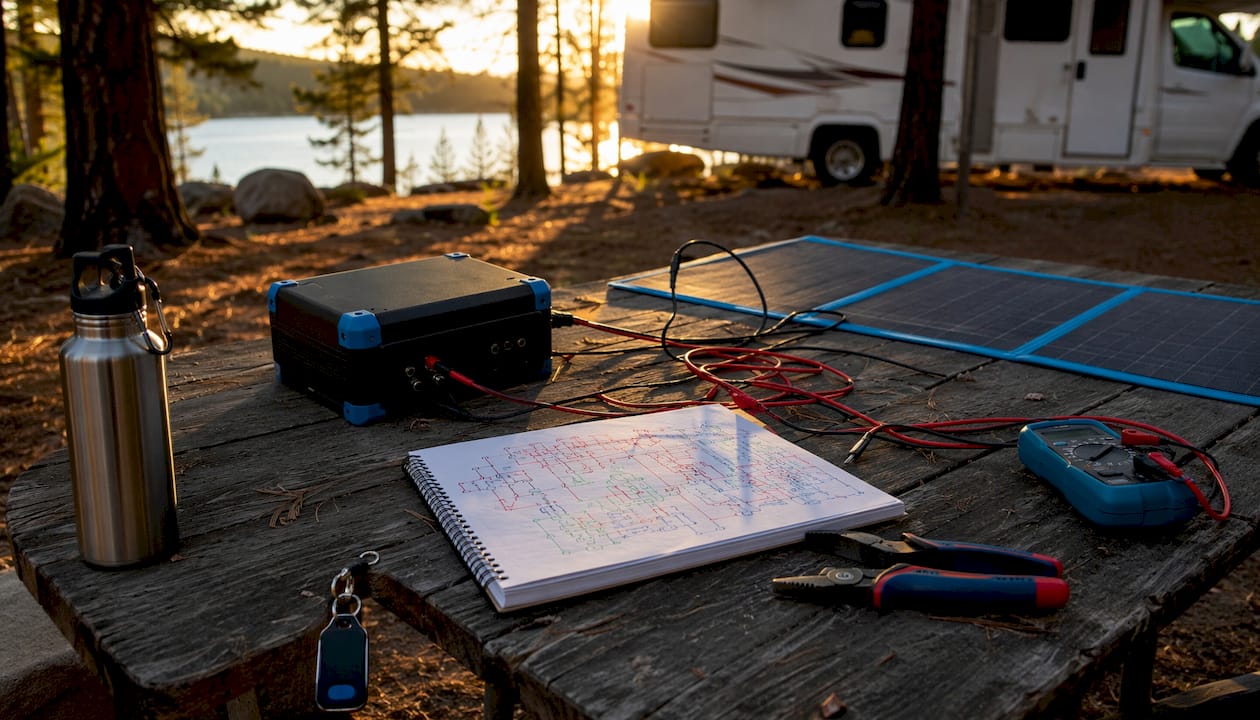
Why charger profiles must match your battery chemistry
Getting the voltage targets wrong is the fastest way to shorten a premium battery’s life.
AGM multi-stage profile:
- Bulk: 14.2–14.8V (constant current until ~80% SOC)
- Absorption: 14.2–14.4V (tapering current)
- Float: 13.2–13.8V (maintenance)
- Equalization: only for flooded lead-acid cells — never run equalization on AGM
LiFePO4 CC/CV profile:
- Bulk/absorption: 14.2–14.6V
- Float: disabled or set near 13.6V
- No equalization, no trickle stages that hold voltage above the BMS ceiling
The “drop-in replacement” problem is real. Many LiFePO4 batteries physically fit where an AGM sat, and they’ll accept a charge from an AGM-profile charger. But the charger’s float voltage and absorption timing won’t match what the BMS expects, so the battery never reaches a true full charge and cycle life suffers. Programmable chemistry-specific smart chargers are the fix — select the lithium profile, verify the voltage targets, and you’re done.
For proper AGM maintenance specifically, float stage discipline matters as much as bulk voltage. Holding AGM at too high a float voltage accelerates water loss and grid corrosion.
Pro Tip: When switching from AGM to LiFePO4, budget for a new inverter/charger or DC-DC unit with a dedicated lithium profile. Firmware updates on newer smart chargers sometimes add lithium profiles — check the manufacturer’s update page before buying new hardware.
Hybrid system recipes for common RV profiles
Weekend warrior
A modest solar panel array feeding an MPPT controller can handle float and partial top-off between trips. Shore power via a quality multi-stage charger does the bulk work at the campground. A DC-DC charger isn’t critical here unless you’re regularly driving more than two hours between sites.
Boondocker
Size the solar array for multiple days of autonomy, with typical arrays around 400W or more for a battery bank of 200Ah or greater in LiFePO4. A DC-DC charger on the alternator covers travel days when sun is limited. Keep a small generator as a last resort for extended cloudy stretches. Marine-rated wiring and vibration-resistant mounting matter here — rough roads stress connections.
Full-timer
Redundancy is the priority. Shore power inverter/charger as the primary bulk source, 400W+ MPPT solar for daily maintenance, and a DC-DC charger while driving. Thermal management becomes critical: LiFePO4 banks in enclosed compartments need ventilation, and cold-weather operation requires self-heating battery models or a charging cutoff below 32°F.
Powersports and marine rigs
Weight-sensitive craft benefit most from LiFePO4 — a 100Ah LiFePO4 weighs roughly 22–30 lbs versus significantly more for AGM at equivalent capacity. Use marine-grade connectors, tinned copper wiring, and secure battery mounting to handle vibration. For powersports vehicle maintenance in general, connection integrity and proper fusing are the two items that cause the most field failures.
Charge time example: A 100Ah LiFePO4 battery at 50% state of charge requires about half its capacity to reach full charge, accounting for its high efficiency. A 50A DC-DC charger can recharge the battery within about an hour of driving. A 400W solar array in good sun can deliver current to recharge in roughly an hour and a half. A 30A inverter/charger on shore power requires more time, typically several hours, depending on battery size and state.
How to size chargers and solar arrays
Converting amp-hours to watt-hours is the starting point: multiply Ah by 12V to get Wh. Then account for charging efficiency — divide required Wh by 0.97 for LiFePO4 or 0.85 for AGM to find actual input energy needed.
| Battery Size | Charging Source | Approx. Charge Time (50% to 100%) | Input Energy Required |
|---|---|---|---|
| 100Ah LiFePO4 | 30A shore charger | several hours | roughly 1,000 Wh |
| 100Ah LiFePO4 | 50A DC-DC | about an hour | roughly 1,000 Wh |
| 100Ah LiFePO4 | 400W solar (5h sun) | roughly an hour and a half | roughly 1,000 Wh |
| 200Ah LiFePO4 | 50A inverter/charger | about an hour | around 2,000 Wh |
| 100Ah AGM | 30A shore charger | several hours | around 1,000 Wh |
Derating factors to account for: battery temperature below 50°F slows acceptance rate; panel shading cuts output disproportionately (one shaded cell can reduce an entire string); smart alternators may limit DC-DC input to 20–30A in some vehicles.
Installation, wiring, and safety checklist
Follow RV battery bank wiring best practices before commissioning any multi-source system.
- Wire gauge: size for the highest expected current plus a 25% safety margin; undersized wire causes voltage drop and heat.
- Fusing: fuse every source at or near the battery terminal — not just at the charger output.
- Isolation: use a DC-DC charger or battery isolator to keep the starter battery separate from the house bank.
- Marine connectors: tinned copper, heat-shrink terminals, and waterproof fuse holders for any boat or high-humidity application.
- Cold weather: LiFePO4 BMS circuits typically block charging below 32°F. Self-heating battery models or a thermal wrap solve this; check the spec sheet before winter use. For LiFePO4 storage in cold conditions, store at 50–60% SOC in a temperature-controlled space.
- Ventilation: generators and flooded lead-acid cells produce hydrogen gas — never run either in an enclosed space.
- Maintenance: check terminal voltage monthly, update MPPT controller and smart charger firmware annually, and verify float voltage settings after any firmware update.
For general RV safety practices, pre-trip electrical checks are as important as tire and brake inspections.
How to diagnose common charging problems
- Slow or no charge: check charger output voltage with a multimeter at the battery terminals. If it reads below 14V during bulk, the charger profile is wrong or the charger is undersized.
- Alternator not topping off the bank: measure alternator voltage under load. Below 13.8V suggests a smart-alternator cutback — add a DC-DC charger.
- Chronic undercharging: look for a basic converter (not an inverter/charger) running a flat 13.6V output. That voltage maintains AGM but won’t bulk-charge a depleted bank.
- Solar underperformance: check open-circuit panel voltage first (should be well above 18V for a 12V panel in sun). Low OCV points to shading or a failed cell; correct OCV with low controller output points to an MPPT configuration issue.
- When to call a pro: persistent alternator overheating, blown isolators, or conflicting charge sources that can’t be resolved through settings — these need a certified RV electrician.
Always disconnect shore power and isolate the battery before any major wiring work. Test fuses and breakers first; a blown fuse is the most common cause of a “dead” charging circuit.
What’s the best final setup for AGM and LiFePO4 owners?
The hybrid approach wins every time. Solar handles the quiet daily work; a programmable bulk charger handles the heavy lifting. The one hardware choice that protects premium batteries above all others is a charger with a dedicated chemistry profile — a lithium CC/CV profile for LiFePO4, a proper multi-stage profile for AGM. Pair that with an MPPT controller for solar and a DC-DC charger for alternator charging, and you’ve covered the three scenarios where batteries most commonly fail prematurely.
Pro Tip: Before buying any charger, confirm it has a selectable lithium (LiFePO4) profile, not just a generic “lithium” label. Check that the bulk voltage ceiling matches your battery’s spec sheet — typically 14.2–14.6V for LiFePO4. A $20 firmware update on an existing smart charger sometimes adds this profile.
Key Takeaways
A hybrid charging strategy combining MPPT solar for daily maintenance with a high-current bulk source protects premium AGM and LiFePO4 batteries better than any single charging method.
| Point | Details |
|---|---|
| Use a hybrid approach | Combine MPPT solar for daily maintenance with shore power, DC-DC, or generator for bulk charging. |
| Match charger to chemistry | LiFePO4 requires a CC/CV charging profile with specific voltage ranges; AGM benefits from multi-stage charging with appropriate float voltage ranges. |
| DC-DC for alternator charging | A dedicated DC-DC charger protects smart alternators and delivers a correct charge profile to the house bank. |
| Size by efficiency | For LiFePO4, divide required Wh by 0.97 for input energy; for AGM, use a 0.85 factor to account for charging efficiency. |
| Bansheebatteries warranty coverage | Bansheebatteries backs AGM batteries for 4 years and LiFePO4 marine batteries for 5 years, both built for hybrid charging environments. |
Why the “just plug it in” mindset costs you batteries
Most RVers who burn through batteries early share one habit: they treat charging as a binary — either the battery is plugged in or it isn’t. The chemistry doesn’t care about convenience. A LiFePO4 bank sitting on an AGM float voltage of 13.8V isn’t being maintained; it’s being held at a state of charge the BMS wasn’t designed to sustain indefinitely. An AGM bank that never gets a proper absorption stage develops sulfation quietly, over months, until capacity drops and you’re buying replacements two years ahead of schedule.
The hybrid strategy isn’t about adding complexity. It’s about giving each battery chemistry what it actually needs: a solar panel that keeps the bank topped off without human intervention, and a charger that knows the difference between lithium and lead-acid. Twenty years of building batteries for powersports and marine applications — the environments where charging is most inconsistent and the consequences of failure are most immediate — taught us that charger selection is where most owners underinvest. The battery gets the premium budget; the charger gets whatever’s left. That order should be reversed.
Bansheebatteries has the batteries and chargers to back this strategy
If you’re running a hybrid charging setup and want batteries built to handle it, Bansheebatteries offers LiFePO4 marine batteries engineered for exactly these conditions — deep discharge cycles, variable charge sources, and the vibration that comes with life on the water or the road. The 5-year warranty on lithium marine batteries and 4-year warranty on AGM reflect how these products are built, not just marketed.
For a proven starting point, the 12V 100Ah LiFePO4 deep cycle battery covers the most common RV and marine bank size and pairs with any charger that has a dedicated lithium profile. Before ordering, verify your charger’s bulk voltage ceiling against the battery’s BMS spec — or reach out to Bansheebatteries directly for compatibility guidance.
Useful sources
| Source | What it covers |
|---|---|
| RVGeo — RV Battery Charging Methods | Hybrid strategy overview, solar sizing examples, DC-DC and smart-alternator guidance |
| Arvee — RV Battery Types Compared | LiFePO4 vs AGM efficiency, cycle life, CC/CV profile requirements, cold-charging limits |
| NIRVC — RV Batteries and Chargers | Converter vs inverter/charger differences, multi-stage charging modes |
| REDARC Manager Alpha | Multi-input battery management with AC, DC, and solar prioritization |
| TechBullion — Solar vs Alternator Charging | Side-by-side comparison of solar and alternator charging for RV setups |
| Bansheebatteries — AGM Maintenance Guide | Float stage discipline and AGM charging cycle best practices |
| Bansheebatteries — RV Battery Bank Wiring Guide | Safe wiring, fusing, and isolation practices for multi-source RV systems |
| Bansheebatteries — LiFePO4 Storage Guide | Cold-weather handling and storage SOC recommendations for lithium batteries |