


Voltage Regulator Role in Powersports: What Riders Need to Know
The voltage regulator in your ATV, UTV, or motorcycle does one job that everything else depends on: it keeps the charging system’s output within a safe voltage window so your battery and electronics don’t get fried. Without it, the raw AC power your stator generates would swing wildly with engine speed, and your battery, ECU, and lighting would take the hit.
What it does, fast:
- Prevents overcharging by capping DC output before it reaches the battery and connected loads
- Smooths charging ripple so sensitive electronics, including fuel injection ECUs and LED drivers, receive stable power
The short version: a failing or absent regulator means a dead battery at best, and a damaged ECU or blown lighting harness at worst.
Table of Contents
- Why does the regulator directly affect your battery life and electronics?
- How do you test a voltage regulator with a multimeter?
- LiFePO4 batteries and charging-system compatibility
- Key Takeaways
- The part most riders overlook until it’s too late
- Authoritative sources and further reading
Why does the regulator directly affect your battery life and electronics?
Voltage and ripple quality aren’t abstract specs. They translate directly into how long your battery lasts and whether your ECU survives a season.
| Battery Type | Safe Charging Range | Maximum Voltage | Notes |
|---|---|---|---|
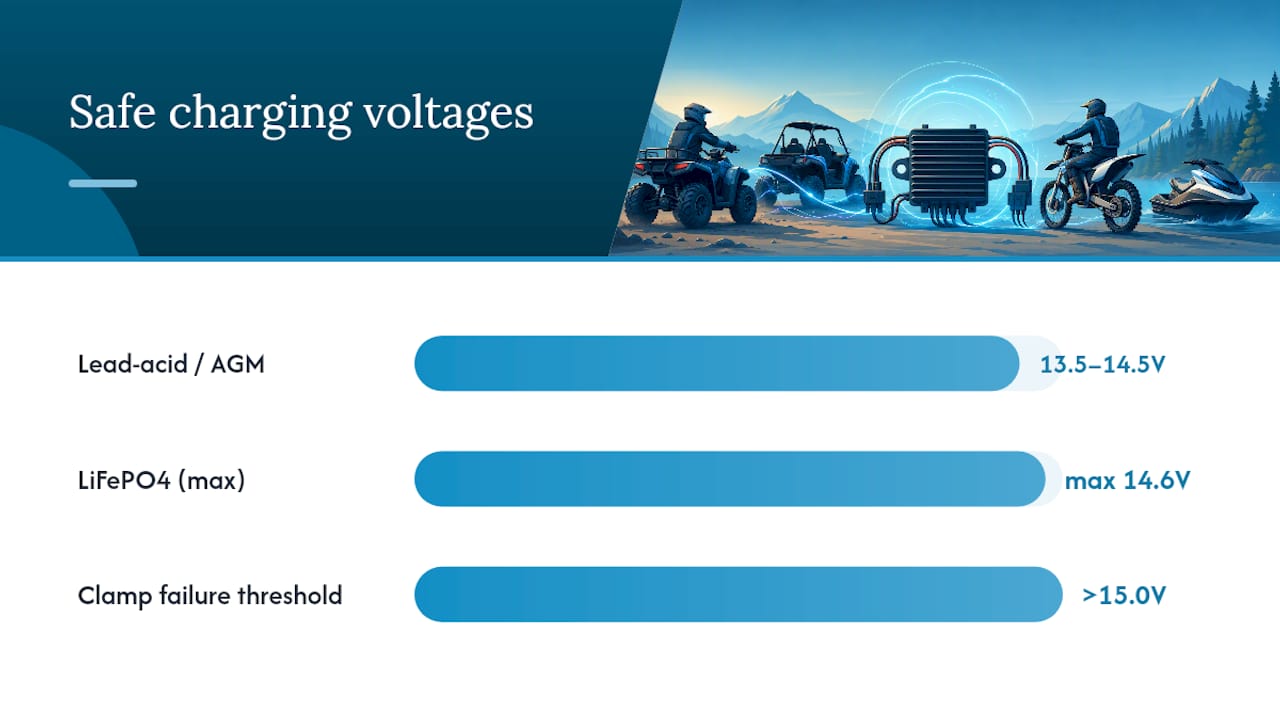
| Lead-acid / AGM | 13.5V–14.5V | 14.8V | Tolerates moderate ripple; overcharge causes gassing and plate damage |
| LiFePO4 | 13.6V–14.4V | 14.6V | Low ripple required; sustained voltages above 14.6V can cause permanent cell damage |
LiFePO4 cells have a hard ceiling of approximately 14.6V. Push past it consistently and you’re not just shortening battery life, you’re risking a cell that won’t recover. Lead-acid chemistry is more forgiving of brief spikes, but chronic overcharge still boils off electrolyte and corrodes plates.
Voltage alert: A regulator that allows output above 14.6V will permanently damage LiFePO4 cells. Even a few sustained cycles above that threshold can render a lithium battery unrecoverable.
High ripple is the second threat, and it’s less obvious. AC ripple riding on top of the DC charging signal stresses cell chemistry and can confuse battery management systems. Ripple, output noise, and transient response are core design parameters that separate a quality regulator from a cheap one. On the electronics side, excessive voltage spikes blow incandescent bulbs prematurely, can corrupt ECU memory, and shorten the life of any sensitive sensor or module on the CAN bus.
How do you test a voltage regulator with a multimeter?
Symptoms come first. A failing regulator typically shows up as flickering or dimming lights, difficulty starting, blown bulbs or fuses, or a battery that won’t hold a charge. You might also see an erratic voltage reading on a dash gauge. Any of these warrants a multimeter check before you buy parts.
Step-by-step voltage test:
-
Check resting battery voltage. With the engine off and the bike sitting for at least two hours, touch the DMM probes to the battery terminals. A healthy 12V lead-acid or AGM battery should read 12.6–12.8V. A LiFePO4 at rest typically reads 13.2–13.3V. Below 12.0V on lead-acid means the battery is discharged or failing.
-
Start the engine and check at idle. Rev to a stable idle (roughly 1,000–1,500 RPM) and read voltage at the battery terminals again. You should see 13.0–13.5V minimum. A reading below 12.8V at idle suggests the stator or regulator isn’t charging. Above 15.0V is an immediate red flag.
-
Rev to approximately 3,000 RPM and hold. This is where the regulator’s job gets real. Voltage should climb into the 13.5–14.5V range and hold steady. If it climbs well beyond the safe range and continues to rise, the regulator is not clamping output. If it stays flat at 12.8V or below, the regulator or stator may be failing.
-
Check for AC ripple (if your DMM supports it). Switch to AC voltage mode while the engine runs. More than 0.5V AC at the battery terminals indicates excessive ripple, a particular problem for LiFePO4 batteries.
Troubleshooting checklist after the test:
- Inspect all wiring harness connectors at the regulator/rectifier for corrosion, melted plastic, or loose pins
- Check the ground strap from the regulator to the frame; a poor ground causes erratic readings
- Measure stator output directly (AC voltage across stator leads with engine running) to isolate whether the stator or the regulator is the weak link
- Look for heat discoloration or burn marks on the regulator body itself
LiFePO4 batteries and charging-system compatibility
Most OEM regulators were engineered for lead-acid chemistry. That’s not a knock on the engineers; it’s just the reality of what was standard when those vehicles were designed. LiFePO4 cells have a narrower acceptable voltage window and a much lower tolerance for ripple, so the charging system that kept your AGM alive for four years may quietly damage a lithium battery over the same period.
The core issue is twofold. First, average output voltage must stay below 14.6V consistently, not just on average. A shunt regulator that occasionally spikes to 15V during a load dump can stress lithium cells even if the average reads fine. Second, powersports charging systems cannot balance individual lithium cells; the vehicle’s regulator charges the pack as a whole. Cell-level balancing requires a dedicated charger with a proper lithium charge profile.
Pro Tip: Use a dedicated LiFePO4-compatible maintainer whenever the vehicle sits for more than a week. The vehicle’s charging system keeps the pack topped up while riding, but a quality lithium charger handles the cell-balancing function that the regulator simply cannot perform. Follow your battery manufacturer’s charging guidance, not a generic lead-acid profile.
Bansheebatteries’s lithium powersports conversion guide covers regulator compatibility checks, recommended charger specs, and what to verify before swapping chemistry. For long-term storage, the LiFePO4 storage guide from Bansheebatteries walks through the correct state-of-charge and temperature practices that protect cell health between seasons.
If you’re ready to make the switch, Bansheebatteries’s lithium powersport battery collection includes chemistry-matched options for motorcycles, ATVs, and UTVs, backed by a 5-year warranty on marine lithium units.
Key Takeaways
The voltage regulator is the single component that determines whether your powersports charging system protects or destroys your battery and electronics, and a MOSFET-based series regulator is the right upgrade for any LiFePO4 build or accessory-heavy vehicle.
| Point | Details |
|---|---|
| Safe charging range | Lead-acid/AGM targets 13.5–14.5V; LiFePO4 maximum charging voltage is 14.6V. |
| MOSFET advantage | Series MOSFET regulators run cooler, charge better at idle, and produce lower ripple than shunt/SCR designs. |
| Test at 3,000 RPM | Voltage should hold 13.5–14.5V; above 15.0V means the regulator is not clamping output. |
| LiFePO4 cell balancing | The vehicle’s charging system cannot balance individual lithium cells; use a dedicated LiFePO4 maintainer. |
| Inspect before replacing | Check mounting, connectors, and grounding before buying a new unit; heat and corrosion cause most failures. |
The part most riders overlook until it’s too late
The voltage regulator is one of those components that gets zero attention until something expensive fails. Riders will spend hours researching tires or suspension and never once check whether their reg/rec is running at a safe temperature or producing clean output. That’s backwards.
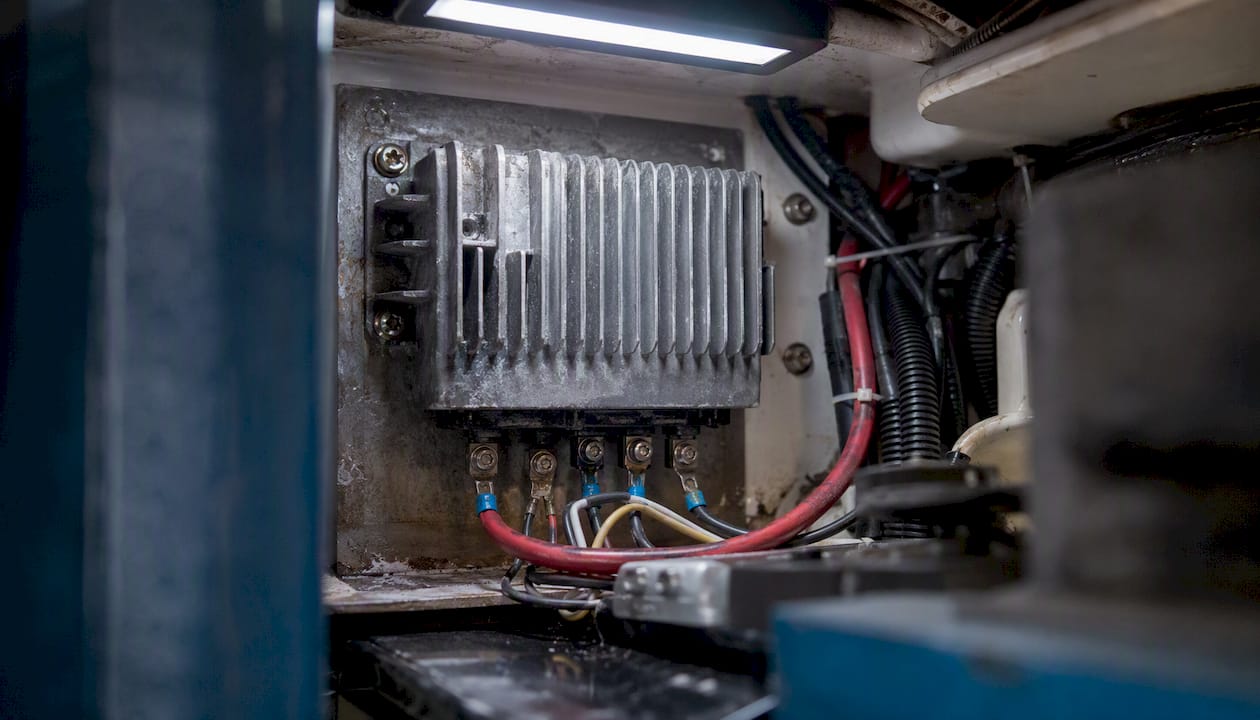
Here’s what actually matters in practice: the regulator’s mounting location and connector quality predict failure more reliably than brand or price. A quality MOSFET unit bolted into a dead-air pocket with a corroded ground will fail faster than a stock shunt regulator with clean connections and airflow. Fix the environment before you fix the part.
The lithium battery angle adds another layer most guides skip. Riders convert to LiFePO4 for the weight savings and cold-cranking performance, then run the same OEM shunt regulator that was designed for a flooded lead-acid battery. The chemistry mismatch is slow and invisible until a cell goes out of balance or the pack won’t hold a charge. A MOSFET upgrade and a dedicated lithium maintainer aren’t optional extras for a lithium build; they’re part of the conversion cost.
One practical habit worth keeping: carry a known-good spare regulator/rectifier on any multi-day ride in a remote area. The part is small, relatively inexpensive, and a failed reg/rec will strand you just as effectively as a blown engine. It’s the kind of redundancy that experienced riders build in quietly.
Authoritative sources and further reading
- Respect Your Regulator: Safely Charging Lithium Powersport Batteries - Adventure Motorcycle Magazine (ADVMoto)
- Voltage regulator - Wikipedia
- Voltage regulators guide — Keysight
- mer.alternator.rectifier.regulator.overview - Motolectric
- The Role of Voltage Regulators in ATV and UTV Performance - DB Electrical
- Why You Need to Pay More Attention to Your Voltage Regulator - Tribal Motorsports
- Voltage regulator design technical article - Analog Devices
- Lithium Battery Powersports Conversion: 2026 Guide - Banshee Battery