


Prevent Battery Drain Off-Season: A Vehicle Owner's Guide
To prevent battery drain off-season, take five actions before you park the vehicle: charge to the chemistry-appropriate level, disconnect the negative terminal or connect a smart maintainer, clean and tighten terminals, store the battery above freezing when possible, and schedule checks every 30–90 days. These steps apply whether you’re storing a motorcycle, RV, boat, or ATV — and skipping even one of them is how you end up with a dead battery in spring.
- Charge correctly: Lead-acid to 100%; LiFePO4 to 40–60% SOC for long-term storage.
- Disconnect or maintain: Pull the negative terminal, or connect a smart ISM/4-stage maintainer rated for your chemistry.
- Clean terminals: Remove corrosion, tighten clamps, and apply dielectric grease.
- Protect from freezing: Move the battery indoors or insulate the compartment if temps drop below 32°F.
- Schedule checks: Every 30 days in cold climates; every 60–90 days with a maintainer in mild storage.
Pro Tip: If you can’t remove the battery, use a temperature-compensating, ISM-capable maintainer. At freezing temperature, a 12V lead-acid battery requires a slightly higher absorption voltage for proper charging, and only a temperature-sensing maintainer adjusts for that automatically.
Table of Contents
- Why do batteries lose charge during off-season storage?
- Pre-storage checklist: what to do before you park for the season
- Leave it installed or remove it? Two storage strategies compared
- What to look for in a smart charger or maintainer
- How often should you check a battery in storage?
- How to test and recommission a stored battery before driving
- Signs a stored battery needs replacement
- Key Takeaways
- The part most owners get wrong about off-season battery care
- Bansheebatteries has the right battery and charger for your storage setup
Why do batteries lose charge during off-season storage?
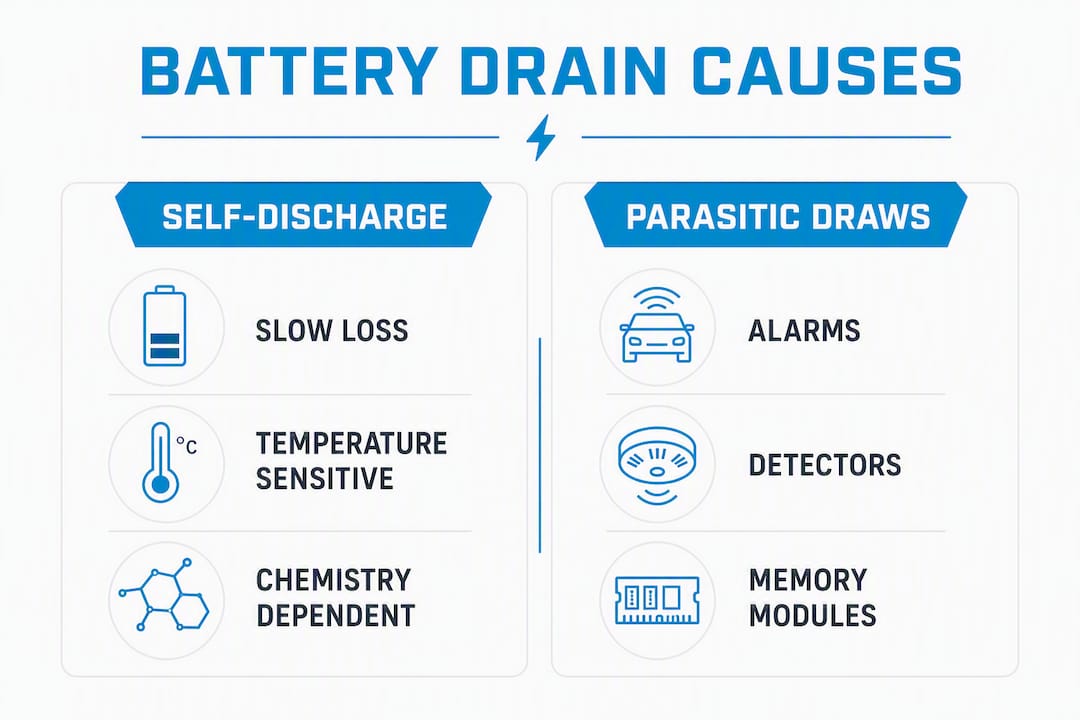
Two forces work against a stored battery: self-discharge and parasitic draws. Understanding both tells you exactly why the checklist above is ordered the way it is.
Self-discharge is unavoidable. Lead-acid batteries lose a small percentage of charge each month at around 50°F, and that rate increases as temperatures rise. Over a typical off-season duration, a battery stored at moderate indoor temperatures can lose a significant amount of its charge without any load connected. That matters because sulfation — the formation of lead sulfate crystals on the plates — accounts for roughly 80% of premature lead-acid failures, and it accelerates sharply once a battery drops below roughly 80% state of charge.
Parasitic draws are the faster killer. Detectors, alarms, clocks, and memory modules commonly pull 0.5–3.0 amps continuously. A 200 Ah battery bank at a 1A draw can be fully depleted in about eight days. Even with a disconnect switch set, many onboard systems keep drawing current — physically removing the negative terminal is the only guaranteed way to cut all parasitic loads.
Cold makes everything worse. Here’s the chemistry in plain terms:
| Chemistry | Self-Discharge (50°F) | Freeze Risk | Charge Restriction |
|---|---|---|---|
| Flooded lead-acid | moderate self-discharge per month | freeze risk rises at lower state of charge | no charge allowed below freezing |
| AGM | lower self-discharge per month | similar freeze risk to flooded lead-acid | no charge allowed below freezing |
| LiFePO4 | very low self-discharge per month | minimal freeze risk | BMS prevents charging below freezing temperature |
A fully charged lead-acid battery won’t freeze until temperatures reach around −92°F. Drop it to 50% charge and that freeze point rises to about 15°F — well within reach of a cold garage in Minnesota or Montana. LiFePO4 batteries face a different problem: their Battery Management System (BMS) will refuse to accept a charge below 32°F, and forcing a charge on a cold lithium cell risks lithium plating, which is permanent damage.
Pre-storage checklist: what to do before you park for the season
Work through this in order. The sequence matters — you want to know the battery’s health before you commit to a storage method.
-
Test battery health. Measure open-circuit voltage (OCV) after the battery has rested for at least two hours off the charger. A 12V lead-acid reading below 12.4V needs a full charge cycle before storage. A LiFePO4 reading below 13.0V should be recharged before setting the storage SOC.
-
Charge to the correct level. Bring lead-acid to 100% — this is not optional. A fully charged lead-acid battery’s freeze point drops to roughly −92°F, versus about 15°F at 50% SOC. For LiFePO4, charge to 40–60% SOC per manufacturer guidance; storing lithium at full charge accelerates long-term capacity loss.
-
Clean terminals and cases. Mix baking soda and water to neutralize corrosion on lead-acid terminals, rinse, and dry thoroughly. For lithium contacts, use a non-corrosive cleaner. Apply a thin layer of dielectric grease to all terminals after cleaning. Corrosion creates leakage paths that accelerate self-discharge and can cause a no-start condition even on a charged battery.
-
Inspect for damage. Look for swelling, cracks, electrolyte leaks, and frayed cables. For flooded lead-acid, check electrolyte levels and top up with distilled water to the marked line — never tap water.
-
Decide on removal. If your storage location drops below freezing, you lack shore power, or you can’t access the vehicle for checks, remove the battery and store it indoors.
-
Disconnect safely. Always remove the negative terminal first, then the positive. Reconnect in reverse order. Wear eye protection when handling lead-acid batteries — electrolyte is sulfuric acid. Avoid open flames or sparks near any battery being disconnected.
Proper pre-storage prep delivers far more lifespan protection than any mid-winter top-up charge. Getting the battery to the right state of charge before storage is the single highest-leverage step in this entire guide.
Leave it installed or remove it? Two storage strategies compared
The right choice depends on your climate, your access to shore power, and how often you can check on the vehicle.
| Factor | Leave installed + smart maintainer | Remove and store indoors |
|---|---|---|
| Shore power available | Ideal — maintainer runs continuously | Not required |
| Storage temp below 32°F | Risky for lead-acid unless heated | Eliminates freeze risk |
| Parasitic draws present | Maintainer compensates if draw is low | Eliminated entirely |
| Access for monthly checks | Convenient | Requires separate storage location |
| LiFePO4 in cold climate | BMS blocks charging; risk of damage | Preferred option |
Leaving the battery installed works well when you have reliable shore power and a quality ISM/4-stage maintainer. The maintainer monitors voltage and delivers a charge pulse only when the battery drops below a set threshold — it won’t overcharge. Basic trickle chargers are not a substitute; they deliver constant current regardless of battery state and can boil electrolyte over a long winter.
Removing the battery is the safer choice for cold climates, vehicles stored outdoors, and LiFePO4 packs. Store on a wooden board or insulation pad — not directly on concrete, which can accelerate discharge through moisture contact. Keep the storage location between 40°F and 70°F. For LiFePO4, storage above 32°F is the minimum; 50–68°F is ideal.
Pro Tip: No shore power? A small solar trickle panel (5–10W) with a proper charge controller can maintain a lead-acid battery through winter. Without the controller, the panel can overcharge — the controller is not optional.
What to look for in a smart charger or maintainer
Not all chargers are built for long-term storage duty. Here’s what actually matters when you’re selecting one.
Must-have features:
- Multi-stage (ISM/4-stage) charging: Bulk, absorption, float, and maintenance stages. The maintainer monitors voltage and only pulses when needed — safe for indefinite connection.
- Temperature compensation: Automatically adjusts absorption voltage based on ambient temperature. Without it, a lead-acid battery in a cold garage won’t reach full charge.
- Chemistry profiles: Separate settings for AGM, flooded lead-acid, and LiFePO4. Using a lead-acid profile on a lithium battery can damage the BMS.
- Low-current maintenance mode: A 1–2A maintainer is appropriate for most motorcycle, ATV, and small marine batteries during storage. A 10A charger is better for pre-storage conditioning on larger banks.
- Automatic return-to-charge: If voltage drops below the float threshold, the unit restarts the charge cycle automatically.
What to avoid: Consumer-grade RV converters and basic trickle chargers are not suitable for months-long storage. They deliver constant current without monitoring battery state, which risks overcharging and electrolyte loss in lead-acid batteries.
Safety note for lithium: Never charge a LiFePO4 battery below 32°F. If the battery has been in a cold garage, wait 20–30 minutes after bringing it indoors before connecting a charger. Cold lithium cells can’t accept charge safely, and forcing one risks lithium plating — a failure mode with no repair.
Pro Tip: An inline battery disconnect switch eliminates parasitic draws without physically removing the battery. Pair it with a simple voltage monitor (many run under $20) to check battery state without opening the compartment.
Bansheebatteries carries chargers sized for both small powersport batteries and larger marine/RV banks, including units with the multi-stage profiles described above. Their 10A automatic charger covers 6–230Ah lead-acid batteries and includes overcharge and short-circuit protection.
How often should you check a battery in storage?
The baseline is every 30–90 days, but the right interval depends on your setup.
-
Monthly (every 30 days): Cold climates, suspected parasitic draws above 0.5A, flooded lead-acid without a maintainer, or any battery stored without shore power.
-
Every 60 days: Mild climates, AGM or LiFePO4 with a smart maintainer connected, storage temperatures stable between 40–70°F.
-
Every 90 days: Heated indoor storage, ISM maintainer confirmed running, LiFePO4 at 40–60% SOC with no parasitic loads.
At each check, verify:
- Maintainer LED status (green = float/maintenance; amber or red = investigate)
- Battery OCV or maintainer-reported voltage
- Electrolyte level for flooded lead-acid
- Terminal condition — any new corrosion or loosening
- BMS indicator lights on lithium packs
Increase frequency if storage temperatures vary widely or if a previous check showed voltage below 12.4V (lead-acid) or below 50% SOC (LiFePO4). Monthly visual checks combined with a maintainer’s status LED are a low-effort way to catch problems before they become replacements.
Pro Tip: Keep a simple log — date, OCV reading, charger status, and any observations. Three months of data will show you a trend before the battery fails. A sudden voltage drop between two otherwise-stable readings is almost always a sign of a developing cell fault.
How to test and recommission a stored battery before driving
Don’t just start the vehicle and hope for the best. A five-minute check before the first drive of the season can save you a tow.
-
Visual inspection first. Look for swelling, cracks, corrosion, and loose cables. Any swelling means the battery should not be reinstalled — dispose of it properly.
-
Clean terminals. Even with pre-storage prep, some oxidation may have formed. Clean and re-grease before reconnecting.
-
Measure OCV. For a 12V lead-acid battery, 12.6–12.8V indicates a full charge. Below 12.4V, run a full charge cycle before attempting to start the vehicle. For LiFePO4, target 13.2V or above for full function — check your manufacturer’s spec sheet for the exact return-to-service voltage.
-
Recharge if needed. Use the correct chemistry profile. For lithium batteries that have been in cold storage, bring the battery to room temperature first and wait before charging — cold lithium cells cannot safely accept a charge.
-
Load test if in doubt. If the battery holds voltage at rest but struggles under load (slow crank, dim lights), a professional load test will confirm whether capacity has dropped below a usable threshold. Most auto parts stores offer free load testing.
-
Verify alternator recharge. After the first drive, check that voltage at the battery terminals reads 13.5–14.5V with the engine running. If it doesn’t, the charging system needs attention before the next trip.
Signs that warrant bench testing rather than a field check:
- Voltage recovers after charge but drops quickly at rest
- Battery won’t hold charge for more than a few days
- Visible plate damage or electrolyte discoloration in flooded cells
Signs a stored battery needs replacement
Maintenance can extend battery life significantly, but it can’t reverse every failure mode. Here’s when to stop trying and replace.
Replace when you see:
- Rapid voltage drop after a full charge (lead-acid returning to below 12.2V within hours)
- Visible swelling, cracks, or case distortion — discard immediately
- Electrolyte leaks or a rotten-egg smell (hydrogen sulfide from a failing lead-acid cell)
- Persistent low capacity on a load test — capacity below 70–80% of rated is the standard replacement threshold
- BMS faults on LiFePO4 that don’t clear after a full charge cycle
Typical lifespans by chemistry:
- Flooded lead-acid: 3–5 years with proper maintenance
- AGM: 4–7 years; Bansheebatteries backs their AGM batteries with a 4-year warranty
- LiFePO4: 8–12 years under normal use; Bansheebatteries offers a 5-year warranty on lithium marine batteries
Improper storage commonly results in $200–$800 in replacement or repair costs for RV and boat battery systems. A $30–$60 smart maintainer and one pre-storage hour of prep eliminates most of that risk. Before replacing, confirm the diagnosis with a professional load test — a battery that looks dead after storage sometimes just needs a proper multi-stage charge cycle to recover.
For a detailed diagnostic checklist, Bansheebatteries has a guide covering the top signs a battery needs replacement that walks through each failure indicator by chemistry type.
Key Takeaways
A fully charged lead-acid battery, a smart ISM maintainer, and a 30–90 day check schedule are the three things that prevent most off-season battery failures.
| Point | Details |
|---|---|
| Charge to the right level | Lead-acid to 100% before storage; LiFePO4 to 40–60% SOC to reduce long-term stress. |
| Disconnect or maintain | Remove the negative terminal or use an ISM/4-stage maintainer — basic trickle chargers risk overcharging. |
| Temperature matters | Lead-acid at 50% SOC freezes at ~15°F; LiFePO4 BMS blocks charging below 32°F. |
| Check every 30–90 days | Monthly in cold climates or without a maintainer; every 60–90 days in mild, maintained storage. |
| Bansheebatteries AGM and LiFePO4 | Backed by 4-year and 5-year warranties respectively — built for the storage conditions this guide covers. |
The part most owners get wrong about off-season battery care
Most guides treat off-season battery care as a single task — charge it, disconnect it, done. The real failure point is the middle of winter, not the day you park the vehicle. A battery that was in good shape in November can be sulfated beyond recovery by February if storage temperatures fluctuate and no one checks it.
The chemistry-specific rules are where owners consistently make mistakes. Storing a LiFePO4 at 100% charge because “full is always better” is the lead-acid habit applied to the wrong battery — and it accelerates capacity loss. Conversely, leaving a flooded lead-acid at 50% charge in a cold garage because “it’ll be fine for a few months” is how you end up with a cracked case and frozen electrolyte.
The 30–90 day check schedule isn’t bureaucratic caution. It’s the interval at which a maintainer problem, a developing cell fault, or an unexpected parasitic draw becomes visible before it becomes permanent. A voltage log with four entries over a winter tells you more about battery health than any single spring test. That’s the habit that actually separates owners who replace batteries every two years from those who get six or seven years out of the same pack.
Bansheebatteries has the right battery and charger for your storage setup
If this guide has you reconsidering your current battery or maintainer, Bansheebatteries builds AGM and LiFePO4 batteries specifically for the powersports and marine applications where off-season storage is a real annual concern. Their LiFePO4 marine batteries are engineered for the chemistry-specific storage requirements covered here — partial SOC storage, temperature tolerance, and BMS protection — and carry a 5-year warranty. For motorcycle and ATV owners, the lithium powersport line covers the same chemistry-specific needs in a smaller form factor.
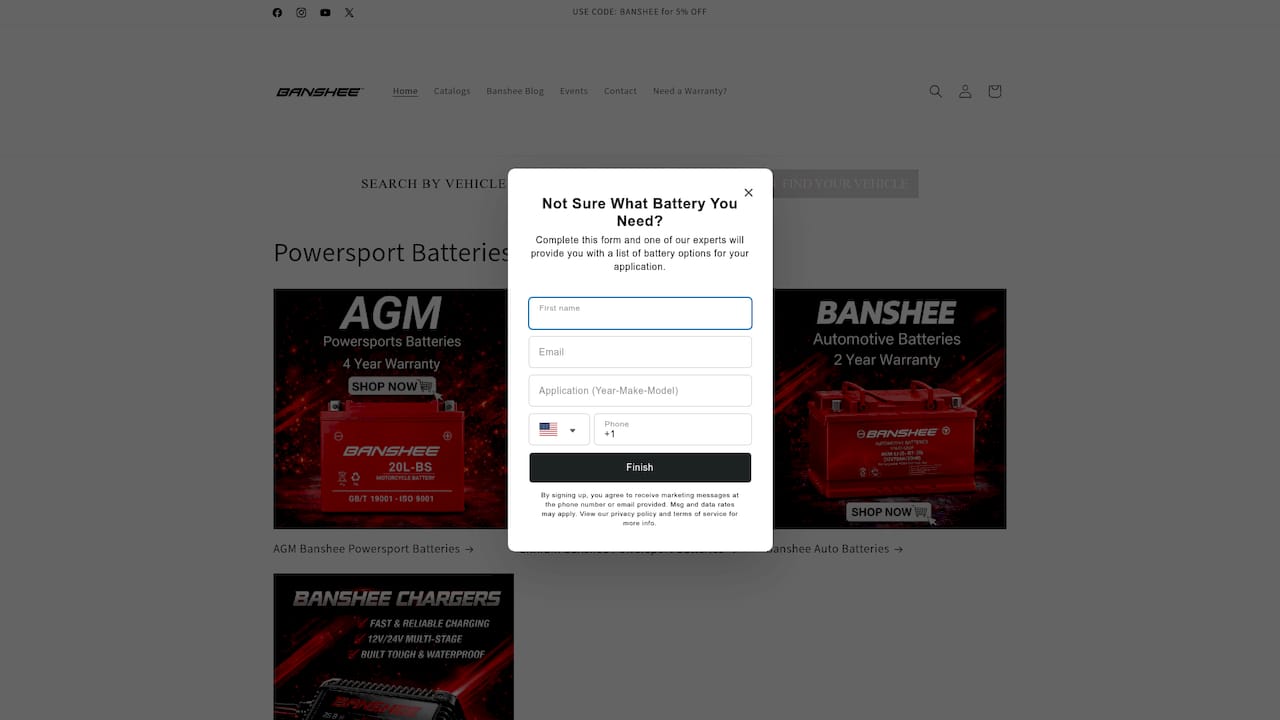
Their charger lineup includes multi-stage units sized for both small powersport batteries and larger marine banks, with the overcharge protection and chemistry profiles that make long-term storage connection safe. Browse the full catalog at Bansheebatteries.com and use the vehicle-specific battery finder to confirm the right fit before you order.
Sources and further reading
- Battery Tender — How to Winterize RV Battery Banks: Self-discharge rates, parasitic draw data, ISM charging standards, freeze-point data, and storage cost estimates for RV/marine applications.
- Battery Tender — Winterizing Boat Batteries: LiFePO4 storage SOC guidance, terminal cleaning procedures, and monthly monitoring recommendations for marine batteries.
- Chargie.org — Cold Weather Battery Drain Guide: Lithium plating risk from cold charging and the 20–30 minute warm-up recommendation before charging cold lithium cells.
- Vatrer Power — RV Battery Winter Storage Guide: Chemistry-by-chemistry storage tips, temperature ranges, and monitoring intervals for flooded, AGM, gel, and LiFePO4 batteries.