


Why Lithium Often Costs Less Per Year. Motorcycle Battery Cost for Riders
A flooded lead-acid motorcycle battery runs about $40 to $85, an AGM battery lands between $70 and $160, and a LiFePO4 lithium unit costs $120 to $400. Installed labor typically adds an amount that can vary substantially depending on how buried the battery is on your bike. Lithium costs more today, but its longer service life usually makes it cheaper per year of ownership than the alternatives.
TL;DR:
- Lithium batteries, though more expensive upfront, typically last nearly a decade, reducing long-term replacement costs compared to lead-acid options.
- Labor costs for installation vary significantly based on bike model and accessibility, ranging from $10 on simple bikes to over $120 on complex, accessorized models.
- Proper specification matching, especially CCA and physical fit, prevents early battery failure and voided warranties, saving money over time.
- Using a designated charger or maintainer can extend battery life, especially for lead-acid and AGM types, and is a cost-effective way to avoid premature replacements.
- Longer warranty coverage on higher-priced batteries offers better overall value by shifting risk away from the rider, particularly with lithium and AGM options.
Table of Contents
- How Much Does a Motorcycle Battery Cost by Chemistry?
- What Does It Cost to Get a Motorcycle Battery Installed?
- Does a More Expensive Battery Actually Save You Money?
- Why Does the Wrong Battery Spec Cost You More Later?
- What Maintenance Habits Actually Lower Your Battery Bill?
- What Warranty Coverage Should Change Your Buying Decision?
- Which Battery Actually Fits Your Riding Style?
- Where to Find the Right Battery and Charger for Your Bike
- Sources
How Much Does a Motorcycle Battery Cost by Chemistry?
Price differences between battery types aren’t random markup. Each chemistry uses different materials, manufacturing processes, and internal engineering, and those differences show up directly on the price tag.
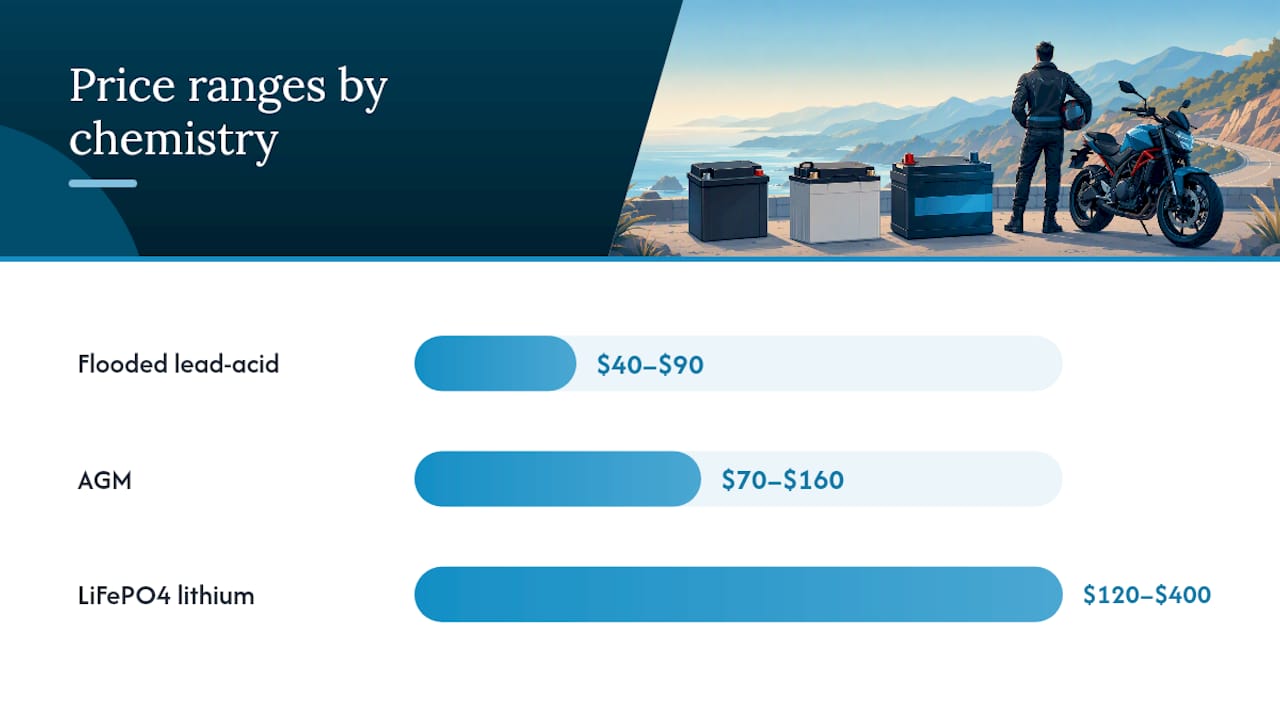
Flooded lead-acid batteries sit at the bottom of the price scale for a reason: they’re the oldest, simplest design on the market. You get lead plates submerged in liquid sulfuric acid electrolyte, housed in a vented case. Manufacturing costs are low, the technology has been refined for over a century, and that translates to retail prices between $40 and $90. The tradeoff is maintenance. You have to check fluid levels, they’re vulnerable to spills if the bike tips, and they lose charge faster when parked. Riders spend about $85 on average for a standard replacement across all chemistries, and flooded lead-acid is usually what pulls that average down.
AGM (absorbed glass mat) batteries occupy the middle ground, and it’s a comfortable one. The electrolyte is absorbed into a fiberglass mat instead of sitting as free liquid, which means no spills, no maintenance top offs, and better vibration resistance. That construction pushes retail prices to roughly $70 to $160, depending on capacity and cold cranking amps. Most mid-size cruisers, sport bikes, and standard commuters end up here. It’s the chemistry most riders default to because it balances upfront cost against reliability without asking for babysitting.
LiFePO4 lithium batteries carry the highest sticker price, ranging from about $120 to $400 depending on capacity and brand. You’re paying for a battery that weighs roughly a third of an equivalent lead-acid unit, holds voltage more consistently under load, and self-discharges far more slowly when the bike sits idle. Retailers like RevZilla list lithium products spanning that entire range, with premium high-CCA units commanding the top end.
Within any single chemistry, CCA rating and amp-hour capacity are what move the price up or down. A small dual-sport with a 250cc engine might need only 100 to 120 CCA, while a big touring bike or V-twin cruiser can demand 200 CCA or more to turn over a larger engine. Higher CCA means thicker plates or denser lithium cells, and that costs more to manufacture.
Typical retail price bands by chemistry:
- Flooded lead-acid: $40 to $90, best for budget-focused riders willing to do fluid checks
- AGM: $70 to $160, the default choice for most street and cruiser bikes
- LiFePO4 lithium: $120 to $400, best for weight-conscious or performance riders
Quick stat: Riders spend an average of $85 on a standard motorcycle battery replacement, though the full retail spread runs from $45 to $250 depending on chemistry and CCA requirements.
What Does It Cost to Get a Motorcycle Battery Installed?
Buying the battery is only part of the bill. Labor charges vary more than most riders expect, and the difference comes down to how much of the bike a mechanic has to take apart to reach the battery tray.
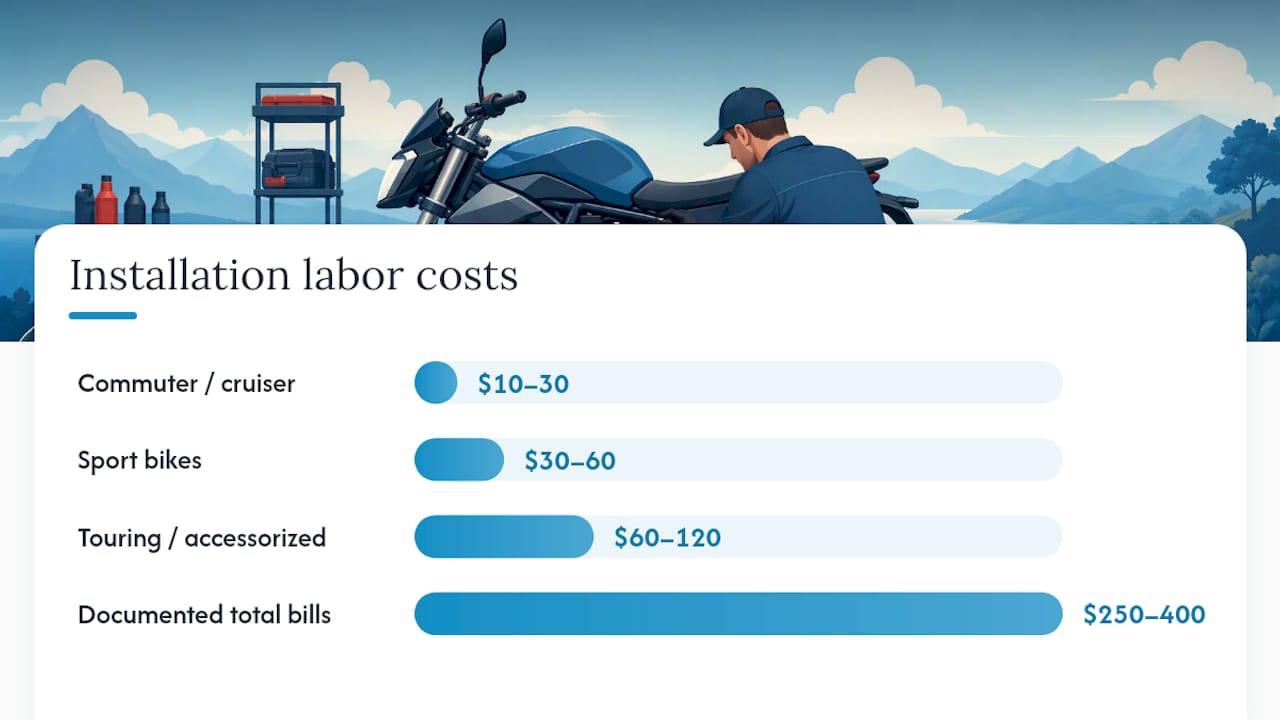
A naked commuter bike or standard cruiser with an accessible battery compartment usually adds just $10 to $30 in labor, since the job is a five-minute swap. Sport bikes and bikes with full fairings push that number higher, often $30 to $60, because side panels and sometimes tank covers have to come off first. Touring bikes and heavily accessorized cruisers with saddlebags, alarm systems, or aftermarket electronics can run $60 to $120 in labor, and in some documented cases, total bills including the battery reached $250 to $400 once parts and shop time were combined.
What drives labor time up:
- Fairings, tank shrouds, or saddlebags that block direct access to the battery tray
- Alarm systems or aftermarket ECUs that need a reset or reprogram after disconnect
- Battery trays mounted under the seat pan, tank, or behind side covers
- Bikes with keyless ignition systems that require relearning after a power interruption
DIY replacement makes sense for anyone comfortable with a wrench and a multimeter, especially on bikes where the battery sits under a simple seat latch. It’s a straightforward swap: disconnect negative first, connect positive last, torque the terminals, done. Where a shop visit earns its fee is on bikes with security systems, complex fairings, or when you want the old battery tested to confirm it’s actually the failure point rather than a charging system problem. Many shops also waive the install fee if you buy the battery from them directly, which is worth asking about before you commit to a DIY job just to save labor cost.
Does a More Expensive Battery Actually Save You Money?
The math depends entirely on how long each chemistry actually lasts, and the gap is bigger than most riders assume.
Flooded lead-acid batteries typically last a couple of years under normal riding conditions, less if the bike sits unused for long stretches or gets exposed to temperature swings. AGM batteries generally hold up for several years thanks to their sealed, vibration-resistant construction. LiFePO4 lithium batteries often push past several years and can reach close to a decade of service life, largely because lithium chemistry resists the slow capacity loss that plagues lead-based batteries sitting in storage.
Run that out over an 8 year ownership window and the picture flips. A rider on flooded lead-acid might replace the battery three times at $60 average, landing around $180 in battery costs alone, not counting labor each time. An AGM rider replacing twice at $110 average spends about $220. A lithium rider who buys once at $250 and never replaces it spends less overall, even though the single purchase looked expensive on day one.
Extra costs that factor into true ownership cost:
- Core charges on old lead-acid batteries, which can add to upfront costs though may be refunded on return, refunded on return but easy to forget about upfront
- A dedicated lithium-compatible maintainer, often recommended to avoid damaging LiFePO4 cells, which can cost tens to over one hundred dollars
- Shipping fees on lead-acid batteries, which sometimes include hazardous material surcharges that lithium and AGM batteries avoid
Quick stat: Lithium’s low self-discharge rate makes it especially cost-effective for seasonal riders whose bikes sit for months at a stretch, since it needs far less babysitting to stay usable in spring.
Why Does the Wrong Battery Spec Cost You More Later?
Buying by price alone is how riders end up replacing a battery twice as often as they should. Cold cranking amps, amp-hour capacity, and physical fitment aren’t optional details, they’re what determines whether a battery actually survives on your bike.
- Check your CCA requirement first. A small single-cylinder or twin needs less cranking power than a big V-twin or four-cylinder engine, and installing a battery rated below spec forces it to work harder on every start, shortening its life dramatically.
- Match amp-hour capacity to your electrical load. Bikes with heated grips, extra lighting, or aftermarket audio draw more reserve capacity, and an undersized battery drains faster and sulfates sooner.
- Confirm physical dimensions and terminal orientation before ordering. A battery that’s a fraction of an inch too tall won’t seat properly, and reversed terminals can mean rerouting cables that weren’t designed to stretch that far.
- Use a vehicle-specific fitment tool rather than guessing from memory. Mechanics consistently point to incorrect CCA or fitment as a leading cause of batteries failing well before their expected lifespan.
Skipping these checks doesn’t just risk a bad fit. An under-rated battery works harder on every cold start, degrades faster, and often fails within a year, meaning you pay for a “cheap” battery twice within the time a properly matched one would have lasted.
Pro Tip: Write down your bike’s exact battery group size and CCA rating from the owner’s manual before you shop. Comparing three listings side by side is a lot easier when you’re not guessing at specs from memory.
What Maintenance Habits Actually Lower Your Battery Bill?
The single biggest lever most riders ignore is the charger sitting in their garage, or the one they never bought.
A smart charger or trickle maintainer can cost from tens to over one hundred dollars depending on amperage and charging technology. That’s a one-time cost that can prevent sulfation on lead-acid and AGM batteries during winter storage, and it keeps lithium cells balanced so they don’t degrade prematurely. Riders who store bikes for months without a maintainer often find a “dead” battery each spring that’s really just a sulfated one, sometimes salvageable, often not.
Habits that extend battery life and lower lifetime cost:
- Connect a maintainer any time the bike sits idle for more than two weeks
- Keep terminals clean and lightly greased to prevent corrosion-related voltage drops
- Store batteries in moderate temperatures, since extreme heat or cold accelerates capacity loss
- Use a charger rated for your specific chemistry, since a standard lead-acid charger can damage lithium cells
Comparing the math, a $50 maintainer that adds even one extra year of service to a $150 AGM battery pays for itself easily. Riders who buy batteries online to save money often skip this step, then wonder why the “bargain” battery died a year early.
Quick stat: A basic maintainer purchase in a moderate price range routinely costs less than a single premature battery replacement, which is the real ROI case for owning one.
For readers troubleshooting a battery that seems to drain repeatedly despite proper charging, a comprehensive look at common battery issues covers diagnostic steps that apply just as well to powersports charging systems as they do to cars.
What Warranty Coverage Should Change Your Buying Decision?
Warranty length is where a higher sticker price starts to make more sense on paper. Banshee Batteries offers warranties on its AGM and lithium marine batteries, built on years of experience designing AGM and LiFePO4 batteries specifically for powersports and marine conditions.
That warranty window matters because it shifts risk off the rider. If a $250 lithium battery is backed for 5 years and a cheaper unmarked import carries a 1-year warranty, the real comparison isn’t the sticker price, it’s what happens if the battery fails in year three. Longer coverage lowers the effective cost of the higher-priced option because you’re not paying full replacement price if it underperforms early.
Matching CCA, physical fitment, and charger compatibility to the manufacturer’s specs is also what keeps a warranty valid in the first place. Skipping that step, or using an incompatible charger on a lithium battery, is one of the fastest ways to void coverage you already paid for.
Which Battery Actually Fits Your Riding Style?
If you commute daily and just need reliability without fuss, AGM is the sensible default. Seasonal riders who park their bike for winter should lean lithium, since low self-discharge means less babysitting between rides. Long-distance touring riders benefit most from lithium’s weight savings and consistent voltage under heavy electrical loads. Performance riders chasing every pound saved should also go lithium, full stop.
Before you buy anything, run through this checklist: your budget ceiling, how many years you want out of the battery, whether shaving weight actually matters for your riding, and how the bike is stored between rides. Get those four answers straight and the chemistry choice picks itself.
— Donald
Where to Find the Right Battery and Charger for Your Bike
You’ve seen the price ranges, the lifespan math, and why fitment mistakes cost more than the battery itself. Banshee Batteries offers AGM and LiFePO4 batteries designed for powersports and marine use, supported by warranties on these products.
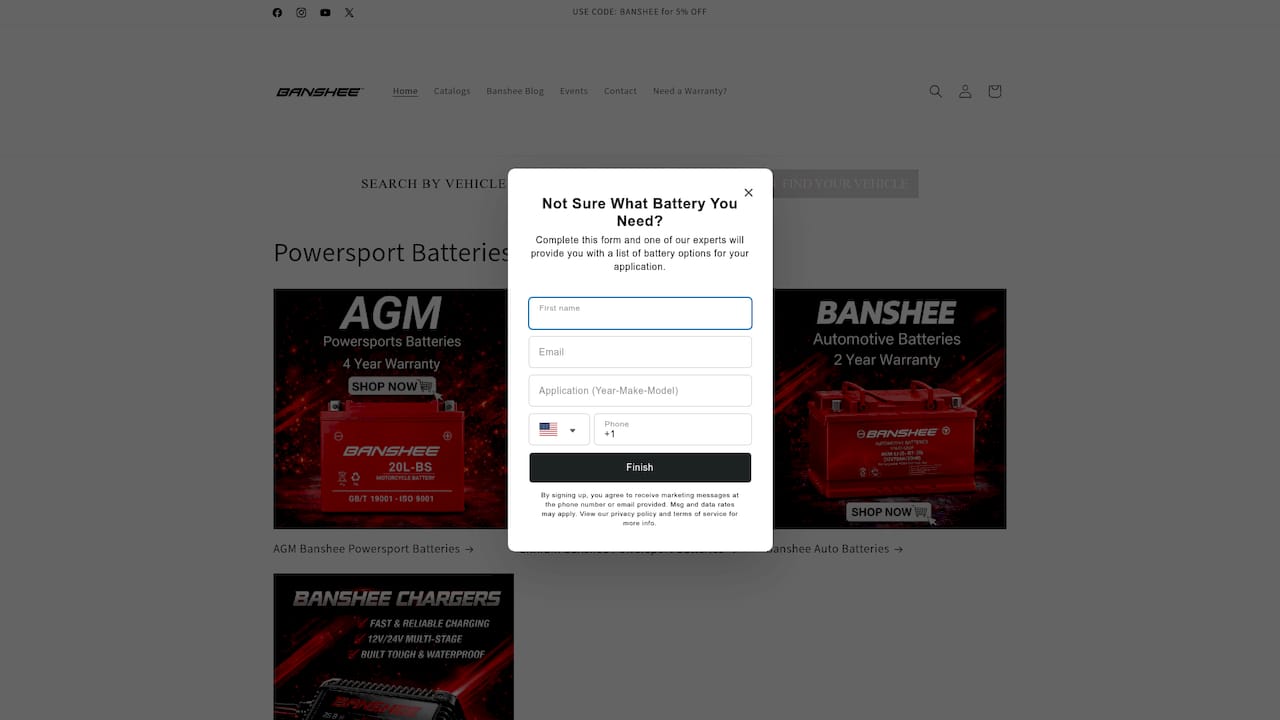
The lithium motorcycle battery collection covers the weight-conscious and long-life end of the spectrum discussed above, while riders who want the AGM middle ground can compare options through the Banshee Batteries homepage, which links to the full product range and a vehicle-specific battery finder. If you’re pairing a new lithium battery with a maintainer, a compatible lithium charger protects that warranty instead of accidentally voiding it. Run your bike’s CCA and group size through the finder tool first, then pick the chemistry that actually matches how you ride and store your bike.
Sources
Price ranges and lifespan figures in this guide draw on cost breakdowns from EngineerSkill’s price guide and Leoch Lithium America’s replacement cost analysis. For a deeper technical comparison, see Banshee’s guide to AGM vs lithium motorcycle batteries.
- Engineerskill
- Motorcycle Battery Replacement Cost: What Riders Should Expect and How to Choose the Right Option | Leoch Lithium America
- How Much Does It Cost To Replace A Motorcycle Battery? - SlashGear