


How to Calculate Marine Battery Runtime Accurately
The core formula for marine battery runtime calculation is simple: Ah required = total current draw (A) × desired runtime (h). Run 3.5 amps of electronics for 8 hours, and you need 28 Ah of rated capacity before any adjustments. In watt-hours: Wh = Ah × V (so a 12V, 28 Ah need equals 336 Wh). Going the other direction: Ah = Wh ÷ V. A LiFePO4 battery gives you 80–95% usable capacity, so 28 Ah needed means roughly 30–35 Ah rated.
Key Takeaways
Accurate marine battery sizing comes down to three numbers: your total amp draw, your target runtime, and your battery’s usable DoD percentage — get those right and the rest is arithmetic.
| Point | Details |
|---|---|
| Core runtime formula | Ah = A × h; apply DoD (50% AGM, 90% LiFePO4) and add a 20% safety margin. |
| Wh conversion | Wh = Ah × V; Runtime (h) = Battery Wh × efficiency ÷ total load watts. |
| Derate for real conditions | Subtract 10–30% for cold, age, or high discharge rates before finalizing bank size. |
| LiFePO4 doubles usable capacity | A 100 Ah LiFePO4 delivers ~85 usable Ah vs. ~40 Ah from an equivalent AGM. |
| Bansheebatteries sizing support | Bansheebatteries LiFePO4 marine batteries carry a 5-year warranty; use the marine size guide to confirm Ah before ordering. |
Table of Contents
- How to run a marine battery runtime calculation step by step
- How the watts method works and when to use it
- How battery chemistry changes how much power you actually get
- Three worked examples for common boating scenarios
- Real-world factors that shrink your calculated runtime
- Battery sizing checklist before you buy or pack a spare
- How to use a calculator or spreadsheet to validate your math
- Why LiFePO4 is usually the right call for serious marine use
- Ready to size and order your marine battery
- Installer’s practical tips and maintenance checklist
- Sources
How to run a marine battery runtime calculation step by step
Getting the right number starts with knowing exactly what’s running on your boat and for how long.
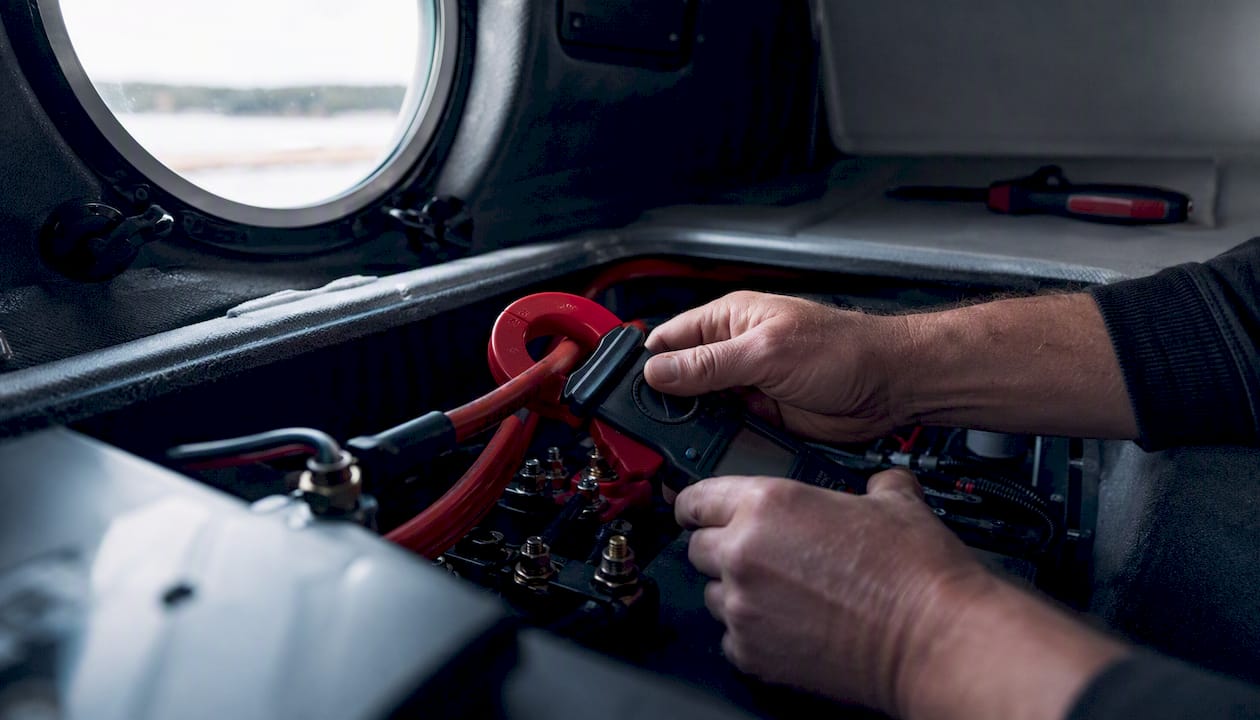
Collect your device current draws from the label on each device, the owner’s manual, or measure directly with an inline ammeter. Fishfinders, VHF radios, GPS units, and bilge pumps all list amp draw somewhere.
Step 1: Total your current draw. Add the amps of every device running simultaneously. A GPS at 0.5 A, a VHF at 1.5 A, and running lights at 1.5 A gives you 3.5 A total.
Step 2: Choose your target runtime. Pick a realistic number of hours for your trip, not the optimistic one. An 8-hour day on the water is a reasonable baseline for most anglers.
Step 3: Apply the Ah formula.
Ah = A × h → 3.5 A × 8 h = 28 Ah
Step 4: Adjust for usable capacity and add a safety margin.
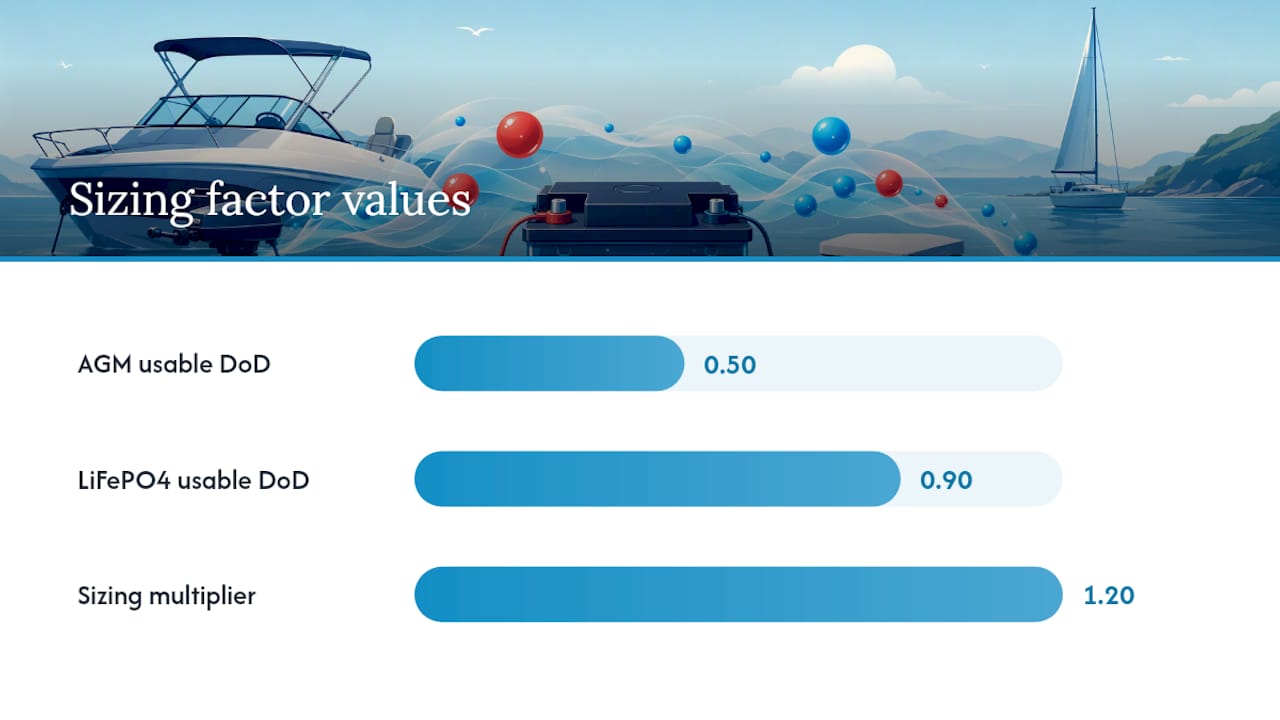
- Lead-acid (AGM): usable capacity is ~50% DoD → 28 ÷ 0.50 = 56 Ah rated
- LiFePO4: usable capacity is high, typically around 90%, so 28 Ah needed indicates about 31 Ah rated capacity
- Add a 20% safety margin on top: 56 × 1.20 = 67 Ah for lead-acid; 31 × 1.20 = 37 Ah for LiFePO4
The Humminbird battery runtime guide confirms that lead-acid should not go below ~50% DoD, and that LiFePO4 efficiencies run 90–95%.
Pro Tip: For intermittent devices like a livewell pump or bilge pump, don’t use peak draw. Estimate how many minutes per hour they actually run, then calculate average draw: a pump pulling 4 A for 15 minutes per hour averages 1 A over that hour.
How the watts method works and when to use it
When device specs list watts instead of amps, or when you’re running a mixed-voltage system, the watt-based approach is cleaner.
The core conversions:
- Watts from amps: W = A × V
- Wh from Ah: Wh = Ah × V
- Ah from Wh: Ah = Wh ÷ V
- Runtime: Runtime (h) = Battery Wh × efficiency ÷ total load (W)
Worked example: A 12V 100 Ah battery holds 1,200 Wh.
Runtime = 1,200 × 0.90 ÷ 50 = 21.6 hours
That’s the full rated capacity. DigiKey’s battery life calculator uses this same capacity ÷ consumption × efficiency logic and notes that outputs are estimates affected by age, temperature, and discharge rate.
Prefer the watts method when: you’re running an inverter, mixing 12V and 24V accessories, or your trolling motor specs are listed in watts rather than amps.
How battery chemistry changes how much power you actually get
Two batteries labeled “100 Ah” do not deliver the same usable energy. Chemistry determines how much of that rating you can actually use.
- Lead-acid (AGM): ~50% safe DoD, ~80% effective efficiency. A 100 Ah AGM gives you roughly 40 usable Ah (100 × 0.50 × 0.80).
- LiFePO4: ~80–95% usable DoD, 90–95% efficiency. A 100 Ah LiFePO4 gives you roughly 85 usable Ah (100 × 0.90 × 0.95).
That’s more than double the practical energy from the same labeled capacity.
Cycle life compounds the difference. AGM batteries typically deliver a few hundred deep cycles before significant capacity loss. LiFePO4 cells routinely handle 2,000–3,000+ cycles. For a tournament angler running the trolling motor hard every weekend, that gap translates directly into replacement cost and reliability.
Sizing for repeated heavy use? Check manufacturer specs and warranty terms before committing to a bank size. Bansheebatteries backs its LiFePO4 marine batteries with a 5-year warranty and its AGM line with a 4-year warranty — concrete signals of expected service life that should factor into your capacity math.
The marine battery runtime calculator at VoltCalcs demonstrates this with trolling-motor scenarios: the same motor running at medium versus max thrust produces dramatically different runtimes, and LiFePO4’s deeper usable DoD consistently extends the day.
Three worked examples for common boating scenarios
Example A: Small-electronics day
- AGM (50% DoD + 20% margin): 23.5 ÷ 0.50 × 1.20 = 56 Ah rated
- LiFePO4 (90% DoD + 20% margin): 23.5 ÷ 0.90 × 1.20 = 31 Ah rated
Recommendation: A 12V 100 Ah LiFePO4 covers this load with substantial reserve.
Example B: Mixed day with livewell pump and low-speed trolling motor
Livewell pump: 4 A peak, runs 15 min/hr → 1 A average. Fishfinder: 2 A. Trolling motor at low speed: 20 A, used 2 hours of an 8-hour day → weighted draw = (20 × 2 + 0 × 6) ÷ 8 = 5 A average. Total average draw: 1 + 2 + 5 = 8 A. The AllAboutCircuits battery life calculator uses this same time-weighted averaging for mixed duty-cycle loads.
8 A × 8 h = 64 Ah → LiFePO4 (90% DoD + 20% margin): 64 ÷ 0.90 × 1.20 = 85 Ah rated
Recommendation: A 100 Ah LiFePO4 handles this comfortably. With AGM, you’d want 150+ Ah.
Example C: Heavy trolling-motor session
A 24V trolling motor at medium thrust draws ~30 A at 24V = 720 W. Running 5 hours:
Energy needed = 720 W × 5 h = 3,600 Wh → at 90% DoD and 92% efficiency: 3,600 ÷ (0.90 × 0.92) = 4,348 Wh bank needed
Two 12V 100 Ah LiFePO4 batteries in series = 24V 100 Ah = 2,400 Wh. That’s not enough for 5 hours at this draw. Recommendation: size for a 24V 200 Ah bank, or plan a mid-day charge stop. See the marine battery bank setup guide for series/parallel wiring details.
Real-world factors that shrink your calculated runtime
The theoretical number almost always beats the real one. Here’s what cuts into it and by how much:
- Cold temperature: battery capacity drops noticeably below 50°F. Plan for 10–30% less usable capacity in cold-weather fishing.
- Battery age: an older AGM or lithium cell may hold 70–80% of its original rated capacity. Factor in 10–20% reduction for batteries more than 2–3 years old.
- Peukert effect (high discharge rate): pulling high amps fast reduces effective capacity. At aggressive C-rates, expect 10–40% less than the rated Ah suggests.
- Inverter losses: inverters typically add 10–15% overhead to any AC load you run through them.
- Wiring and voltage drop: undersized cables waste energy as heat. Keep runs short and wire gauge heavy.
- Parasitic draws: bilge pumps, fish finders left on standby, and stereo systems in sleep mode add up over a full day.
Size for your worst common day, not your average one. If you fish in November in the Northeast or run a trolling motor at high thrust for tournament practice, those conditions define your real bank requirement.
Alternator charging helps but isn’t a substitute for proper sizing. At cruise RPM, a typical marine alternator recovers 20–40 Ah per hour depending on output rating and state of charge. A 4-hour run back to the dock might recover 80–120 Ah, which matters for multi-day trips but won’t save you mid-session.
Battery sizing checklist before you buy or pack a spare
- List every load you’ll run, with its amp or watt draw from the label or manual.
- Estimate realistic runtime for each device (not “all day” — actual hours used).
- Calculate total Ah needed using Ah = A × h, or Wh ÷ V for watt-rated devices.
- Apply DoD adjustment: divide by 0.50 for AGM, 0.90 for LiFePO4.
- Add efficiency factor: multiply by 0.80 for AGM systems, 0.92 for LiFePO4.
- Apply derating: add 10–30% for cold, age, or high discharge conditions.
- Add a 20% reserve margin on top of the derated number.
-
Answer these questions before purchase:
- Will you run a trolling motor? (If yes, it likely dominates your load.)
- Do you need a separate starting battery? (House and start banks should stay separate.)
- Will your alternator recharge during the trip? (Reduces required bank size for multi-leg days.)
- Choose chemistry: AGM for budget-first or starting needs; LiFePO4 for weight savings, deep cycling, and longer service life. Review the marine battery size guide for boat-specific sizing examples.
- Match battery types in a bank. Never mix AGM and LiFePO4 in the same bank — different charge profiles cause damage.
How to use a calculator or spreadsheet to validate your math
Any reliable runtime calculator needs five inputs: battery Ah, system voltage, total load in amps or watts, usable DoD percentage, and an efficiency factor. Tools like Microchip’s Battery Life Estimator go further, letting you model active and sleep profiles with temperature and voltage settings for tighter estimates.
For a spreadsheet, these are the formulas to paste in:
| Formula | Cell logic |
|---|---|
| Total Ah needed | =SUM(load amps × hours per device) |
| Rated Ah (AGM) | =Total_Ah / 0.50 * 1.20 |
| Rated Ah (LiFePO4) | =Total_Ah / 0.90 * 1.20 |
| Battery Wh | =Rated_Ah × Voltage |
| Runtime (h) | =(Battery_Wh × Efficiency) / Total_Watts |
| Weighted avg draw | =SUM(A_active × h_active + A_sleep × h_sleep) / Total_hours |
Validation check: run both the Ah method and the Wh method and compare results. Then measure a short real-world run with an inline ammeter and compare to your spreadsheet prediction. Save the file with a tab for each trip, documenting battery age, temperature, and load assumptions. That history becomes your most accurate sizing reference over time.
Why LiFePO4 is usually the right call for serious marine use
For most boat owners running electronics, a trolling motor, or both, LiFePO4 wins on almost every practical dimension: more usable capacity per pound, longer cycle life, better performance at high discharge rates, and more stable voltage under load. The chemistry doesn’t sag the way lead-acid does when you’re pushing a trolling motor hard, which means your motor actually delivers rated thrust longer into the session.
Bansheebatteries backs its LiFePO4 marine line with a 5-year warranty, compared to 4 years on AGM. That gap reflects real differences in expected service life. The LiFePO4 marine battery guide covers charging profiles and lifecycle expectations in detail.
When to stay with AGM: cold-cranking starts (LiFePO4 BMS can cut out under extreme cold-start loads), tight budgets, or applications where the battery sits unused for long stretches without a maintainer.
When Bansheebatteries LiFePO4 is the clear pick:
- Tournament days with 6–8 hours of trolling motor use
- Long off-grid trips where recharge isn’t available mid-day
- Weight-sensitive boats where every pound affects handling
- Anglers who want a battery that outlasts the boat payments
Ready to size and order your marine battery
Bansheebatteries has spent over 20 years building batteries for exactly the conditions this guide describes: hard tournament days, long offshore runs, and boats where reliability isn’t optional. The marine LiFePO4 lineup covers 12V and 24V configurations with a 5-year warranty and U.S.-based support for sizing questions.
If you’ve run the numbers above and landed on a 100 Ah LiFePO4 as your target, the 12V 100 Ah LiFePO4 deep-cycle battery is a direct match for most of the scenarios in this guide. For the full marine lineup, including AGM options for starting banks, visit the Bansheebatteries marine battery page and use the sizing resources there to confirm your configuration before ordering.
Installer’s practical tips and maintenance checklist
A few things the formulas don’t tell you:
Installation tips that protect your runtime numbers:
- Match chemistry within a bank. Mixing AGM and LiFePO4 in parallel causes one to overcharge and the other to undercharge.
- Keep cable runs as short as possible and use heavy-gauge wire. Voltage drop on undersized cables wastes energy and reduces effective motor thrust.
- Fuse each battery individually, close to the positive terminal.
- Check terminals every season. Corrosion adds resistance and quietly steals capacity.
Maintenance checklist:
- Charge after every use, not just when the battery feels “low.”
- Store LiFePO4 at 50–60% charge if the boat sits for more than a few weeks.
- Use a charger with the correct profile for your chemistry. A lead-acid charger on a LiFePO4 bank shortens cell life.
- For LiFePO4, verify your charger’s absorption voltage matches the BMS spec (typically 14.4–14.6V for 12V systems).
Common runtime surprises and what causes them:
- Voltage sag mid-session: usually a sign of undersized wire gauge or a battery near end of life.
- Shorter runtime than calculated: check for parasitic draws (fishfinder on standby, bilge pump cycling). An inline ammeter at the battery terminal shows the real resting draw.
- Alternator not holding charge: a failing regulator or a mismatched charge profile for LiFePO4 is the usual culprit. LiFePO4 banks charge faster than AGM and can confuse older alternator regulators into cutting output early.
Sources
- Battery Runtime for Your Marine Electronics – Humminbird
- Battery Life Calculator
- Marine Battery Runtime Calc — Trolling Motor Draw | VoltCalcs
- Battery Life Calculator
- Battery Life Estimator