


Marine Battery Capacity Selection Guide for Boat Owners
The right marine battery capacity matches your measured daily amp-hour draw to a chemistry-specific usable-capacity multiplier, then adds at least 20% headroom. That’s the whole formula. LiFePO4 delivers 80–100% usable capacity versus roughly 50% for flooded and AGM, so a 100Ah LiFePO4 bank genuinely replaces a 200Ah lead-acid bank in the same tray. Get those two numbers right before you ever look at a group size or price tag.
Quick-start checklist — jump to the section you need:
- Sizing math: Read the step-by-step bank sizing section for a worked example with real numbers.
- Chemistry choice: The chemistry comparison section covers flooded, AGM, gel, and LiFePO4 side by side.
- Physical fit: The installation checks section walks through tray measurement and venting rules.
- Wiring: The configurations section covers series/parallel, starting vs. house separation, and trolling-motor banks.
- Charging: The charging and BMS section tells you what charger profile each chemistry needs.
Three rules to carry everywhere: always run separate starting and house battery banks on anything larger than a small runabout; never mix chemistries in the same bank; and always size for your worst day on the water, not your average day.
Table of Contents
- What do BCI group sizes actually tell you?
- Which battery chemistry fits your boat?
- How do you read a marine battery spec sheet?
- How do you size a marine battery bank step by step?
- How should you wire your battery banks?
- What charging system does each chemistry need?
- Pre-buy installation checks: will it actually fit?
- What maintenance and lifespan should you expect?
- The one sizing mistake pros see most often
- Key Takeaways
- Why most boaters get battery sizing backwards
- Bansheebatteries has the marine batteries to match your sizing math
- Useful sources and references
What do BCI group sizes actually tell you?
BCI group sizes define the physical footprint of a battery, not its chemistry or quality. The number tells you whether the battery fits your tray. Ah ratings within a group vary by chemistry and manufacturer, so treat the ranges below as planning targets, not guarantees.
| BCI Group | Typical L × W × H (inches) | Typical Ah Range | Common Marine Application |
|---|---|---|---|
| 24 | — | 70–85Ah | Small runabouts, PWC, outboard auxiliaries |
| 27 | — | 90–105Ah | 20–25 ft. cruisers, mid-size fishing boats |
| 31 | — | 105–125Ah | 25–30 ft. cruisers, larger house banks |
| 4D | — | 160–200Ah | Large cruisers, commercial vessels |
| 8D | — | 200–260Ah | High-capacity house banks, large diesels |
| GC2 (6V) | — | 180–225Ah (6V) | Paired for 12V high-capacity banks |
Common applications by group:
- Group 24/27: Small runabouts and day boats with minimal electronics; a single Group 27 often handles both starting and light house loads on boats under 22 feet.
- Group 31: The workhorse for 25–30 ft. cruisers; two in parallel gives a solid 200–250 Ah AGM house bank.
- 4D/8D: Large cruisers, trawlers, and commercial vessels where a single battery needs to anchor a big house bank.
- GC2 pairs: Popular in sailboat bilges where height is limited but capacity is not; two 6V GC2s wired in series deliver 12V at 200+ Ah.
Measuring your battery bay before you buy:
- Measure length, width, and height of the tray opening with a tape measure, not the old battery.
- Add at least 1 inch of clearance above terminals for cable routing and vent hose connections.
- Confirm the hold-down bracket or strap will reach the new battery’s case dimensions.
- Check terminal orientation (top-post vs. side-post) against your existing cable lengths.
Pro Tip: If your tray fits a Group 31 but you need more than 125 Ah of usable capacity, switching to LiFePO4 in the same footprint often solves the problem without cutting new tray space, since LiFePO4 delivers roughly twice the usable Ah per rated Ah compared to AGM.
Which battery chemistry fits your boat?
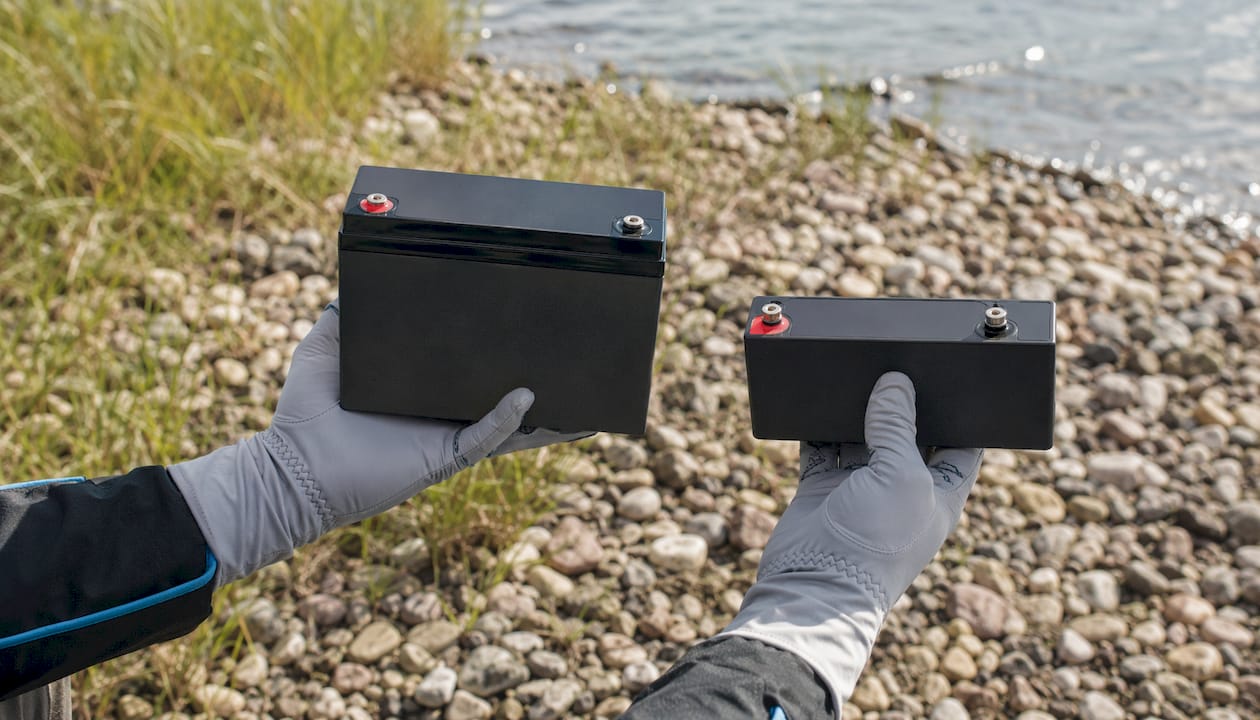
Chemistry determines how much of the rated Ah you can actually use, how long the bank lasts, and what your charging system needs to do. The table below compares the four main options on the metrics that matter most for marine use.
| Chemistry | Usable Capacity | Cycle Life | Weight (relative) | Cold-Charge Limit | Maintenance | Relative Cost |
|---|---|---|---|---|---|---|
| Flooded (FLA) | 50% | 300–500 | Baseline | None | Required (watering) | $ |
| AGM | 50% | 400–600 | Similar to FLA | None | None | $$ |
| Gel | — | 500 | Similar to FLA | None | None | $$ |
| LiFePO4 | 80–100% | 2,000–3,500+ | ~40–50% lighter | Below 32°F | None (BMS monitoring) | $$$$ |
Cycle life figures above are drawn from West Marine’s battery comparison data and reflect discharge to the stated usable-capacity limit for each chemistry.
Best-use cases by chemistry:
- Flooded lead-acid still makes sense for budget-conscious day boaters who have a ventilated engine compartment, don’t mind checking water levels monthly, and replace batteries every 2–4 years without complaint.
- AGM is the drop-in upgrade for most boats: no venting required, handles vibration well, charges faster than flooded, and works with virtually every existing charger. It’s the right call when you want reliability without changing your charging system.
- Gel suits boats with slow, steady discharge profiles and no need for rapid recharge. It’s sensitive to overcharging, so it pairs poorly with high-output alternators without a proper regulator.
- LiFePO4 pays off for liveaboards, tournament anglers running trolling motors all day, and cruisers who anchor for multiple nights. The weight savings alone matter on performance boats. For a deeper look at the LiFePO4 vs. AGM trade-off, the chemistry comparison goes well beyond sticker price.
Chemistry-specific installation caveats:
- Flooded batteries must be mounted upright, need a dedicated vent path to outside air, and off-gas hydrogen during charging.
- AGM and gel are sealed; they can be mounted in almost any orientation but still benefit from ventilation in enclosed spaces.
- LiFePO4 must not be charged below 32°F without a BMS that includes low-temperature charge inhibition. Charging a cold lithium cell causes permanent plating damage. Every quality LiFePO4 pack for marine use should have this protection built in.
How do you read a marine battery spec sheet?
Spec sheets throw a lot of numbers at you. Most of them matter only for specific use cases.
The metrics that count:
- Rated Ah (amp-hours): The total stored energy at a C/20 discharge rate (20-hour rate). A 100Ah battery delivers 5A for 20 hours before hitting 10.5V. This is the number you use for sizing math.
- Usable Ah: Rated Ah multiplied by the chemistry’s depth-of-discharge limit. A 100Ah AGM has roughly 50 usable Ah; a 100Ah LiFePO4 has 80–100 usable Ah.
- CCA (Cold Cranking Amps): Amps delivered for 30 seconds at 0°F above 7.2V. Relevant only for starting batteries. MCA (Marine Cranking Amps) is measured at 32°F and runs 20–25% higher than CCA — a more realistic figure for most US boating conditions.
- Reserve Capacity (RC): Minutes a battery sustains a 25A load before dropping to 10.5V. Useful for estimating emergency runtime but less precise than Ah for house-bank sizing.
- Cycle rating: The number of charge/discharge cycles to 80% of original capacity. A battery rated for 500 cycles at 50% DoD will reach end-of-life sooner if you routinely push it to 70% DoD.
Discharge rate and the Peukert penalty:
Lead-acid batteries lose effective capacity at high discharge rates. A 200Ah AGM discharged at C/5 (40A over 5 hours) may only deliver around 160Ah. LiFePO4 is nearly immune to this effect, which matters a lot for trolling motors drawing 30–50A continuously.
Statistic callout: According to West Marine’s battery data, a lithium battery delivers 280,000 total usable Ah over its lifespan versus 25,000 for a high-performance AGM and 15,000 for flooded lead-acid, at comparable rated capacities.
For inverters and trolling motors, always calculate load in amps (watts ÷ volts) and multiply by run time to get actual Ah demand. Then apply the Peukert penalty for lead-acid or skip it for LiFePO4.
How do you size a marine battery bank step by step?
This is the core of any marine battery capacity selection guide. Follow these steps in order and you’ll arrive at a bank size you can actually buy.
- List every DC load. Walk the boat and write down each device, its amp draw (check the nameplate or divide watts by 12), and realistic daily run hours. Include the bilge pump, refrigerator, navigation lights, chartplotter, VHF, and any inverter loads.
- Calculate daily Ah demand. Multiply amps × hours for each device, then sum the column. Add 15% for loads you’ll forget (bilge pump during rain, instrument backlighting, standby draws).
- Choose days of autonomy. Coastal weekenders who motor daily need 1 day of autonomy. Coastal cruisers anchoring 2–3 nights need 2 days. Offshore passages or off-grid liveaboards should plan for 3–5 days.
- Apply the chemistry DoD multiplier. Divide your autonomy-adjusted Ah by the chemistry’s usable fraction: AGM → divide by 0.50; LiFePO4 → divide by 0.80.
- Add reserve headroom. Add 20% as a baseline. Conservative cruisers or boats with limited charging sources should add 50%.
- Match to available group sizes or module counts. Round up to the nearest standard bank size and confirm it fits your tray.
Worked example: 28 ft. cruiser with refrigeration
- Daily loads: refrigerator (5A × 8h = 40Ah), chartplotter (2A × 6h = 12Ah), VHF (1A × 4h = 4Ah), LED cabin lights (3A × 4h = 12Ah), bilge pump (1A × 2h = 2Ah). Raw total: 70Ah/day.
- Add 15% safety margin: 70 × 1.15 = 80.5Ah/day.
- Two days of autonomy: 80.5 × 2 = 161Ah.
- AGM at 50% DoD: 161 ÷ 0.50 = 322Ah rated bank. Two Group 31 AGM batteries (105Ah each) = 210Ah — undersized. Three Group 31 = 315Ah — close but tight. Better: two Group 4D AGM (180Ah each) = 360Ah rated, 180Ah usable per day.
- LiFePO4 at 80% DoD: 161 ÷ 0.80 = 201Ah rated. Two 100Ah LiFePO4 modules in parallel = 200Ah, delivering 160Ah usable — right on target, in a much smaller footprint.
Worked example: fishing boat with trolling motor
A 24V trolling motor drawing 40A for 5 hours = 200Ah at 24V (equivalent to 400Ah at 12V). Add 20% headroom: 480Ah rated at 12V for AGM, or 300Ah rated for LiFePO4. That’s a significant bank. Most serious tournament anglers run two or three 100Ah LiFePO4 batteries in a 24V series-parallel configuration rather than hauling 150+ lbs of lead-acid.
Quick formulas:
- AGM bank size (Ah rated) = (Daily Ah × Days autonomy) ÷ 0.50, then × 1.20
- LiFePO4 bank size (Ah rated) = (Daily Ah × Days autonomy) ÷ 0.80, then × 1.20
For a marine battery size calculator that walks through load entry row by row per ABYC E-10 guidelines, the ToolGrit marine battery bank planning tool is a solid pre-purchase planning aid. Replace every preset with your actual measured loads before trusting the output.

How should you wire your battery banks?
Architecture matters as much as capacity. Get the wiring wrong and even a correctly sized bank will underperform or fail early.
Recommended configurations by boat type:
- Small boats (under 20 ft., single engine): A single Group 24 or 27 dual-purpose battery handles starting and light house loads. Simple, low-cost, and adequate for day trips.
- Mid-size boats (20–30 ft.): Separate starting and house banks. The starting battery handles cranking only; the house bank handles all electronics and cabin loads. A battery switch or combiner keeps them isolated.
- Larger cruisers and liveaboards: Multiple house batteries in parallel, a dedicated starting battery, and often a dedicated bow-thruster bank. Each bank should be its own chemistry and age group.
- Trolling-motor boats: A dedicated trolling-motor bank (often 24V or 36V) separate from the starting battery. Never pull trolling-motor loads from your starting battery.
Parallel vs. series wiring:
- Parallel (same voltage, more Ah): Two 12V 200Ah batteries wired positive-to-positive and negative-to-negative = 12V 400Ah. Use this to increase capacity in a 12V system.
- Series (higher voltage, same Ah): Two 12V 200Ah batteries wired positive-to-negative = 24V 200Ah. Use this for 24V trolling motors or 24V house systems.
- Series-parallel: Four 12V 200Ah batteries — two series strings wired in parallel = 24V 400Ah. Common on larger vessels with 24V systems.
Critical wiring rules:
- Never mix chemistries or different-age batteries in the same bank. Mismatched internal resistance causes uneven charging and accelerates failure in every cell.
- Fuse within 7 inches of every positive terminal per ABYC guidance. For high-current LiFePO4 banks, Class-T fuses are the correct choice due to high prospective fault currents.
- Use marine-grade tinned copper cable sized for the maximum continuous current, not the average. Undersized cable creates voltage drop and heat.
- Keep cable runs equal length in parallel banks to balance current distribution.
For a complete walkthrough of bank architecture options, the marine battery bank setup guide covers installation layouts in practical detail.
What charging system does each chemistry need?
Swapping battery chemistry without updating your charging system is the single most common and expensive mistake in marine battery upgrades. Lithium accepts charge faster and can demand higher continuous alternator output than lead-acid systems were designed to deliver.
Charger profile checklist by chemistry:
- Flooded: Three-stage charger (bulk, absorb, float). Float voltage 13.2–13.4V. Tolerates slight overcharge better than sealed types.
- AGM: Three-stage charger with AGM-specific profile. Absorb voltage typically 14.4–14.7V; float 13.6–13.8V. Do not use a flooded profile — it will overcharge and dry out the cells.
- Gel: Requires a gel-specific profile with lower absorb voltage (typically 14.1–14.4V) and slower charge rates. High-output alternators without a regulator will damage gel batteries.
- LiFePO4: Charges to 14.2–14.6V (12V system) with no float required. Many LiFePO4 packs actually prefer the charger to stop at absorb rather than hold a float voltage. Verify the manufacturer’s spec before setting float.
Alternator compatibility for LiFePO4:
A lithium bank with a healthy BMS will accept charge at whatever rate the alternator can deliver, right up to full capacity. That’s great for fast recharge but hard on older alternators designed for the gradual taper of lead-acid. When the BMS hits full charge and disconnects, the alternator can spike voltage dangerously. Solutions include a DC-DC charger between the alternator and the lithium bank, an external alternator regulator with lithium programming, or an alternator isolation device. The marine battery charging system guide covers these options with specific hardware recommendations.
BMS requirements for LiFePO4 installs:
- Cell balancing (passive or active) to prevent individual cell drift over time.
- Low-temperature charge inhibition (cuts off charging below 32°F).
- High-current disconnect on both overcharge and over-discharge.
- Short-circuit protection and state-of-charge reporting via Bluetooth or display.
Charger sizing rule: Size your charger to 10–20% of bank capacity in amps for reasonable shore-power recharge times. A 200Ah bank needs a 20–40A charger; a 400Ah LiFePO4 bank needs at least 80A of combined charging capacity to recover overnight.
Pre-buy installation checks: will it actually fit?
Buying the right battery on paper and then discovering it doesn’t fit the tray is a frustrating and avoidable problem. Run through these checks before placing an order.
Physical measurement steps:
- Measure the tray interior (not the old battery) at its narrowest point in all three dimensions.
- Confirm terminal clearance: top-post batteries need at least 1 inch above the terminals for cable lugs and any terminal covers.
- Check that the hold-down hardware can accommodate the new battery’s case height and width.
- Verify cable length from the terminal to the first connection point — LiFePO4 batteries are often shorter than the lead-acid they replace, which can leave cables too long and prone to chafing.
Venting and mounting requirements:
- Flooded batteries must have a dedicated vent hose routed to outside air. Hydrogen accumulation in an enclosed space is a genuine explosion risk.
- AGM and gel are sealed and don’t require a vent hose, but still benefit from airflow in hot engine compartments.
- LiFePO4 doesn’t off-gas under normal conditions but should not be installed in a sealed, unventilated space due to thermal runaway risk in a fault condition.
- All batteries must be secured against movement in any sea state. A battery that shifts under way can break terminals, short cables, and start a fire.
Safety checklist before installation:
- Wear safety glasses and chemical-resistant gloves when handling flooded batteries.
- Disconnect the negative terminal first, reconnect it last.
- Install terminal covers on all exposed positive terminals after connection.
- Confirm the fuse or circuit breaker is within 7 inches of the positive terminal.
- Test the BMS disconnect function on LiFePO4 before closing the compartment.
LiFePO4’s advantage in tight trays is real: it delivers more usable Ah in the same footprint and weighs roughly 40–50% less than an equivalent lead-acid bank, which also improves boat trim.
What maintenance and lifespan should you expect?
Long-term value comes down to cost per usable Ah over the battery’s actual service life, not the sticker price.
Typical service life:
- Flooded lead-acid: 2–4 years with proper maintenance; 300–500 cycles at 50% DoD.
- AGM: 4–7 years; 400–600 cycles at 50% DoD.
- LiFePO4: 10+ years; 2,000–3,500+ cycles at 80% DoD.
Illustrative cost-per-usable-Ah comparison (not price quotes):
A 100Ah AGM at 50% DoD delivers 50 usable Ah per cycle. Over 500 cycles, that’s 25,000 total usable Ah. A 100Ah LiFePO4 at 80% DoD delivers 80 usable Ah per cycle. Over 3,000 cycles, that’s 240,000 total usable Ah — roughly 9–10 times more energy delivered per dollar of battery cost when you account for replacement frequency. The math consistently favors LiFePO4 for boats used regularly, typically breaking even around year 3 compared to AGM.
Maintenance schedule by chemistry:
- Flooded: Check electrolyte levels monthly during the season; top off with distilled water only. Equalize charge every 3–6 months. Keep terminals clean and coated with anti-corrosion spray.
- AGM: No watering. Check float voltage quarterly with a multimeter. Keep terminals clean. Avoid deep discharges below 50% — they shorten cycle life faster than anything else.
- LiFePO4: Monitor BMS health via app or display at the start of each season. Check firmware updates if the BMS supports them. Inspect cell balance data annually; significant cell drift signals a failing cell.
Warranty terms to verify at purchase:
Look for the stated number of years, whether the warranty covers capacity fade (not just defects), and whether it requires professional installation. Bansheebatteries backs its AGM marine batteries with a 4-year warranty and its lithium marine batteries with a 5-year warranty, which is among the longer coverage periods in the category.
The one sizing mistake pros see most often
Size for your worst day, not your average day. That means the day you’re anchored overnight, the refrigerator runs all night, the anchor light stays on, and the engine doesn’t run until noon. Pros consistently advise sizing to that scenario rather than a typical motoring day where the alternator tops off the bank every few hours.
Common mistakes that cost money:
- Sizing to the tray, not the load. Picking the biggest battery that fits the existing tray without ever calculating actual Ah demand. The tray is a constraint, not a specification.
- Ignoring charger and alternator compatibility when switching to LiFePO4. A direct swap without verifying charging infrastructure can trip the BMS repeatedly, stress the alternator, or leave the bank chronically undercharged.
- Underspeccing headroom. A bank sized exactly to calculated daily demand with no reserve will chronically deep-discharge. That kills lead-acid batteries fast and shortens LiFePO4 cycle life too.
- Mixing old and new batteries in parallel. An older battery with higher internal resistance will drag down a new one. Replace the whole bank at once.
Pro Tip: Before finalizing your bank size, run the worst-case scenario: add up every load running simultaneously for 12 hours with no charging input. If your bank can’t cover that without dropping below 50% DoD (lead-acid) or 20% state of charge (LiFePO4), add another module.
When buying a high-value LiFePO4 bank, register the warranty immediately and keep the installation documentation. Some warranty claims require proof of correct charger settings and proper installation, and having that paperwork ready saves significant hassle if a cell issue appears in year 4.
Key Takeaways
Sizing a marine battery bank correctly requires matching your measured daily Ah load to a chemistry-specific usable-capacity multiplier, adding autonomy days and 20% headroom, then confirming physical fit and charger compatibility before purchase.
| Point | Details |
|---|---|
| Usable capacity drives bank size | LiFePO4 delivers 80–100% usable Ah; AGM/flooded deliver ~50%, so a 200Ah AGM equals a 100Ah LiFePO4 in practice. |
| Size for worst-case, not average | Add 20% reserve as a baseline; conservative cruisers and liveaboards should add 50% to avoid chronic deep discharge. |
| Separate starting and house banks | Mixing starting and house roles in one battery shortens battery life on any boat larger than a small runabout. |
| Charger profile must match chemistry | Swapping to LiFePO4 without updating charger settings or alternator protection risks BMS trips and alternator damage. |
| Bansheebatteries warranty coverage | Bansheebatteries backs AGM marine batteries with a 4-year warranty and lithium marine batteries with a 5-year warranty. |
Why most boaters get battery sizing backwards
Here’s the thing most guides won’t say plainly: the majority of boaters pick a battery by tray size and price, then rationalize the choice afterward. That’s backwards, and it’s why so many boats end up with undersized house banks that get chronically deep-discharged and replaced every two years.
The actual sequence is: measure your loads, calculate your worst-case daily Ah, choose chemistry based on budget and duty cycle, then check whether the result fits your tray. If it doesn’t fit, that’s when LiFePO4 becomes the obvious answer — not because it’s the premium option, but because it delivers more usable Ah in the same footprint and weighs less, which often solves a tray constraint without any structural modification.
The other thing worth saying directly: the total cost of ownership argument for LiFePO4 is real, but it only holds if you verify charging compatibility before you install it. A lithium bank on a boat with an unregulated alternator and a flooded-profile charger will underperform and potentially fail early. The battery isn’t the problem in that scenario — the charging system is. Spend the time on the marine lithium battery sizing details before you buy, and the math works out strongly in lithium’s favor over a 5-year horizon.
AGM still makes complete sense for day boaters, budget-conscious owners, and anyone who doesn’t want to think about BMS firmware. It’s not a consolation prize. It’s the right tool for a specific use case.
Bansheebatteries has the marine batteries to match your sizing math
Once you’ve run the numbers, the next step is finding batteries that actually match your calculated bank size and come with the warranty to back them up. Bansheebatteries has spent over 20 years building AGM and LiFePO4 batteries for marine and powersports applications, and their product line maps directly to the sizing outcomes this guide produces.
For house banks in the 100–200Ah range, the 12V 100Ah LiFePO4 marine battery is a direct fit for the worked examples above — two in parallel cover a 28 ft. cruiser’s two-day autonomy requirement with room to spare. For larger builds or AGM alternatives, the full marine battery lineup covers both chemistries with the 4-year AGM and 5-year lithium warranty terms stated above. If you need a charger to match, the fully automatic 10A shore charger handles lead-acid and AGM banks up to 230Ah with overcharge and short-circuit protection built in. Contact Bansheebatteries technical support with your calculated bank size and boat details to confirm the right configuration before you order.
Useful sources and references
The following references were used to build this guide. Use them to verify figures, run your own calculations, and confirm ABYC compliance requirements with a qualified marine electrician.
- Battery Council International (BCI) — The authoritative source for BCI group-size standards and physical footprint specifications.
- ToolGrit Marine Battery Bank Sizing Calculator — A free planning tool that walks through load entry, chemistry DoD, days of autonomy, and charger sizing per ABYC E-10 guidelines. Use it to build a load checklist before purchasing hardware; outputs are planning screens only and require qualified review before installation.
- West Marine Battery Advisor — Practical chemistry comparison data including cycle life, usable Ah over lifespan, and reserve-capacity explanations.
- GoodKit Marine Battery Bank Sizing Calculator — Useful for days-of-autonomy planning and comparing AGM vs. LiFePO4 bank sizes side by side.
- ABYC E-10 and E-13 standards — The governing standards for marine electrical systems and lithium battery installations in the US. Any LiFePO4 install on a vessel subject to survey should be reviewed against current ABYC E-13 requirements by a certified marine electrician or ABYC-certified technician.
- Bansheebatteries marine battery pages — Product specs, warranty terms, and installation resources for AGM and LiFePO4 marine batteries.
- Watercraft trailer buying guide — Useful companion reference when planning full boat transport and equipment upgrades alongside a battery system overhaul.
This article provides general technical guidance for informational purposes. Electrical system design, lithium battery installation, and ABYC compliance require review by a qualified marine electrician or ABYC-certified technician for your specific vessel.