


3 Specs That Must Match Before Installing a Lithium Starting Battery
Yes, LiFePO4 batteries can replace a lead-acid starting battery, but only when three specs line up with your engine: peak/CCA output has to meet or beat your original battery’s rating, the case has to physically fit your terminals and hold-down, and your charging system has to play nice with lithium’s voltage curve. Skip any one of those checks and you risk a no-start or a fried BMS. Before buying, read the warranty terms and BMS feature list as closely as the price tag.
TL;DR:
- A lithium starting battery must match your engine’s peak or burst current requirements, not just CCA, and the duration of the peak current is crucial.
- Compatibility with your charging system depends on ensuring your alternator voltage profile aligns with the lithium battery’s recommended charge voltage range.
- Marine and powersports applications demand batteries with at least IP66 or IP67 sealing and vibration resistance to withstand harsh conditions.
- Buyer should verify a clear BMS feature set, including overcurrent, over/under-voltage, temperature protection, and warranty coverage before purchasing.
- Lithium starter batteries are most suitable for weight-sensitive, cold-storage, or long-idle scenarios, while older vehicles with unreliable charging systems may still need lead-acid options.
Table of Contents
- What Is a Lithium Starting Battery, and How Does It Differ From AGM?
- Which Specs Actually Matter When Comparing Lithium Starting Batteries?
- Will My Alternator Charge a Lithium Starting Battery Correctly?
- What Should Boat, ATV, and Motorcycle Owners Check Before Switching?
- How Do You Vet a Seller Before Buying a Lithium Starting Battery?
- Where Lithium Starters Make Sense, and Where They Don’t
- Ready to Upgrade to a Lithium Starting Battery?
- Sources
What Is a Lithium Starting Battery, and How Does It Differ From AGM?
A lithium starting battery uses lithium iron phosphate (LiFePO4) chemistry tuned for short, violent bursts of current rather than the slow, steady drain of a trolling motor or RV house bank. Starter-focused LiFePO4 packs are built with cells and a battery management system (BMS) optimized for delivering hundreds of amps for a second or two, then sitting at rest for days or weeks. Deep-cycle lithium, by contrast, is built to sustain lower current over hours.
The appeal is straightforward once you’ve hauled a group 24 lead-acid battery out of an engine bay. LiFePO4 packs deliver high burst currents with a BMS that guards against overcharge, over-discharge, overcurrent, and temperature extremes, all while weighing a fraction of the lead equivalent. Some product literature claims significant weight savings versus comparable lead-acid units, along with cycle life claims of 2,000 or more cycles, far beyond what a flooded or AGM battery typically survives.
The trade-offs are real, though. Cold weather hits lithium chemistry harder than lead-acid at the chemical level, the BMS can shut a battery down mid-crank if it senses a fault, and your alternator or charger needs to speak lithium’s voltage language. None of that disqualifies LiFePO4 as a starting battery, but the details matter more than they do with a lead-acid swap.
- Weight savings often in the range of 50 to 70% versus lead-acid or AGM equivalents
- Flat discharge curve keeps voltage steady until the battery is nearly empty
- Lower self-discharge means less maintenance during off-season storage
- BMS protection adds a layer of safety lead-acid batteries simply don’t have
Which Specs Actually Matter When Comparing Lithium Starting Batteries?
Spec sheets throw a lot of numbers at you, and not all of them tell you what you actually need to know. Here’s the order to check them in.
- Peak or burst current, not just CCA. Manufacturers often list a peak short-duration current separate from a marketed CCA figure, and the two aren’t always equivalent. Ask exactly how long that peak number can be sustained, and compare it against your engine’s actual cranking draw, not the battery you’re replacing.
- Nominal voltage and Ah. A 12.8V nominal pack behaves differently under load than a 12V lead-acid unit, and Ah capacity tells you runtime for accessories, not starting punch. A 12.8V 105Ah dual-purpose example rated at 1000 CCA shows how these numbers get bundled on a single label.
- Group size, terminal type, and hold-down compatibility. Lithium cells pack more capacity into a smaller case, but the case still has to match your tray and clamp.
- BMS features. Look for overcurrent protection, low and high temperature cutoffs, and restart or recovery behavior after a fault trips.
- Bluetooth monitoring, where available, lets you check cell balance and state of charge from your phone instead of guessing.
Pro Tip: Call or message the seller and ask them to define their peak current number in writing, including the exact duration it’s rated for. A vague answer is itself useful information.
Will My Alternator Charge a Lithium Starting Battery Correctly?
This is where most lithium starter conversions go wrong, and it has nothing to do with the battery itself. LiFePO4 wants a charge voltage profile that differs from the absorption and float stages a lead-acid regulator is tuned for, and a mismatch either undercharges the pack over time or trips the BMS on overvoltage.
Stock alternators on many modern vehicles regulate within a range that a quality lithium BMS can tolerate, but older vehicles and some marine charging systems run hotter or less consistent voltage than lithium chemistry prefers. Installers who diagnose electrical faults roadside report that alternator voltage behavior is the single most common real-world compatibility issue they see, which makes a multimeter check on your regulator’s output a five-minute investment before you commit to a swap.
- Check your alternator’s regulated voltage range against the battery manufacturer’s recommended charge voltage.
- Add a DC-DC charger or lithium-compatible alternator regulator if your system runs outside that range.
- Use a charger explicitly rated for LiFePO4 for the first charge and any shore-power charging.
- Fuse the battery close to the terminal, sized to the wire gauge, not just the battery’s peak output.
What Should Boat, ATV, and Motorcycle Owners Check Before Switching?
Marine and powersports environments punish batteries in ways a car engine bay doesn’t: constant vibration, splash exposure, and temperature swings that hit an exposed hull or saddlebag harder than an insulated hood. Some vendors advertise IP67 or IP66 ratings paired with vibration-resistant construction specifically for these applications, and that rating should be a hard requirement, not a nice-to-have, for anything mounted near a bilge or a fender.
Dual-purpose batteries that handle both starting and house loads work for smaller boats and RVs where space is tight, but a dedicated starter battery paired with a separate house bank still gives you more predictable performance on larger vessels. Cold-start behavior is the other variable worth planning for: some starter-focused packs include built-in heaters or reservation heating that keep cells within operating range before a cold crank, while others rely purely on the BMS to cut power below a temperature threshold.
- Prioritize IP66/IP67 sealing for anything exposed to spray, rain, or bilge moisture.
- Choose vibration-tested cases for outboards, ATVs, and off-road motorcycles.
- Look for built-in heating or a BMS with a clear low-temperature cutoff for winter storage.
- Use marine-grade, corrosion-resistant terminal connectors and inspect them each season.
How Do You Vet a Seller Before Buying a Lithium Starting Battery?
A good checklist turns a confusing spec sheet into a five-minute comparison. Work through these in order before you add anything to your cart.
- Confirm the peak current or CCA number includes a stated duration, and that it beats your engine’s cranking requirement with margin to spare.
- Verify the case dimensions, terminal style, and mounting orientation match your existing tray or bracket.
- Ask whether the BMS includes overcurrent, over/under-voltage, and temperature protection, plus how it behaves after a fault trips.
- Confirm your alternator or charger’s output voltage falls inside the battery’s recommended charge range.
- Request the warranty length and cycle-life claim in writing, ideally with the depth-of-discharge assumption stated. A simple five-point checklist covering voltage, peak current duration, BMS restart behavior, IP rating, and warranty terms catches most bad purchases before money changes hands.
Pro Tip: Ask any seller these three questions directly: What’s your BMS restart behavior after a low-voltage cutoff? What’s the exact charge voltage range you recommend? What does your warranty actually cover if a cell fails in year two? A seller who answers clearly and specifically is worth trusting more than one who repeats marketing copy.
Red flags worth walking away from: a listing with no BMS detail at all, a peak current number with no stated duration, no visible warranty process, or silence on shipping and hazmat handling, since lithium batteries ship under different rules than lead-acid. For deeper background on chemistry differences, it helps to understand how lithium ion compares to LiFePO4 before you shop by price alone, and readers weighing a broader chemistry comparison can find useful context in this LFP versus NMC technical breakdown as well.
Where Lithium Starters Make Sense, and Where They Don’t
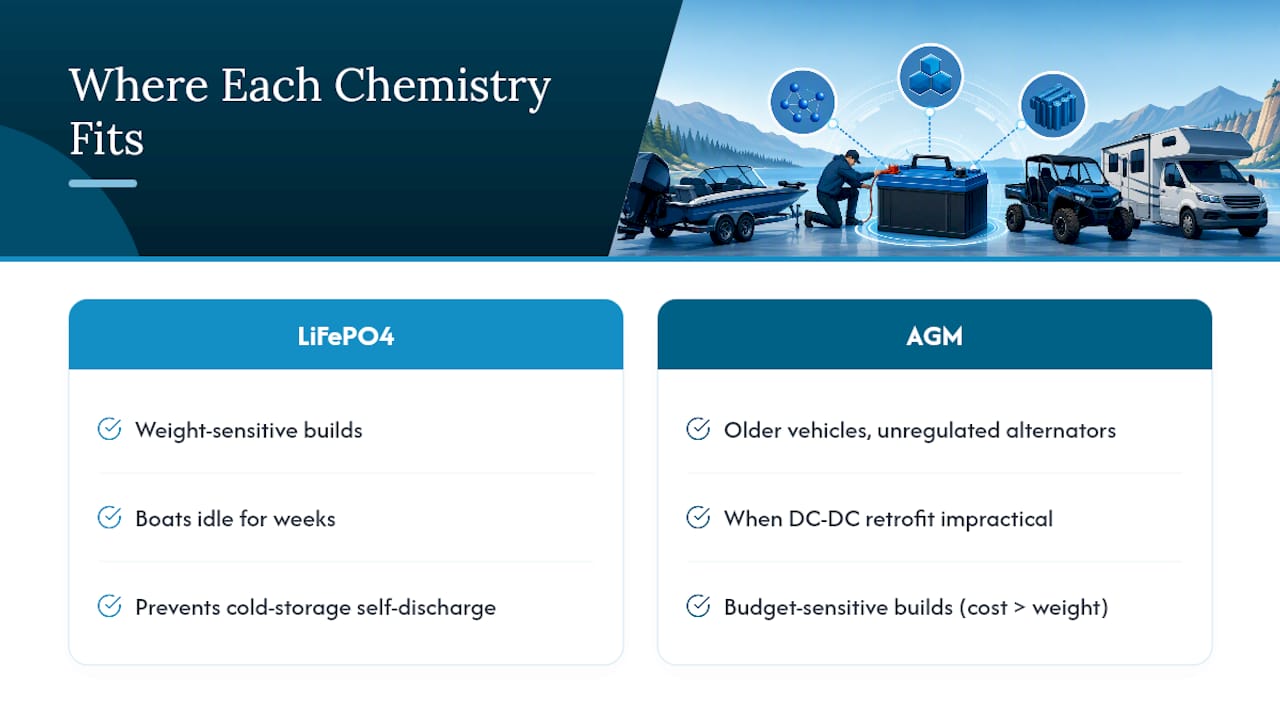
Two decades of building AGM and lithium batteries for powersports and marine use has taught us that the “always switch to lithium” advice floating around forums oversimplifies a decision that actually depends on your charging system and how you store the vehicle. LiFePO4 earns its keep on weight-sensitive builds, boats that sit idle for weeks at a time, and any application where cold storage self-discharge has killed a lead-acid battery before.
AGM still makes sense on older vehicles with unregulated or inconsistent alternators where retrofitting a DC-DC charger isn’t practical, and on budget-sensitive builds where the weight savings don’t justify the price gap. If you’re unsure which category your setup falls into, our battery finder tool and support team can walk through your engine’s cranking specs and charging system before you commit to either chemistry.
— Donald
Ready to Upgrade to a Lithium Starting Battery?
Banshee Batteries builds the exact spec transparency this guide just walked you through into every product page: peak current with a stated duration, documented BMS protection, and IP-rated sealed construction for marine and powersports use, backed by a warranty that runs longer than most competitors offer on lithium packs.
Our lithium marine battery lineup covers dedicated starter and dual-purpose options built for boats, while the powersport lithium collection fits motorcycles, ATVs, and UTVs that need weight savings without sacrificing cold-crank reliability. Every listing states BMS features, warranty length, and cycle-life claims up front, so you can run the checklist from this guide directly against the spec sheet instead of guessing. If you’re not sure which group size or capacity fits your engine, reach out to our support team with your vehicle’s details, and we’ll match you to the right battery before you place an order.
Sources
- 12.8V 80Ah Lithium Starting Battery | COPOW
- LiFePO4 Lithium Battery: 12V 105AH Starter & Deep Cycle, Marine & RV – WEIZE