


Boat Owners: Lithium Marine Battery and Conversion Costs, When It Pays
A single 12V 100Ah lithium marine battery typically runs $700 to $1,300, versus $200 to $450 for a comparable AGM. Factor in a full conversion, including charger and wiring upgrades, and total project costs often land in the low thousands depending on boat size. For anyone who runs their boat hard, off-grid or with a heavy inverter load, that upfront gap usually closes within a few seasons because lithium commonly delivers multiple times the cycle life of lead-acid alternatives.
TL;DR:
- Lithium marine batteries with higher features such as BMS, Bluetooth monitoring, and cold-weather heating can cost up to or above $1,500 for 100Ah units, significantly more than basic models.
- Full conversion costs—including charger, regulator, wiring upgrades, and installation—often reach several thousand dollars, roughly matching the price of the battery itself in larger boats.
- The actual affordability of lithium depends on usage; heavy, frequent, and long-term cycling favors lithium’s longer lifespan and potentially saves money over time.
- Weight savings of around 50 to 60 percent compared to AGM batteries can improve fuel efficiency and boat performance, especially on larger vessels with multiple batteries.
- Proper documentation, warranties, and component upgrades are essential to maintain resale value, as unverified lithium installations can appear as red flags to future buyers.
Table of Contents
- How Much Do Lithium Marine Batteries Cost by Size?
- What Does a Full Lithium Conversion Actually Cost?
- What Makes One Lithium Battery Cost More Than Another?
- When Does Lithium Actually Pay for Itself?
- How Do You Estimate Your Total Cost?
- Does Lithium Save Money Beyond the Battery Itself?
- Do Lithium Batteries Help or Hurt Resale Value?
- What I’d Tell a Friend Shopping for Lithium Right Now
- Where to Start Shopping for Lithium Marine Batteries
- Sources
How Much Do Lithium Marine Batteries Cost by Size?
Retail prices scale with capacity, but they scale even faster with the electronics packed inside the case. Two 100Ah batteries sitting side by side on a shelf can differ by $400 or more, and the reason usually comes down to the battery management system and discharge rating, not the amp-hours printed on the label.
Here’s roughly what boat owners are paying at each tier:
- 12V 60–100Ah (entry to budget): typical prices fall within a few hundred dollars, suitable for smaller boats and setups.
- 12V 100–150Ah (midrange): prices commonly range in the mid hundreds to low thousands, fitting many standard boats with moderate power needs.
- 12V 150Ah+ and higher-voltage or multi-battery packs (premium): these tend to be more expensive, generally costing several thousands per unit depending on features and capacity.
Wired2Fish’s testing of marine lithium batteries found prices spanning $329 to $1,499 across tested units, a spread wide enough that Ah rating alone tells you almost nothing about what you’re buying. The bigger driver of price at any given capacity is what’s built around the cells: internal heating elements for cold starts, Bluetooth-enabled monitoring, and a high continuous discharge rating all push a battery toward the top of its price band. A stripped-down drop-in unit without those features will sit at the bottom of the range, and it may not survive a cold snap or a heavy winch load the way a better-equipped battery will.
What Does a Full Lithium Conversion Actually Cost?
The battery itself is rarely the whole bill. Lithium chemistry requires charging voltages and profiles that most stock lead-acid systems weren’t built to deliver, so a real conversion touches several other parts of the boat’s electrical system.
Budget for these additions:
- LFP-compatible charger or converter — $150 to $500, since most factory chargers are tuned for AGM absorption curves that don’t suit lithium.
- Alternator regulator or DC-DC charger — $200 to $600, needed to prevent overcharging the alternator while it feeds a lithium bank.
- Battery monitor or smart shunt — $150 to $350, for tracking state of charge accurately, which lead-acid gauges handle poorly.
- Upgraded cabling and fuses — $100 to $400, sized for lithium’s higher sustained discharge.
- Professional installation labor — $300 to $1,500+, depending on boat complexity and whether the old system needs rewiring.
RepairYachts breaks down conversion costs for a real 40-foot cruiser and finds that the parts and labor surrounding the batteries can add several thousand dollars beyond the battery price itself. A small day-boat swap might total a few thousand dollars all in. A 40-foot cruiser with a full house bank conversion can run several thousand dollars once labor and every upgrade component are counted.
Statistic Callout: A full lithium conversion on a larger cruising boat can cost a substantial amount in supporting parts and labor, roughly comparable to the batteries themselves, according to RepairYachts’ conversion breakdown.
Get at least two installer quotes before committing. Wiring runs, panel space, and existing charger compatibility vary boat to boat, and a quote that skips the alternator regulator or assumes your existing cabling is adequate will look cheaper right up until it isn’t.
What Makes One Lithium Battery Cost More Than Another?
Two batteries with identical Ah ratings can price hundreds of dollars apart, and the difference almost always traces back to a short list of features.
- Usable capacity and continuous discharge rating: Lithium batteries typically deliver closer to 100% of rated capacity versus roughly 50% for AGM, but the continuous discharge (C-rate) matters more than the Ah number when you’re running a windlass or high-draw inverter.
- BMS quality and Bluetooth monitoring: A well-built battery management system with app-based monitoring costs more to engineer, and industry testers treat it as a baseline requirement rather than a luxury add-on.
- Internal heating: Lithium cells can suffer permanent damage if charged below freezing, so batteries with built-in heating elements for cold-weather charging carry a real price premium, especially useful for boats stored or run in northern climates.
- IP rating and case quality: Marine environments are wet and vibration-heavy; a sealed, higher IP-rated case costs more to manufacture and tends to last longer.
- Warranty length and manufacturer support: Longer warranties usually signal the manufacturer trusts its own cell quality and BMS design.
Pro Tip: Don’t shop by Ah and price alone. Pull the spec sheet and check the continuous discharge rating against your highest simultaneous load, whether that’s a windlass, inverter, or bow thruster.
When Does Lithium Actually Pay for Itself?
Lithium’s math works in your favor once you’re cycling the battery often enough to rack up real hours on it. If you’re a weekend boater who runs the bank down 20% and plugs into shore power every trip, AGM’s lower upfront cost is hard to beat, and Practical Sailor’s analysis backs that up.
Lithium tends to pull ahead for:
- Boats doing multi-day anchor-outs without shore power access
- Heavy inverter loads (refrigeration, AC, electronics running continuously)
- Frequent, deep discharge cycles rather than shallow top-offs
- Owners planning to keep the boat 5+ years, long enough for a 5-year warranty to pay out real value
At thousands of rated cycles compared to several hundred for flooded lead-acid, a frequently used lithium bank can outlast multiple AGM replacement cycles over the same period.
How Do You Estimate Your Total Cost?
Start with your current bank size and daily amp-hour draw, then build outward from there.
- Calculate usable Ah needed. Add up your daily draw (lights, fridge, electronics, pumps) and multiply by the number of days you want between charges.
- Price the battery bank using the size bands above, based on that usable Ah figure.
- Add system upgrades: charger ($150 to $500), regulator ($200 to $600), monitor ($150 to $350), and cabling ($100 to $400).
- Add installation labor: $300 to $1,500+ depending on complexity.
- Add a 10 to 15% contingency for site-specific surprises like corroded terminals or panel space constraints.
Worked example: A 150Ah bank at $900, plus a $350 charger, $400 regulator, $250 monitor, $200 cabling, and $600 labor totals roughly $2,700. Add contingency and you’re budgeting closer to $3,000.
Statistic Callout: Buyer guides consistently recommend padding conversion budgets with contingency and confirming installer warranty terms, since quoted totals for the same job can vary by hundreds or thousands of dollars depending on what’s included.
Does Lithium Save Money Beyond the Battery Itself?
Weight is the part most buyers underestimate. A lithium battery typically weighs 50 to 60% less than an AGM of the same capacity, and on boats running two or three batteries that difference adds up to 40 pounds or more coming out of the stern.
Less weight aft means less drag and a better running angle, which translates into measurable fuel savings on boats that run at cruising speed for hours at a stretch. It’s not a dramatic number on a short trip to the sandbar, but on a cruiser doing 200 hours a season, shaving weight off the battery bank is one of the few upgrades that pays a small dividend every single time you’re underway.
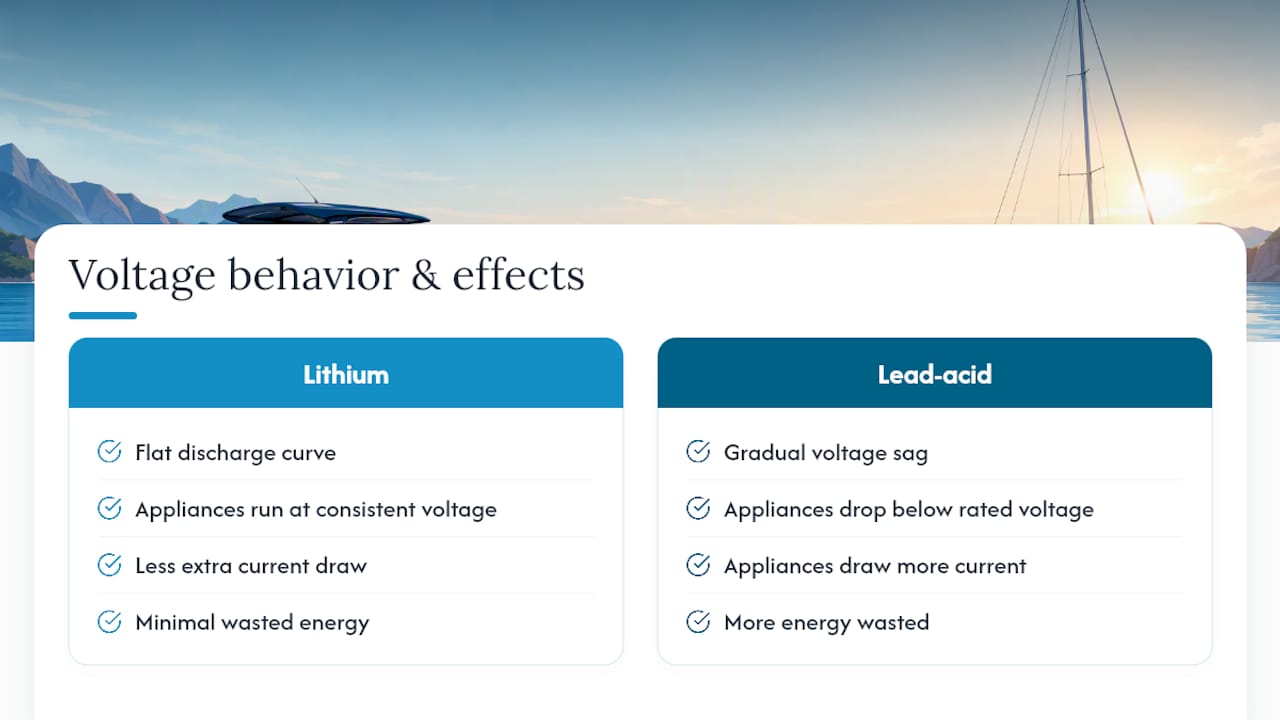
There’s a secondary efficiency gain too. Lithium’s flat discharge curve means your electronics, pumps, and refrigeration run at a more consistent voltage right up until the battery is nearly depleted, rather than sagging gradually the way lead-acid does. Appliances running below their rated voltage draw more current to compensate, which quietly wastes energy. A stable voltage curve keeps that waste to a minimum, which matters most on boats leaning on an inverter for AC power for hours at a time.
None of this replaces the core cost calculation from the sections above. But if you’re already leaning toward lithium for cycle life, the weight and voltage stability are the parts of the value proposition that don’t show up on the invoice.
Do Lithium Batteries Help or Hurt Resale Value?
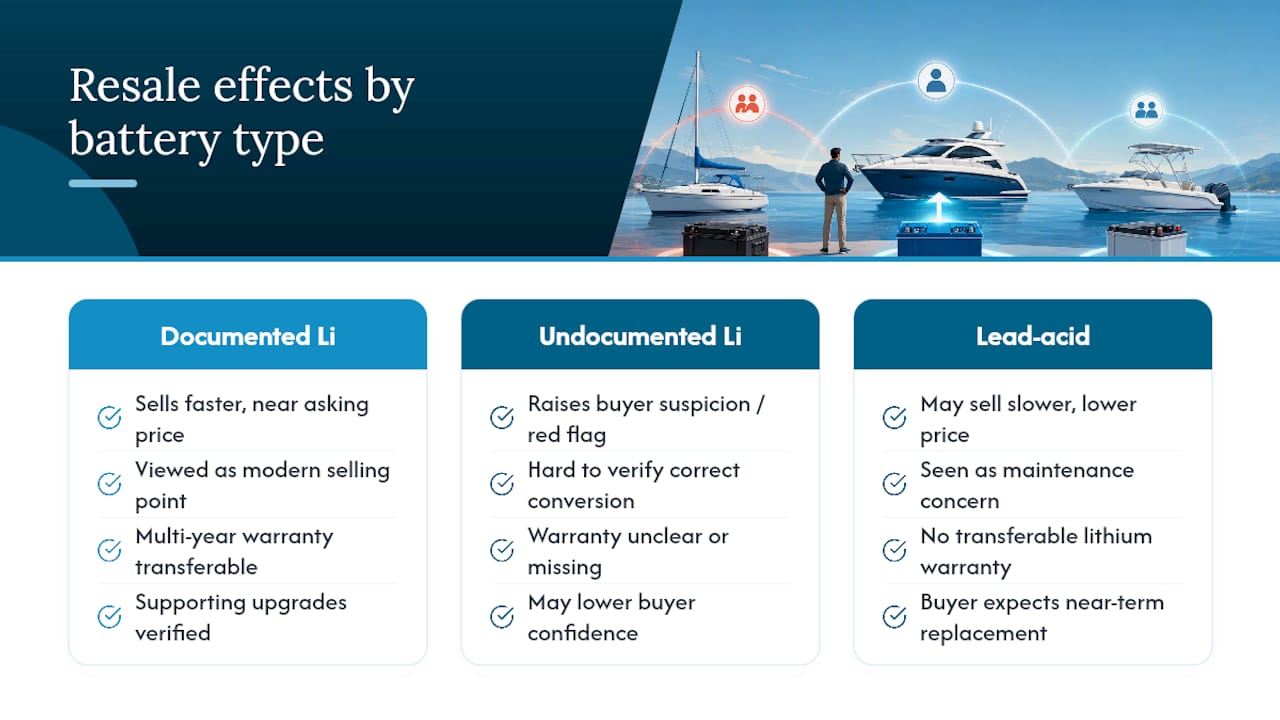
A boat with a documented lithium upgrade generally sells faster and closer to asking price than one with tired lead-acid batteries needing replacement. Buyers touring a used boat notice a modern battery bank, and a battery with a valid multi-year warranty still attached is a tangible selling point rather than a maintenance question mark.
The catch is documentation. Lithium’s resale value depends heavily on whether the seller can show installation records, warranty paperwork, and confirmation that supporting components (charger, regulator, wiring) were upgraded alongside the batteries. An undocumented lithium swap looks like a red flag to a careful buyer, since there’s no way to verify the conversion was done correctly rather than bolted on without the necessary charging upgrades.
Boats sold within a battery’s warranty window tend to benefit most, since the remaining warranty can often transfer or at least reassure the next owner the batteries won’t need replacing soon. On a boat you plan to sell in three to five years, that transferable warranty coverage can be worth more to a buyer than the marginal weight or cycle-life advantage lithium offers you day to day.
What I’d Tell a Friend Shopping for Lithium Right Now
Match the battery to how you actually use the boat, not to the biggest number on the spec sheet. A weekend angler doesn’t need the same continuous discharge rating as someone running a full house bank off-grid for a week. The lithium marine lineup is built around that distinction, with a 5-year warranty for marine lithium batteries reflecting the importance of cell quality and BMS design in battery longevity.
Before you buy, ask any installer about alternator compatibility, charger settings, and what happens if a cell in the BMS trips. Get that in writing, and keep your warranty paperwork with the boat’s records.
— Donald
Where to Start Shopping for Lithium Marine Batteries
If you’ve landed on the midrange 100 to 150Ah tier from the price breakdown above, Banshee Batteries’ lithium marine collection is built around exactly that range, with each unit backed by a 5-year warranty, well above what most budget drop-in batteries offer.
Some batteries in this category ship with a built-in BMS and Bluetooth monitoring as standard features, and units rated for cold-climate use may include internal heating to help with freezing-morning charges. If you’re mapping your own conversion budget from the estimate checklist above, the 12V 100Ah LiFePO4 battery is a solid anchor point for that midrange calculation, and Banshee’s team can walk you through charger and alternator compatibility before you order. Browse the full marine battery lineup and get a system-compatibility check started before you commit to a size.
Sources
- Our Recommended Drop-In LifePo4 Batteries - Marine How To
- Lithium marine batteries deep dive - RepairYachts
- Best Marine, Lithium and Trolling Motor Batteries - Wired2Fish