


70% Capacity Rules That Can Void Your Lithium Battery Warranty
Most lithium battery warranties run several years depending on the application, with many EV and home energy storage policies also guaranteeing a capacity floor generally between 70% and 80% of original charge. Coverage generally protects against manufacturing defects, internal cell faults, and battery management system failures. It won’t touch normal wear, physical abuse, or damage from the wrong charger. If something’s gone wrong with your battery, your first move is simple: dig up your proof of purchase and serial number, confirm you registered the product, then contact the manufacturer to request an RMA.
TL;DR:
- Many lithium battery warranties last several years, but the coverage often depends on specific conditions like cycles, energy throughput, or capacity retention, not just time.
- Manufacturers typically offer full replacement warranties early in the term, with prorated coverage that decreases as the warranty ages, affecting value especially after several years.
- Common exclusions such as physical damage, water intrusion, incorrect charging, or temperature abuse frequently void warranties, making proper care crucial.
- Filing a claim requires detailed documentation, BMS data, and adherence to proper shipping and registration procedures to ensure timely support.
- Warranty support quality depends heavily on manufacturer support practices, registration ease, and actual ongoing customer service, not just the length promised in the warranty document.
Table of Contents
- Decoding Lithium Battery Warranty Terms: Years, Cycles, and Prorating
- What Lithium Battery Warranties Cover and How Capacity Claims Work
- Common Exclusions That Can Void Your Lithium Battery Warranty
- How to File a Lithium Battery Warranty Claim, Step by Step
- Registration Deadlines and Keeping Your Coverage Transferable
- How Long Do Lithium Batteries Actually Last? Setting Realistic Expectations
- Your Legal Rights Under Lithium Battery Warranties
- The Warranty Question Nobody Asks Until It’s Too Late
- Why Banshee Batteries Backs Its Lithium Lineup With Real Coverage
- Key Warranty Documents and Authoritative Resources
- Sources
- FAQ
Decoding Lithium Battery Warranty Terms: Years, Cycles, and Prorating
Warranty documents don’t all speak the same language, and that’s where most confusion starts. Some manufacturers promise a flat number of years. Others count cycles, or in the case of large energy storage systems, total energy throughput measured in megawatt hours. A few tie coverage to a capacity-retention percentage instead of a calendar date at all.
The distinction between replacement and prorated coverage matters more than most buyers realize. A straight replacement warranty means the manufacturer swaps a failed battery at no cost, full stop, for the length of the term. Prorated coverage works differently: you get full replacement early on, then a declining credit toward a new battery as the warranty ages. Buy a battery with a 10-year prorated warranty, and a failure in year 8 might only get you 20% off a replacement, not a free one.
Term length also tracks with what the battery is powering:
- Starter and powersport batteries commonly carry 2 to 5 year terms.
- Marine deep-cycle lithium batteries often land in the 4 to 5 year range, sometimes longer for premium lines.
- Home energy storage systems frequently carry 10-year warranties, often paired with a capacity guarantee.
- EV batteries typically run at least 8 years or 100,000 miles, whichever comes first, according to Kelley Blue Book’s overview of EV battery coverage.
Read the fine print on “years” claims specifically. A 10-year warranty that’s prorated after year 3 is a very different promise than a 10-year warranty that’s fully covered the entire term.
What Lithium Battery Warranties Cover and How Capacity Claims Work
Coverage centers on two failure categories: manufacturing defects and abnormal degradation. A defect might mean a cell that fails prematurely, a weld that breaks down internally, or a battery management system (BMS) that miscalculates charge and damages the pack. Normal degradation, the slow capacity loss every lithium battery experiences with age and cycling, is not a defect. It’s physics, and warranties are written to exclude it, right up until it crosses a defined threshold.
That threshold is the real teeth of a capacity-retention warranty. Manufacturers set a floor, commonly in the 70% to 80% range of original rated capacity, and if your battery drops below that line within the warranty period, you typically qualify for repair or replacement. Above that line, no matter how much weaker the battery feels, you’re outside the warranty’s scope.
A useful way to picture the industry standard: Tesla’s Powerwall carries a 10-year limited warranty in the U.S. tied to specific capacity retention figures, showing how energy storage warranties increasingly bake a measurable performance floor into the contract rather than just a calendar date.
Manufacturers determine eligibility a few ways:
- Diagnostic testing at an authorized service center, comparing measured capacity against the original rating.
- BMS logs pulled from the pack, which record charge cycles, voltage history, and fault codes.
- In some cases, remote telemetry data if the battery or system reports usage automatically.
Module-level repair is sometimes offered before full-pack replacement, especially on larger systems where only one cell group has failed. Smaller consumer batteries, like those in powersport or marine applications, are more often replaced outright since individual cell repair isn’t practical at that scale.
Common Exclusions That Can Void Your Lithium Battery Warranty
Warranty language is written defensively, and the exclusions list is where most denied claims actually originate. Knowing these upfront saves you a shipping label and a wasted inspection fee.
- Physical damage. Drops, punctures, crushing, or any impact damage voids coverage almost universally, regardless of cause.
- Water intrusion. Even marine batteries rated for wet environments typically exclude submersion beyond their stated rating.
- Incorrect charger use. Charging a lithium battery with a charger designed for lead-acid or AGM chemistry is one of the fastest ways to cause irreversible damage, and manufacturers can usually tell.
- Unauthorized repair or disassembly. Opening the case yourself, even to inspect it, often voids the warranty on sight.
- Extreme temperature abuse. Charging or storing a lithium battery well outside its rated temperature range accelerates degradation and can trigger a denial.
- Deep discharge beyond spec. Repeatedly draining a battery past its rated depth of discharge (DOD) stresses cells in ways manufacturers don’t cover.
- Disabled connectivity or refused firmware updates. This one catches people off guard. Some manufacturers, Tesla’s Powerwall among them, tie full warranty duration to staying connected and accepting remote firmware updates; refusing updates can shorten the guaranteed minimum coverage window.
None of these are exotic edge cases. They’re the everyday mistakes that account for most rejected claims, and every one is avoidable with basic care and the right charger.
How to File a Lithium Battery Warranty Claim, Step by Step
Filing a claim is mostly a paperwork exercise before it’s a technical one. Manufacturers want evidence, not just a complaint.
- Gather your documentation first. Proof of purchase, the battery’s serial number, photos of the unit and any visible damage, your charger model, and confirmation that you registered the product.
- Pull BMS data if you can access it. Many lithium batteries log charge cycles and fault events internally; this data speeds up diagnosis and helps your case.
- Contact manufacturer support to request an RMA (Return Merchandise Authorization). Don’t ship anything before you have one. Most manufacturers will ask for your registration details and a description of the failure symptoms.
- Package and ship according to instructions. Lithium batteries require UN-approved packaging for return shipping, a rule manufacturers enforce strictly for safety and legal reasons, and shippers face real restrictions on how lithium cells travel.
- Wait for inspection. The manufacturer tests the returned unit against its original specifications, often comparing measured capacity to the rated capacity threshold.
- Receive the outcome. Depending on findings, expect one of three results: a repaired unit, a full replacement, or a prorated credit if you’re past the full-coverage window.
Pro Tip: Photograph your battery’s serial number and date code the day you install it, before it’s buried under a seat or bilge cover. That single photo saves you a frustrating hunt later, and it’s the first thing most manufacturers ask for.
Some brands cap what they’ll reimburse for return shipping or require you to cover it outright, so ask about that cost before you box anything up.
Registration Deadlines and Keeping Your Coverage Transferable
Registering your battery isn’t paperwork theater. It’s often the difference between full coverage and a shortened, prorated version of the same warranty. Manufacturers commonly set registration windows of 30 to 120 days from purchase, and missing that window can mean losing the strongest years of protection before you’ve used the battery at all.
Transferability matters if you’re buying used or planning to sell. Some warranties transfer to a second owner with proper documentation; others are void the moment ownership changes hands. Check this before buying a secondhand lithium battery, since a “5-year warranty” advertised by a seller might already be non-transferable and worthless to you.
A few habits protect your coverage over the life of the battery:
- Register immediately after purchase, not months later when you remember.
- Keep the original receipt and registration confirmation in one place, digital or paper.
- Use only the charger specified for that battery chemistry.
- Store the battery at the state of charge the manufacturer recommends during off-season storage.
- Accept firmware updates on connected systems where applicable.
Good record keeping doesn’t just help if something breaks. It’s frequently the first thing a manufacturer’s support team asks for, and having it ready cuts a multi-week claim process down to days.
How Long Do Lithium Batteries Actually Last? Setting Realistic Expectations
Degradation is gradual and largely predictable, which is exactly why warranties can set firm capacity thresholds instead of vague promises. Most lithium batteries lose capacity slowly at first, then more noticeably as cycle counts climb.
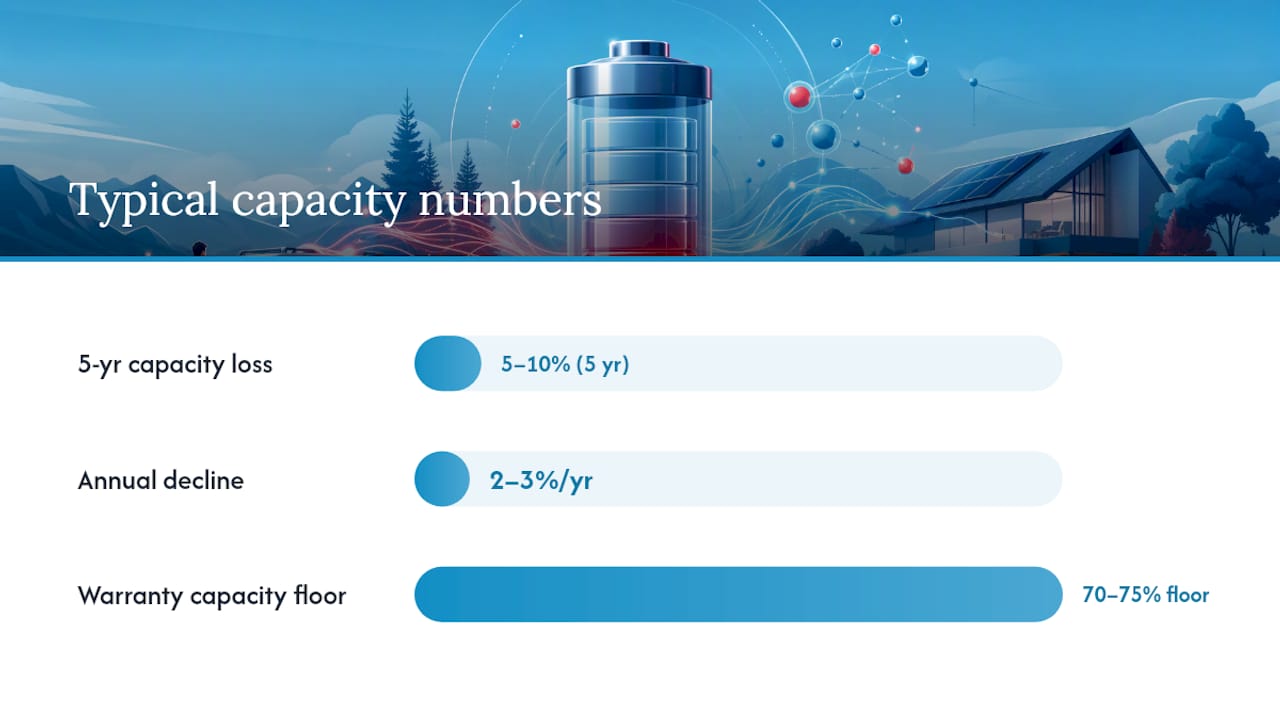
Consumer data on EV batteries, a useful proxy since they’re the most studied lithium application, shows most packs lose roughly 5% to 10% of capacity in the first five years, with fleet-tracking studies putting the annual decline closer to 2% to 3% per year on average. That’s a slower fade than most people expect walking in.
Where the numbers actually land:
- EV and hybrid battery warranties commonly guarantee coverage lasting at least eight years or 100,000 miles, with replacement generally triggered if capacity drops below a threshold around 70% to 75%.
- Home energy storage warranties often stretch to 10 years, frequently with a stated capacity floor rather than just a time limit.
- Marine and powersport lithium batteries typically carry shorter terms, often 4 to 5 years, reflecting harder duty cycles and more exposure to temperature swings.
- Cycle-count claims (such as certain number of cycles to a specified capacity retention) are converted into practical years based on usage patterns, which is why batteries with identical cycle ratings may have different year-based warranties depending on the application.
The takeaway for a buyer comparing options: a longer stated warranty is only as good as the capacity threshold and prorating schedule behind it. Read both numbers together, not the headline year count alone.
Your Legal Rights Under Lithium Battery Warranties
Warranty language isn’t just marketing copy. It’s governed by federal law, and that gives you more leverage than most consumers realize. The Magnuson-Moss Warranty Act gives the Federal Trade Commission enforcement authority over written warranties on consumer products, including lithium batteries sold for personal, family, or household use.
Under this law, manufacturers can’t misrepresent what a warranty covers, and they’re required to make the terms clearly available to consumers before purchase, not buried behind a support ticket after something fails. If a company advertises a “5-year warranty” and then attempts to deny a legitimate claim using undisclosed conditions, that’s a potential violation the FTC has authority to pursue.
The law also affects implied warranties, the unwritten assumption that a product will work as intended for a reasonable period. Manufacturers can limit implied warranties in certain ways, but they can’t use fine print to eliminate consumer protections entirely while still marketing a written guarantee.
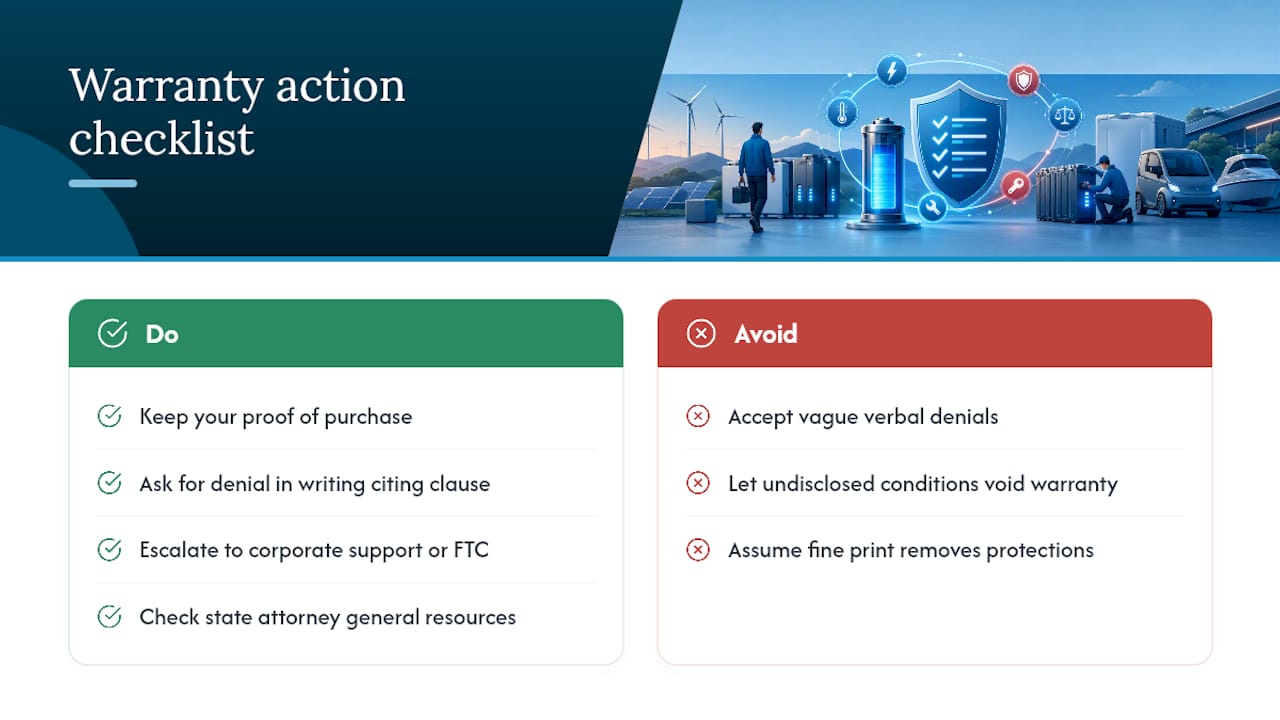
Practically, this means two things for you as a buyer. First, keep your proof of purchase; it’s your primary evidence if a dispute over warranty terms ever escalates. Second, if a manufacturer denies a claim you believe is legitimate, ask for the denial in writing with the specific clause cited. Vague verbal denials don’t hold up well, and a written explanation gives you something concrete to escalate, whether to the manufacturer’s corporate support tier or, if necessary, a consumer protection complaint.
State-level consumer protection laws can add further rights on top of Magnuson-Moss, particularly around lemon-law style protections for major purchases, though coverage varies enough by state that it’s worth checking your own state attorney general’s consumer resources if a dispute drags on.
The Warranty Question Nobody Asks Until It’s Too Late
Here’s what gets lost in most warranty discussions: the length of the term matters less than whether the manufacturer will still be answering the phone when you need them. A 10-year warranty from a company that folds in year 4 is worth exactly nothing. I’d rather see a shorter, clearly documented warranty from a manufacturer with a real support operation than an impressive-sounding decade-long promise with no track record behind it.
The company backs its lithium marine batteries and AGM lineup with multi-year warranties. The number itself isn’t the interesting part. What matters more is what happens between the warranty document and the actual claim: whether registration is straightforward, whether support walks you through documentation instead of making you guess, and whether the process matches what’s written on the PDF. That gap, between paper promises and lived experience, is where most warranties actually succeed or fail.
The other underrated piece is the connectivity trend creeping into warranty terms. As more batteries ship with monitoring and firmware capability, expect more manufacturers to follow the pattern set by home energy storage systems by tying full coverage to staying connected. That’s worth watching if you’re buying a battery for a boat or off-grid setup where connectivity isn’t guaranteed year-round.
— Donald
Why Banshee Batteries Backs Its Lithium Lineup With Real Coverage
If a long, clearly documented warranty is the deciding factor in your next battery purchase, Banshee Batteries built its lithium marine lineup around exactly that priority: a 5-year warranty backed by a manufacturer that answers support calls directly, not through a third-party call center.
That coverage applies across the lithium LiFePO4 marine battery collection, built for the temperature swings and vibration that shorten the life of lesser batteries on boats and off-grid setups. Powersport riders get the same manufacturer-backed approach through the lithium powersport battery lineup. Registering your battery soon after purchase and keeping your receipt on hand helps if you ever need support. Reach out to the company team after your purchase to register your battery before you need to file a claim.
Key Warranty Documents and Authoritative Resources
- Tesla Powerwall limited warranty (USA): shows how connectivity and firmware acceptance affect coverage terms.
- Magnuson-Moss Warranty Act (FTC): the federal law governing written warranty disclosure.
- Lithium Rhino full warranty page: example of registration windows and prorated coverage terms.
- Battery management system overview: explains how BMS logs support claim inspections.
Sources
- Tesla Powerwall limited warranty (USA)
- Magnuson-Moss Warranty Act (FTC)
- Car warranty coverage on an electric car battery | Kelley Blue Book
- Full warranty — Lithium Rhino
FAQ
Is There a Lithium Battery With a 3-Year Warranty?
Yes, 3-year warranties are common on entry-level lithium batteries for powersports and starter applications, though marine and home storage batteries often carry longer terms of 4 to 10 years.
How Many Years Do Lithium Batteries Usually Last?
Most lithium batteries retain usable capacity well beyond their warranty term, but expect noticeable degradation after 8 to 10 years of regular use, with EV packs losing roughly 5% to 10% of capacity in the first five years.
Can a LiFePO4 Battery Last 20 Years?
LiFePO4 chemistry is known for long cycle life, and with proper charging, storage, and moderate use, some batteries can last many years, though warranty coverage rarely extends that far.
Which Lithium Batteries Offer a 10-Year Warranty?
Home energy storage systems most commonly carry 10-year warranties, often with a stated capacity floor, while consumer applications like marine and powersport batteries typically top out at 4 to 5 years, as with Banshee Batteries’ lithium marine lineup.
What Voids a Lithium Battery Warranty Fastest?
Using the wrong charger and physical or water damage are the two most common reasons manufacturers deny lithium battery warranty claims.