


14.2–14.6V, 0.2–0.5C: Lithium Battery Charger Settings for Powersports
The correct profile for LiFePO4 is CC/CV: bulk charge at constant current, then hold constant voltage at absorption until current tapers off. For 12V banks, set absorption to 14.2–14.6V (3.55–3.65V per cell); 24V banks to 28.4–29.2V; 48V banks to 56.8–58.4V. Charge at a moderate current suitable to your battery’s specifications and stop when current tapers to a low level indicating near full charge. Never float, never equalize, and never charge below 0°C unless your BMS explicitly allows it. Your manufacturer’s datasheet always overrides these defaults.
TL;DR:
- Most lithium chargers for LiFePO4 batteries should limit absorption voltage to 14.2–14.6V for 12V systems and stop charging once current tapers to below C/20, usually 2-5 amps for a 100Ah pack.
- Using a charger with preset AGM, gel, or flooded modes can cause damage because LiFePO4 batteries require dedicated CC/CV profiles, not float or equalization.
- Charging below 0°C risks lithium plating, so battery temperature monitoring and protections, like automatic charge cutoff, are essential in cold environments, and heating methods can extend battery life.
- Extending absorption time beyond a short window offers no benefit and may harm battery longevity; a quick absorption phase with proper voltage and current tapering is optimal.
- Daily partial charges at 0.2–0.5C are acceptable, but full charges at 100% should be occasional; storage at 40–60% state of charge prolongs battery life.
Table of Contents
- Lithium Battery Charger Settings at a Glance
- Why LiFePO4 Chargers Use CC/CV Instead of Float
- Can You Charge a Lithium Battery in Cold Weather?
- How to Set Up a Lithium Charger Step by Step
- Why Your Charger Keeps Cutting Out (and Other Common Mistakes)
- Everyday Charging Routines That Extend Battery Life
- What Banshee Batteries Recommends for LiFePO4 Setup
- The Trade-Off Between Fast Charging and Battery Life
- Get LiFePO4 Batteries Built for These Exact Settings
- Sources
- FAQ
Lithium Battery Charger Settings at a Glance
Every number here assumes a standard LiFePO4 chemistry pack with an internal BMS. Confirm your own battery’s datasheet before locking in a charger profile, since some packs run slightly different absorption targets.
To convert a per-cell target into a bank voltage, multiply the cell count by 3.6 to 3.65V. A 12V bank has four cells in series, so 4 cells × 3.65V lands you at 14.6V, the upper edge of the safe absorption range.
Termination is current based, not time based. Most chargers built for lithium cut off once current tapers to somewhere between C/20 and C/50, meaning a 100Ah battery stops charging around 2 to 5 amps. Manufacturer manuals for smart lithium batteries often specify a shorter absorption window, sometimes just an hour or two at voltage, rather than the multi-hour absorption stages common on lead-acid chargers, based on Victron’s published operation guidance.
A few quick rules worth memorizing:
- Absorption voltage should never exceed 3.65V per cell under normal conditions.
- Float mode has no place in a LiFePO4 charge cycle. Skip it entirely.
- If your charger only offers preset “AGM,” “gel,” or “flooded” modes with no lithium option, it is the wrong charger for this battery.
- Current below 0.2C works fine for trickle charging but will charge slowly; current above 0.5C should only be used if your specific pack’s datasheet supports it.
Why LiFePO4 Chargers Use CC/CV Instead of Float
Charging in two stages exists for a reason rooted in basic battery physics. The constant current (CC) phase pushes as much current as the pack safely handles until voltage climbs to the absorption target. Once it hits that ceiling, the charger switches to constant voltage (CV) and holds it there while current naturally drops as the cells fill up. That current drop, called the taper, is the signal the battery is nearly full.
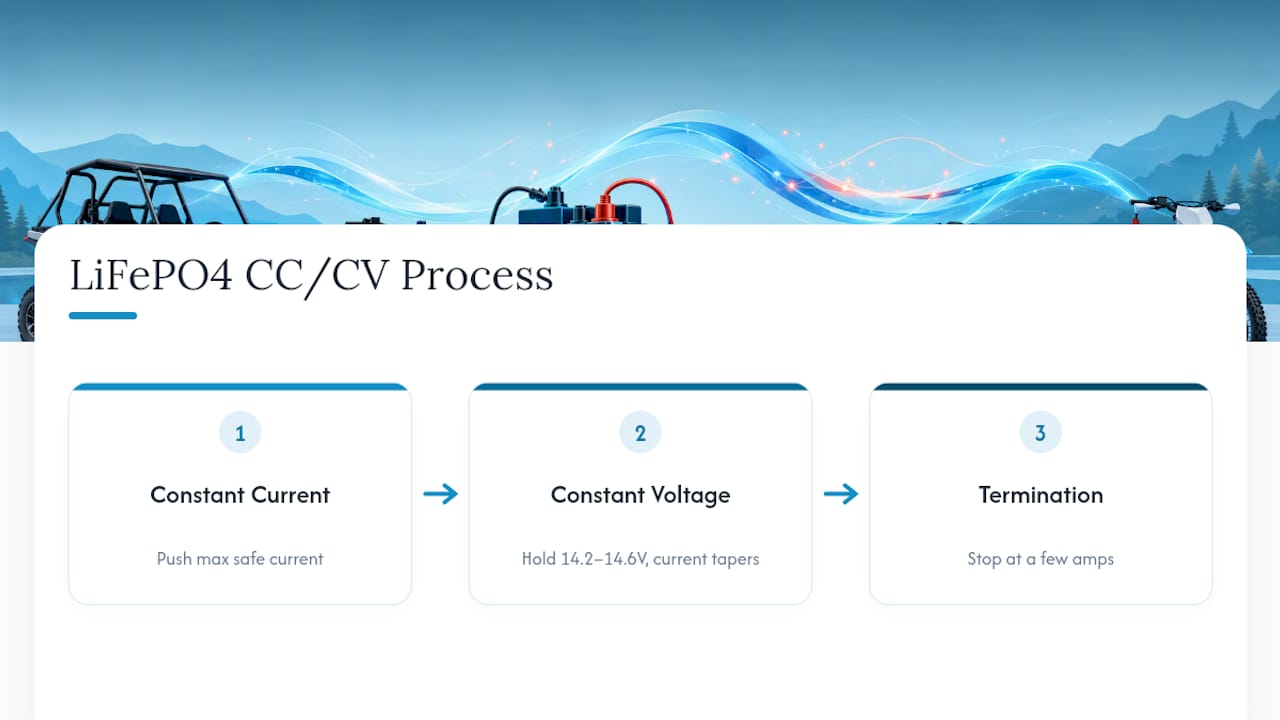
Termination during the CV phase is generally based on current tapering to a low level that indicates near full charge, for example in a 100Ah battery stopping at a few amps. Holding voltage any longer serves no purpose. This differs sharply from lead-acid chemistry, where float charging indefinitely trickles a small current to offset self-discharge. LiFePO4 cells do not need that. Sitting at absorption voltage after the taper completes just stresses the cells and accelerates degradation over hundreds of cycles.
That is also why equalization, a deliberate lead-acid technique that intentionally overcharges cells to correct stratification, has no place in a lithium charge cycle. LiFePO4 cells do not stratify, and pushing voltage above the safe ceiling to “equalize” them risks tripping the battery’s BMS or damaging cells outright.
Physics-informed charging research backs a more nuanced version of this two-stage approach. Studies on fast-charge protocols for high-energy lithium cells show that bounding current density during the CC phase and monitoring cell behavior as voltage rises can push charge speed higher without triggering lithium plating, the process where metallic lithium deposits on the anode instead of intercalating properly. Plating is largely irreversible and eats into both capacity and safety margin.
Absorption time matters less than people assume. A short absorption window, long enough for the BMS to balance cells, usually beats a long one. Extended hold time at 14.6V does nothing for capacity and just adds thermal and electrochemical stress.
Pro Tip: If you’re shopping for a new charger, look for one that reads BMS contactor status or has a temperature probe input. Chargers that operate blind to what the battery pack is actually doing are the ones most likely to cause oscillation or nuisance shutoffs.
Can You Charge a Lithium Battery in Cold Weather?
No, not without protection. Charging LiFePO4 below 0°C (32°F) risks lithium plating on the anode, and unlike some degradation mechanisms, this damage does not heal. A pack that gets plated during a handful of cold charges can lose meaningful capacity permanently, sometimes within a single winter season of neglect.
Most LiFePO4 batteries with a built-in BMS handle this automatically by cutting off charge current entirely once internal temperature sensors detect near-freezing conditions. That protection is a feature, not a malfunction. If your charger keeps trying to push current into a pack that’s refusing it, the BMS is doing its job correctly.
Practical steps for cold-weather charging:
- Check cell or ambient battery temperature before connecting a charger, especially in unheated garages, boats, or trailers.
- Use a charger with a temperature input or remote temperature sensor if you regularly charge in cold environments.
- Consider a battery heating pad or insulated battery box for packs that see regular sub-freezing exposure.
- Reduce charge current as temperature drops, even above freezing. Many manufacturers recommend cutting the C-rate roughly in half between 0°C and 10°C (32°F to 50°F).
Pro Tip: Don’t assume “the BMS will handle it” is a free pass to ignore temperature. A BMS that trips repeatedly during cold starts is still cycling stress onto the pack even if it prevents catastrophic plating. Warm the battery first when you can.
How to Set Up a Lithium Charger Step by Step
Getting the settings right on paper means nothing if the wiring or profile selection is off. Work through this sequence before your first charge cycle:
- Confirm the battery chemistry is LiFePO4, not a different lithium chemistry like NMC or LCO, since voltage targets differ across chemistries.
- Pull up the manufacturer’s datasheet and note the exact absorption voltage, max charge current, and any temperature limits specific to that model.
- Inspect wiring: fuse placement should sit close to the battery’s positive terminal, cable gauge should match the charge current, and every termination should be clean and torqued to spec.
- Select the Li or LiFePO4 profile on your charger, or manually dial in the voltage if the unit supports custom curves.
- Set charge current between 0.2C and 0.5C for routine use, and confirm float and equalize modes are switched off.
- Connect positive first, then negative, and power on the charger to begin the first cycle.
During that first charge, watch for the transition from constant current to constant voltage. Voltage should climb steadily, plateau at your absorption target, then current should taper down cleanly rather than bouncing.
Before you walk away, run through this final check:
- Current should taper smoothly to your cutoff range (C/20–C/50), not drop abruptly or oscillate.
- The BMS should not be cycling the charger on and off repeatedly.
- Terminal temperature should stay close to ambient. Warm cables or connectors point to a wiring problem, not a charger problem.
Why Your Charger Keeps Cutting Out (and Other Common Mistakes)
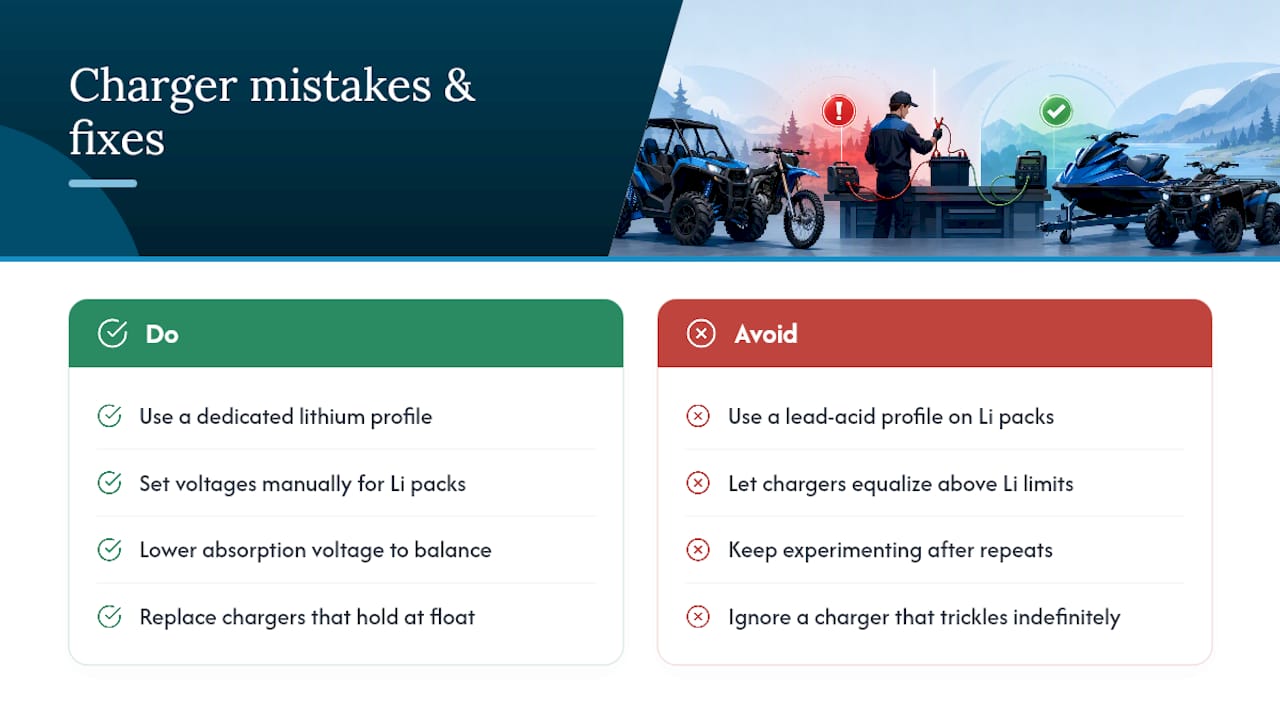
The single most common mistake is running a lead-acid charger profile on a lithium pack. Lead-acid chargers float indefinitely and sometimes equalize at voltages well above what LiFePO4 cells tolerate. If your battery’s BMS is protecting it correctly, that mismatch shows up as a charger that trips or cycles rather than a battery that gets damaged, but it’s still the wrong setup and should be fixed immediately by switching to a dedicated lithium profile or setting voltages manually.
A charger cycling on and off repeatedly during the CV stage usually means the BMS is disconnecting at an overvoltage threshold before the charger’s taper logic catches up. This can happen from cell imbalance, where one cell hits its ceiling before the rest of the pack does. Lowering absorption voltage slightly, or letting the BMS complete a balancing pass at a lower voltage first, generally resolves it. Mismatched lead-acid and lithium charger behavior is a documented cause of this kind of repeated partial charging.
A charger that holds at float instead of stopping is a different problem entirely: it’s a charger design issue, not a battery issue, and the fix is replacing it with a unit that terminates rather than trickles indefinitely.
Pro Tip: If a fix doesn’t hold after two or three charge cycles, stop experimenting and contact the battery manufacturer or a qualified technician. Repeated overvoltage events add up fast on lithium chemistry.
Everyday Charging Routines That Extend Battery Life
Daily use doesn’t call for maxing out every charge cycle. Charging at a lower current for routine top-ups is gentler on the pack, and partial charges are generally acceptable for LiFePO4, unlike older nickel chemistries that suffered from memory effects. Let the charger run a full taper to 100% occasionally, roughly monthly or per your manufacturer’s recommendation, so the BMS gets a chance to balance cells against each other.
Routine full charges every single day aren’t necessary and don’t meaningfully extend runtime for most recreational use. What they do is add cumulative time at high voltage, which is one of the bigger long-term stress factors on lithium cells.
For storage, most manufacturers recommend keeping packs at 40% to 60% state of charge rather than full or empty. A boat or ATV sitting in the garage all winter lasts longer on its battery when stored partially charged than when left at 100% on a permanent float. Our guide to storing LiFePO4 batteries walks through the specifics for seasonal storage.
If you’re charging off solar through an MPPT controller, set it to a lithium profile or custom voltage curve matching the numbers above, and confirm the controller doesn’t default to a permanent float stage meant for lead-acid batteries.
What Banshee Batteries Recommends for LiFePO4 Setup
Getting settings dialed in for a specific battery model matters more than following generic numbers. Banshee Batteries publishes model-specific charger compatibility guidance and voltage charts across its LiFePO4 marine and powersports lineup, built around the same physics that make CC/CV charging necessary in the first place.
A few resources worth checking before your first charge cycle:
- The LiFePO4 charger compatibility guide walks through which charger profiles pair correctly with lithium marine and powersports batteries.
- The voltage chart breakdown converts per-cell targets into practical bank voltages for 12V, 24V, and 48V systems.
- Certain lithium marine batteries carry a 5-year warranty, and some AGM batteries carry a 4-year warranty, often backed by direct technical support for installation and setup.
When a specific pack’s datasheet conflicts with general guidance, the datasheet wins every time. That’s true whether the battery came from Banshee or anywhere else.
The Trade-Off Between Fast Charging and Battery Life
Higher C-rates get you back on the water or trail faster, but they come with a real cost. Pushing current above what a pack’s chemistry and temperature comfortably support raises the odds of lithium plating and adds mechanical stress to the cells with every cycle, a trade-off backed by research into fast-charge lithium behavior.
For most recreational users, that trade-off isn’t worth it. Charging at 0.2C to 0.3C as a daily default, with occasional 0.5C charges only when your pack’s datasheet explicitly supports it, keeps degradation slow without leaving you waiting around. If you’re running a demanding setup, like a trolling motor bank you need topped off in an hour, talk to a qualified battery technician before pushing past manufacturer limits rather than guessing.
— Donald
Get LiFePO4 Batteries Built for These Exact Settings
Once you know the right numbers, the next question is whether your battery and charger actually work well together. Banshee Batteries designs its lithium powersports and marine batteries with a built-in BMS engineered around the CC/CV settings covered here, so you’re not guessing at compatibility between a generic charger and an unfamiliar pack.
Every Banshee lithium battery ships pre-charged and installation-ready, and the LiFePO4 marine lineup comes with a 5-year warranty backing it. If you’re replacing an aging AGM battery or upgrading a boat, ATV, or off-grid setup, browse the full battery and charger catalog to match a pack and charger to your system voltage. Have questions about a specific model’s absorption voltage or current limit? Reach out to Banshee’s support team before your first charge cycle, not after.
Sources
The voltage ranges and charge rates in this guide draw from published battery manuals, peer-reviewed charging research, and vendor technical guides rather than any single source. Worth checking directly:
- Requirements for Enabling Extreme Fast Charging of High Energy Density Li-Ion Cells while Avoiding Lithium Plating
- How to Charge Lithium Batteries: The Basics Explained
Always cross-check your specific battery and charger manuals first. They override any general guidance here.
FAQ
Is It Okay to Charge LiFePO4 to 100%?
Yes, charging LiFePO4 to 100% occasionally is fine and actually helps the BMS balance cells against each other. It just shouldn’t be a daily habit, since routine partial charges around 80–90% put less cumulative stress on the pack over hundreds of cycles.
What Charger Settings Should I Use for a Lithium Battery?
Set the charger to a dedicated Li or LiFePO4 profile with absorption around 14.2–14.6V for a 12V pack, charging current between 0.2C and 0.5C, and float and equalize both disabled. Products like Banshee’s lithium batteries are built with a BMS designed around exactly this profile.
What Percentage Should I Charge My Lithium Battery To?
There’s no single mandatory percentage for daily use.
What Is the Best Charging Routine for Lithium Batteries?
Avoid leaving the battery on a permanent float charge, since LiFePO4 chemistry doesn’t need trickle maintenance the way lead-acid batteries do.