


3.2–3.3V per Cell: LiFePO4 Storage Voltages for 12V, 24V, 48V Owners
Check that voltage every 3 to 6 months and top off if it drops below 50% SOC. Store the battery in a cool, stable environment within moderate temperature ranges to minimize aging during storage.
TL;DR:
- Storing LiFePO4 batteries at around 3.2 to 3.3 volts per cell, or 25.6 to 26.4 volts for 24V packs, maximizes longevity and prevents capacity loss.
- Regular checks every 3 to 6 months are essential to monitor voltage, inspect terminals, and detect internal resistance increases or faults early.
- Keep batteries in a stable, cool environment between 32°F and 77°F to slow aging, and use desiccants and insulation to prevent moisture-related corrosion.
- Avoid leaving batteries on incompatible chargers, especially lead-acid float chargers, which can gradually overvoltage LiFePO4 cells and cause damage.
- Always bring batteries to 40-60% state of charge before storage and disconnect loads and automatic chargers to prevent unintentional overdischarge or charging issues.
Table of Contents
- What Is the Right LiFePO4 Storage Voltage for 12V, 24V, and 48V Packs?
- How Do You Read State of Charge From LiFePO4 Voltage?
- What Temperature and Humidity Are Safe for Storing LiFePO4 Batteries?
- How Do You Prepare a LiFePO4 Battery for Long-Term Storage?
- How Often Should You Check a Stored LiFePO4 Battery?
- What Are the Most Common LiFePO4 Storage Mistakes?
- Why Trust This LiFePO4 Storage Guidance
- The Overlooked Part of LiFePO4 Storage
- Get Storage-Ready Power Built for the Long Haul
- Sources
- FAQ
What Is the Right LiFePO4 Storage Voltage for 12V, 24V, and 48V Packs?
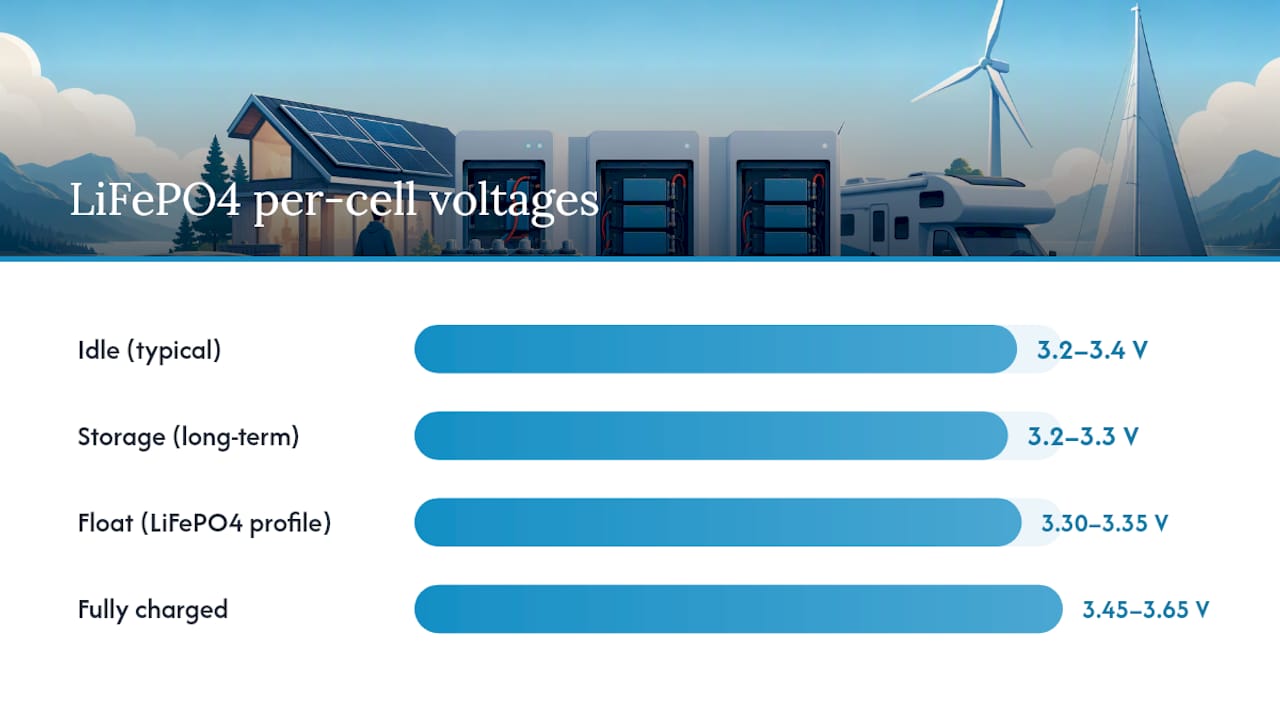
Every LiFePO4 cell wants to sit at roughly 3.2 to 3.4 volts when it’s not being used. Most battery makers narrow that further for long-term storage, recommending closer to 3.2 to 3.3 volts per cell. That range keeps the cell chemistry stable without leaving it near either end of its usable capacity, where degradation accelerates.
Multiply that per-cell number by however many cells are wired in series, and you get your pack-level target. Here’s how that math plays out for the pack sizes most owners actually use:
- 12V nominal (4 cells in series): A nominal 12V pack storage voltage range typically recommended for battery longevity
- 24V nominal (8 cells in series): 25.6 to 26.4 V for storage
- 48V nominal (16 cells in series): 51.2 to 52.8 V for storage
Those numbers are for storage only, not active use. A fully charged LiFePO4 cell reads closer to 3.45 to 3.65 volts, which on a 12V pack translates to roughly 14.2 to 14.6 volts during bulk charging. That’s the voltage your charger hits while topping the battery off for use, not where you want it sitting on a shelf for the winter.
Float charging deserves a separate mention because it trips up a lot of people who move from lead-acid to lithium. Lead-acid float voltages will slowly cook a LiFePO4 pack if the charger isn’t built for the chemistry. When float is used at all with LiFePO4, it typically sits around 3.30 to 3.35 volts per cell, and only when the charger explicitly supports LiFePO4 profiles. If you’re not certain your charger does, disconnect the battery entirely rather than leave it hooked up. For a deeper breakdown of bulk, absorption, and float stages, Banshee Batteries’ guide on how to charge a lithium LiFePO4 battery walks through the full charging curve.
How Do You Read State of Charge From LiFePO4 Voltage?
Voltage is the easiest window you have into state of charge, but LiFePO4’s discharge curve is notoriously flat through the middle of its range. That flatness is actually the reason the 40% to 60% storage window works so well: the cell sits in the most chemically stable part of its curve, away from the steep voltage swings near empty and the high-stress plateau near full.
Because the curve is flat, small voltage differences represent real swings in charge level. A rough per-cell resting-voltage map looks like this:
- ~20% SOC: approximately 3.00 V per cell
- ~40% SOC: approximately 3.20 V per cell
- ~50% SOC: approximately 3.25 V per cell
- ~60% SOC: approximately 3.30 V per cell
- ~80% SOC: approximately 3.35 V per cell
- ~100% SOC: approximately 3.40 to 3.45 V per cell
These figures only hold true at rest. Measure voltage after the battery has sat disconnected, with no load and no charger attached, for at least an hour or two. Pull a reading while a winch, inverter, or bilge pump is drawing current and you’ll see a sagged number that has nothing to do with actual stored capacity.
If your system has a battery management system with a built-in SOC readout, trust that over a manual voltage guess, since the BMS is tracking coulomb counts rather than inferring charge from a flat curve. For setups without any gauge, a basic voltmeter across the terminals and the mapping above is enough to get within a reasonable margin. Banshee Batteries breaks this relationship down further in its LiFePO4 voltage chart explainer, which is worth bookmarking if you manage more than one pack.
What Temperature and Humidity Are Safe for Storing LiFePO4 Batteries?
Voltage gets the attention, but temperature does more long-term damage than most people realize. The safe range for lithium battery storage temperature runs from 32°F to 77°F, with 59°F to 77°F considered ideal for extended periods.
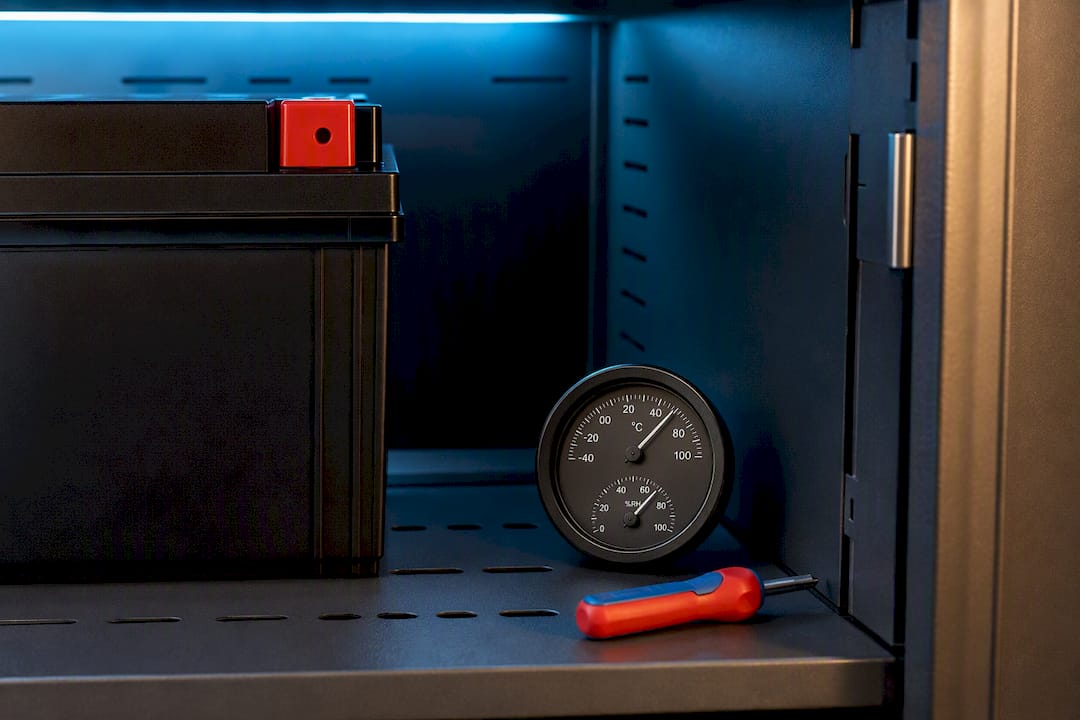
Push past that upper limit and the clock starts ticking faster. Manufacturer data on large lithium packs shows that storage above roughly 95°F to 113°F meaningfully shortens usable life compared to storage in the mid-range, even when the charging and discharging temperature windows are respected during active use. A pack that spends a hot afternoon at 100°F in a closed trailer isn’t ruined, but months of that kind of exposure compound.
Humidity matters almost as much as heat, just through a different mechanism. Temperature swings, not just high heat, cause condensation inside battery compartments, and that moisture can corrode terminals and connectors long before it touches the cells themselves. A few practical habits solve most of this:
- Store the battery off a bare concrete floor, on a shelf or insulated pad, since concrete pulls heat and can hold ambient moisture
- Use a small desiccant pack inside sealed battery boxes or enclosures, especially in boats and RVs
- Avoid attics, uninsulated sheds, or anywhere temperature cycles hard between day and night
- Keep the battery away from direct sunlight even indoors, since a sunny window can push local temperature well above room temperature
Pro Tip: If you store a battery in a garage or boat that swings from freezing nights to warm afternoons, that daily cycling stresses the pack more than a stable location that runs slightly warmer overall. Consistency matters more than chasing the exact midpoint of the ideal range.
How Do You Prepare a LiFePO4 Battery for Long-Term Storage?
Getting a pack ready for months of sitting isn’t complicated, but skipping a step is how people end up with a dead BMS or a swollen cell six months later. Work through this in order.
- Check the pack’s current voltage and note the date. A quick multimeter reading at rest tells you exactly where you’re starting from. If you have access to internal resistance testing, log that too. A rising resistance reading over time is often the earliest sign of a pack heading toward failure.
- Bring the battery to 40% to 60% SOC. If it’s sitting near full, run it down through normal use or a resistive load until per-cell voltage lands around 3.2 to 3.3 volts. If it’s low, give it a partial charge rather than a full one.
- Disconnect every load. Parasitic draws (alarms, clocks, trackers) will slowly pull a stored pack down even with the BMS protecting the cells. A fully disconnected battery holds its charge for months thanks to LiFePO4’s low self-discharge rate.
- Confirm the BMS is active and functioning. The battery management system is your backstop against over-discharge during storage, so don’t disconnect or bypass it unless you have a specific reason to.
- Isolate the terminals. Cover exposed terminals with terminal caps or electrical tape if there’s any chance of accidental contact with metal shelving, tools, or another battery.
- Place it somewhere stable. Follow the temperature and humidity guidance above, and make sure the battery is secured so it can’t tip, roll, or get crushed under other stored gear.
- Label it with the date and starting voltage. This one step is what makes the 3 to 6 month check-in actually useful later, since you’ll have a baseline to compare against.
- If it’s wired into a boat, RV, or solar setup, suspend any automatic charger or inverter top-off. A charge controller set to maintain 100% will fight against everything you just did. Set a proper storage charge limit instead, or unplug the system entirely.
Pro Tip: Write the storage date directly on painter’s tape stuck to the battery case. It sounds low-tech, but it’s the single easiest way to make sure a “quick winter storage” doesn’t quietly turn into 14 months with zero checks.
How Often Should You Check a Stored LiFePO4 Battery?
Plan on a check every 3 to 6 months for the entire time the battery sits unused. LiFePO4’s self-discharge rate is low, generally in the range of a couple percent per month, so it doesn’t demand monthly babysitting the way some other chemistries do. But “low” isn’t zero, and a year of neglect adds up.
Each check should cover three things: resting voltage, terminal condition, and any BMS fault indicators if your system reports them. A quick voltmeter reading against the SOC mapping above tells you whether the pack has drifted.
The top-off rule is straightforward: if SOC has fallen below roughly 30%, bring it back up to around 50% with a controlled charge cycle rather than a full charge. Don’t chase 100% just because you have the charger out.
Watch for these warning signs during routine checks:
- Resting voltage that’s dropped noticeably faster than the last check, suggesting rising self-discharge
- Any visible swelling or deformation of the case, which means the pack should be taken out of service immediately
- A BMS that won’t reset or reports persistent faults after a normal charge attempt
- Terminals showing corrosion or discoloration despite being isolated
A basic voltmeter and a five-minute look-over covers most of this. Battery monitors that log voltage over time make the pattern easier to spot, but they’re a convenience, not a requirement. If a pack shows rising internal resistance or a fault that won’t clear, that’s the point to involve a professional rather than keep cycling it and hoping.
What Are the Most Common LiFePO4 Storage Mistakes?
A fully charged cell sitting for months spends that entire time at the top of its voltage curve, which is the most stressful place for LiFePO4 chemistry to sit long-term.
The second mistake is leaving a LiFePO4 pack on a charger that wasn’t designed for it. A generic float charger built for lead-acid can overvoltage lithium cells slowly and quietly, since there’s no dramatic failure moment, just gradual capacity loss. Set the charge profile correctly or disconnect entirely.
A few more situations worth flagging:
- If per-cell voltage has fallen below roughly 2.5 to 2.8 volts, or the BMS has locked out entirely, stop and consult the manufacturer rather than attempting an aggressive manual recovery charge.
- Persistent swelling, a case that feels warm with no load connected, or a BMS that faults repeatedly are all signs the pack should be retired, not pushed back into service.
- A battery still under warranty showing these symptoms should go back through the manufacturer’s return process rather than being disassembled or force-charged at home.
Why Trust This LiFePO4 Storage Guidance
Some battery manufacturers have spent many years building AGM and lithium batteries for powersports, marine, and off-grid use, so the voltage and SOC ranges in this guide reflect what holds up in vehicles and boats that sit unused for a season. That real-world exposure to extreme temperature swings and long idle periods is reflected in some manufacturers’ warranties on lithium marine and AGM batteries.
For procedures that go deeper than storage alone, the step-by-step LiFePO4 storage guide and the seasonal battery drain guide cover related scenarios like off-season vehicle storage in more detail. If you’re trying to match voltage recommendations to a specific vehicle or vessel, the battery finder tool on the Banshee Batteries site cross-references pack requirements directly, and the car battery size chart can help ensure you get the right physical dimensions for your battery housing.
The Overlooked Part of LiFePO4 Storage
Most storage advice fixates on the single number, the exact voltage, and stops there. That’s incomplete. The voltage target matters, but it’s a proxy for state of charge, and state of charge is only half the equation. Temperature stability does as much long-term damage as getting the storage percentage wrong, and it gets a fraction of the attention.
The conventional wisdom also oversells precision. Chasing 3.25 volts exactly instead of accepting anywhere in the 3.2 to 3.3 range wastes effort on a distinction that doesn’t meaningfully change outcomes. What actually predicts a healthy pack a year later is consistency: the same reasonable SOC window, a stable temperature range, and a check-in every few months without fail.
If you take one thing from this guide, make it the calendar habit, not the decimal point.
— Donald
Get Storage-Ready Power Built for the Long Haul
Some lithium battery packs include a built-in BMS designed to help prevent storage mistakes like over-discharge, which matters for owners seeking exact voltage numbers rather than guesswork.

If you’re shopping for a pack that needs to sit through an off-season without babysitting, the Lithium (LiFePO4) Marine Batteries collection and the Lithium Banshee Powersport Batteries lineup are both built with pre-charged, installation-ready cells backed by a 5-year warranty on the marine lithium line. Need a charger that actually respects LiFePO4 voltage limits instead of a lead-acid profile borrowed from an old float charger? Check the chargers and accessories collection. Not sure which pack fits your bike, boat, or RV? Use the battery finder on the Banshee Batteries homepage or reach out to support directly to confirm the right storage voltage for your specific setup.
Sources
The voltage and SOC figures in this guide draw on Huawei Digital Power’s lithium storage guidelines, the BSLBATT LiFePO4 cell voltage chart, Enphase’s temperature guidelines for IQ batteries, and Bluetti’s LiFePO4 voltage chart guide. Always cross-check against your specific pack’s datasheet, since manufacturer limits vary slightly by cell design.
FAQ
Is It Safe to Store a Lithium Battery at 3.9 Volts Per Cell?
For LiFePO4 specifically, 3.65 volts per cell is the upper limit for full charge, and storage voltages recommended are lower, typically around 3.2 to 3.4 volts per cell. Any reading above the storage range suggests either a different chemistry or a charging error, and the pack should not be stored at that level.
What Is the Resting Voltage of a LiFePO4 Cell?
A LiFePO4 cell at rest typically reads between 3.00 and 3.45 volts depending on state of charge, with the ideal storage window landing around 3.2 to 3.3 volts per cell. Always measure after the battery has sat disconnected for an hour or more.
Is It Okay to Leave a LiFePO4 Battery on the Charger?
Only if the charger has a LiFePO4-specific profile with an appropriate storage or float voltage; a generic lead-acid charger left connected long-term can gradually overvoltage the cells. Disconnecting the battery entirely is the safer default for extended storage.
What Is the Best Voltage to Store a Lithium Battery?
Some lithium battery packs, along with general manufacturer guidance, recommend similar voltage ranges for extended storage.