


LiFePO4: Read State of Charge Accurately in 30 Minutes for Techs
The catch: that voltage barely moves across the middle of the charge range, so a single reading between 20% and 90% tells you almost nothing precise. Disconnect every load and charger, wait at least several minutes to allow the battery voltage to settle, then measure at the terminals with a meter precise enough to detect small voltage changes. For anything more accurate than a rough guess, pair that reading with a coulomb-counting monitor.
TL;DR:
- Voltage measurements are unreliable during the middle of discharge due to a flat voltage plateau, with only the top and bottom of the curve providing useful SOC clues.
- Properly resting the battery for at least 15 to 30 minutes after charging eliminates surface charge effects and yields more accurate voltage readings.
- Coulomb counting monitors significantly outperform voltage checks for daily SOC tracking, especially given lithium iron phosphate’s flat voltage curve.
- Charging should be limited to around 3.65V per cell for longevity, and operating the pack between 20% and 80% SOC extends cycle life.
- As batteries age, their true capacity at 100% SOC declines, so periodic capacity verification is essential for accurate SOC estimation.
Table of Contents
- What Is LiFePO4 State of Charge and Why Is Voltage So Flat?
- LiFePO4 Voltage vs SOC: Reference Charts For Common Pack Sizes
- How Do You Measure LiFePO4 Voltage Correctly?
- Why Voltage Alone Isn’t Enough (and What Actually Works)
- What Charge Voltages and SOC Window Should You Target?
- How Does Aging Change What 100% Actually Means?
- What Should You Check When SOC Readings Look Wrong?
- Practitioner Perspective: What Twenty Years in Battery Design Teaches You
- Get a Pack That Manages State of Charge For You
- Sources
- FAQ
What Is LiFePO4 State of Charge and Why Is Voltage So Flat?
LiFePO4 state of charge simply means how much usable capacity remains in the pack, expressed as a percentage of full. The standard industry term for the underlying property is open-circuit voltage, or OCV, and it is the foundation of every voltage-based SOC chart you’ll find. A single LiFePO4 cell runs at a nominal 3.2V, with a charge ceiling around 3.65V per cell during the bulk stage. Scale that up and a 12V pack (four cells in series) tops out near 14.4 to 14.6V while charging, a 24V pack (eight cells) doubles it, and a 48V pack (16 cells) quadruples it.

Here’s the part that trips up a lot of people coming from lead-acid or AGM backgrounds: LiFePO4 has an unusually long, flat discharge plateau. Between roughly 90% and 20% state of charge, the voltage barely changes at all, drifting from about 3.35V down to 3.22V per cell across that entire middle stretch, according to Wevolver’s LiFePO4 voltage chart. Voltage only becomes a useful indicator near the very top and very bottom of the curve, where the line finally steepens.
A few practical wrinkles complicate any single reading:
- Surface charge inflates voltage right after charging, sometimes for hours, before it settles to the true resting value.
- Load sag pulls voltage down while current is flowing, which can make a healthy battery look half empty.
- Temperature shifts the curve slightly, with cold readings running lower than warm ones at the same actual SOC.
None of these are flaws in the battery. They’re just reasons a rushed voltage check, taken mid-discharge or seconds after unplugging a charger, will lie to you.
LiFePO4 Voltage vs SOC: Reference Charts For Common Pack Sizes
Once you understand that the middle of the curve is mushy, the top and bottom become genuinely useful. Below is a resting (rested at least 15 to 30 minutes, no load) single-cell reference, drawn from the OCV mapping used across EASYWAY Energy’s SOC guide and corroborated by GridWright’s pack voltage tables.
The 12V column lines up closely with the reference table in VoltageBasics’ conversion guide, which lists 14.6V during charging, 13.6V at true resting full, 13.3V near 90%, and 12.8V around the 20% mark. Multiply any single-cell value by 4, 8, or 16 to get your 12V, 24V, or 48V pack equivalent, assuming the cells are reasonably balanced.
Treat every number in that table as a coarse reference, not a lab-grade measurement. Temperature and how the pack has aged shift things further. For a deeper look at how these numbers apply specifically to your setup, Bansheebatteries breaks down the LiFePO4 battery voltage chart in more detail.
How Do You Measure LiFePO4 Voltage Correctly?
Getting a number off a multimeter is easy. Getting a number that actually means something takes a bit more discipline. Here’s the sequence that produces a reading you can trust against the charts above:
- Power everything down. Turn off inverters, chargers, DC to DC converters, and any load pulling from the battery. Even a small parasitic draw skews the reading.
- Let the pack rest. Fifteen to 30 minutes is the practical minimum, and it’s enough to shed most surface charge from a recent charge cycle. If you want a reading precise enough to trust within a percent or two, rest it 2 to 4 hours instead.
- Use a meter with 0.01V resolution. A cheap meter that only shows one decimal place cannot resolve the differences that matter on a curve this flat.
- Probe the actual terminals, not the output lugs of a fuse block or busbar, where voltage drop across connections can shave off a few hundredths of a volt.
- Record the number to two decimal places and check it against a resting chart, never a charging or loaded one.
If you measure immediately after charging and get a suspiciously high number like 3.55V per cell, that’s surface charge talking, not true state of charge. It will settle within a couple of hours. If you measure under load and the voltage looks alarmingly low, that’s sag, and it will bounce back once the load comes off.
Pro Tip: Keep a small notebook or phone note with your pack’s resting voltage at a known SOC, like right after a full charge and rest period. Over months, comparing fresh readings against that baseline tells you more about aging than any single chart ever will.
Why Voltage Alone Isn’t Enough (and What Actually Works)
The flat plateau is the whole problem in a nutshell. A voltage swing of just 0.10V per cell can represent a 50 or 60 percentage point swing in actual capacity remaining, which means your $15 multimeter simply doesn’t have the resolution to tell 40% from 70% with any confidence. That’s not a defect in the battery chemistry. It’s just how lithium iron phosphate behaves, and it’s the tradeoff for the flat, stable power delivery that makes LiFePO4 so appealing for powersports and marine use in the first place.
The fix that actually works is coulomb counting. A shunt-based battery monitor sits in line with your main negative cable and tracks every amp-hour flowing in and out of the pack in real time, giving you a running tally that doesn’t care where you are on the voltage curve. GridWright notes that a decent shunt monitor runs somewhere in the $50 to $150 range, and for daily use it delivers far more useful data than repeated voltage spot checks.
Modern battery management systems go a step further:
- They recalculate full charge capacity (FCC) periodically instead of assuming the pack still holds its original amp-hour rating.
- They apply temperature compensation, since a cold cell reads slightly lower than a warm one at identical SOC.
- Higher-end systems use algorithmic filtering, including Kalman filter models, to blend voltage, current, and temperature data and correct for sensor drift over time, a technique detailed in research on SOC estimation for aged lithium-ion batteries.
None of this makes voltage checks useless. It just means voltage is your sanity check at the extremes, and coulomb counting is your day-to-day instrument.
What Charge Voltages and SOC Window Should You Target?
Charging parameters and the daily SOC window you run your pack in are two sides of the same longevity question. Get either one wrong and you’re either undercharging every cycle or grinding down cycle life faster than necessary.
- Bulk/absorption charge voltage: cap at 3.65V per cell, which works out to 14.4 to 14.6V for a 12V pack.
- Resting full voltage: once the charger disconnects and the pack settles, expect 13.4 to 13.6V on a healthy 12V bank.
- Float charging: LiFePO4 generally doesn’t need it. If your charger insists on a float stage, keep it around 13.5 to 13.6V for a 12V pack to avoid unnecessary stress on the cells.
- Daily operating window: running the pack between 20% and 80%, or up to 90% on days you need the extra range, extends cycle life meaningfully compared to habitually charging to 100% and draining to empty, per EASYWAY Energy’s guidance.
- Low-voltage cutoff: set load disconnects around 12.8V (about 20% SOC) rather than letting the BMS trip its own low-voltage protection repeatedly, which shortens cell life over time.
If you’re dialing in a charger for the first time, Bansheebatteries walks through the specifics in its guide on how to charge a LiFePO4 battery correctly.
How Does Aging Change What 100% Actually Means?
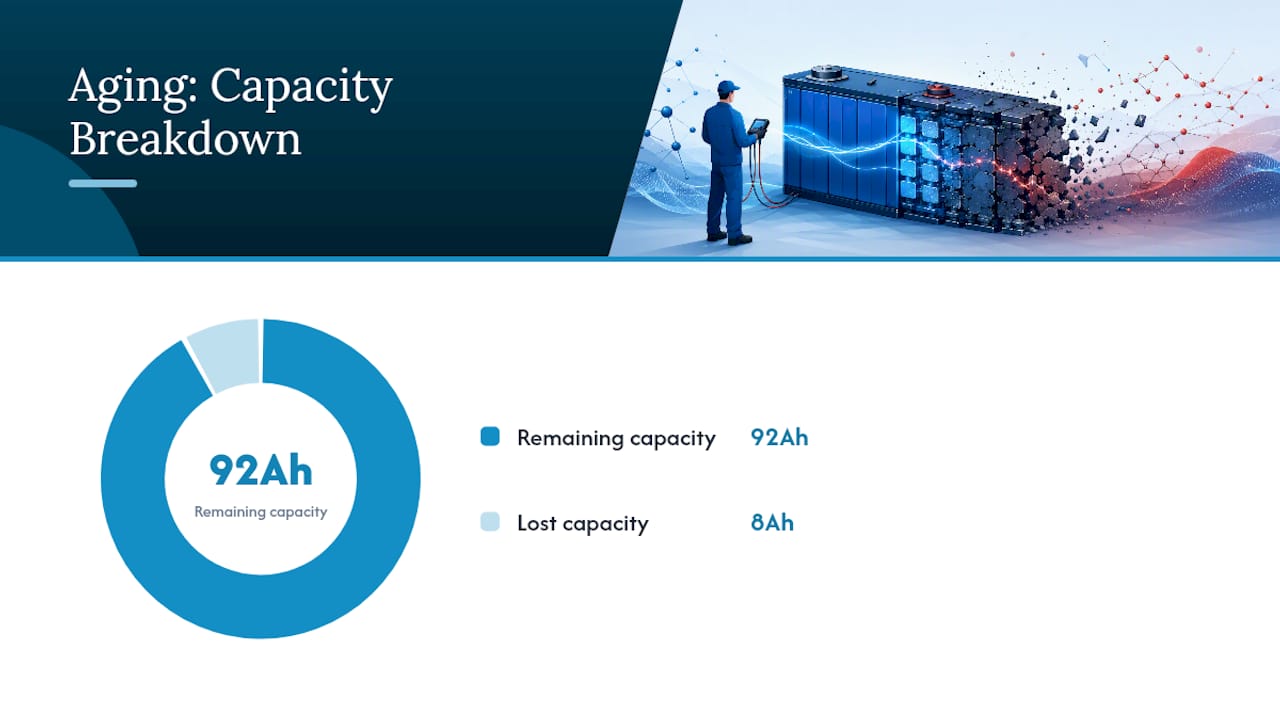
State of charge isn’t just a voltage lookup. It’s a ratio: current stored capacity divided by full charge capacity (FCC), and FCC shrinks every year as the pack accumulates cycles and calendar age. A pack that’s rated 100Ah new might genuinely hold only 92Ah after a few seasons of hard use, and a well-designed BMS recalculates that new ceiling rather than pretending the battery is still brand new, based on model-adaptive SOC estimation research.
That means 100% on a three-year-old pack delivers less actual runtime than 100% did on day one, even though the display still says 100%.
- Run a periodic amp-hour verification: fully charge, then discharge through a known load while logging total amp-hours delivered, and compare that number to the rated capacity.
- Recalibrate your monitor whenever that test shows a meaningful gap from the last calibration.
- Expect this gap to widen faster in packs that regularly see full 0 to 100% cycles versus ones kept in the 20 to 80% window.
For more on how this plays out over a battery’s service life, see Bansheebatteries’ breakdown of how long LiFePO4 batteries actually last.
What Should You Check When SOC Readings Look Wrong?
When a voltage reading or a monitor’s percentage doesn’t match what you’d expect, the cause is almost always one of five things: you measured under load instead of at rest, you’re reading the wrong chemistry’s chart (lead-acid tables don’t apply here), one or more cells in the pack have drifted out of balance, your meter lacks the resolution to resolve a flat curve, or the pack is simply cold.
Pro Tip: Before you assume a battery is failing, rest it for 30 minutes at room temperature and re-measure. That single step resolves more “my battery is dying” panics than anything else.
Quick fixes, in order of how often they solve the problem:
- Let the pack rest and remeasure before drawing any conclusions.
- Run a full charge cycle to trigger the BMS’s automatic cell rebalancing.
- Pull the BMS log if your system has one, and compare its coulomb count against your expected amp-hours used.
- If cells stay imbalanced after a full rebalance cycle, that points to a hardware issue worth a technician’s look rather than a software fix.
Practitioner Perspective: What Twenty Years in Battery Design Teaches You
An expert with two decades of experience building AGM and lithium packs for powersports and marine use states: voltage charts are a starting point, not a verdict. The setups that hold up best in the field pair a quality BMS with a shunt-based monitor, because that combination catches problems, like drifting FCC or cell imbalance, long before a voltmeter ever would.
— Donald
Get a Pack That Manages State of Charge For You
Chasing accurate SOC with a multimeter and a spreadsheet works, but it takes discipline most hobbyists don’t have time for after a long day on the water or the trail. Some lithium battery packs include a built-in Battery Management System that handles cell balancing, FCC tracking, and low-voltage cutoffs automatically, so resting the battery for a long period before measuring state of charge is less necessary.

If you’re running a boat, a prebuilt pack from the Lithium (LiFePO4) marine batteries collection gives you integrated BMS protection without any DIY calibration. Powersports riders looking to swap out an aging AGM unit can browse the full lineup at Bansheebatteries and use the battery finder tool to match a pack to their exact vehicle. Either way, pick a battery, check the fit against your vehicle’s specs, and place the order. That’s the whole process.
Sources
- SOC in Lithium Batteries: Practical, technical and system-level guide — EASYWAY Energy
- LiFePO4 voltage chart: SOC & voltages for 3.2V/12V/24V/48V systems — Wevolver
- LiFePO4 voltage chart: 12V/24V/48V state of charge | GridWright
- How to convert LiFePO4 voltage to SOC percentage — VoltageBasics
FAQ
What Voltage Should a LiFePO4 Battery Be When Fully Charged?
A single cell reads about 3.65V while actively charging and settles to 3.30 to 3.40V once rested; a 12V pack shows 14.4 to 14.6V during charging and 13.4 to 13.6V at true resting full.
What Are the Different Charge Stages of LiFePO4?
LiFePO4 charging typically moves through a bulk stage (constant current up to the voltage ceiling), a short absorption stage near 3.65V per cell to top off the last few percent, and an optional float stage that most packs don’t need at all.