


Jump Start a Boat Battery Safely, Run Bilge Blower 4 Minutes First
Yes, you can jump-start a boat’s starting battery, but only under the right conditions. Ventilate the engine compartment first, and keep every spark away from the battery itself. A marine-rated portable jump starter is the safer choice over a car or long cable run across a dock. If you smell fuel, see a cracked case, or feel hot wires anywhere near the battery, stop. That’s a towing call, not a jump-start job.
TL;DR:
- Using a marine-rated portable jump starter is safer and more effective than car jump leads, especially when avoiding long cable runs near fuel vapors.
- Always ventilate the engine compartment for at least four minutes and check for damage, cracks, or fuel odors before attempting to jump-start.
- Peak amps are less important than cranking amps (CA) and cold cranking amps (CCA), which determine whether a jump starter can reliably start your engine size.
- Jumper only to the correct battery bank and follow a specific connection order to minimize sparks and prevent ignition of fuel vapors.
- Deep-cycle batteries generally should not be jumped and require proper charging or replacement, especially if they show signs of physical damage or cannot hold voltage.
Table of Contents
- How Do You Jump Start a Boat Battery Safely?
- Which Marine Battery Types Are Safe to Jump?
- Can You Use a Car to Jump a Boat Battery?
- What Specs Matter When Choosing a Marine Jump Starter?
- What Is the Correct Step-by-Step Jump-Start Sequence?
- What Should You Check After Jump-Starting the Battery?
- Why Won’t the Engine Start After a Jump?
- How Do You Jump Start Multiple Batteries or a Battery Bank Safely?
- Does Weather Affect Jump-Starting a Boat Battery?
- Does the Battery Need Jumping or Full Replacement?
- Do Inboard and Outboard Engines Need Different Jump-Start Precautions?
- What Marine Rescue Pros Get Right About Jump-Starting
- Sources
- FAQ
How Do You Jump Start a Boat Battery Safely?
Before you touch a single clamp, run through this checklist. Most failed or dangerous jump attempts trace back to skipping one of these steps.
- Run the bilge blower for at least four minutes in any enclosed engine compartment before doing electrical work.
- Kill the ignition and every electronic device, then open the hatch fully and check for fuel odor. If you smell gas, stop entirely.
- Look the battery over for cracks, bulging, or leaking acid. Physical damage means no jump, period.
- Check voltage with a meter: healthy batteries typically read in a range near 12.6 to 12.8 volts; lower voltage indicates a discharged battery.
- Try the battery switch’s BOTH or ALL position, or flip to a backup battery, before reaching for cables.
Pro Tip: Keep a cheap voltmeter in your ditch bag. Testing takes ten seconds and tells you whether you’re dealing with a dead battery or a bad connection, which are two completely different fixes.
Which Marine Battery Types Are Safe to Jump?
Starting batteries and dual-purpose batteries are built to deliver a short burst of high current, and they’re normally fine to jump. Deep-cycle batteries are a different story. They’re designed to feed accessories like trolling motors, refrigerators, and electronics over long stretches, and on most boats they aren’t wired into the starting circuit at all. Jumping one rarely helps and can stress a battery that was never meant for cranking loads.
Chemistry matters too:
- Flooded lead-acid and AGM or EFB starting batteries are typically safe to jump using standard procedures.
- LiFePO4 batteries can have manufacturer-specific jump-starting guidance, so check the battery’s manual before connecting anything.
- Any battery with a cracked case, bulging sides, or a suspected internal short needs to come out for bench charging or professional inspection, not a jump attempt.
Can You Use a Car to Jump a Boat Battery?
You can, but a car introduces risks a marine-rated donor doesn’t. Long cable runs from a dock to a boat mean more resistance, weaker grounding, and a higher chance of exposing the bilge to sparks. If you go this route, the car’s voltage needs to match your boat’s system, and the car’s engine should stay running the whole time.
A donor boat is the better option when one is available, since it skips the long cable run entirely. Keep that donor engine idling at moderate RPM the whole time it’s charging the dead battery.
- A car can work if voltages match and cable runs stay short and secure.
- A donor boat avoids cross-dock cable runs and reduces spark exposure near fuel vapors.
- A marine-rated portable jump starter is the safest on-water option, since it skips cables entirely and often includes reverse-polarity protection and spark-proof clamps.
What Specs Matter When Choosing a Marine Jump Starter?
Peak amps tell you the maximum burst a jump starter can deliver, while cranking amps (CA) and cold cranking amps (CCA) tell you what it can sustain during actual engine cranking. CA and CCA are the numbers that matter most for real-world starting performance, not the flashy peak-amp figure on the box.
As a rough buying guide by engine size:
- Small outboards generally need less peak capacity, and a unit with moderate peak amps often covers them.
- Mid-size outboards and small inboards typically call for something in the 1,000 to 1,200 peak amp range, which covers most recreational outboards.
- Larger inboards and small diesels need more margin. Buy jump starters rated above the minimum for your engine.
Look for spark-proof or smart clamps, reverse-polarity protection, heavy-gauge marine-rated cables, and a real IP water-resistance rating. Lithium jump starters recharge faster and weigh less, but some units are sensitive to extreme cold, so check the manufacturer’s temperature range if you boat in cold climates.
Store the unit in a dry bag away from the bilge, out of direct heat and salt spray to ensure lasting protection; learn more about effective gelcoat protection for your boat’s finish. Recharge it quarterly even if it hasn’t been used, and inspect the clamps for corrosion before every trip.
What Is the Correct Step-by-Step Jump-Start Sequence?
Marine jump-starting follows a specific connection order that standard car procedures don’t teach, and the difference matters near fuel vapors.
Before connecting anything:
- Run the bilge blower for at least four minutes.
- Confirm both batteries and cables are in good shape, with no cracks or corrosion.
- Turn off the ignition and every electronic device on both boats.
Connection order:
- Red clamp to the dead battery’s positive terminal.
- Red clamp to the donor’s positive terminal.
- Black clamp to the donor’s negative terminal.
- Black clamp to a bare metal point on the engine block of the disabled boat, away from the battery itself.
That last connection point isn’t arbitrary. Grounding the final negative clamp to the engine block instead of the battery keeps any final spark away from hydrogen gas that can vent near the battery terminals.
Starting protocol:
Let the donor engine idle at a moderate speed. Wait one to three minutes before attempting to start, longer if the battery is deeply discharged, so it can pick up some surface charge first. Crank in short bursts of three to five seconds with 30-second rests between tries. Don’t chain attempts back to back. That habit burns out starter motors and stresses alternators fast.
Disconnect in reverse order, engine block ground first, then watch and smell for smoke or overheating. Once the engine is running, let it idle at a slightly elevated RPM for 20 to 30 minutes to rebuild some charge.
If you feel hot wires, see smoke, or notice a cracked case at any point, stop immediately. That’s not a jump-start situation anymore. It’s a call for a tow.
Pro Tip: Count your cranking attempts out loud. It’s an easy way to actually enforce the rest periods instead of guessing how long it’s been.
What Should You Check After Jump-Starting the Battery?
A jump gets your engine running. It doesn’t mean the battery is fixed. Idling for 20 to 30 minutes puts some charge back, but it’s rarely enough to fully restore a battery that was deeply discharged, and it’s no substitute for a proper charging cycle.
- Watch your voltage: 12.6 to 12.8V reads as a full charge, while anything under 12.4V suggests the battery is heading toward replacement soon.
- If voltage keeps dropping fast or you notice an electrical smell, that points to alternator or diode trouble, not just a tired battery.
- Repeated deep discharges followed by a jump can stress alternator diodes and voltage regulators, so don’t treat jumping as routine maintenance.
- If the problem keeps coming back, pull the battery for bench charging and testing, or bring in a marine electrician. Our guide on replacing a boat battery safely walks through that process.
Why Won’t the Engine Start After a Jump?
If the jump didn’t work, don’t assume the battery is dead. Check the engine cutoff switch (ECOS) first, and confirm the battery switch is actually on BOTH or ALL rather than a single bank. Sea Tow resolves a lot of dead-battery calls just by checking these two things, which is worth remembering before you assume the worst.
- Confirm the ECOS lanyard is attached and the battery switch is in the correct position, and check our battery switch wiring guide if you’re not sure how yours is set up.
- Do a thermal check: carefully feel the wires near the battery. Warm or hot wires point to an internal fault, and jumping again won’t fix it.
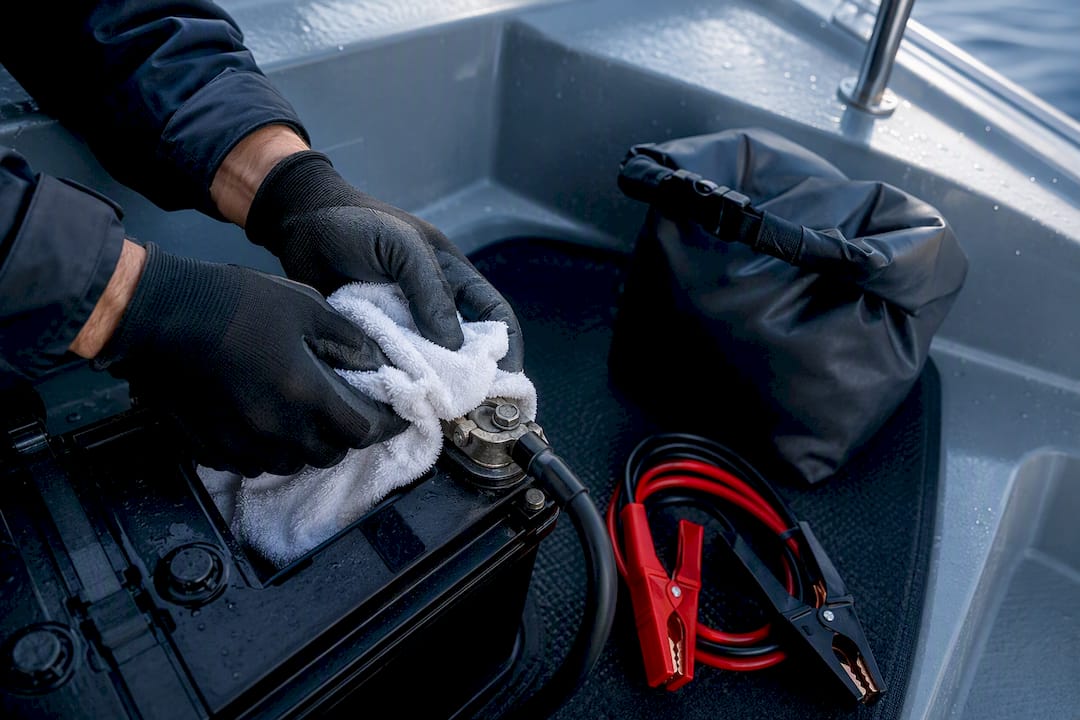
- Clean light surface corrosion off terminals and press clamps firmly, but never work near fuel fumes.
- If the engine still won’t start after a clean connection and a healthy donor, suspect the starter motor, alternator, or an internal battery short, and get a professional diagnosis.
Pro Tip: If the same battery needs jumping twice in one season, it’s not a fluke. Something in the charging system or the battery itself is failing, and testing it beats guessing every time.
How Do You Jump Start Multiple Batteries or a Battery Bank Safely?
Boats with multiple batteries or a battery bank need extra care, because the wiring adds more places for a mistake to turn into a spark near fuel vapors. Before doing anything, find your battery switch and figure out which bank is actually dead. Many “dead battery” calls on multi-bank setups turn out to be a switch left in the wrong position, not an actual failure.
If you do need to jump a specific bank, connect only to the terminals of the battery that’s actually discharged, not to a bus bar or a combined terminal serving multiple batteries at once. Jumping into a shared connection point can send current through wiring and fuses that weren’t sized for it, and that risks damage well beyond the dead battery itself.
Keep the same connection order regardless of how many batteries are on board: positive to positive first, then negative to a clean engine block ground, never to a battery terminal. If your boat runs a series or parallel bank setup for higher voltage or capacity, don’t try to jump across the entire bank. Isolate the single faulty battery using the battery switch, jump that one unit, then let the isolation switch reintegrate it with the rest of the bank once it’s running.
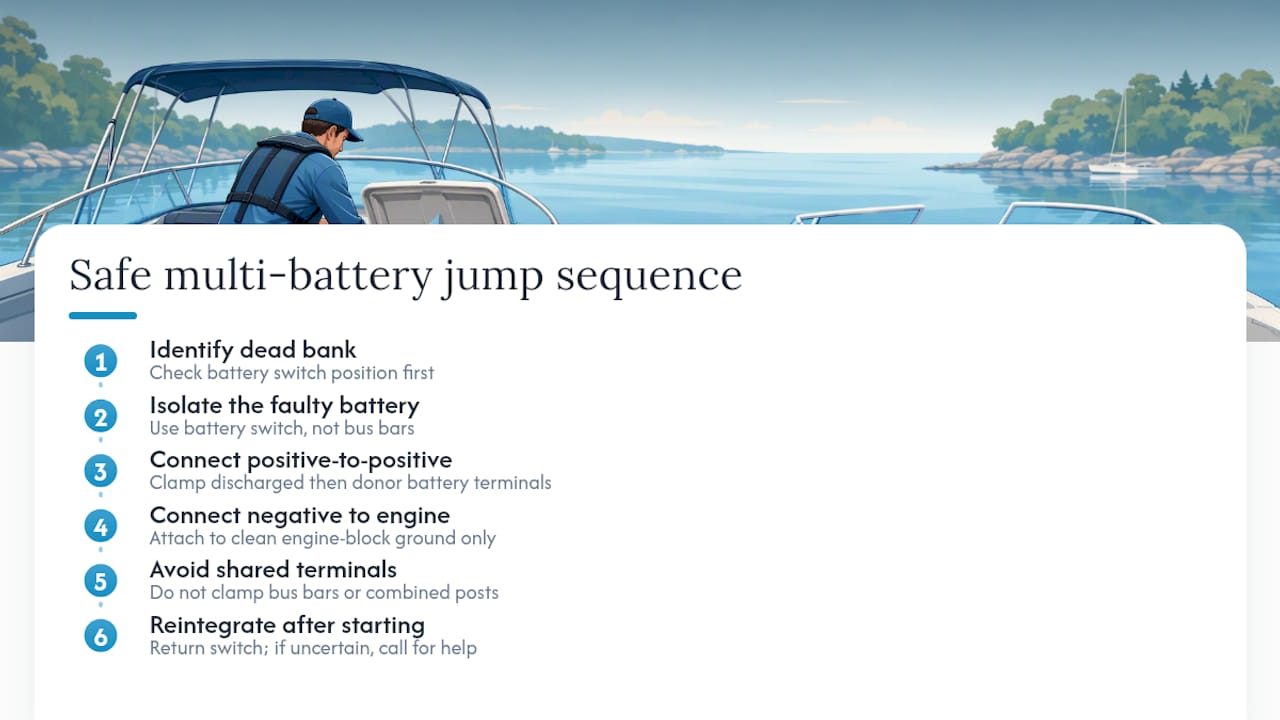
If you can’t isolate a single battery, or you’re not confident in how the bank is wired, that’s a sign to call for help rather than experiment. Multi-battery systems are exactly where a wiring mistake escalates from an inconvenience to real equipment damage.
Does Weather Affect Jump-Starting a Boat Battery?
Cold and heat both change how a jump-start plays out, and neither one is intuitive if you’re used to jumping a car in a garage.
Cold weather thickens battery electrolyte and slows the chemical reaction that produces cranking power, so a battery that reads fine on a summer afternoon can struggle in cold conditions. It also means your donor, whether that’s a portable jump starter or another boat, needs more capacity than the summer minimum to deliver the same crank. Lithium jump starters are especially sensitive here. Extreme cold can reduce their output or trigger a low-temperature cutoff, so check the manufacturer’s rated range before you count on one in winter conditions.
Heat causes its own problems. High temperatures accelerate corrosion at terminals and can speed up water loss in flooded lead-acid batteries, which shortens their useful life and makes a marginal battery fail sooner. Direct sun on a jump starter stored on deck can also push its internal cells outside their safe operating range, so keep any portable unit in a shaded, dry bag rather than a hatch that bakes in the sun.
Rain and humidity introduce a different risk: water near open terminals raises the chance of a short circuit or a shock. If you’re jumping a battery in wet conditions, dry the terminal area first and make sure your hands and gloves are dry before handling clamps. Wind rarely affects the electrical side of things, but it does affect how long you can safely stand at an open engine hatch working, so factor that into how much time you budget for the whole procedure.
Does the Battery Need Jumping or Full Replacement?
A jump is a temporary fix, not a diagnosis. Some symptoms point toward a battery that’s simply discharged and will recover fine. Others point toward a battery that’s on its way out no matter how many times you jump it.
A battery that cranks slowly, reads around 12.0 to 12.4V, and starts normally after a jump with a stable voltage afterward is probably just discharged from sitting unused or a parasitic drain. That’s a battery worth keeping, and a case for better charging habits between trips.
A battery that needs jumping every few trips, drops voltage fast even after a full charge, or won’t hold above 12.4V for more than a day or two is telling you it’s near the end of its service life. Physical signs settle the question outright: a swollen case, visible corrosion at the terminals beyond light surface buildup, a rotten-egg smell, or any leaking fluid mean it’s time to stop jumping it and start shopping for a replacement.
Age matters as much as symptoms. Flooded and AGM starting batteries typically last three to five years under normal marine use, and a battery already at or past that mark that’s also showing slow cranking is a much stronger replacement candidate than a one-year-old battery with the same symptom. If you’re due for an upgrade, Banshee’s marine battery lineup is worth a look, particularly if you’re considering a move to LiFePO4 for the weight and cycle-life advantages.
Do Inboard and Outboard Engines Need Different Jump-Start Precautions?
Outboard motors typically sit outside the hull, so their battery connections are more exposed to spray and moisture but usually easier to reach and ventilate. The main precaution is still fuel vapor: even though the motor is external, the battery is often mounted in a compartment near the fuel tank or bilge, so the same blower and ventilation rule applies before you connect anything.
Inboard engines sit inside an enclosed engine compartment, which is exactly the vapor-trap scenario that makes ventilation non-negotiable. Gasoline vapors are heavier than air and settle into the bilge, and a single spark near the battery in that environment can ignite them. Run the blower the full four minutes minimum on any inboard before working near the battery, no exceptions, even if you’re in a hurry.
Diesel inboards carry less fire risk from vapor since diesel doesn’t ignite as easily as gasoline, but they typically demand more cranking amps to turn over compression, so undersized jump starters that work fine on a gas outboard may not deliver enough power for a diesel inboard. Match your jump starter’s CCA rating to your specific engine, not a generic “boat battery” assumption.
Twin-engine boats, whether inboard or outboard, add one more wrinkle: make sure you’re jumping the correct battery bank tied to the engine that won’t start, not just the nearest battery you find. A quick check of your battery switch layout before you start saves a lot of wasted effort.
What Marine Rescue Pros Get Right About Jump-Starting
Sea Tow captains see the same failure patterns over and over, and most of them aren’t dramatic. They’re small oversights: an engine cutoff switch that got bumped, a battery switch left on the wrong bank, a terminal that’s just loose enough to lose contact. Checking those first solves a surprising share of dead-battery calls before anyone reaches for a cable.
The thermal check is the piece most boat owners skip, and it’s the one that actually prevents bad outcomes. A warm or hot wire near the battery isn’t a minor detail. It’s a sign of an internal fault that a jump won’t fix and might make worse.
There are battery manufacturers who build AGM and LiFePO4 batteries for marine and powersport use with failure-prevention mindsets and industry-leading warranties. If you’re rebuilding your onboard electrical setup after a bad season of jump-starts, pairing a reliable battery with routine maintenance habits, like the checks in our winterizing guide, does more for your reliability than any single emergency fix.
— Donald
Sources
- Dead Battery? Here’s What to Do | Sea Tow
- Marine Jump Starters: On-Water Emergency Starting Guide
- Engineerskill
- Jump Starters for Boats: How They Work and Which to Buy - West Marine
If your battery ends up needing more than a jump, browsing Banshee’s lithium marine battery collection is a solid next step, especially if repeated deep discharges have shortened your current battery’s life.
FAQ
Is It Possible to Jump-Start a Dead Boat Battery?
Yes, a dead starting or dual-purpose marine battery can typically be jump-started if it’s not physically damaged and the engine compartment has been properly ventilated first.
Can You Jump-Start a Boat Battery With a Car Battery?
You can, but it carries more risk than using a marine donor because of long cable runs and weaker grounding. A donor boat or a marine-rated portable jump starter is the safer choice.
Can You Use a Jump Starter on a Boat?
Yes, a marine-rated portable jump starter is generally the safest option for boats, since it skips cable runs entirely and often includes spark-proof clamps and reverse-polarity protection.
Can You Charge a Marine Battery With Jumper Cables?
Jumper cables start the engine so the alternator can begin charging the battery, but they don’t fully recharge it. A deeply discharged battery still needs a dedicated charger or a full engine run afterward to restore a real charge.