


How to Read Battery Specs: A Practical Decoding Guide
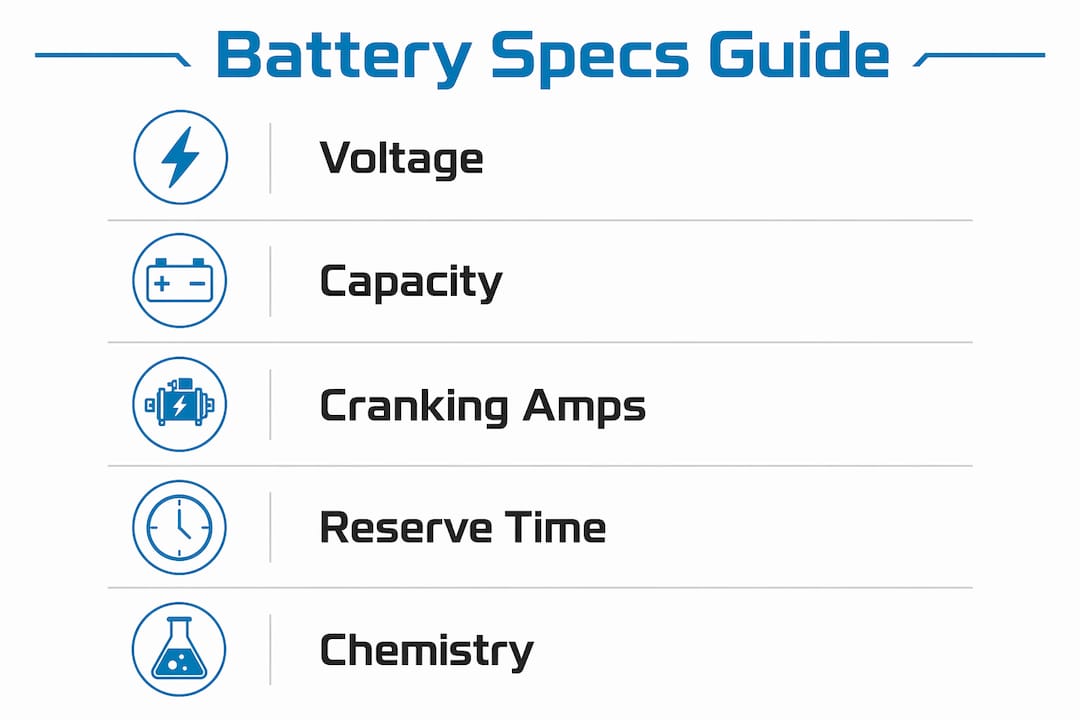
When you pick up a battery, five numbers tell you almost everything you need to know: voltage, Cold Cranking Amps (CCA) or Cranking Amps (CA), Reserve Capacity (RC), amp-hours (Ah), and the group size code. Read those first. If the voltage and group size match your vehicle’s requirements, then CCA tells you whether it will start reliably in cold weather, RC tells you how long it can run accessories if the alternator fails, and Ah tells you how much total energy it stores for deep-cycle use.
Quick-read checklist:
- Starting a vehicle: Prioritize CCA (match or exceed OEM spec), then group size for fitment, then RC for emergency run time.
- Deep-cycle or auxiliary power: Prioritize Ah (and watt-hours if comparing across voltages), then chemistry (AGM or LiFePO4 over flooded for cycle life), then maximum continuous discharge current.
- What to skip initially: Manufacturer part numbers, marketing claims, and any spec without stated test conditions.
- Standards to know: Battery Council International (BCI) and SAE govern most U.S. label specs; DIN, IEC, and JIS apply to imported or European-market batteries.
- Safety first: Every label carries handling icons. Respect them. Batteries contain sulfuric acid (flooded), pressurized electrolyte (AGM), or lithium compounds (LiFePO4), all of which require eye protection and ventilation during handling.
Table of Contents
- How to read battery specs, field by field
- How do you inspect a battery label in front of you?
- How do you choose the right battery using specs?
- What do test conditions actually mean for the numbers on a label?
- What do common battery labels actually look like?
- What should you check first when a battery underperforms?
- Key Takeaways
- The spec that most buyers ignore is the one that matters most
- Bansheebatteries has ready-made options worth checking before you buy
- Useful sources and further reading
How to read battery specs, field by field
Voltage
The nominal voltage printed on a label (12 V, 6 V, 24 V) is a pack-level average, not a precise operating point. A standard 12 V lead-acid battery is actually six 2-volt cells in series. Under full charge it sits closer to 12.6–12.8 V; under load it drops; at the discharge cutoff it may be as low as 10.5 V. Datasheets list both the nominal voltage and the cutoff voltage, and that range is what actually matters for your application. A charger or BMS tuned for a flooded 12 V battery will overcharge a LiFePO4 pack with a different charge cutoff, so chemistry and voltage range must match together.
Amp-hours (Ah) and watt-hours (Wh)
Ah measures the total charge a battery can deliver at a specific rate. A 100 Ah battery discharged at 5 A theoretically lasts 20 hours — but actual delivered Ah falls as the discharge rate increases and drops further in cold temperatures. That rate dependence is expressed as a C-rate: C/20 means the full capacity is drawn over 20 hours; 1C means it is drawn in one hour. Most automotive batteries are rated at C/20; most lithium cells are rated at 0.2C (also C/5). Comparing a C/20 lead-acid Ah to a 1C lithium Ah is an apples-to-oranges comparison.
Watt-hours (Wh) equal Ah multiplied by nominal voltage and become the more useful metric when you are comparing packs at different voltages or sizing a system for a specific energy load.
Cold Cranking Amps (CCA) and Cranking Amps (CA)
CCA is the single most important spec for a starting battery in the U.S. market. It measures the current a fully charged battery can deliver for 30 seconds at 0°F (–18°C) while maintaining at least 7.2 V. CA (sometimes called MCA, Marine Cranking Amps) uses the same 30-second window but tests at 32°F (0°C), which produces a higher number for the same battery. Never substitute CA for CCA when matching a cold-climate vehicle spec.
Statistic callout: BCI and SAE define CCA at 0°F/–18°C for 30 seconds to 7.2 V — the standard comparison point for all U.S. automotive batteries.
Manufacturers can push CCA higher by using thinner plates, which raises cranking performance but reduces mechanical robustness and lifetime in hot, vibration-prone environments. A battery with an unusually high CCA for its size deserves extra scrutiny on its warranty terms. For powersports applications specifically, high CCA relative to engine displacement is often the deciding factor between a reliable start and a dead vehicle on the trail.
Reserve Capacity (RC)
RC is defined as the number of minutes a fully charged battery can sustain a 25 A load before voltage drops below 10.5 V. That 25 A load approximates the minimum electrical demand of a running vehicle with the alternator disconnected. A battery with a higher RC gives you sufficient time to reach help if your charging system fails. For starting batteries, RC predicts emergency run time more directly than Ah because it uses a realistic automotive load rather than a slow theoretical discharge.
Group size and physical fitment
Group size is a BCI/SAE code (e.g., Group 35, Group 24F) that encodes the battery’s physical dimensions and terminal layout. BCI/SAE group sizes have international equivalents under DIN, JIS, and IEC numbering, but the codes are not interchangeable without a cross-reference chart. Getting the group size wrong means the battery either does not fit the tray or the terminal polarity is reversed, which can damage vehicle electronics. Always verify OEM group size from the owner’s manual or a fitment guide before buying.
Date codes and manufacture stamps
Most U.S. batteries carry a round sticker or heat stamp encoding the manufacture date. A common format uses a letter for the month (A = January, B = February, and so on, skipping I) and a single digit for the year (e.g., “D6” = April 2026). Some manufacturers use a two-row alphanumeric heat stamp on the case. A battery older than 12 months from manufacture date may have lost meaningful capacity even if it has never been used, because lead-acid batteries self-discharge and sulfate during storage.
Battery chemistry and type
| Chemistry | Typical use | Usable DOD | Relative cycle life |
|---|---|---|---|
| Flooded lead-acid | Starting, low cost | 50% | Low (200 cycles) |
| AGM (absorbed glass mat) | Starting + light deep-cycle | 50% | Moderate (400 cycles) |
| Gel | Deep-cycle, sensitive electronics | 50–80% | Moderate |
| LiFePO4 | Deep-cycle, weight-sensitive | 80–100% | High (more than 1,000 cycles) |
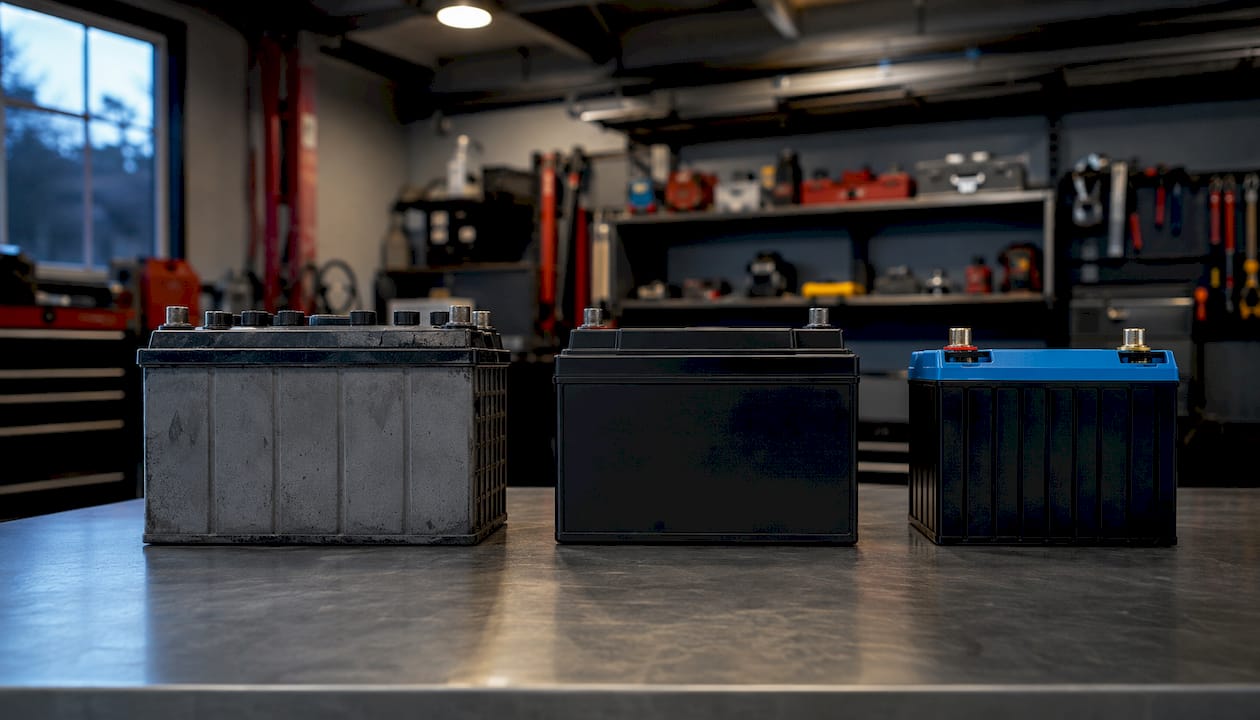
Chemistry also determines charge voltage. Charging a flooded battery charger to an AGM or LiFePO4 pack will either undercharge or damage it. Always match the charger profile to the chemistry.
Cycle life, Depth of Discharge (DOD), and End-of-Life (EOL)
Most automotive and consumer batteries have a practical life of roughly 3–5 years, and the industry defines End-of-Life as the point where a battery retains only 80% of its original capacity. Cycle-life claims on labels are almost always measured under optimal lab conditions: 0.5C discharge rate, 25°C ambient, and a specific DOD. A cycle-life number tested at 50% DOD will look far better than the same battery tested at 80% DOD. For LiFePO4 cycle life expectations, always ask which DOD and temperature the manufacturer used.
Internal resistance
Internal resistance is the opposition to current flow inside the battery. As a battery ages or degrades, internal resistance rises, causing a larger voltage drop under load and more heat generation. A battery can read 12.6 V at rest and still fail to start an engine because its internal resistance is too high to deliver the required current. Conductance-based testing reveals this hidden degradation far better than a static voltage check.
Maximum continuous discharge current
For high-demand applications, the maximum continuous discharge current matters as much as Ah. It is calculated as capacity (Ah) multiplied by the C-rate. A 50 Ah battery rated at 1C delivers a maximum of 50 A continuously; the same battery rated at 2C delivers 100 A. Failing to confirm this figure before installing a battery in a high-draw application — a trolling motor, a winch, a high-powered audio system — is one of the most common causes of premature battery failure.

Safety markings
Labels carry standardized warning icons: no open flames (hydrogen gas from flooded batteries during charging), eye protection required, keep away from children, and recycling symbols. Lithium batteries add UN38.3 transport certification marks and sometimes UL or CE marks. A missing UN38.3 mark on a lithium pack is a red flag for unverified safety testing.
How do you inspect a battery label in front of you?
Follow this sequence every time, whether you are at a store or pulling a battery from a vehicle.
- Confirm voltage and group size. Check the label’s voltage (6 V, 12 V, 24 V) and BCI group size against your OEM spec. If either is wrong, stop here.
- Read CCA and RC. Match CCA to or above the OEM minimum. Note the RC in minutes for emergency planning.
- Check Ah and chemistry if deep-cycle capability matters. For marine, RV, or auxiliary applications, verify Ah at the stated C-rate and confirm the chemistry matches your charger.
- Find the manufacture date code. Locate the round sticker or heat stamp. Avoid any battery manufactured more than 12 months before purchase.
- Inspect the casing, terminals, and safety labels. Look for cracks, bulging, corrosion, or missing warning icons. A swollen case on a lithium battery is a safety hazard; do not install it.
When a manufacturer part number does not match a standard BCI group code, cross-reference it against the OEM fitment guide or the manufacturer’s own group-size chart. Part numbers are often internal stock codes that encode chemistry and production batch, not fitment dimensions.
Pro Tip: A conductance tester (such as those made by Midtronics) gives you a direct reading of internal resistance and a CCA estimate under load. If the measured CCA is more than 20% below the label spec, the battery is degraded regardless of what the resting voltage reads. A basic multimeter can only tell you state of charge, not state of health.
How do you choose the right battery using specs?
Match specs to use case first
The spec that matters most depends entirely on what the battery needs to do.
- Starting priority: CCA at or above OEM spec, correct group size, then RC for emergency time. Ah is secondary.
- Deep-cycle priority: Ah (at a stated C-rate), maximum continuous discharge current, cycle life at your expected DOD, then chemistry.
- Mixed use (starting + accessories): Look for a dual-purpose AGM with both a solid CCA rating and a meaningful RC figure.
A higher Ah is not always better for a starting application; check AutoTuner ECU read/write steps: a technician’s guide to understand how battery health can interfere with ECU reads and vehicle diagnostics. Oversized batteries can stress the charging system, and in some vehicles a BMS or smart alternator calibrated for the OEM battery capacity will not charge an oversized replacement correctly. Check battery compatibility with engine management systems before upgrading capacity.
Similarly, a very high CCA number achieved through thin plates trades long-term durability for peak cranking performance. In hot climates or high-vibration applications like ATVs and motorcycles, that trade-off shortens service life noticeably.
Cost vs. lifespan trade-offs
| Chemistry | Typical upfront cost | Expected lifespan | Best for |
|---|---|---|---|
| Flooded lead-acid | Lowest | 3–5 years | Budget starting applications |
| AGM | Moderate | 4–6 years | Starting + light deep-cycle, vibration environments |
| LiFePO4 | Highest | Up to 15+ years | Deep-cycle, weight-sensitive, high-cycle applications |
LiFePO4 batteries cost more upfront but can have a lower cost per cycle over their life, making them often favorable for daily cycling applications. For vehicles used primarily for engine starts, AGM batteries tend to be a practical choice. The powersport battery buying guide from Bansheebatteries walks through this trade-off specifically for riders.
Before buying, verify four things: OEM group size, terminal polarity (positive left or right), BMS or charging system compatibility with the chemistry, and warranty terms relative to the expected cycle count.
What do test conditions actually mean for the numbers on a label?
Published specs come from controlled lab environments. Understanding those conditions is the difference between a battery that performs as expected and one that disappoints in the field.
Standards bodies and what they govern
- BCI (Battery Council International): Sets group size standards and test procedures for U.S. automotive batteries, including CCA and RC definitions.
- SAE (Society of Automotive Engineers): Publishes the formal test standards (e.g., SAE J537) that define CCA test temperature (0°F/–18°C), duration (30 seconds), and voltage threshold (7.2 V).
- DIN (Deutsches Institut für Normung): German standard used on European-market batteries; DIN CCA tests at –18°C but uses a different voltage threshold and time window than SAE, so DIN and SAE CCA numbers are not directly comparable.
- IEC (International Electrotechnical Commission): International standard covering a broad range of battery types; IEC cold-crank tests use –18°C but differ in load profile.
- JIS (Japanese Industrial Standards): Common on Japanese-market batteries and some imports; uses different group-size codes and test conditions from BCI.
When you see a battery labeled with both a BCI group size and a JIS or DIN equivalent, the physical dimensions may match but the electrical specs were measured under different conditions. Use the BCI/SAE figure for any U.S. vehicle comparison.
How test conditions shift the numbers
| Spec | Standard test condition | Real-world effect if conditions differ |
|---|---|---|
| CCA | 0°F (–18°C), 30 sec, to 7.2 V (SAE) | DIN/IEC tests yield different numbers; not directly comparable |
| RC | 25 A continuous to 10.5 V | Higher accessory loads reduce actual run time proportionally |
| Ah (capacity) | C/20 rate, 25°C | Higher discharge rates and lower temperatures reduce usable Ah |
| Cycle life | 0.5C, 25°C, 80% DOD | Every 10°C above 25°C can reduce lifespan by 15–25% for lithium chemistries |
Manufacturers report specs from optimal lab conditions that overstate real-world performance. Heat, higher C-rates, and deeper or shallower DOD all change both capacity and cycle life. The most reliable way to predict real behavior is to pull the manufacturer’s datasheet and read the discharge curves at multiple C-rates and temperatures rather than relying on the headline Ah number. If your required current at your operating temperature crosses the discharge curve below the cutoff voltage, the battery will fail in that application regardless of what the label says.
Statistic callout: For lithium chemistries, every 10°C rise above the standard 25°C test temperature can reduce effective cycle life by 15–25%, according to datasheet guidance from battery manufacturers.
What do common battery labels actually look like?
Date code formats
| Format | Example | How to read it |
|---|---|---|
| Letter + digit (round sticker) | D6 | D = April (A=Jan, skipping I), 6 = 2026 |
| Two-digit month + two-digit year | D6 | March 2026 |
| Heat stamp, alphanumeric | D6 | 6th day, April, 2026 (varies by brand) |
| Julian date code | 26 | April 2026 |
Date code formats vary by manufacturer. When in doubt, check the brand’s website or call their support line. Yuasa, for example, publishes a group-size and date-code reference that covers their full product line.
Sample label walkthrough
A typical top-of-battery label on a U.S. automotive battery might read:
- BCI Group 35 — physical fitment code
- 12V / 650 CCA / 100 MCA — voltage, cold-crank rating (SAE), and marine crank rating
- RC 120 min — reserve capacity at 25 A to 10.5 V
- 55 Ah — capacity at C/20
- AGM — chemistry (absorbed glass mat)
- D6 — manufacture date (April 2026)
Each of those codes maps directly to a spec definition above. The MCA figure (100) is higher than the CCA (650 is already the CCA; MCA would be higher still) because it is tested at 32°F rather than 0°F. Never use MCA to meet a CCA requirement.
Manufacturer part numbers printed elsewhere on the label (e.g., “35-AGM-H6-BX”) are internal stock codes. They encode chemistry, group, and production series for the manufacturer’s inventory system, but they do not replace the BCI group size for fitment purposes.
What should you check first when a battery underperforms?
Start with internal resistance, not voltage.
- Step 1: Run a conductance test. A conductance tester gives a direct CCA estimate under simulated load. If the reading is more than 20% below the label CCA, the battery is degraded. Resting voltage alone will not catch this.
- Step 2: Check state of charge. A fully charged 12 V lead-acid battery reads 12.6–12.8 V at rest after 30 minutes off charge. Below 12.4 V suggests a partial state of charge; below 12.0 V suggests deep discharge or a failing cell.
- Step 3: Compare observed cranking behavior to CCA. Slow, labored cranking with a charged battery points to a CCA problem. The battery may pass a static voltage test and still fail to deliver the required current.
- Step 4: Check RC if accessory drain is the issue. If the battery dies with the engine off but starts fine, the RC is likely insufficient for the accessory load, or there is a parasitic drain elsewhere in the system.
Symptoms map:
- Slow crank, normal resting voltage: high internal resistance or low CCA
- Dead battery after sitting: low RC, parasitic drain, or self-discharge from a sulfated cell
- Battery dies under load but recovers at rest: high internal resistance, failing cell
Replace rather than recharge when a conductance test shows CCA below 80% of the label spec, or when the case is swollen, cracked, or leaking. A swollen lithium battery is a fire risk; handle it with gloves, keep it away from heat sources, and follow local disposal guidelines. For a full checklist of signs a battery needs replacement, the pattern of symptoms matters as much as any single reading.
This article is general information, not professional or safety advice. Confirm specifications and handling procedures with the manufacturer’s datasheet and a qualified technician for your specific application.
Key Takeaways
Reading battery specs correctly means matching voltage and group size first, then prioritizing CCA for starting applications or Ah and cycle life for deep-cycle use, always checking the test conditions behind every published number.
| Point | Details |
|---|---|
| CCA is the starting spec | Match CCA to or above OEM spec; never substitute MCA or CA for a cold-climate CCA requirement. |
| RC predicts emergency run time | RC (minutes at 25 A to 10.5 V) is more useful than Ah for estimating how long a starting battery sustains accessory loads. |
| Test conditions change the numbers | Cycle life and Ah ratings come from lab conditions (25°C, 0.5C); heat and higher discharge rates reduce both figures in real use. |
| Group size is non-negotiable | BCI group size encodes physical dimensions and terminal polarity; a mismatch risks fitment failure or reversed polarity. |
| Bansheebatteries for AGM and LiFePO4 | Bansheebatteries offers AGM (4-year warranty) and LiFePO4 (5-year warranty) options with fitment support for powersports and marine applications. |
The spec that most buyers ignore is the one that matters most
Most people buying a replacement battery look at two things: price and CCA. That is not wrong, but it misses the single most predictive number for long-term satisfaction: the test conditions behind the cycle-life claim.
A battery rated for 500 cycles tested at 50% DOD and 25°C will fail in half that time in a boat in Florida, cycling to 80% DOD in 90°F heat. The headline number is not a lie; it is just measured under conditions that do not match the application. The buyers who get burned are the ones who never asked which DOD and temperature the manufacturer used.
The same logic applies to CCA. Thin-plate construction can push a battery’s CCA number well above what its physical size would suggest, which looks great on a shelf comparison. In a high-vibration powersports application, those thin plates degrade faster. The warranty period is often the clearest signal of how confident a manufacturer actually is in their construction choices.
What pros actually do when reading specs: they treat the label as a starting point and go straight to the datasheet. Discharge curves at multiple C-rates, cycle-life conditions, and the charge cutoff voltage tell you far more than the four numbers printed in large type on the top of the case. If a manufacturer does not publish a datasheet, that absence is itself a data point.
Bansheebatteries has ready-made options worth checking before you buy
If you have worked through the spec checklist above and want a battery that ships with the hard work already done, Bansheebatteries builds AGM and LiFePO4 packs specifically for powersports and marine applications, with fitment support built into the buying process.
The practical case for their lithium line is straightforward: a 12V 100Ah LiFePO4 deep-cycle battery carries a 5-year warranty and is rated for deep-cycle use in RV, marine, and trolling motor applications where cycle count and weight both matter. Their AGM batteries carry a 4-year warranty and cover the starting and light deep-cycle use cases where flooded batteries typically fall short on vibration resistance. For marine buyers specifically, the lithium marine battery collection includes fitment guidance and chemistry-matched charging recommendations.
Before ordering, verify the BCI group size against your tray dimensions, confirm terminal polarity (positive left or right), and check that your charger profile matches the chemistry. Bansheebatteries’s product pages list all of those details. Browse the full lineup at bansheebatteries.com or go directly to the product page that matches your application.
Useful sources and further reading
For deeper technical reading beyond what a label can tell you, these sources are worth bookmarking:
- Battery Council International (BCI) — the governing body for U.S. automotive battery group sizes, CCA definitions, and recycling standards. Their group-size charts are the authoritative fitment reference.
- SAE International — publishes SAE J537 and related standards that define the exact test conditions for CCA, RC, and other automotive battery specs. Access requires a subscription, but the standard numbers are widely cited.
- MIT Electric Vehicle Team — Battery Specifications Summary — a concise technical summary of nominal voltage, cutoff voltage, and capacity definitions; useful for understanding the relationship between cell chemistry and pack-level specs.
- Midtronics — Decoding Battery Specs — practical explanation of Ah, RC, and conductance testing from the company that makes most of the professional battery testers used in U.S. shops.
- Intepowers — How to Read a Battery Datasheet Like an Expert — the best single resource on reading test conditions rather than headline numbers; covers C-rate, DOD, temperature derating, and cycle-life interpretation.
- Saft — Everything You Need to Know About Reading a Battery’s Datasheet — explains discharge curves and how to use them to predict real-load performance; more technical, but worth it for anyone sizing a battery for a specific current draw.
- Manufacturer datasheets — always request the full datasheet, not just the spec sheet. Discharge curves at multiple C-rates and temperature derating tables are the most reliable predictors of real-world behavior. If a manufacturer does not publish them, ask directly before buying.