


How an Inverter Affects Your RV Battery Life
Yes, running an inverter shortens RV battery life, and the degree depends on three factors: conversion losses that add about 15% to every watt you pull (pure-sine inverters typically run at 85–93% efficiency at mid-load, while modified-sine types are 75–85%), so for most systems, add ~15% when estimating battery drain., idle draw that quietly burns 240–720 Wh per day even when nothing is plugged in, and the mismatch risk of pairing an oversized inverter with an undersized battery bank.
Three actions that make the biggest difference right now:
- Turn the inverter off when you’re not actively using it. An inverter drawing 10–30W at idle can drain a 100Ah battery overnight without powering a single appliance.
- Size your inverter to your battery bank, not just your appliance list. A 2,000W inverter on a single 100Ah battery with a 1C discharge rating will hit its current limit immediately under heavy load and trigger shutdowns.
- Consider LiFePO4 if you boondock regularly. It tolerates high-current inverter loads with far less voltage sag and gives you roughly 60% more usable capacity than AGM at the same amp-hour rating.
The sections below cover the math, the chemistry differences, and a full diagnostic checklist.
Key Takeaways
Inverter use shortens RV battery life primarily through conversion losses, idle draw, and chemistry mismatch, but the right battery, sizing, and habits reduce that impact dramatically.
| Point | Details |
|---|---|
| Idle draw is the silent drain | An inverter left on draws some power with nothing plugged in, quietly burning battery capacity over a day. |
| Efficiency loss adds 7–15% to every load | Factor inverter efficiency into runtime math; pure-sine units run at 85–93%, modified-sine at 75–85%. |
| LiFePO4 gives 60% more usable capacity | A 100Ah LiFePO4 delivers roughly 90Ah usable versus 50Ah from a 100Ah AGM under inverter loads. |
| Sizing mismatch causes shutdowns, not failure | A 2,000W inverter on a single 100Ah battery hits current limits immediately; match bank capacity to inverter draw. |
| Bansheebatteries LiFePO4 is built for this | The 12V 100Ah LiFePO4 from Bansheebatteries is a drop-in upgrade with a 5-year warranty for heavy inverter users. |
Table of Contents
- How an inverter draws power from your RV battery
- How battery chemistry changes the way inverter use affects lifespan
- How to match inverter size to your battery bank
- Which appliances hit your battery hardest
- How to estimate how long your battery will last
- Practical ways to reduce inverter wear on your batteries
- How to diagnose whether it’s the inverter, battery, or wiring
- When to replace your battery or upgrade your inverter
- How operating temperature affects inverter efficiency and battery life
- How inverter use affects battery state of charge management
- Long-term damage from partial state of charge cycling
- How inverter waveform quality affects batteries and connected loads
- Scheduling inverter use to get more life from your batteries
- What most RV owners get wrong about inverters and batteries
- LiFePO4 batteries built for heavy inverter use
- Sources
How an inverter draws power from your RV battery
An inverter takes DC power from your battery and converts it to 120V AC so you can run standard household appliances. That conversion is never free. Quality pure-sine inverters run at 85–93% efficiency at mid-load, meaning for every 100W your appliance consumes, the battery actually supplies 108–118W. Modified-sine units typically land at 75–85%, so the gap is real and it compounds over a full day.
The math for translating appliance watts to battery amps is straightforward:
DC Amps = AC Watts ÷ (System Voltage × Inverter Efficiency)
For a 1,200W microwave on a 12V system with a 90% efficient pure-sine inverter:
1,200 ÷ (12 × 0.90) = 111 amps DC
That’s a massive draw. Run it for 5 minutes and you’ve pulled roughly 9.3 Ah from the bank. A 150W TV on the same system draws about 14 amps, which is far more manageable for extended viewing.
| Inverter Type | Typical Efficiency | Idle (No-Load) Draw |
|---|---|---|
| High-end pure sine | 85–93% | 10–20W |
| Budget pure sine | 85–93% | 15–25W |
| Modified sine | 75–85% | 20–30W |
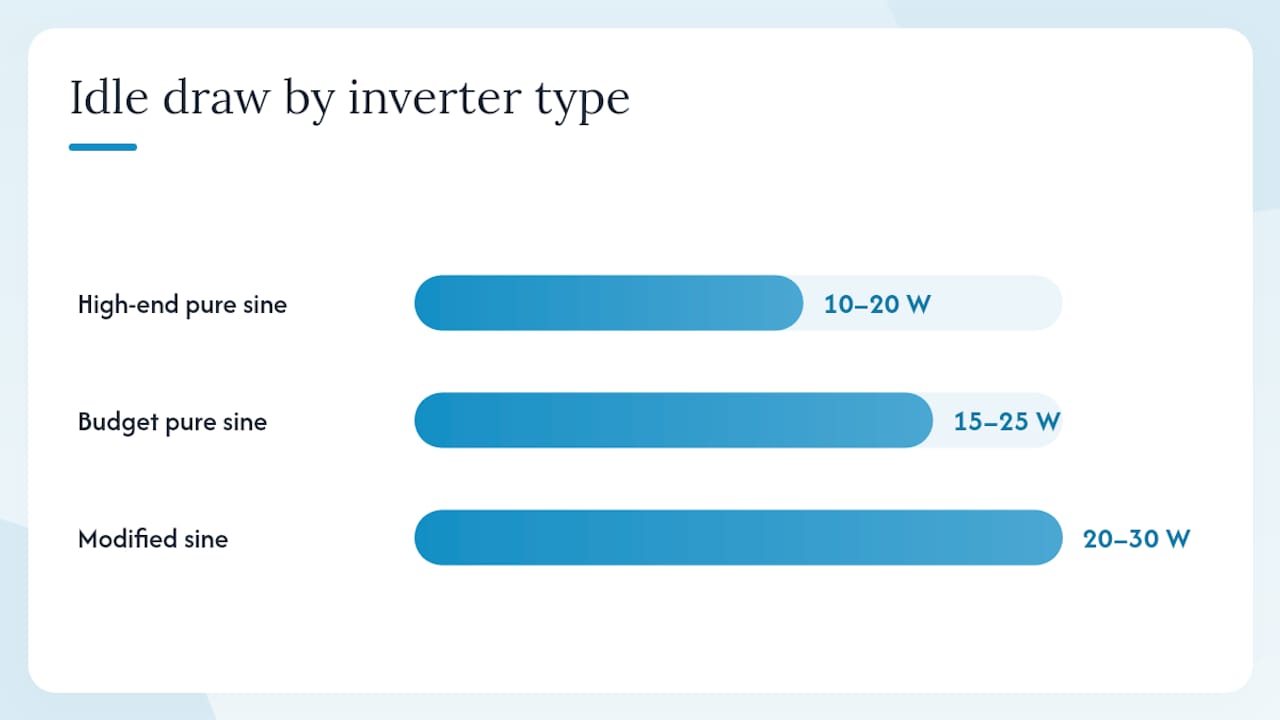
The idle draw column deserves more attention than most owners give it. At 20W idle, a forgotten-on inverter burns 480 Wh over 24 hours. That’s nearly half a 100Ah 12V battery gone before you’ve made coffee (since 100Ah × 12V = 1,200Wh; half is 600Wh). Boondocking runtime data confirms that parasitic loads in the 10–30W range are among the most common causes of unexpected overnight depletion.
Pro Tip: Install a physical disconnect switch or a smart outlet timer on your inverter’s DC input line. Flipping it off when you leave the rig costs nothing and saves hundreds of watt-hours per day.
How battery chemistry changes the way inverter use affects lifespan
Not all batteries absorb inverter punishment equally. Lead-acid and AGM batteries are sensitive to deep discharge and high-current draws in ways that LiFePO4 simply isn’t.
Lead-acid and AGM lose cycle life fast when discharged below 50% state of charge (SoC). Under heavy inverter loads, their terminal voltage sags noticeably, which can trigger low-voltage shutdowns even when the battery still holds charge. Repeated deep cycles accelerate sulfation, and each cycle below 50% DoD chips away at total cycle count. A typical flooded lead-acid battery rated for 200–300 cycles at 50% DoD might see fewer than 150 real-world cycles when an inverter regularly pulls it to 40% or lower.
LiFePO4 handles high-current inverter loads with far less voltage sag and supports discharge to 80–90% DoD without the same cycle-life penalty. LiFePO4 offers roughly 60% more usable capacity than AGM at the same Ah rating, which means a 100Ah LiFePO4 gives you about 90Ah of real working capacity versus roughly 50Ah from a 100Ah AGM. For a 3–5 day boondocking trip with regular inverter use, that difference is the gap between running out of power on day two and arriving home with capacity to spare.
Cycle life at a glance: Flooded lead-acid typically delivers 200–300 cycles at 50% DoD. Quality AGM stretches to 400–600 cycles. LiFePO4 commonly rates at 2,000–4,000 cycles at 80% DoD, though actual results depend on charge profile, temperature, and load.
Charging profiles matter just as much as discharge behavior. AGM requires a lower absorption voltage and a float stage; LiFePO4 needs a CC/CV profile with no float. Running a lead-acid charger profile on a LiFePO4 bank, or vice versa, causes chronic undercharge or overcharge that shortens life faster than any inverter load. Correct chemistry-specific charge profiles are non-negotiable for longevity. Pairing your charger settings with your battery type is covered in detail in the RV battery charging options guide from Bansheebatteries.
Pro Tip: If you run your inverter more than two hours per day while boondocking and you’re still on AGM, the math on LiFePO4 usually works in your favor within two to three seasons. The higher upfront cost is offset by cycle life and the extra usable capacity you stop leaving on the table.
How to match inverter size to your battery bank
Sizing is where most RV electrical problems start. The instinct is to buy the biggest inverter that fits the budget, but an oversized inverter on an undersized bank causes voltage sag, BMS cutoffs, and premature wear.
Sizing checklist:
- List every appliance you’ll run simultaneously and add their running wattages.
- Add a 25% safety headroom multiplier to that total for surge and inefficiency.
- For a 12V system, confirm your battery bank can deliver the peak amps. A 2,000W inverter needs up to 185 amps DC at 12V. A single 100Ah battery with a 1C discharge limit maxes out at 100A, so it will hit its limit immediately under full load.
- For loads above 2,000W, consider moving to 24V or 48V. Higher system voltage reduces current, which means thinner wire, less heat, and better efficiency across the whole system.
Wiring is where efficiency gains or losses get locked in. Short, heavy-gauge cables between the battery and inverter minimize resistive losses and voltage drop. Loose terminals, undersized fuse holders, or corroded busbars can cause a 0.5V drop that looks exactly like a failing battery under load. The RV battery bank wiring guide from Bansheebatteries covers cable gauge selection and fuse placement in detail.
Pro Tip: For any system above 2,000W, move to 24V before adding more parallel 12V batteries. Parallel banks introduce balancing problems and increase fault current risk. Higher voltage is a cleaner solution.
Which appliances hit your battery hardest
Running a microwave for two minutes feels harmless. The battery math says otherwise.
Common high-draw appliances and their typical wattage ranges:
- RV rooftop AC (13,500 BTU): 1,500–2,000W running, 3,000–6,000W startup surge
- Microwave (standard countertop): 900–1,500W running, minimal surge
- Blender or food processor: 300–600W running, 600–1,200W startup spike
- Electric induction cooktop: 1,200–1,800W running
- Hair dryer: 1,200–1,875W running
- Laptop charger: 45–100W running
The AC compressor and blender are the two that catch owners off guard. Motor-driven loads spike to nearly double their running wattage at startup. If your inverter or BMS can’t supply that surge current, it shuts down even though your battery still has plenty of charge.
Scenario A: Running a 1,500W AC unit overnight. At 90% inverter efficiency, that’s 1,667W from the battery, or roughly 139 amps on a 12V system. Over 8 hours, that’s 1,112 Ah. No practical 12V battery bank handles that without a generator or shore power. This is why AC and inverter power are a poor match for boondocking.
Scenario B: Microwave and blender bursts. A 1,200W microwave for 5 minutes pulls about 9.3 Ah. A blender at 500W for 2 minutes pulls about 1.4 Ah. These are manageable, but doing both repeatedly across a day adds up to 20–30 Ah before you’ve counted anything else.
Pro Tip: Add a soft-start device to your AC compressor if you want to run it on inverter power occasionally. Soft starters reduce the startup surge by 50–70%, which can mean the difference between a clean startup and a BMS trip.
How to estimate how long your battery will last
The formula every RV owner should have on hand:
Battery runtime (hours) = Usable battery Wh ÷ (Appliance watts ÷ Inverter efficiency)
Step by step:
- Calculate usable battery Wh. For a 100Ah 12V LiFePO4 at 90% DoD: 100 × 12 × 0.90 = 1,080 Wh. For a 100Ah 12V AGM at 50% DoD: 100 × 12 × 0.50 = 600 Wh.
- Divide appliance watts by inverter efficiency. A 150W fridge at 90% efficiency: 150 ÷ 0.90 = 167W from the battery.
- Divide usable Wh by that adjusted draw.
| Scenario | Usable Wh | Adjusted Draw | Runtime |
|---|---|---|---|
| 150W fridge, 100Ah LiFePO4 | 1,080 Wh | 167W | ~6.5 hours |
| 150W fridge, 100Ah AGM | 600 Wh | 167W | ~3.6 hours |
| 1,200W microwave, 100Ah LiFePO4 | 1,080 Wh | 1,667W | ~49 minutes |
| 1,200W microwave, 100Ah AGM | 600 Wh | 1,667W | ~27 minutes |
The LiFePO4 advantage is stark. For a fridge running all day, you’d need roughly three 100Ah AGM batteries to match what one 100Ah LiFePO4 delivers. Add a 12V/120V-capable fridge and run it on DC directly, and you bypass the inverter entirely, cutting that 167W draw back toward the native 28W the direct 12V test showed.
Quick self-check: List your appliances, note their watts, divide by inverter efficiency, multiply by hours of daily use, then compare to your usable Wh. If the total exceeds your bank, something has to change.
Practical ways to reduce inverter wear on your batteries
Start with behavior, then hardware.
Quick wins (zero cost):
- Turn the inverter off at the physical switch when not in use. This alone eliminates 240–720 Wh of daily idle loss.
- Run high-draw appliances during peak solar hours when the panels are actively replenishing the bank.
- Swap AC appliances for 12V DC equivalents wherever possible. A 12V compressor fridge uses roughly 28W on DC versus about 45W through an inverter, nearly doubling energy use for the same cooling due to inverter losses.
Monitoring and maintenance:
- Install a shunt-based battery monitor (Victron BMV-712 or similar). Voltage alone lies; a shunt measures actual current in and out and gives you real SoC.
- Check terminal connections monthly. A loose connection adds resistance that mimics battery aging and generates heat that shortens battery life.
- Verify your charger’s chemistry profile matches your battery type. Wrong profiles cause chronic partial charging that compounds cycle damage.
Mid-level upgrades:
- Add a soft starter to compressor loads.
- Replace AC-only appliances with DC-native versions.
- Add solar to offset daily inverter consumption. The role of solar in your camp setup explains how panel sizing interacts with battery capacity.
Major upgrades:
- Switch to LiFePO4 for the cycle life, usable capacity, and high-current tolerance.
- Move to 24V or 48V if your inverter load regularly exceeds 2,000W.
Pro Tip: Schedule your usage: charge hard during the day with solar, run moderate loads in the evening, and keep overnight draw to DC-only devices. This pattern avoids partial SoC cycling, which is the slow killer of both AGM and LiFePO4 banks.
How to diagnose whether it’s the inverter, battery, or wiring
Before you replace anything, run through this checklist.
Step-by-step diagnostic:
- Measure idle inverter draw. With nothing plugged into the inverter’s AC outlets, check DC current draw. More than 30W at idle suggests a failing inverter or a unit running inefficiently.
- Inspect all terminals and connections. Look for corrosion, loose bolts, and heat discoloration at the shunt, busbars, fuse holders, and battery terminals. A single loose connection can cause a 0.5–1V drop under load.
- Measure voltage under load. Apply a known load (a 100W bulb or a drill) and watch battery voltage. A healthy 12V LiFePO4 should stay above 12.5V under moderate load. AGM dropping below 11.8V under light load is a warning sign.
- Check BMS and charger profiles. Confirm the charger is set to the correct chemistry. A LiFePO4 bank on a lead-acid profile will chronically undercharge to 80–85% SoC and never tell you.
- Verify cable gauge and fuse placement. Undersized wire between the battery and inverter causes voltage drop that the inverter reads as low battery. Check the battery bank wiring guide for gauge recommendations by current.
Common misconceptions:
- “The inverter shut down, so the battery is dead.” Usually wrong. Most shutdowns trace to voltage sag, BMS limits, or wiring faults, not a depleted battery.
- “My battery monitor says 50%, so I have plenty of power.” A voltage-only monitor on AGM is notoriously inaccurate under load. Only a shunt-based meter gives reliable SoC.
- “My charger works fine on my old battery, so it’ll work on the new one.” Chemistry matters. Flooded lead-acid, AGM, and LiFePO4 each need different absorption voltages and charge termination logic.
When to replace your battery or upgrade your inverter
Decision rules by owner type:
- Light camper, mostly shore power: Your AGM bank is probably fine. Focus on correct charge profiles and keeping connections clean. Replace when capacity drops below 70% of rated Ah or when the battery fails a load test.
- Frequent boondocker (2–5 nights per trip, inverter daily): LiFePO4 is worth the investment. The cycle life advantage pays off within two to three seasons of regular use, and the usable capacity gain reduces the chance of running low mid-trip.
- Full-time off-grid: LiFePO4 is the baseline, not an upgrade. Consider 24V or 48V system voltage if your inverter load regularly exceeds 2,000W. A marine LiFePO4 comparison covers the chemistry tradeoffs in depth.
One-line upgrade signals:
- Inverter waveform: Switch from modified sine to pure sine if you run sensitive electronics, variable-speed motors, or anything with a microprocessor.
- Battery chemistry: Move to LiFePO4 when your AGM bank needs replacement and you run an inverter more than 90 minutes per day.
- System voltage: Move to 24V when your inverter load exceeds 2,000W or your 12V wiring runs longer than 6 feet from battery to inverter.
Consult a certified RV technician when you’re adding more than 200Ah of new capacity, rewiring for a new system voltage, or when your BMS is throwing fault codes you can’t clear with a profile reset.
How operating temperature affects inverter efficiency and battery life
Heat is the shared enemy of both inverters and batteries. Most inverters are rated for peak efficiency at 77°F (25°C) and derate noticeably above 104°F (40°C). At high temperatures, internal components run hotter, efficiency drops, and thermal protection circuits may throttle output or shut the unit down entirely.
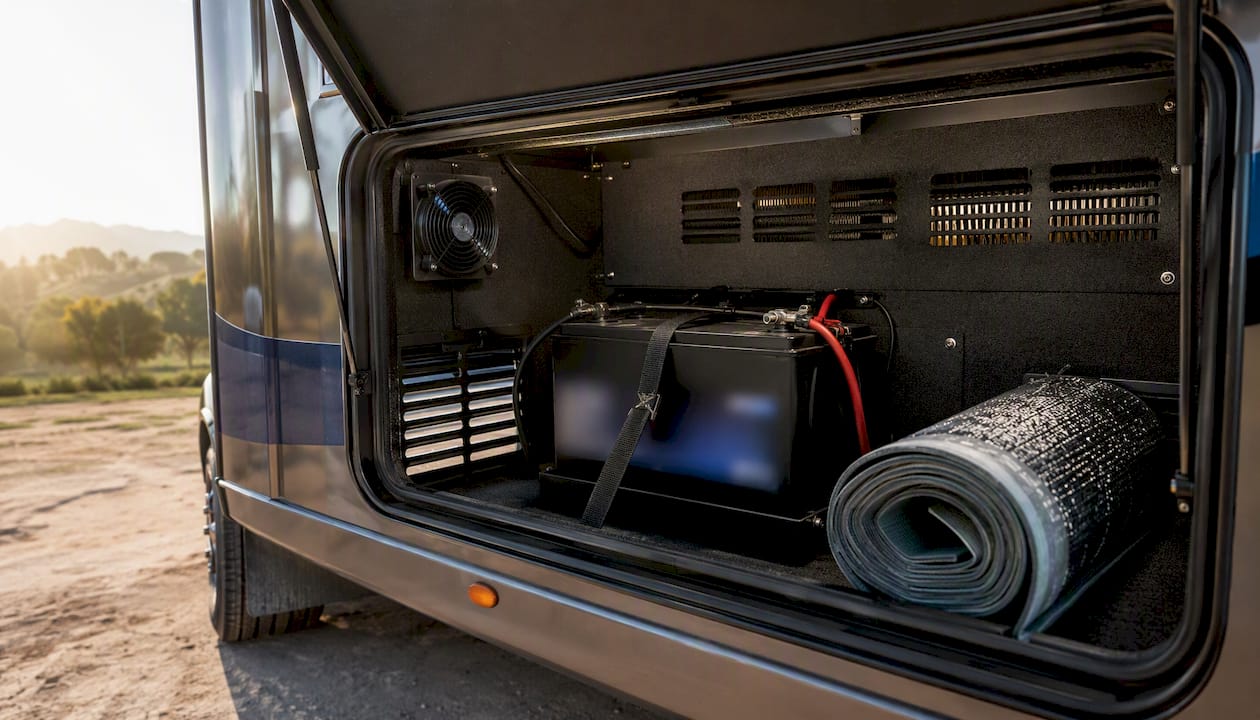
For batteries, the relationship is more nuanced. Heat accelerates chemical reactions inside lead-acid cells, speeding up water loss and plate corrosion. A flooded battery operating consistently at 95°F ages roughly twice as fast as one kept at 77°F. LiFePO4 is more tolerant of heat but still degrades faster above 113°F (45°C), and charging a LiFePO4 below 32°F (0°C) without a self-heating BMS can cause lithium plating that permanently reduces capacity.
Mount your inverter in a ventilated compartment with at least 2 inches of clearance on all sides. Keep batteries out of direct sun exposure when possible, and if you’re camping in extreme heat, check that your battery compartment isn’t acting as a heat trap. A 10°F reduction in average operating temperature can meaningfully extend both inverter component life and battery cycle count.
How inverter use affects battery state of charge management
Every time your inverter runs, it pulls the battery down from whatever SoC it started at. The problem isn’t any single draw. It’s the pattern of draws that never fully recharge before the next session.
A healthy charge cycle looks like this: discharge to a planned depth, recharge fully to absorption, hold briefly, then rest. Inverter use in an RV rarely follows that pattern. You run the microwave at noon, the TV in the afternoon, and the fridge overnight, and the solar or converter charger is playing catch-up the whole time. The battery spends most of its life somewhere between 40% and 80% SoC, never fully charged, never deeply discharged, just grinding through partial cycles.
For AGM, this is particularly damaging. Chronic partial charging causes sulfation on the plates, which reduces capacity and raises internal resistance over time. LiFePO4 handles partial cycling better, but it still benefits from a full charge at least once every few weeks to allow the BMS to balance cells.
Set your charger’s absorption stage to run long enough to actually complete a full charge. For AGM, that typically means holding absorption voltage (around 14.4–14.8V for 12V systems) until current drops to 2–3% of rated Ah. For LiFePO4, follow the manufacturer’s spec, which usually means charging to 14.2–14.6V and terminating when current tapers to near zero.
Long-term damage from partial state of charge cycling
Partial SoC cycling is the slow, invisible killer of RV battery banks. It doesn’t announce itself with a single dramatic failure. Instead, capacity quietly shrinks over months until the bank that once ran your rig for three days barely makes it through one.
For flooded lead-acid and AGM, the mechanism is sulfation. Lead sulfate crystals form on the plates during discharge and are supposed to dissolve during a full recharge. When the battery never reaches full charge, those crystals harden and become permanent, reducing active plate area and raising internal resistance. A battery with significant sulfation may still show 12.6V at rest but deliver only 60% of its rated capacity under load.
LiFePO4 avoids sulfation entirely, but partial cycling still causes gradual capacity fade through a different mechanism: cell imbalance. When cells drift apart in SoC, the BMS cuts off the pack based on the weakest cell, leaving capacity in the stronger cells stranded. Regular full charges let the BMS top-balance the pack and recover that stranded capacity.
The practical fix is simple: schedule at least one full charge cycle per week during active use. If your solar isn’t getting the bank to 100% SoC on a typical day, either add panels, reduce load, or run a generator for a 30-minute absorption top-up. Monitoring with a shunt-based meter like the Victron BMV-712 lets you see exactly when the bank reaches full charge rather than guessing from voltage.
How inverter waveform quality affects batteries and connected loads
The waveform your inverter produces matters more than most owners realize, and it affects both the appliances you’re running and, indirectly, the battery.
A modified-sine wave inverter produces a stepped approximation of AC power. It works fine for resistive loads like incandescent lights and simple heating elements. For anything with a motor, transformer, or microprocessor, modified sine causes the device to run hotter, draw more current, and wear out faster. That extra current draw translates directly to more battery drain per hour of use.
A pure-sine wave inverter produces clean AC that matches utility power. Motors run cooler and more efficiently, variable-speed devices work correctly, and sensitive electronics like CPAP machines, laptop chargers, and audio equipment behave as designed. The efficiency advantage at the appliance level compounds over time: a motor running 10% cooler draws less current, which means less battery drain per hour and less heat stress on the inverter itself.
For battery chemistry specifically, modified-sine waveforms can cause issues with smart chargers that use AC power to charge secondary batteries. Some charger designs detect waveform quality and either refuse to operate or charge inefficiently on modified sine, which can leave batteries chronically undercharged. Pure sine eliminates that variable entirely.
The cost gap between modified-sine and pure-sine inverters has narrowed considerably. For any RV with a mix of appliances, pure sine is the right choice.
Scheduling inverter use to get more life from your batteries
When you run your inverter matters almost as much as how much you run it.
The worst pattern is running high-draw appliances in the evening after a cloudy day. The battery is already partially depleted, solar has underperformed, and you’re pulling it down further with no recovery until morning. Repeated often enough, this trains the battery into a chronic partial-SoC cycle that shortens its life.
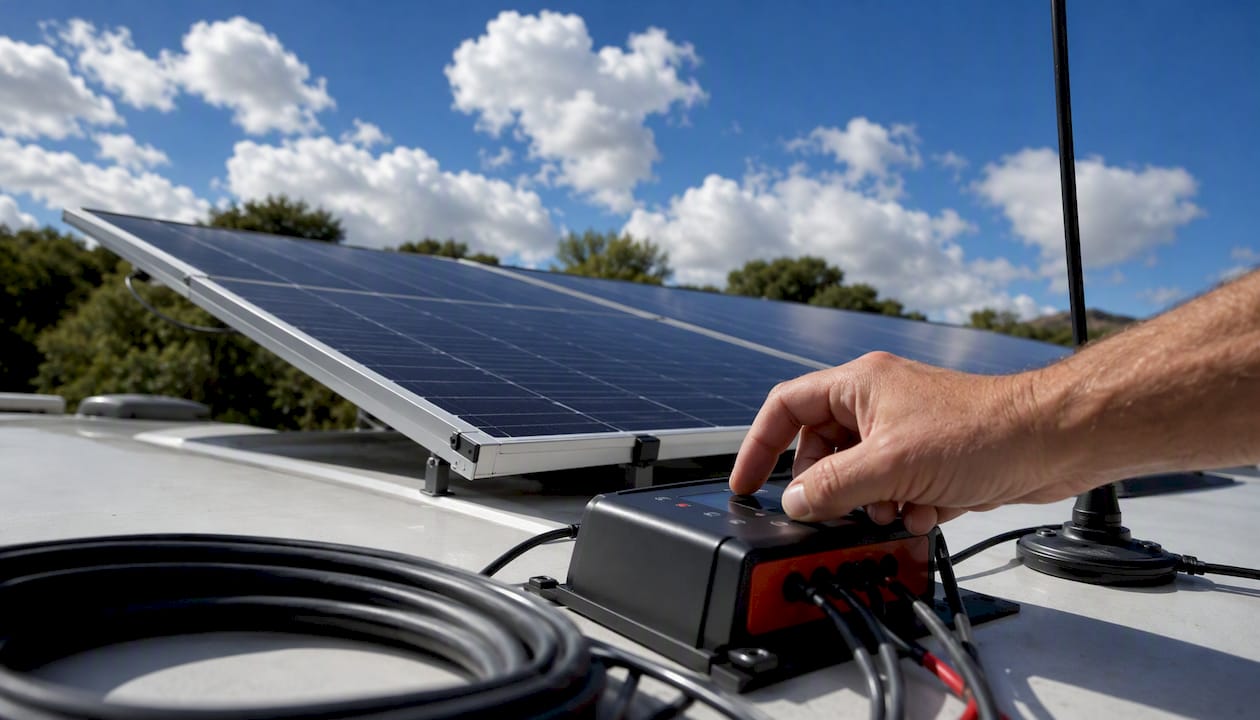
The best pattern works with your solar window. Run your highest-draw appliances between 10 AM and 2 PM when panels are producing peak output. The inverter load is partially offset by live solar production, so the battery barely moves. Save low-draw tasks like phone charging and LED lighting for evening when the bank is full from a day of sun.
For multi-day boondocking trips, capacity planning before you leave is the difference between a comfortable trip and a scramble for a campground with hookups. Map your daily Wh budget, identify which loads can shift to DC, and decide in advance which appliances simply won’t run on battery power. An AC unit is the most common culprit. Running it for two hours via inverter on a 200Ah LiFePO4 bank will consume the majority of your usable capacity in a single session.
A simple rule: if an appliance draws more than 500W and you need to run it for more than 30 minutes, plan for a generator or shore power rather than relying on the battery bank alone.
What most RV owners get wrong about inverters and batteries
The most common mistake isn’t buying the wrong inverter. It’s leaving the right inverter on all the time.
Owners spend hours researching pure-sine vs modified-sine, sizing calculators, and battery chemistry, then plug the inverter in on day one and never touch the power switch again. At 20W idle draw, that’s 480 Wh per day, or roughly 14,400 Wh per month, consumed by an inverter powering nothing. On a 200Ah LiFePO4 bank, that’s the equivalent of a full discharge every 17 days, just from forgetting to flip a switch.
The second mistake is treating a voltage reading as a state-of-charge reading. A 12V AGM battery resting at 12.4V might be at 75% SoC or it might be at 50% SoC with elevated internal resistance from sulfation. Without a shunt-based monitor, you’re guessing. Owners who rely on voltage alone consistently over-discharge their banks without knowing it, then wonder why the battery only lasted two seasons.
The third mistake is sizing the inverter to the appliance list without checking whether the battery bank can actually deliver the current. A 3,000W inverter on two 100Ah AGM batteries looks fine on paper. Under load, those batteries sag, the inverter shuts down, and the owner concludes the batteries are bad. They’re not bad. They’re undersized for the job.
The fix for all three is the same: a shunt-based monitor, a physical inverter disconnect, and a sizing check before buying anything.
LiFePO4 batteries built for heavy inverter use
If your boondocking trips are getting longer or your inverter runs daily, the battery doing the most work should be built for it. Bansheebatteries designs LiFePO4 batteries specifically for the high-current demands of off-grid RV use, with a 5-year warranty that reflects genuine confidence in cycle life under real conditions.
The 12V 100Ah LiFePO4 deep-cycle battery from Bansheebatteries is a direct drop-in replacement for most RV battery compartments, delivering 90Ah of usable capacity versus the 50Ah you get from a comparable AGM. For owners who want a broader selection or need to match a specific system voltage, the full LiFePO4 battery collection covers multiple configurations. Browse the lineup and use the battery-finder tool to match the right unit to your rig.
Sources
- How to Size an Inverter for Your RV: Wattage Guide & Calculator - RVGeo
- Inverter loss: 12-volt vs 120-volt energy usage - RVelectricity
- RV Inverters: Proper Sizing & Setup | Pur Solar and Electrical
- Battery & Inverter Matching: Engineering for Stable Power Systems – EDECOA
- RV battery maintenance guide - OffGridRVHub