


Car Owners: Measure Tray Length and Terminal Orientation for 94R vs 48
H6 is Group 48, and H7 is Group 94R. The two share the same width and height, but the 94R runs about 1.5 inches longer, so they are not interchangeable in every tray. Before you buy either one, measure your battery tray and confirm terminal orientation. Skip that step and you risk a battery that rocks loose, won’t seat under the hold-down, or has cables that can’t reach the posts.
TL;DR:
- The 94R battery is about 1.5 inches longer than a Group 48, making fitment an issue in tight trays if measurements are not confirmed.
- Confirm tray length, hold-down clearance, and terminal orientation before purchase to avoid installing a battery that cannot fit or secure properly.
- The “R” in 94R indicates reversed polarity, with the positive terminal on the right side when facing the battery, which must match your vehicle’s setup.
- A 94R typically provides higher CCA, Ah, and reserve capacity than a 48, offering better performance in cold climates, start-stop systems, and high accessory loads.
- Upgrading from 48 to 94R by size alone often leads to fit issues; consider chemistry upgrades like AGM to enhance capacity without risking physical compatibility.
Table of Contents
- Group 94R vs 48: Specs You Need Side by Side
- Will a 94R Fit Where a 48 Used to Sit?
- What Does the ‘R’ in 94R Actually Mean?
- Does the Extra Capacity in a 94R Actually Matter?
- AGM, Flooded, or Lithium: Does Chemistry Matter More Than Size?
- How to Confirm Fit and Swap the Battery Safely
- How Banshee Batteries Helps You Get the Fit Right
- The One Rule Most Battery Guides Skip
- Ready to Match Your Battery to the Right Specs?
- Sources
- FAQ
Group 94R vs 48: Specs You Need Side by Side
The two group sizes look nearly identical until you check the tape measure. According to the BCI group-size chart, Group 48 (H6) measures 10.9 inches long, 6.9 inches wide, and 7.5 inches tall. Group 94R (H7) shares that same width and height but stretches to 12.4 inches long. That 1.5 inch gap is the whole story behind most fitment complaints.
Performance specs diverge too, based on typical ranges published across battery industry references:
- Group 48 (H6): roughly 600 to 800 CCA, 60 to 70 Ah
- Group 94R (H7): roughly 750 to 950 CCA, 76 to 80 Ah, with higher reserve capacity in most product lines
- Weight: the 94R typically runs a few pounds heavier due to added plate material and case volume
- Price: both sizes span a wide range depending on chemistry, with AGM and lithium options costing more than flooded lead-acid at the same group size
If your vehicle came factory-equipped with a 94R, it likely needs that extra CCA and Ah headroom for accessories, start-stop cycling, or engine size. Swapping down to a 48 to save space usually means giving up cranking reserve you may need on a cold morning.
Will a 94R Fit Where a 48 Used to Sit?
Fitment comes down to three measurements: tray length, hold-down clearance, and cable reach to the terminals. Here’s the check sequence that avoids a wasted trip back to the parts counter:
- Measure the tray’s usable length, not just the visible opening, since some trays have raised lips that eat into clearance.
- Check the hold-down bracket’s adjustment range. Many brackets flex enough for a half-inch difference, but not the full 1.5 inches between these two groups.
- Trace the positive and negative cables to see how much slack you have if the terminals shift position.
- If the new battery is shorter than the tray (a 48 going into a 94R space), a foam spacer or non-conductive filler block keeps it from sliding.
- If the new battery is longer than the tray, stop. Forcing a 94R into a 48 slot risks a cracked case, a shorted terminal, or a hood that won’t latch.
Owner reports on the Jeep Gladiator Forum confirm that tight factory trays leave almost no wiggle room, which is exactly why the length difference between these two groups matters more than it looks on paper.
Pro Tip: Bring a tape measure and your old battery’s label to the store. Comparing the physical part against the shelf option beats trusting a fitment chart that assumes your specific trim level matches the base model.
What Does the ‘R’ in 94R Actually Mean?
The “R” stands for reversed polarity. On a Group 94R battery, the positive terminal sits on the right side when you’re facing the battery with the terminals toward you. Group 48 batteries typically ship with standard polarity, though some manufacturers also offer reversed variants under different labels.
Confirming orientation before you buy takes under a minute:
- Look at your current battery. Note which side the positive post sits on.
- Check your owner’s manual, which usually states the OEM group size and polarity.
- Read the new battery’s label. Manufacturers often print both the DIN code (H7) and the BCI code (94R) on the same label, so don’t assume one code guarantees the other matches.
Getting polarity wrong isn’t just inconvenient. A reversed battery installed in a standard tray can force cables to stretch across the case, increasing the odds of a short circuit or a melted cable jacket. One detail worth remembering: some sellers list the same physical battery under H7, L4, 77L4, and 94R when the dimensions and terminal layout all line up, so seeing an unfamiliar code doesn’t automatically mean it’s the wrong part.
Does the Extra Capacity in a 94R Actually Matter?
Cold cranking amps measure how much current a battery can deliver at 0°F for 30 seconds, which is the number that decides whether your engine turns over on a January morning. Amp-hour rating measures total stored energy, and reserve capacity tells you how long the battery can run accessories if the alternator quits.
Where the difference shows up in daily driving:
- Cold climates or big V8 engines: the 94R’s higher CCA range gives you more margin when the oil is thick and the starter has to work harder.
- Start-stop vehicles: frequent engine cycling drains and recharges the battery constantly, so the 94R’s extra Ah and reserve capacity absorb that cycling better.
- Heavy accessory loads: winches, aftermarket stereos, and auxiliary lighting draw down reserve capacity fast, favoring the larger group.
- Mild climates with a stock electrical system: a Group 48 with mid-range CCA is often plenty, and there’s no reason to force a 94R into a tighter tray just to chase a bigger number.
If your factory spec calls for a 48 and you’re not adding load, upgrading to a 94R buys you little beyond a tighter fit problem.
AGM, Flooded, or Lithium: Does Chemistry Matter More Than Size?
Sometimes the group size isn’t your real problem. The battery chemistry inside that case often has more impact on how the battery performs than an extra inch of length.
- Flooded lead-acid: lowest upfront cost, works fine for basic starting duty, but tolerates fewer deep discharge cycles.
- AGM: handles start-stop cycling and vibration better than flooded batteries, and it’s the default choice in most factory-installed 94R applications for that reason.
- Lithium (LiFePO4): cuts weight substantially and tolerates far more charge cycles, but check your charging system’s compatibility first, since some older alternators aren’t tuned for lithium’s charge profile.
If you’re stuck between a cramped 48 slot and accessory demands that want a 94R’s capacity, upgrading chemistry inside the same group size can close that gap without touching the tray. A Group 94R AGM battery built for start-stop duty solves more real-world problems than chasing a bigger group number.
Pro Tip: If your vehicle has factory start-stop, don’t downgrade to flooded lead-acid even if the price looks tempting. It won’t survive the cycling and will fail early, often within a year.
How to Confirm Fit and Swap the Battery Safely
Skipping the checklist is how people end up back at the store with the wrong part. Confirm these five things before you buy anything:
- Pull your owner’s manual and note the OEM group size listed for your trim and engine.
- Read the label on your current battery for the group code, CCA, and Ah rating.
- Measure the tray length, width, and hold-down clearance with the old battery removed.
- Check terminal orientation by facing the battery and noting which side the positive post sits on.
- Match required CCA/Ah to your climate and accessory load, not just to what fits.
Once you’ve confirmed the right part, the swap itself is straightforward. Disconnect the negative terminal first to avoid shorting a wrench across the frame and a live terminal. Remove the hold-down bracket, lift the old battery out, and set the new one in place. Reconnect the positive terminal first this time, then the negative last.
If your vehicle has start-stop technology that requires battery registration through the onboard computer, or if the tray tolerances feel unusually tight, that’s the point to hand the job to a shop instead of forcing it yourself.
How Banshee Batteries Helps You Get the Fit Right
Every AGM automotive battery Banshee Batteries builds lists its BCI group size, dimensions, CCA, and Ah rating directly on the product page, so you’re comparing real numbers instead of guessing from a label alone. AGM batteries carry a 4 year warranty, and lithium marine batteries carry a 5 year warranty, backing the fitment guidance with real coverage if something goes wrong after installation.
If you’re not sure whether your vehicle takes an H6/Group 48 or an H7/94R, Banshee’s support team can walk through your owner’s manual specs and current battery label with you before you order. That conversation costs nothing and saves you a return shipment.
The One Rule Most Battery Guides Skip
Most articles on this topic treat Group 48 and 94R as a spec-sheet comparison: bigger number, better battery. That framing misses the actual failure point. Nobody’s battery dies because the CCA rating was 100 points short. It dies, or rather it never gets installed correctly, because someone assumed a group code on a website matched their tray without measuring anything.
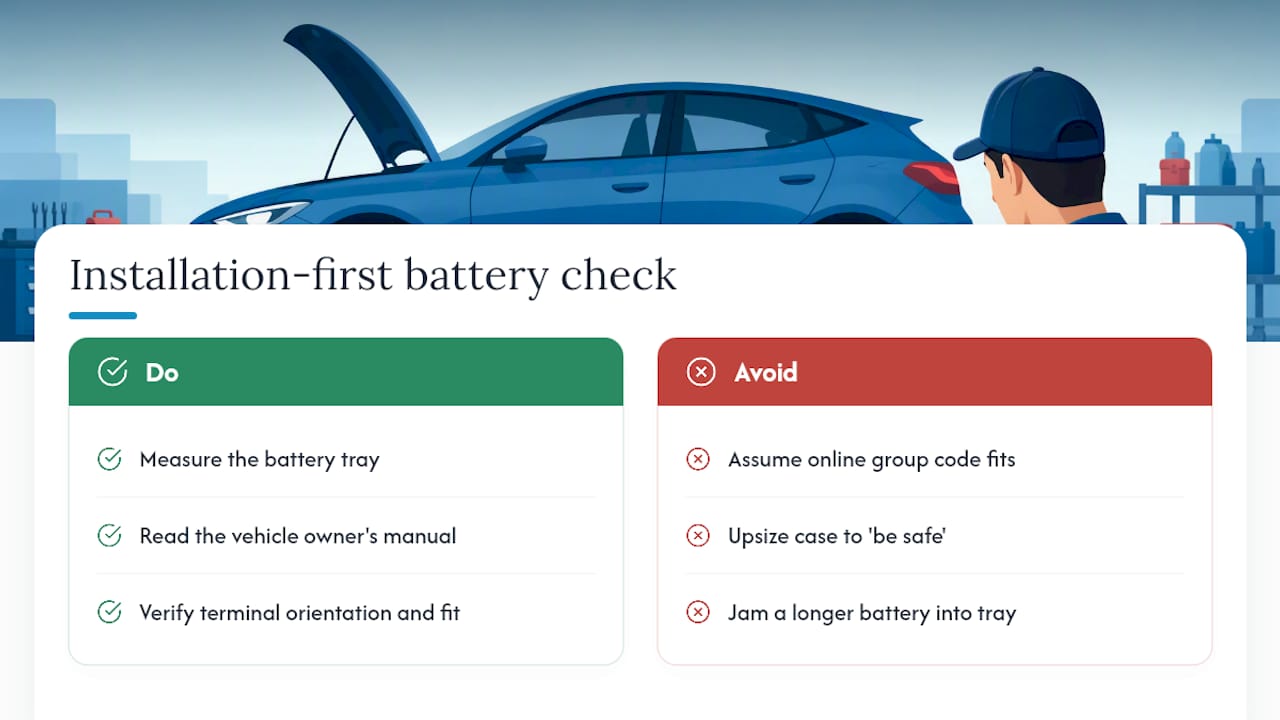
The conventional advice tells you to “check compatibility,” which is true but useless without a next step. The real fix is boring: tape measure, owner’s manual, terminal check. Do those three things and the CCA and Ah numbers mostly sort themselves out, because your OEM spec already tells you what your vehicle needs.
Where I’d push back on common practice is the instinct to upsize “just to be safe.” Cramming a 94R into a tray built for a 48 doesn’t add safety margin. It adds a battery that rattles, cables under tension, and a hold-down that won’t close right. If you need more reserve capacity, look at chemistry before you look at a bigger case. An AGM upgrade in the correct group size solves more real problems than a longer battery jammed into the wrong spot.
— Donald
Ready to Match Your Battery to the Right Specs?
Once you know whether your vehicle needs an H6/Group 48 or an H7/94R, the fastest path forward is checking specs against a battery built for that exact fit. Bansheebatteries lists group size, CCA, Ah, and terminal orientation directly on every product page, so you’re never guessing between two similar-looking codes.
Start at the Banshee Batteries storefront to search by group size, or open the 94R/H7 AGM automotive battery page to compare specs directly against your old battery’s label. AGM models carry a 4 year warranty, and support is available to help confirm terminal orientation and tray compatibility before you check out. If you’re weighing chemistry upgrades too, the AGM versus lithium breakdown covers what actually changes when you switch. Measure your tray, check your label, and order the battery that matches, not the one that looks close enough.
Sources
- Battery Council International — BCI group sizes
- The Home Depot — How to change a car battery (safety steps)
FAQ
What Is the Difference Between a Group 48 and a 94R Battery?
Group 48 (H6) and Group 94R (H7) share the same width and height, but the 94R runs about 1.5 inches longer. The 94R also typically carries higher CCA, Ah, and reserve capacity ratings than the 48.
What Is a Group Size 48 Battery Equivalent To?
Group 48 is the BCI designation equivalent to the DIN code H6. Manufacturers often print both codes on the same label, so you may see either name depending on the brand.
What Battery Is Equivalent to a 94R?
A Group 94R battery is equivalent to the DIN designation H7, and some manufacturers also label the identical physical battery as L4 or 77L4 when dimensions and terminal layout match. Always confirm length and terminal orientation rather than relying on the code name alone.
What Does Group 94R Mean on a Battery?
Group 94R refers to a specific BCI battery size, roughly 12.4 inches long, 6.9 inches wide, and 7.5 inches tall, with a reversed terminal layout, positive on the right when facing the battery. Banshee Batteries lists this group size directly on its 94R/H7 AGM battery page alongside CCA and Ah specs for quick comparison.