


Fit First: 3 Checks for Group 31 Trolling Motor Batteries from a Maker
Group 31 is the right call when your battery tray has room for a larger 12V case and you want more usable amp-hours for a full day on the water. Confirm three things before you buy: does it physically fit your tray and terminals, does its usable amp-hour rating cover your motor’s draw for your typical outing, and does your charger match the chemistry you pick. Measure your tray and check your motor’s amp draw first; everything else follows from those two numbers.
TL;DR:
- Group 31 refers to case size and dimensions, not performance or capacity, so battery chemistry and build quality determine actual runtime and cycle life.
- Proper fit measurement and terminal compatibility are essential to avoid issues, as identical group size does not guarantee interchangeability across brands or chemistries.
- Larger cases like Group 31 can hold more amp-hours, but internal chemistry influences usable capacity, with lithium offering more efficiency and weight savings than AGM or flooded lead-acid.
- When building 24V or 36V banks, always match batteries by age, capacity, and chemistry, and maintain equal cable lengths to prevent imbalance.
- Selecting the right chemistry and battery size depends on boat size, intended usage, and charger compatibility; never assume all Group 31 batteries will perform equally in your setup.
Table of Contents
- What “Group 31” Actually Means (Hint: It’s Not a Power Rating)
- Group 31 vs. Group 24, 27, and 29: Bigger Isn’t Always Better
- Chemistry Matters More Than the Case Number
- How to Calculate the Runtime You’ll Actually Get
- Building a 24V or 36V Bank With Group 31 Batteries
- Your Pre-Install Checklist Before You Buy
- Keeping a Group 31 Battery Alive for Years, Not Seasons
- How Banshee Batteries Fits Your Group 31 Trolling Motor Setup
- A Battery Specialist’s Honest Take
- Ready to Match a Group 31 Battery to Your Boat
- Where to Verify the Technical Details
- Sources
- FAQ
What “Group 31” Actually Means (Hint: It’s Not a Power Rating)
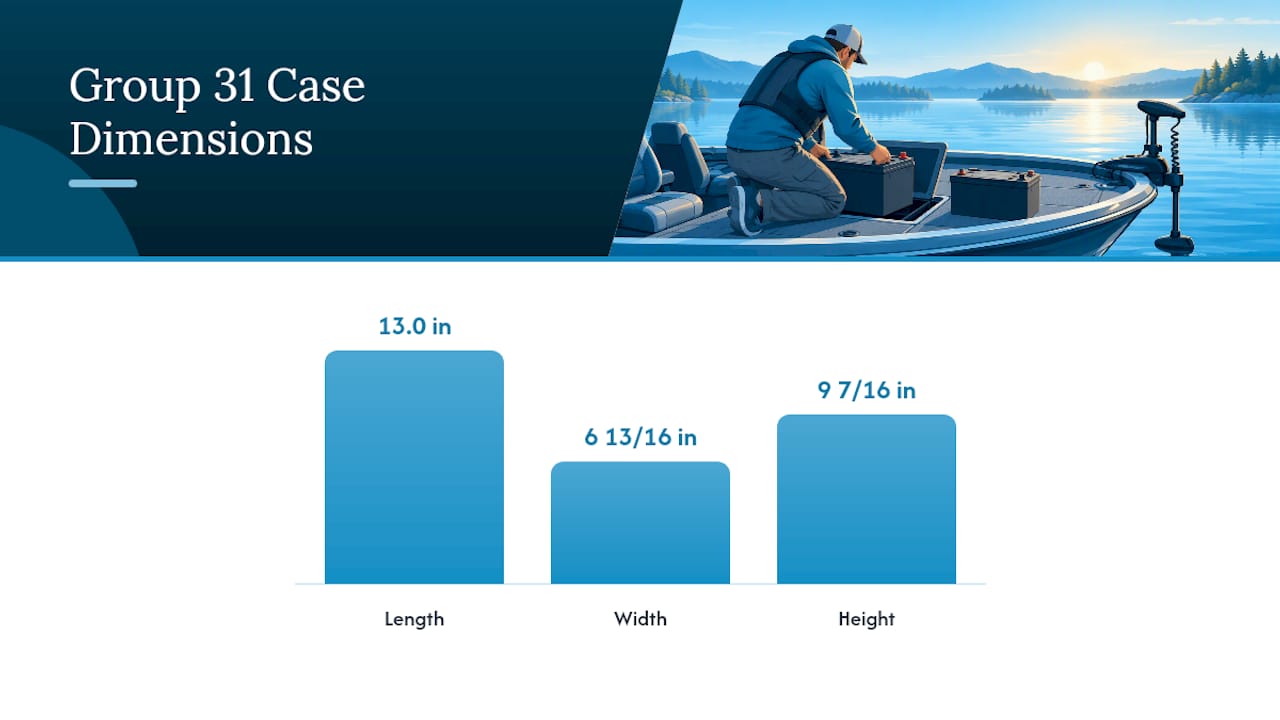
Group 31 is a size classification, not a performance spec. The Battery Council International (BCI) standard defines Group 31 as a case roughly 13.0 inches long, 6 13/16 inches wide, and 9 7/16 inches tall with a defined terminal layout. That’s it. The BCI number tells manufacturers how to build the case and where to put the posts, not how many amp-hours to pack inside.
This is why two batteries labeled “Group 31” can behave completely differently once you put them to work. A BCI group size covers dimensions, terminal arrangement, and chemistry flags, but the actual runtime and cycle life come down to the internal chemistry and construction, not the case number stamped on the label. An AGM Group 31 and a lithium Group 31 can sit in the exact same tray and deliver wildly different results on a six-hour trolling day.
Before you buy, run through this quick checklist:
- Measure your tray’s length, width, and height, and compare against the manufacturer’s actual dimensions, since lithium cases sometimes run slightly different from lead-acid Group 31 shells.
- Check terminal orientation and polarity so your existing cables reach without strain.
- Confirm hold-down clearance, including lid space if your compartment has a cover.
Skip this step and you’ll find out the hard way that “same group size” doesn’t mean “same battery.”
Group 31 vs. Group 24, 27, and 29: Bigger Isn’t Always Better
Group 31 sits at the top of the common marine size range, and it’s generally larger in length and height than Group 24, which means it usually has room for more amp-hours. But group size alone doesn’t guarantee more capacity. Chemistry and internal construction still decide how much energy actually fits in that larger shell.
Here’s how the sizes typically shake out for trolling motor use:
- Group 24: The smallest of the common trolling-motor sizes, favored on smaller trailerable boats and kayaks where every pound and inch counts.
- Group 27: A middle-ground case that fits many mid-size jon boats and bass boats without eating too much storage space.
- Group 29: Less standardized across brands, occasionally used as a stopgap between 27 and 31 dimensions.
- Group 31: The largest common option, and it’s popular in marine use because the bigger case gives manufacturers room for higher Ah and more robust internal plates, according to Better Boat’s Group 31 guide. Typical lead-acid units often support a range of usable amp-hours, with lithium versions offering more usable capacity in a lighter package.
The decision rule is simple: tray fit plus your boat’s mission determines size. A weekend kayak angler doesn’t need a Group 31. Someone running a 24V trolling motor bank for eight hours of bass fishing probably does.
Chemistry Matters More Than the Case Number
Once fit is settled, chemistry decides how the battery actually performs on the water. Three chemistries dominate the Group 31 trolling motor space, and each fits a different kind of angler.
AGM (Absorbed Glass Mat) batteries remain the workhorse choice for sealed, vibration-resistant marine use. They tolerate rough water and bouncing trailers better than flooded lead-acid, and they don’t require topping off electrolyte. Cycle life on a quality AGM Group 31 typically runs several hundred cycles when discharged moderately, though deep, repeated discharges shorten that window. Maintenance is minimal: keep terminals clean and keep the battery charged.
EFB (Enhanced Flooded Battery), sometimes marketed as dual-purpose, splits the difference between starting and deep-cycle use. These work for anglers who need one battery to crank a small outboard and also handle light trolling duty, but they compromise on both ends compared to a dedicated deep-cycle AGM or a true starting battery. If your boat runs a separate cranking battery, skip dual-purpose and get a purpose-built deep-cycle unit instead.
LiFePO4 (lithium) changes the math entirely. A lithium Group 31 typically delivers more usable Ah than a same-size AGM, weighs roughly half as much, and holds far more charge cycles over its service life. The trade-off is charger and system compatibility. Interstate Batteries’ lithium marine safety manual specifically warns owners with brushed trolling motors to limit motor speed settings, since lithium’s flatter discharge curve can push more current through the motor than it was designed to handle continuously, risking overheating.
- Never mix chemistries within the same bank. Voltage curves and charge acceptance differ enough to cause imbalance and premature failure.
- Confirm your charger’s profile matches your chemistry before you plug in. A lead-acid charger running an absorption stage that never terminates can damage a lithium battery’s BMS over time.
Pro Tip: If you’re upgrading from AGM to lithium on a brushed trolling motor, check the manufacturer’s speed-setting guidance first. Skipping this step is the single most common lithium-related warranty claim.
For a deeper look at how these chemistries compare on weight, capacity, and charging, see this breakdown of marine lithium versus AGM performance.
How to Calculate the Runtime You’ll Actually Get
Runtime planning comes down to one formula: usable amp-hours divided by your motor’s average amp draw. That’s the estimate in hours. The catch is in the words “usable” and “average.”
Usable Ah isn’t the same as rated Ah. A lead-acid battery loses meaningful capacity once you push past 50% depth of discharge repeatedly, while lithium can safely use 80% to 100% of its rated capacity. So a 100Ah AGM and a 100Ah lithium battery don’t hand you the same runtime, even with identical labels.

Minn Kota’s battery selection guidance recommends using average current draw, not peak amperage, when estimating runtime, since peak draw only happens in short bursts and wildly overstates your power needs. Consult your motor’s runtime chart if the manufacturer publishes one.
Real-world factors that eat into your estimate:
- Wind and current force the motor to work harder to hold position, raising average draw above the flat-water number.
- Weeds and prop drag increase resistance and current pull throughout the day.
- Boat load (extra passengers, gear, coolers) adds drag that the motor has to overcome.
- Spot-lock or anchor-lock use on GPS-enabled motors draws continuously and adds up over hours.
- Reserve for the return trip matters. Never plan a battery to run down to zero on the way out.
To build your own number: record your motor’s voltage and average amp draw, decide your desired outing length in hours, multiply those two to get required usable Ah, then pick a battery chemistry and capacity that clears that number with room to spare.
Building a 24V or 36V Bank With Group 31 Batteries
Trolling motors above 55 pounds of thrust often run on 24V or 36V systems, and Group 31 batteries wired in series handle both setups well. Series wiring raises voltage while amp-hour capacity stays the same as a single battery, not the sum. Two 12V, 100Ah Group 31 batteries wired in series give you 24V at 100Ah, not 200Ah.
Keep these rules in mind when building a bank:
- Use matched batteries of the same age, brand, and chemistry. Mixing an older battery with a new one creates imbalance that drags down the whole bank.
- Keep cable lengths equal between batteries to avoid uneven resistance and charging imbalance.
- Size fuses and cable gauge to your motor’s maximum current draw, following both the motor and battery manufacturer’s wiring specs.
- Never mix chemistries or mismatched capacities in the same series string. A lithium and an AGM in series will charge and discharge unevenly and can damage both.
For a 36V bank, three matched 12V Group 31 batteries in series get you there. If you’re building a higher-capacity lithium bank, sizing guidance for 12V 100Ah lithium trolling motor setups covers the practical side of matching capacity to motor demand.
Your Pre-Install Checklist Before You Buy
Run through this before you swipe your card, not after the battery is already in the boat:
- Measure your compartment’s usable length, width, and height, and compare against the manufacturer’s published dimensions for that specific model.
- Check terminal location and polarity against your existing cable runs.
- Verify hold-down hardware fits and that the compartment lid closes without pressure on the terminals.
- Confirm cable length and terminal type. Top-post and side-post terminals aren’t interchangeable without adapters.
- Torque terminal connections to spec. Overtightened lithium terminals can crack the case; undertightened connections cause voltage drop and heat.
- Confirm your charger’s profile matches the chemistry you’re installing, and note any lithium storage state-of-charge guidance before the off-season.
Pro Tip: Take a tape measure and a photo of your current battery’s terminal layout with you when you shop. It takes thirty seconds and saves a return trip.
If you’re weighing Group 27 against Group 31 for a tight compartment, this comparison of fit problems between the two sizes walks through the measurements that actually matter.
Keeping a Group 31 Battery Alive for Years, Not Seasons
Charging and storage habits determine whether your battery lasts three seasons or eight. AGM batteries want a charger with an absorption voltage typically in the 14.2 to 14.6 volt range, tapering to a float stage once full. LiFePO4 batteries need a charger built specifically for lithium, since their absorption and float behavior differs enough that a lead-acid charger can leave a lithium pack chronically undercharged or stress the internal BMS.
A smart charger matters here more than most anglers realize. It automatically matches voltage stages to the battery’s actual state, instead of dumping a flat charge rate that overcharges a nearly-full battery or undercharges a depleted one.
- Store lithium batteries at roughly 60% to 80% state of charge during off-season storage, and check voltage periodically rather than leaving them untouched for months.
- Top off AGM batteries every few weeks in storage, since they self-discharge faster than lithium.
- Watch for symptoms of aging: shortened runtime, longer charge times, or a battery that won’t hold voltage under load. Any of these signal it’s time to replace rather than nurse along.
How Banshee Batteries Fits Your Group 31 Trolling Motor Setup
Bansheebatteries offers AGM and LiFePO4 batteries designed for marine and powersport use, with industry-leading warranty coverage on various products. That mapping to buyer needs looks like this:
- Weekend anglers who want proven, budget-friendly reliability: AGM Marine Batteries in Group 31 sizing cover sealed, vibration-resistant deep-cycle duty.
- Boaters who need one battery for starting and light trolling: EFB (Enhanced Flooded) Marine Batteries fill that dual-purpose role.
- Anglers running long days, spot-lock, or higher-voltage banks: Lithium (LiFePO4) Marine Batteries deliver more usable Ah at roughly half the weight of AGM.
Use the battery finder tool on the Bansheebatteries site to confirm tray fit and terminal layout before ordering, and check the charger and accessories collection to make sure your existing charger matches whichever chemistry you choose.
A Battery Specialist’s Honest Take
Most fit failures and warranty claims trace back to skipping the tape measure, not picking the wrong chemistry. Measure your tray, confirm your charger matches your battery, and the rest of this decision gets a lot easier. If you’re stuck between options, use a battery finder tool before you guess.
— Donald
Ready to Match a Group 31 Battery to Your Boat
Bansheebatteries offers AGM, EFB, and LiFePO4 marine batteries designed to address fit and runtime considerations, with warranty coverage on AGM and lithium marine batteries.
Start at the main battery collection to browse AGM, EFB, and lithium Group 31 options side by side, or go straight to the Lithium (LiFePO4) Marine Batteries page if you’ve already decided weight and cycle life matter more than upfront cost. Unsure which chemistry fits your motor’s amp draw? Check the chargers and accessories collection to confirm you’re pairing the right charger before you buy, or reach out to Bansheebatteries support with your tray measurements and motor specs for a direct recommendation.
Where to Verify the Technical Details
For specs beyond this guide, consult the BCI group size standard for exact case dimensions, Minn Kota’s battery selection guide for motor-to-battery matching, the Interstate lithium safety manual for lithium operating cautions, and Better Boat’s Group 31 guide for practical buying context. Always check your specific motor’s manual for runtime charts and voltage requirements before finalizing a purchase.
Sources
- BCI Group Sizes | Battery Council International
- Best Trolling Motor Battery (2026 Selection Guide) - Minn Kota
- Interstate Lithium marine battery safety & operation manual
- Group 31 Battery for Marine Use: Complete Guide | Better Boat
FAQ
How Long Will a Group 31 Battery Last?
A quality AGM Group 31 typically lasts three to five seasons with proper charging and moderate discharge habits, while LiFePO4 versions often last far longer thanks to significantly higher cycle counts. Actual lifespan depends heavily on depth of discharge per outing and whether you’re using a charger matched to the battery’s chemistry.
Is Group 31 Better Than Group 24?
Neither is universally “better.” Group 31 is generally larger and tends to support more amp-hours, making it the stronger pick for bigger boats, higher-voltage banks, or long trolling days, while Group 24 fits smaller boats where weight and space are tighter constraints.
What Is the Difference Between a Group 29 and a Group 31 Battery?
Group 29 sits between Group 27 and Group 31 in typical dimensions and is less standardized across manufacturers, while Group 31 is the larger, more common size in marine deep-cycle applications. If you’re shopping by tray fit, always measure your compartment directly rather than assuming group numbers translate consistently between brands.
What Is a Group Size 31 Battery?
A Group 31 battery is a size classification set by Battery Council International, with a case roughly 13.0 inches long, 6 13/16 inches wide, and 9 7/16 inches tall and a defined terminal layout. It’s a fit standard, not a capacity or chemistry rating, so an AGM, EFB, or lithium battery can all share the Group 31 label with very different performance.
Can I Use a Group 31 Battery on Any Trolling Motor?
Group 31 works on any trolling motor as long as it physically fits your battery tray and matches your motor’s voltage requirement, whether that’s a single 12V setup or part of a 24V or 36V series bank. Confirm your motor’s amp draw against the battery’s usable Ah before buying to avoid running short mid-outing.