


Avoid a 3/4 Inch Fit Fail: Group 27 or 31 for Boats, RVs, Powersports
Pick Group 27 when your tray, cables, or hold-downs leave little room to spare and your loads are moderate. Pick Group 31 when you need more starting punch or longer runtime and your battery box has an inch or two of margin. Either way, check the actual Ah and CCA numbers on the label. The group size tells you about fit, not performance.
TL;DR:
- Battery group size indicates physical dimensions and terminal placement, not power capacity or performance.
- Rated amp-hours show total storage, but usable energy depends on the discharge depth, which varies by chemistry.
- CCA measures starting power, with Group 31 batteries generally offering higher CCA than Group 27, but real-world performance varies.
- Proper fitment requires precise measurement of tray dimensions, terminal orientation, and cable reach to avoid sizing errors.
- Lithium-ion batteries can offer more usable capacity and weight savings within the same footprint but require compatible chargers and BMS.
Table of Contents
- Group 27 vs Group 31: What “Group Size” Really Means
- How Much Runtime You Actually Get: Ah Ranges Compared
- CCA Numbers: Starting Power vs Deep-Cycle Design
- Matching Group Size to Your Boat, RV, or Rig
- Checking Fitment Before You Buy a Group 31
- Why Chemistry Might Matter More Than Case Size
- Building Your Decision Checklist
- What Two Decades in Powersport and Marine Batteries Teaches You
- Where Bansheebatteries Fits Your Battery Upgrade
- Sources
Group 27 vs Group 31: What “Group Size” Really Means
The Battery Council International (BCI) sets the physical standard behind every group number you see on a label. BCI group sizes define length, width, height, and terminal layout so a battery from one manufacturer fits the same tray as one from a competitor. That’s the entire point of the system: interchangeability, not a promise about how much power you’re getting.
According to the BCI group size chart, the two sizes break down like this:
- Group 27: roughly 12.0625 inches long, 6.8125 inches wide, 8.875 inches tall (about 306 × 173 × 225 mm)
- Group 31: roughly 13.0 inches long, 6.8125 inches wide, 9.4375 inches tall (about 330 × 173 × 240 mm)
That’s about three quarters of an inch more length and half an inch more height on the Group 31. It sounds trivial until you’re staring at a battery box that was cut for the smaller case.
Terminal layout adds another wrinkle. You’ll see 27F and 27H variants with different post placement, and 31M is common in marine setups with top-mount studs instead of automotive-style posts. Side-post configurations show up occasionally on automotive-derived Group 27 units too. None of this is universal, either. Manufacturers build within BCI tolerances, but a “Group 27” from one brand can run a quarter inch longer or shorter than another. Always measure the battery you’re removing, not just the sticker on the box.
How Much Runtime You Actually Get: Ah Ranges Compared
Rated amp-hours tell you the battery’s total storage capacity, but they don’t tell you how much of that you can safely use. That gap is where most buyers get the comparison wrong.
Group 27 batteries typically carry 66 to 110 Ah at the 20-hour rate, while Group 31 units run about 75 to 130 Ah, according to Battery Tender’s group size guide. Those ranges aren’t fixed. A deep-cycle Group 27 built for sustained loads can out-capacity a starting-focused Group 31, so the group number alone won’t tell you which battery holds more usable energy.
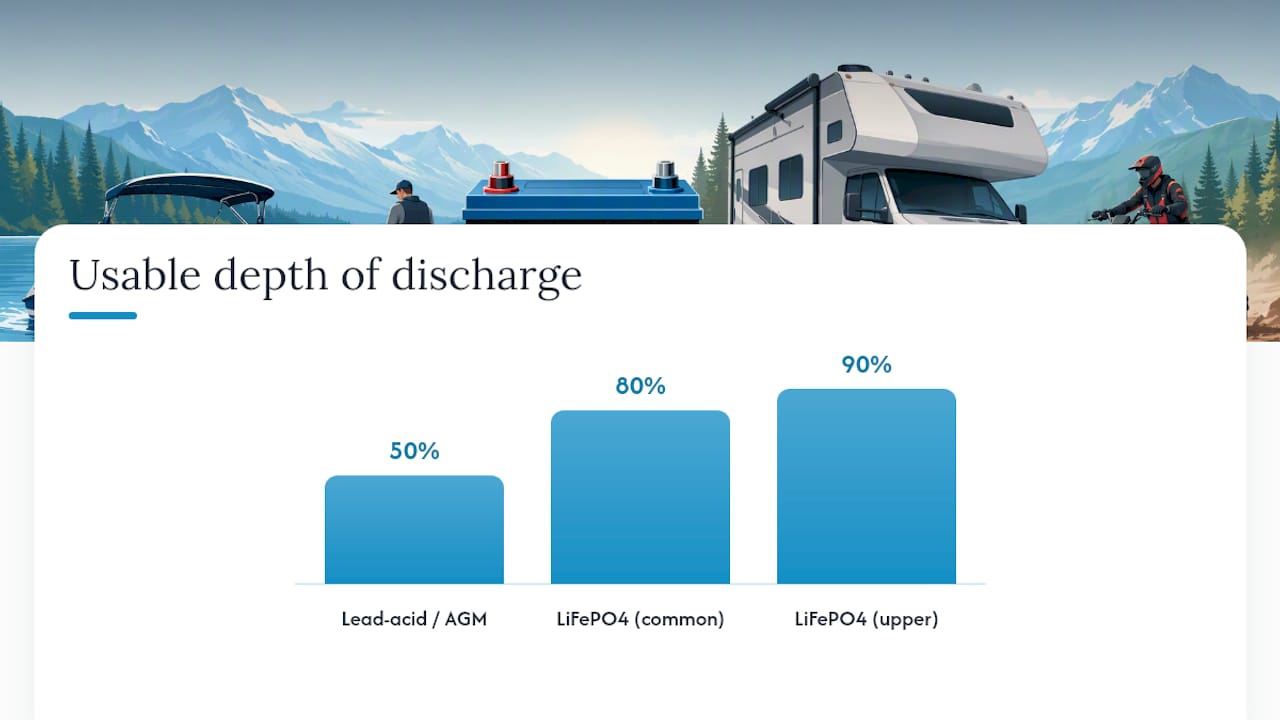
Statistic to remember: a 100 Ah lead-acid battery discharged to the industry-standard 50% depth of discharge gives you 50 usable Ah.
That’s the calculation that actually matters for trip planning:
- Lead-acid and AGM batteries are typically safe to discharge to about 50% before you risk shortening their lifespan.
- LiFePO4 batteries commonly tolerate 80 to 90% depth of discharge without meaningful damage.
- Multiply rated Ah by the usable percentage, not the raw number on the label, to estimate real runtime.
Reserve capacity and voltage sag complicate things further. A battery’s true output drops as it ages, as temperature falls, and as discharge rate climbs. A trolling motor pulling 30 amps continuously behaves very differently than a bilge pump cycling on and off. Two batteries with identical Ah ratings can deliver noticeably different results depending on health and how hard you’re pulling from them.
CCA Numbers: Starting Power vs Deep-Cycle Design
Cold cranking amps measure how much current a battery can deliver at 0°F for 30 seconds while holding at least 7.2 volts. It’s the number that matters when you’re turning a key or hitting the start button on an outboard, and it has almost nothing to do with Ah capacity.
Group 27 batteries designed for starting duty commonly land in the 600 to 900 CCA range, while Group 31 starting batteries often reach 750 to 1,250 CCA, per the BCI group size chart. Those figures shift depending on whether the battery was built to start an engine or to sustain a load over hours.
- A starting-focused Group 31 battery often trades some Ah capacity for higher CCA, because plate design for cranking power differs from plate design for endurance.
- A deep-cycle Group 27 can still post respectable Ah numbers even with modest CCA, since it’s engineered for sustained draw rather than a single high-current burst.
- Check your engine manufacturer’s minimum CCA recommendation before you swap anything, and compare it directly against the label on the replacement battery.
Don’t assume a bigger case automatically means more starting power. Some Group 27 starting batteries outperform lower-tier Group 31 units on CCA alone.
Matching Group Size to Your Boat, RV, or Rig
Real-world use dictates the right size far more than case dimensions do. Here’s how the two typically sort out across common setups:
- Mid-size boats and moderate house loads. Group 27 covers most center consoles and bowriders where you’re running a fish finder, lights, and a stereo without heavy continuous draw.
- RV house banks on shorter trips. A single Group 27, or a pair wired for more capacity, handles weekend trips where you’re not running a residential fridge or AC off battery power alone.
- 24V trolling motor banks. Two Group 27 batteries wired in series is a common and space-efficient way to hit 24V without jumping to a bulkier case size.
- Starter batteries for mid-size outboards. Group 27 starting batteries with adequate CCA cover most outboards in the 90 to 250 horsepower range.
- Larger cruisers with heavier electronics. Group 31 makes more sense once you’re running multiple chartplotters, a livewell pump, and stereo amps simultaneously.
- Extended off-grid RV stays. The extra Ah headroom in a Group 31 buys meaningful extra runtime for boondocking without a generator.
- High-demand trolling motor systems. Bigger electric motors pulling more sustained amperage favor the added capacity of Group 31 cells.
- Heavy-starting outboards and diesel applications. Higher-displacement engines often need the higher CCA ceiling a Group 31 starting battery can reach.
There’s also a middle path worth considering: two smaller batteries wired in parallel can sometimes deliver more usable capacity in the same footprint than jumping to a single larger case, especially if your existing tray already fits Group 27 comfortably. It’s also worth weighing a chemistry upgrade before assuming you need a bigger box at all, a point that matters enough to get its own section below.
Checking Fitment Before You Buy a Group 31
Don’t guess. Measure. A battery that’s a half inch too long will bind against the tray wall or push the lid up off its seal, and that’s a problem you don’t want to discover on the water.
- Measure the tray’s interior length, width, and height, then subtract the strap or bracket hardware that eats into that space.
- Compare terminal orientation between your current battery and the replacement. A top-post battery swapped into a side-post tray won’t work no matter how well the case fits.
- Test cable reach under actual working conditions, not just with the battery sitting loose. Cables pulled taut across a slightly larger case put strain on the terminals over time.
- Inspect hold-down strap length and confirm the box has enough vent clearance if you’re running a flooded lead-acid battery rather than a sealed AGM.
As a practical rule of thumb, leave about 0.5 to 1.0 inch (12 to 25 mm) of extra length tolerance and 0.25 to 0.75 inch (6 to 20 mm) of clearance above the terminal area. That buffer accounts for hold-down hardware and the vibration movement that eventually works a tight-fitting battery loose.
Pro Tip: If your tray is borderline on length, don’t force a Group 31 into it. Upgrading the tray and hold-downs, or switching chemistry to get more usable capacity out of your existing Group 27 footprint, is almost always the safer fix.
Why Chemistry Might Matter More Than Case Size
Swapping from Group 27 to Group 31 isn’t the only way to get more usable power. Sometimes it isn’t even the best way.
LiFePO4 batteries pack more usable amp-hours per cubic inch than lead-acid or AGM cells built to the same BCI group size dimensions, and they typically weigh 50 to 60% less. That combination changes the entire calculation for powersports and small boats, where every pound and every inch of tray space counts.
Weight and capacity, side by side: a Group 27 lead-acid battery usually weighs significantly more than a Group 27 LiFePO4 battery in the same footprint, with the LiFePO4 model delivering more usable capacity due to higher depth of discharge limits.
That gain comes with strings attached:
- LiFePO4 cells need a charger with a lithium-specific profile. A standard flooded or AGM charger can undercharge or damage the cells over time.
- Every LiFePO4 pack requires a battery management system (BMS) to prevent overcharge, over-discharge, and cell imbalance.
- Cold-temperature charging has real limits. Most LiFePO4 chemistries restrict or halt charging below freezing, so cold-climate boaters and RV users need to plan around that.
If your priority is shaving weight off a trailer tongue or squeezing more trolling-motor runtime out of a tray that can’t get any bigger, a chemistry upgrade inside your current group size often beats jumping to a larger case entirely.
Building Your Decision Checklist
Work through this in order rather than jumping straight to “bigger is better.”
- Measure your tray, lid clearance, and terminal orientation first. Everything else depends on this.
- Inventory your actual loads and estimate Ah per day, not just what the appliance nameplate claims.
- Calculate your usable Ah target based on chemistry: divide by roughly 0.5 for lead-acid or 0.85 for LiFePO4.
- Confirm CCA against your engine manufacturer’s minimum if you’re replacing a starting battery.
- Validate that hold-downs, cables, and charger are compatible with whatever you land on.
Bring this to any vendor conversation, or use it to shop online:
| Spec to confirm | Why it matters |
|---|---|
| Tray dimensions | Determines whether Group 27 or Group 31 physically fits |
| Required daily Ah | Sets your minimum usable capacity target |
| Target usable Ah | Adjusts for chemistry’s depth-of-discharge limit |
| Required CCA | Confirms starting power for your engine size |
| Terminal type | Prevents a mismatched top-post or side-post swap |
| Charger compatibility | Critical if you’re moving to LiFePO4 |
| Warranty terms | Affects long-term ownership cost |
Watch for red flags before you finalize anything: cables stretched tight enough to strain the terminals, a lid that contacts the posts when closed, hold-down straps with no slack left for vibration, or a charger with no lithium profile if you’re going LiFePO4. Any one of those is a sign to stop and reassess before you finish the install.
What Two Decades in Powersport and Marine Batteries Teaches You
A reputable battery company specializing in AGM and LiFePO4 batteries for powersports and marine use emphasizes that fitment and warranty are as important as the spec sheet across every group size.
A battery that survives a rough season on the water isn’t just about Ah or CCA on day one. It’s about how the case holds up to vibration, saltwater exposure, and temperature swings over years of use. That’s why warranty length is worth weighing as heavily as capacity when you’re comparing Group 27 against Group 31. Some premium brands offer extended warranties on AGM and lithium marine batteries compared to shorter-term consumer batteries.
If you’re running the numbers on usable Ah, CCA, and fitment tolerance the way this guide walks through, that long-term coverage is part of the real cost comparison, not an afterthought tacked onto checkout.
— Donald
Where Bansheebatteries Fits Your Battery Upgrade
Some manufacturers build AGM and LiFePO4 batteries specifically sized to Group 27 and Group 31 standards to help customers match specs and tray size. Product pages may list exact Ah, CCA, and dimensions upfront to facilitate the measuring and matching process.
If your tray has room to spare and you’re chasing more usable runtime with less weight, the Lithium (LiFePO4) marine battery lineup is worth a look before you commit to a bigger lead-acid case. For a direct Group 27 swap, the Group 27 EFB marine battery delivers 800 CCA with a 2-year warranty, and the Group 31M AGM marine battery covers setups where you’ve confirmed the extra clearance. Powersports riders looking to cut weight without sacrificing cranking power can check the lithium powersport battery collection as well.
Measure your tray, match the spec sheet, and pick the option backed by a warranty that actually covers the years you’ll own it.