


10 Steps to Safely Desulfate an AGM: Charger Specs and When to Replace
Yes, a desulfation charger for AGM batteries can often recover usable capacity from moderate sulfation, but it won’t fix physical damage or reverse years of neglect. Before you try it, check two things: the battery’s resting voltage and the condition of its case. If the case is swollen or cracked, skip desulfation and use an AGM-compatible smart charger with temperature compensation, never exceeding the voltages your battery’s manufacturer specifies.
TL;DR:
- Desulfation can recover some capacity in batteries with moderate sulfation, especially if the battery is under three years old and lightly neglected.
- Use a charger with an AGM-specific profile, microprocessor control, diagnostic testing, and temperature compensation to ensure safe and effective recovery.
- Always inspect the case for physical damage and measure resting voltage before attempting desulfation, discarding the battery if swelling or cracks are present.
- Repeated cycles are only helpful if measurable improvements occur, and further attempts are unlikely to restore heavily degraded or physically damaged batteries.
- Proper storage, regular maintenance with float chargers, and avoiding deep discharges prevent sulfation more effectively than desulfation repairs.
Table of Contents
- How Desulfation and Repair Modes Actually Work for AGM Batteries
- What Charger Features Matter for Safe AGM Desulfation
- How Do You Safely Run an AGM Desulfation Cycle?
- When Should You Stop and Replace the Battery Instead?
- How Do You Prevent Sulfation From Happening in the First Place?
- What We’ve Learned From Two Decades of AGM Batteries
- Get the Right Charger or a Fresh AGM Battery From Banshee
- Sources
How Desulfation and Repair Modes Actually Work for AGM Batteries
Sulfation happens when lead sulfate crystals build up on a battery’s plates during periods of undercharge or storage. Small, soft crystals form during normal discharge and usually dissolve when the battery is recharged normally. The problem shows up when a battery sits at low voltage for weeks or months. Those crystals harden, grow larger, and start blocking the plate surface from doing its job.
A desulfation charger for AGM batteries attacks this hardened layer with controlled pulse charging, short bursts of higher-frequency current layered on top of the normal charge cycle. The pulses are designed to break up crystal structure without pushing the battery into a damaging overcharge state. Done correctly, this can restore some of the plate area that was chemically locked away, which shows up as improved charge acceptance and, sometimes, real amp-hour capacity coming back online.
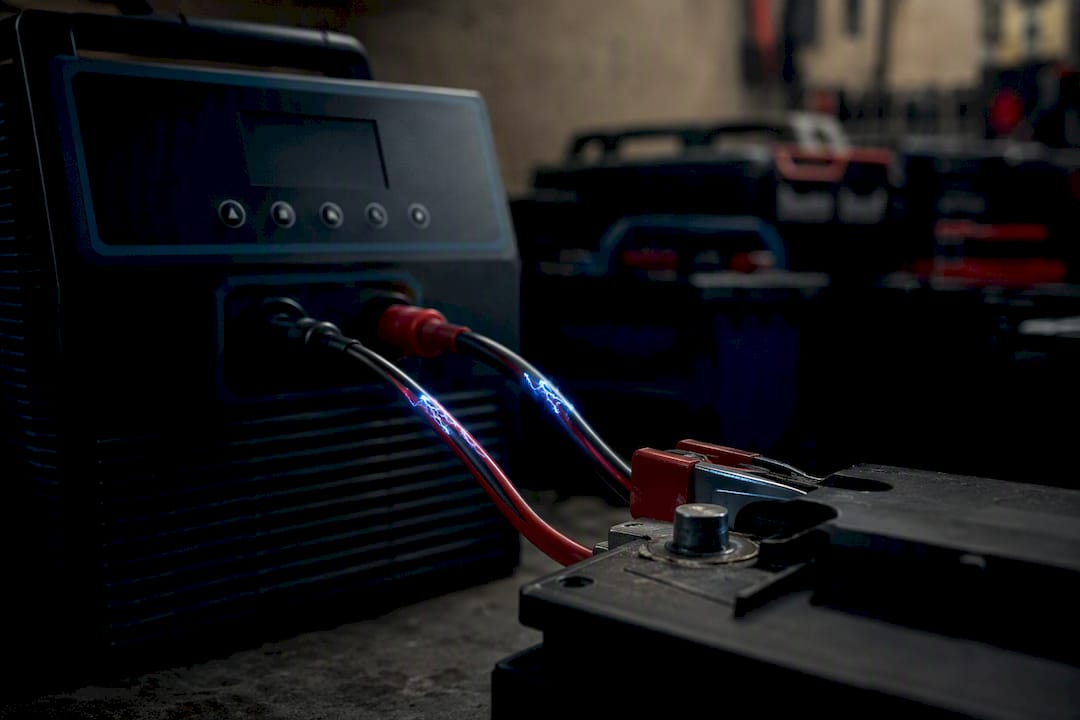
AGM batteries need more careful handling during this process than old-school flooded lead-acid batteries. Their sealed, glass-mat construction traps heat more easily and has less tolerance for gassing, so a charger pushing AGM-unsafe voltages risks drying out the electrolyte or warping the internal plates permanently. That’s a big part of why generic “battery repair” settings on cheap chargers make AGM owners nervous, and rightly so.
Here’s what realistic recovery looks like:
- Moderate sulfation from a few months of storage neglect: often recoverable, sometimes close to full original capacity.
- Sulfation from a year or more at very low voltage: partial recovery is possible, but expect reduced total capacity even after a successful cycle.
- Hard, long-term sulfation combined with plate degradation: electronic desulfation has low odds of meaningful recovery, and you’re better off treating the attempt as a diagnostic exercise rather than a fix.
Desulfation is a recovery tool, not a guaranteed repair. A five-year-old AGM that’s been discharged and forgotten a dozen times is not coming back to factory spec no matter how good your charger is. What you’re aiming for with any battery de-sulfator is a meaningful, measurable improvement, not a miracle.
What Charger Features Matter for Safe AGM Desulfation
Not every charger labeled “smart” is safe to run on an AGM battery in recovery mode. The spec sheet matters more than the marketing copy here, and a few features separate a charger you can trust from one that might cook your battery.
Essential features, non-negotiable:
- A dedicated AGM or VRLA charging profile. This sets voltage ceilings appropriate for sealed batteries instead of the higher limits flooded batteries can tolerate.
- Microprocessor control. This is what lets the charger adjust current and voltage in real time instead of blasting a fixed output regardless of battery response.
- A diagnostic or acceptance test before repair mode engages. Quality chargers analyze internal resistance and battery condition first, and they refuse to start reconditioning on a battery that tests as unsuitable.
- Temperature compensation. Charge voltage needs to shift based on ambient and battery temperature. Skip this and you risk gassing in summer heat or undercharging in cold garages.
- Automatic current and voltage limits. The charger should cap itself at AGM-safe thresholds rather than relying on you to babysit it.
Helpful, but not deal breakers:
- Low-voltage recovery capability for batteries that have dropped below the charger’s normal detection threshold.
- A distinct pulse or recondition mode, separate from bulk and absorption charging, that you can monitor.
- Clear LED or display diagnostics showing charge stage, voltage, and whether recondition mode is active.
- SAE quick-connect leads for vehicles and powersports gear, or ring terminals for permanent installs on marine batteries.
Chargers like the BatteryMINDer line use a seven-stage, microprocessor-controlled charging process that folds automatic pulse desulfation and temperature compensation into the same cycle, which is the kind of feature stack worth looking for regardless of brand.
Red flags that should send you back to the shelf:
- Vague “battery repair” claims with no mention of AGM or VRLA compatibility.
- No temperature sensor or probe included.
- No diagnostic phase, meaning the charger jumps straight into high-voltage pulsing on any battery you connect.
- No published voltage ceiling, or a charger that can’t be confirmed to stay within AGM-safe ranges.
Pro Tip: Check the charger’s manual for its actual absorption voltage ceiling before you buy, not just the word “AGM” on the box. Some units marketed for AGM use still cap out too high for smaller powersports batteries, which run leaner and heat up faster than a full-size automotive AGM.
Reputable vendors also build in a stop-gap. Some units abort repair mode automatically if the diagnostic test flags a bad cell or an unsafe internal resistance reading. That auto-abort function is one of the best indicators you’re dealing with a charger designed by people who actually understand AGM chemistry, not just a rebadged flooded-battery charger with an extra button.
How Do You Safely Run an AGM Desulfation Cycle?
Running a desulfation cycle isn’t complicated, but skipping steps is exactly how AGM batteries end up damaged instead of repaired. Follow this order every time.
- Inspect the case first. Look for swelling, cracks, leaks, or a rotten-egg smell. Any of these means stop, don’t charge, and move to replacement.
- Measure resting voltage with a multimeter after the battery has sat disconnected for at least a few hours. A healthy resting AGM battery sits around 12.6 to 12.8 volts. Anything under 10.5 volts suggests deep discharge that may need a low-voltage recovery step before your charger will even recognize the battery.
- Use a donor battery if your charger won’t engage. Connecting a healthy 12V battery in parallel briefly to raise the sulfated battery’s voltage to a detectable baseline is a widely used technician workaround for batteries too far gone for a smart charger to recognize on its own.
- Let the charger run its diagnostic phase. Don’t interrupt it. This is the step that decides whether recondition mode is even appropriate for this particular battery.
- Engage desulfation or recondition mode once diagnostics pass. Typical AGM desulfation cycles pulse at elevated absorption voltages clustering around 15.2 to 15.8 volts, well above normal float voltage, but the charger should manage this automatically rather than you setting it manually.
- Respect duration limits. Dedicated AGM recondition modes typically cap cycles between four and twelve hours, with cooling periods built in between cycles for deeper attempts. Starter batteries should run shorter, more conservative cycles; deep-cycle AGMs can often tolerate longer, less aggressive pulsing that recovers more usable amp-hours without stressing the plates.
- Monitor temperature throughout. If the case gets noticeably warm to the touch beyond normal charging warmth, stop the cycle.
- Let the battery rest for at least an hour after the cycle ends, then measure voltage again.
- Run a load test if you have access to one, or reinstall the battery and check performance under real load.
- Repeat at most a few times if you’re seeing measurable voltage or capacity gains. If two or three cycles show no improvement, further attempts are unlikely to help.
A practical way to think about this whole sequence: inspect, measure, recover to baseline if needed, run one controlled cycle, rest, test, and only repeat when the numbers actually move. That loop, drawn from the standard technician recovery workflow, keeps you from turning a diagnostic attempt into an accidental overcharge marathon.
When Should You Stop and Replace the Battery Instead?
Some AGM batteries are past the point where any charger, no matter how well designed, can help. Recognizing these signs early saves you time, and keeps you from pushing voltage into a battery that’s already a safety hazard.
Physical damage means stop immediately:
- Swelling or bulging anywhere on the case.
- Visible cracks, especially near the terminals.
- Any sign of venting, meaning gas has escaped through the safety valve.
- A sulfur or acid smell, which indicates internal breakdown that no charge cycle reverses.
Electrical signs point to a dead cell, not sulfation:
- The battery won’t accept any charge at all, even after a low-voltage recovery attempt.
- Your charger’s diagnostic phase flags a “bad cell” reading and refuses to proceed.
- Voltage doesn’t climb even slightly after a full controlled charging attempt.
Practical limits worth factoring in:
- Age matters. An AGM battery that’s already five or more years old and showing sulfation is a worse recovery candidate than a two-year-old battery that just sat too long in a cold garage.
- If you’ve already run two or three recondition cycles with no measurable gain, further cycling risks stressing the plates for no benefit.
- A battery that’s been deeply discharged repeatedly over its life, rather than once, tends to have permanent capacity loss that desulfation can’t touch.
If any of these apply, the honest answer is that a new battery is the safer and cheaper path than chasing marginal recovery on a unit that’s fundamentally compromised.
How Do You Prevent Sulfation From Happening in the First Place?
The best desulfation charger is the one you never need because your battery never sulfates in the first place. Prevention comes down to matching your charging habits to how the battery is actually used.
For vehicles, marine batteries, and powersports gear that sit unused for weeks between rides or trips, a maintainer or float charger with a dedicated AGM profile should stay connected whenever the battery isn’t in use. These units hold the battery at a safe float voltage instead of letting it self-discharge down into sulfation territory.
Match charger current to battery capacity rather than grabbing whatever charger is closest. A small powersports AGM battery doesn’t need the same charger you’d use on a marine deep-cycle bank, and running high current on a small battery for extended periods is its own path to heat damage.
- Marine batteries in seasonal storage should be topped up or left on a float charger through the off-season, not disconnected and forgotten in a cold garage.
- Powersports batteries, especially in motorcycles and ATVs stored over winter, benefit from a small-format AGM maintainer rather than a full-size automotive charger.
- Temperature matters for storage too. Extreme heat accelerates self-discharge and sulfation; extreme cold slows chemical activity but doesn’t stop the slow voltage drop that leads to sulfation over months.
Pro Tip: Check stored battery voltage every 60 to 90 days if it’s not on a maintainer. A voltage drop below 12.4 volts is your signal to charge before sulfation gets a real foothold, not after you notice the battery struggling to start.
Our own guide to AGM battery maintenance walks through specific float voltage targets and seasonal storage routines in more depth if you want the full schedule for your setup.
What We’ve Learned From Two Decades of AGM Batteries
Sulfation gets treated online like a mystery, but it’s mostly a math problem: time at low voltage plus temperature equals crystal growth. What surprises most owners isn’t that desulfation works. It’s how narrow the window is where it actually makes a difference.
Bansheebatteries has spent more than 20 years building AGM and lithium batteries for powersports and marine use, environments where batteries sit unused far longer than an average car battery and get punished by vibration, heat, and cold in equal measure. That experience shapes a simple recommendation: treat desulfation as a rescue tool for a battery you suspect was neglected, not as a routine maintenance step. If you’re running a smart charger with an AGM profile on a schedule already, you shouldn’t need recondition mode often, if ever.
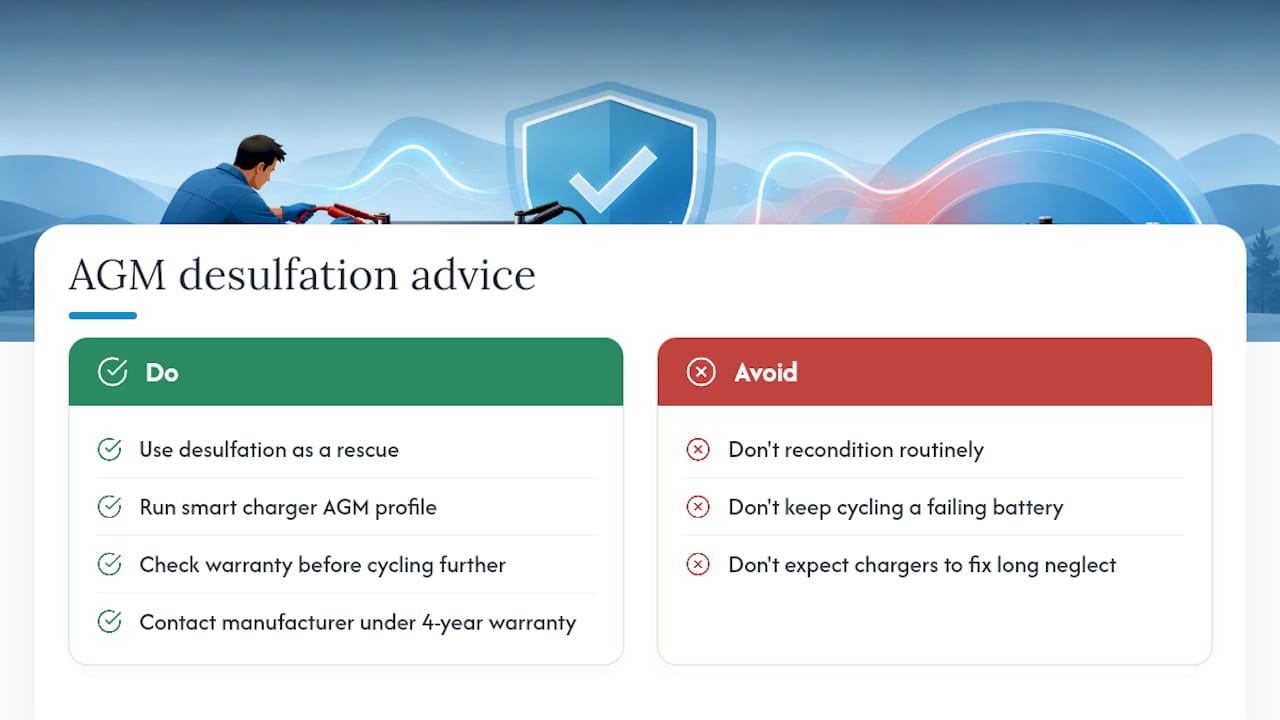
The gap between what desulfation chargers promise on the box and what they deliver in practice usually comes down to starting condition. A battery caught at moderate sulfation, still within its first two or three years, responds well. A battery that’s been ignored through multiple deep discharges over several seasons is a different story, and no charger changes that math.
Every AGM battery Bansheebatteries sells carries a 4-year warranty, which reflects confidence in build quality rather than a hedge against expected failure. If you’re running recondition cycles on a battery that’s still under warranty and seeing no improvement, that’s the moment to contact us directly rather than keep cycling a battery that may need replacement instead of repair.
— Donald
Get the Right Charger or a Fresh AGM Battery From Banshee
If your battery passed the checklist above and just needs a proper recondition cycle, Bansheebatteries carries chargers built for exactly this job. The fully automatic 12-volt battery charger covers AGM profiles with overcharge and short-circuit protection built in, and it’s sized for batteries from 6 to 230Ah, so it works whether you’re maintaining a motorcycle battery or a marine bank.
If your battery failed the red-flag checks, swollen case, no voltage recovery, repeated deep discharges, replacement is the safer call, and it’s where Bansheebatteries actually specializes. Every AGM battery we sell carries a 4-year warranty, and our lithium marine batteries carry 5 years, backed by two decades of building batteries specifically for powersports and marine punishment, not general automotive use. Browse powersport lithium batteries or marine battery options to find a direct replacement sized for your application. Not sure which battery or charger fits your setup? Reach out through our site and our team will walk you through the right choice before you spend a dollar.
Sources
- Is Repair Mode on Battery Chargers Safe for AGM Battery Types? - Battery Skills
- BatteryMINDer 2012-AGM 12V / 2.0 Amp Battery Charger, Maintainer & Desulfator
- Can You Revive a Dead AGM Battery? Repair & Recovery Guide - JCBL Batteries
- Desulfonate an AGM Battery: Effective Methods For Restoration And Maintenance - TheBatteryTips