


Match Battery to Engine: CCA vs MCA and the 20–25% Conversion
CCA is measured at 0°F for 30 seconds to a 7.2 V cutoff and predicts cold-start ability; MCA is measured at 32°F using the same 30 second draw and reflects moderate-weather or marine starting performance. If you’re starting an engine in freezing conditions, prioritize the CCA number. If you’re on the water in mild weather, MCA (sometimes labeled CA) is the more relevant spec.
TL;DR:
- For cold-weather starts, always prioritize batteries with a confirmed CCA rating at 0°F, since values at higher temperatures like MCA are not reliable for freezing conditions.
- MCA ratings are roughly 20 to 25% higher than CCA ratings on the same battery, but only the CCA figure directly reflects cold-start performance in winter climates.
- When comparing batteries, convert MCA to CCA using the factor of 0.80 to 0.83 for accurate evaluation, especially for vehicle or engine types with specific cold-start requirements.
- Lithium batteries use peak current ratings instead of CCA or MCA, so avoid relying on conversion formulas unless the product explicitly states cold-weather starting capability.
- Always check the test temperature and battery chemistry listed on the label, and choose a product with a warranty of at least four years for lead-acid or five years for lithium to ensure long-term reliability.
Table of Contents
- CCA vs MCA: Why the Cold Cranking Number Matters Most for Cars
- MCA and CA: Marine Ratings and the Label That Doesn’t Always Tell the Truth
- Converting Between CCA and MCA: The Math and Its Limits
- Which Rating Actually Matters for Your Situation
- Reading a Spec Sheet Without Getting Fooled
- Why Testing Variance and Vague CA Labels Cause Real Confusion
- How Banshee Batteries Weighs CCA and MCA When Recommending a Battery
- A Technician’s Three Quick Checks Before Recommending a Battery
- Find the Right Battery Once You Know Your Numbers
- Sources
- FAQ
CCA vs MCA: Why the Cold Cranking Number Matters Most for Cars
Cold cranking amps measure how much current a 12 volt battery can deliver for 30 seconds at 0°F while staying above 7.2 volts. That threshold isn’t arbitrary. Below 7.2 volts, most starter motors and ignition systems start struggling to do their job, so the test is really asking: can this battery still crank the engine hard once voltage starts sagging?
Cold makes this harder for a straightforward chemical reason. Battery chemistry relies on ions moving through electrolyte to generate current, and that movement slows down as temperature drops. At 0°F, a lead-acid battery’s ability to deliver current can drop to roughly half of what it produces at 80°F, even though nothing else about the battery has changed. Meanwhile, the engine oil thickens and the starter has to work harder to turn a cold engine over. You’re asking a weaker battery to do more work at exactly the moment it’s least capable of it.
How much CCA is enough? It depends heavily on engine size and climate:
- Small four-cylinder engines typically need 400 to 550 CCA.
- V6 engines in the 3.0 to 3.5 liter range usually call for 550 to 700 CCA.
- Larger V8s and diesel engines often need 700 to 950 CCA or more.
Those numbers assume a fresh, fully charged battery. A battery that’s three or four years old can lose 20% or more of its rated CCA even if it still starts the car on a warm day, which is exactly why a battery that cranked fine in October can leave you stranded in January.
MCA and CA: Marine Ratings and the Label That Doesn’t Always Tell the Truth
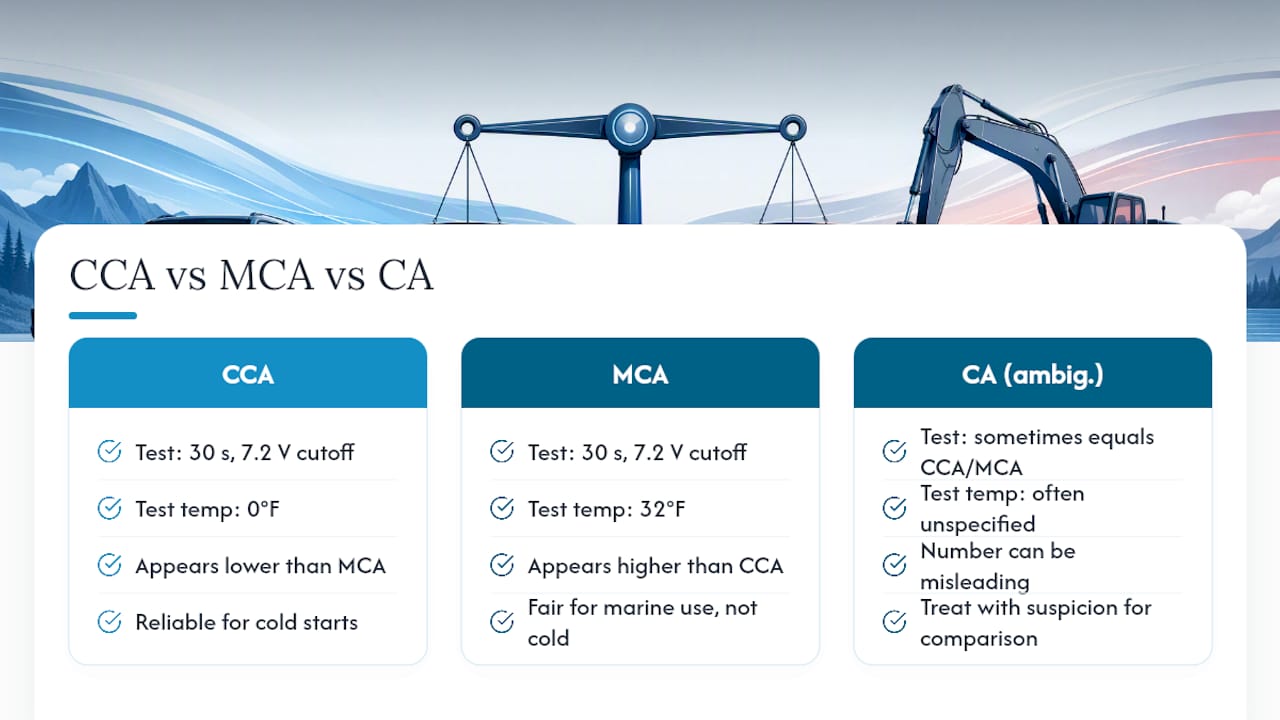
Marine cranking amps use the identical 30 second, 7.2 volt cutoff test as CCA, but at 32°F instead of 0°F. That’s the entire difference in methodology. Because MCA is measured at a much warmer temperature, the electrolyte reacts faster and the battery pushes out more current before hitting the cutoff, which is why an MCA number always looks bigger than a CCA number on the same battery.
CA, or cranking amps, is where things get murkier. Some manufacturers use CA interchangeably with MCA. Others print a CA number without stating any test temperature at all, which makes the figure essentially meaningless for comparison purposes. If a spec sheet lists CA with no temperature attached, treat that number with suspicion and look for a manufacturer that publishes CCA or a clearly labeled MCA at 32°F.
The reason MCA exists at all comes down to how boats actually get used. Most marine batteries are tested at 32°F because most boating happens in conditions far milder than a Midwest driveway in February. That makes MCA a fair, honest spec for its intended environment, but it becomes a trap the moment someone tries to use it to judge how a battery will perform starting a truck in sub-zero weather.
Pro Tip: If you’re comparing two batteries and one lists MCA while the other lists CCA, don’t compare the raw numbers side by side. Convert one to match the other first, or you’ll end up thinking the MCA battery is stronger than it actually is for cold starts.
Converting Between CCA and MCA: The Math and Its Limits
The conversion isn’t exact science, but it’s consistent enough to be genuinely useful. MCA runs roughly 20 to 25% higher than CCA on the same battery, which gives you two workable formulas:
- MCA ≈ CCA × 1.20 to 1.25. A battery rated at 600 CCA will typically carry an MCA rating somewhere between 720 and 750.
- CCA ≈ MCA × 0.80 to 0.83. A battery listed at 1,000 MCA converts to roughly 800 to 830 CCA. Drop to 800 MCA and you’re looking at an estimated 640 to 665 CCA.
Those ranges hold up well enough for lead-acid AGM and flooded batteries, since independent boating forums report the same 20 to 25% gap that manufacturers’ own literature shows. But the formula breaks down in a few specific situations. Lithium (LiFePO4) batteries often use a completely different measurement, a short burst peak current rating rather than a 30 second sustained draw, so running a lithium spec through the CCA/MCA formula gives you a number that doesn’t mean what you think it means. An unlabeled CA rating can’t be converted reliably either, since you don’t know what temperature it was tested at. And two batteries with identical chemistry can still test differently depending on the manufacturer’s equipment and calibration.
The safest rule: if cold-weather starting is the priority, buy a battery with a stated CCA number. Don’t rely on a converted MCA figure to make that call for you.
Which Rating Actually Matters for Your Situation
Not every buyer needs the same number, and chasing the highest rating on the shelf usually wastes money. Match the spec to what you’re actually doing.
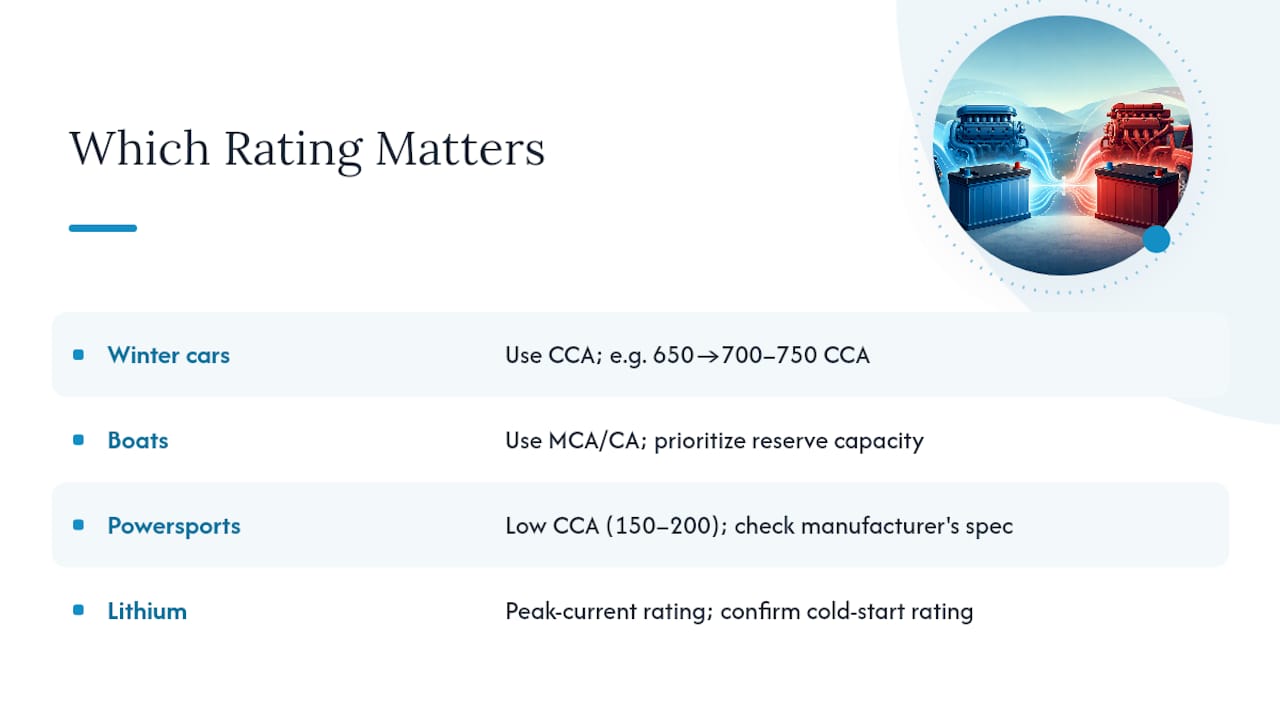
Winter cars and trucks. Buy at or above the CCA your manufacturer recommends, and don’t cut it close. If your owner’s manual calls for 650 CCA and you live somewhere that regularly sees single-digit temperatures, buying a 700 or 750 CCA AGM battery built for cold starts buys you margin against age-related capacity loss.
Boats in temperate climates. MCA or CA is a perfectly valid spec here, and you generally don’t need to convert anything. What matters more for marine use is reserve capacity, since you’re often running electronics, bilge pumps, or a trolling motor for hours, not just cranking an engine once and driving off.
Motorcycles and powersports. Small engines simply don’t need much cranking power. A 250cc dirt bike might only require 150 to 200 CCA, while UTVs and larger powersport engines can need considerably more, especially if you’re running aftermarket lighting or a winch. Check the manufacturer’s spec before assuming bigger is automatically better.
Lithium alternatives. LiFePO4 batteries don’t play by the same rules. Many publish a peak current rating, something like 200 amps for 5 to 10 seconds at room temperature, instead of a true CCA figure. If you’re switching to lithium for a cold-climate vehicle, confirm the battery is explicitly rated for cold-weather starting, not just built for weight savings, since lithium chemistry can struggle below freezing without internal heating.
Pro Tip: If a vehicle’s demand sits near your engine’s specification, upgrading CCA slightly rather than matching it exactly gives you a real buffer against a bad cold morning two winters from now.
Reading a Spec Sheet Without Getting Fooled
A product page or battery label usually lists CCA and MCA (or CA) somewhere near the voltage and amp-hour rating, but the layout varies a lot between brands. Before you buy, run through this short checklist:
- Confirm the chemistry. AGM, flooded, EFB, and lithium all behave differently in cold weather, even at identical CCA numbers.
- Check for a stated test temperature. If CA appears with no temperature listed, treat it as an unreliable figure.
- Look at reserve capacity, not just cranking power, if you’ll be running accessories with the engine off.
- Verify physical fit. Terminal type and case size (like BCI group size) matter just as much as electrical specs.
- Read the warranty terms. A short warranty on a battery claiming a high CCA is worth questioning.
A 3.5 liter V6 truck battery and a small motorcycle battery might sit three feet apart on a shelf with wildly different CCA needs, so matching the number to your actual engine, not the biggest number on the shelf, saves both money and guesswork. If you’re unsure which spec applies to your vehicle, a quick call to a technician or the manufacturer’s fitment tool beats an educated guess.
Why Testing Variance and Vague CA Labels Cause Real Confusion
A battery’s sticker rating and its real-world performance can drift apart faster than most people expect. Age, partial state of charge, and ambient temperature at the moment of testing all shift the numbers, which is why a “fresh” CCA rating from the factory isn’t a permanent guarantee.
- Demand a stated test temperature any time a manufacturer prints CA on the label.
- Expect measured performance to decline noticeably as a battery ages past two or three years, even without visible damage.
- A conductance tester or a professional load test gives a far more honest read on remaining capacity than the printed rating alone.
- If a battery has been sitting on a shelf or in storage for months, don’t trust the sticker until it’s been tested or at least fully charged first.
When a battery’s actual behavior doesn’t match its rating anymore, replacing it beats guessing. The cost of a jump start in a parking lot rarely feels smaller than the cost of a new battery.
How Banshee Batteries Weighs CCA and MCA When Recommending a Battery
Environment drives the recommendation before anything else. A vehicle that starts in freezing temperatures gets steered toward a battery with a confirmed, honest CCA rating, not a converted or estimated one. A boat running in moderate climates can lean on MCA without penalty. For riders and boaters looking to cut weight without sacrificing starting power, lithium comes into play, but only once cold-start behavior for that specific model has been confirmed rather than assumed.
Warranty length factors into that recommendation too. AGM batteries generally carry a 4 year warranty, and lithium marine batteries carry a 5 year warranty, which matters because a battery that’s expected to hold its rated output for years, not months, is worth paying more for upfront.
Before you check out on any battery, bring this short list to the product page or a vendor chat:
- What’s the confirmed test temperature behind the CCA or MCA number?
- Does the chemistry (AGM vs lithium) match how and where you’ll use it?
- What’s the warranty length, and does it match how long you expect to keep the vehicle?
A Technician’s Three Quick Checks Before Recommending a Battery
Before recommending anything, the environment gets confirmed first: is this a winter start, a marine start, or something in between? Cold climates always point toward a stated CCA number, never a converted one. If only MCA or CA is listed, the conversion gets run, then the chemistry gets double checked, since lithium doesn’t follow the same math. Last, warranty length and return policy get reviewed, because a battery that can’t be bench tested before purchase is a bigger gamble than one that can.
— Donald
Find the Right Battery Once You Know Your Numbers
Once you know whether your engine needs CCA or MCA, matching that number to an actual battery is the easy part. Banshee Batteries builds AGM and lithium batteries specifically for powersports, marine, and off-grid use, backed by a 4 year warranty on AGM models and a 5 year warranty on lithium marine batteries, so you’re not gambling on a spec that fades after one season.
If you’re on the water in moderate conditions and want to cut weight without losing starting power, the lithium marine battery collection is built around confirmed cold-start behavior, not just a peak-current number on a spec sheet. Riders and powersport owners can browse the lithium powersport battery lineup for models matched to specific engine demands, and anyone still comparing lead-acid options can check the general marine battery lineup for CCA and MCA specs side by side. If your engine’s starting demand is unusually high, pairing your battery choice with the right performance upgrades can keep your electrical system from being the weak link. Not sure which spec applies to your setup? Reach out to Banshee’s team before you buy, and get a recommendation matched to your actual engine, not a guess.
Sources
- Bauer Built Blog: Winter is coming — do you know your battery’s CCA rating?
- CCA vs MCA – Marine Cranking Amps vs Cold Cranking Amps | PowerCurious
FAQ
How many CCA is a 1,000 MCA battery?
A 1,000 MCA battery converts to roughly 800 to 830 CCA, using the standard 0.80 to 0.83 conversion factor.
How do I convert CCA to MCA?
Multiply the CCA rating by 1.20 to 1.25 to estimate MCA; for example, a 600 CCA battery typically carries an MCA rating around 720 to 750.
How many CCA is 800 MCA?
An 800 MCA battery translates to approximately 640 to 665 CCA, though the exact figure varies by manufacturer and battery chemistry.
What is CCA and MCA in a battery?
CCA is the current a battery delivers for 30 seconds at 0°F before dropping below 7.2 volts, while MCA measures the same 30 second draw at 32°F, which is why MCA numbers read higher.
Should I trust a battery that only lists CA with no test temperature?
Not for critical cold-weather use. An unlabeled CA rating lacks a defined test temperature, so it can’t be reliably converted or compared against CCA or MCA figures.