


Workshop Ready AGM Charger Settings for Powersports, 12 Hour Check
For most 12V AGM batteries, set absorption and bulk to roughly 14.4–14.7V and float to 13.5–13.8V, select AGM mode on the charger, and enable temperature compensation if the unit supports it. Keep charge current at or below about 0.2C. Confirm success by checking the resting voltage, which should settle between 12.6V and 12.8V about twelve hours after the charger stops.
TL;DR:
- Most 12V AGM batteries should be charged with voltage settings between 14.4–14.7V during absorption and bulk, and 13.5–13.8V during float, with a maximum of 15.0V for the full bank.
- Charge currents must stay at or below 0.2C to prevent heat buildup and accelerate plate degradation, except for specific circumstances like recovery procedures.
- Confirm full charge by measuring open-circuit voltage after 12 hours of rest; 12.6V to 12.8V indicates a full 12V AGM battery.
- Use chargers with AGM-specific profiles, manual type confirmation, and automatic temperature adjustment features for optimal safety and longevity.
Table of Contents
- What Are the Right AGM Charger Voltage Settings?
- How Do Bulk, Absorption, and Float Stages Work?
- What Amperage Should You Use to Charge an AGM Battery?
- Why Does Temperature Change Your Charger Settings?
- Which Charger Features Actually Matter for AGM Batteries?
- How Do You Know the Charge Actually Worked?
- What Banshee Batteries Has Learned From Two Decades of AGM Power
- Why Precise Settings Matter More Than People Think
- Get the Right Battery and Charger Setup From Bansheebatteries
- Sources
- FAQ
What Are the Right AGM Charger Voltage Settings?
Every 12V AGM battery on the market responds to roughly the same voltage windows, though the exact number depends on the manufacturer’s datasheet. Absorption and bulk voltage typically run 14.4–14.7V, with float settling into a lower maintenance range of 13.5–13.8V, based on the resting voltage benchmark used across the industry. Odyssey batteries, for example, recommend a float around 13.6V for some models and warn against sustained voltages above 15.0V on 12V AGM units.
Multi-battery systems scale these numbers up. A 24V bank doubles each figure; a 48V bank quadruples it. Equalization voltages, where the manufacturer allows them at all, rarely exceed 14.8V on a 12V bank and should never be run as a routine step.
| System Voltage | Bulk/Absorption Range | Float Range | Notes |
|---|---|---|---|
| 12V | 14.4–14.7V | 13.5–13.8V | Never exceed 15.0V sustained |
| 24V | 28.8V | 27.0V | Doubled from 12V figures |
| 48V | 57.6V | 54.0V | Quadrupled from 12V figures |
Charge current matters as much as voltage. Manufacturer datasheets and sources like Large Battery both confirm these windows hold across most sealed lead-acid designs.
How Do Bulk, Absorption, and Float Stages Work?
A quality charger moves through three distinct phases, and understanding what each one does explains why the voltage settings above matter.
- Bulk: The charger pushes maximum current into the battery while voltage climbs toward the absorption setpoint. This stage restores roughly 80% of capacity fast.
- Absorption: Voltage holds steady at 14.4–14.7V while current gradually tapers off. This is where the last 20% of capacity gets replaced, more slowly and carefully than during bulk.
- Float: Once the battery is full, voltage drops to 13.5–13.8V. Float isn’t for recharging. It’s for offsetting the battery’s natural self-discharge so it stays topped off without overcharging.
- Equalization: Most AGM batteries should never see an equalization cycle. If a manufacturer explicitly permits it, the ceiling is typically 14.8V, and even then it risks gassing and venting that a sealed AGM cell can’t easily recover from. Renogy’s charging walkthrough treats equalization as an exception, not a routine maintenance step.
Pro Tip: If your charger has a dedicated “equalize” button and your battery’s datasheet doesn’t mention equalization by name, leave that button alone. AGM plates don’t have the free electrolyte that flooded batteries use to survive that stage.
What Amperage Should You Use to Charge an AGM Battery?
Charge current should stay proportional to battery capacity, not to how fast you want the job done. A 100Ah AGM battery, for instance, handles a continuous charge current up to about 20A comfortably under the 0.2C guideline, though checking the specific datasheet always beats guessing.
- Routine charging: Keep continuous current at or below 0.2C unless the manufacturer states otherwise.
- Maintenance/storage charging: A 0.5–1.5A trickle keeps a parked battery topped off between uses.
- Deep discharge recovery: Larger batteries sometimes need higher amperage to recover, with Odyssey citing examples up to 40A for certain large-capacity models under supervised charging.
- Why higher amperage carries risk: Excess current generates heat inside the battery case, and heat accelerates plate corrosion and shortens overall service life.
Higher-amperage charging has a place, but only paired with active monitoring, temperature awareness, and a charger that automatically steps down once voltage hits the absorption ceiling.
Why Does Temperature Change Your Charger Settings?
Battery chemistry reacts to ambient temperature, which is why a fixed voltage setting works less well as the seasons change. The commonly cited coefficient is about −24 mV/°C per 12V battery, or roughly −4 mV per cell per degree Celsius, centered on 77°F (25°C).
That means voltage should drop slightly as temperature rises above 77°F, and climb slightly as temperature falls below it. In practice:
- Hot garage or engine bay (95°F/35°C): Reduce absorption voltage by roughly 0.24V from your baseline to avoid overcharging and excess gassing.
- Cold storage shed (32°F/0°C): Raise absorption voltage by roughly 0.6V so the battery actually reaches full charge before the charger cuts off.
- Moderate conditions (60–80°F): Standard manufacturer voltages apply without adjustment.
Most smart chargers with a built-in temperature sensor handle this automatically. If yours doesn’t, calculate the offset manually using the coefficient above rather than leaving a fixed voltage running through a Minnesota winter or a Texas garage in August.
Riders and boat owners who store equipment seasonally feel this most. Batteries pulled from cold storage for spring startup often read low simply because the charger never compensated for the temperature swing, not because the battery itself failed. Bansheebatteries covers seasonal handling in more detail in its cold weather charging guide.
Which Charger Features Actually Matter for AGM Batteries?
Before connecting any charger to an AGM battery, run through this checklist:
- Set the battery type manually to AGM, SLA, or “sealed.” Never leave it on a lithium or flooded-cell profile, even if the charger claims automatic detection. CTEK recommends manual confirmation rather than trusting auto-detect alone.
- Favor chargers with adaptive charging curves. Features like battery-safe mode adjust absorption time to actual battery condition, cutting gassing risk.
- Cross-check the charger’s maximum absorption voltage against your battery’s datasheet. A generic AGM preset doesn’t always match every chemistry exactly.
- Turn off any automatic equalization cycle unless your battery’s documentation specifically calls for it.
Pro Tip: A charger with a storage or maintenance mode holds voltage slightly below float, which does more for long-term plate health than leaving a battery on full float voltage for months at a time.
Bansheebatteries breaks down compatible charger types in its guide to which charger works best with AGM batteries.
How Do You Know the Charge Actually Worked?
Verification takes two minutes and prevents a lot of guesswork. Disconnect the charger, let the battery rest for about 12 hours, then measure open-circuit voltage. A reading between 12.6V and 12.8V means the battery reached a full charge; anything lower points to an undercharge or a battery that’s struggling to hold capacity.
- Never let sustained voltage climb above roughly 15.0V on a 12V AGM. That ceiling exists for a reason: sealed cells can’t vent and recombine gas indefinitely without damage.
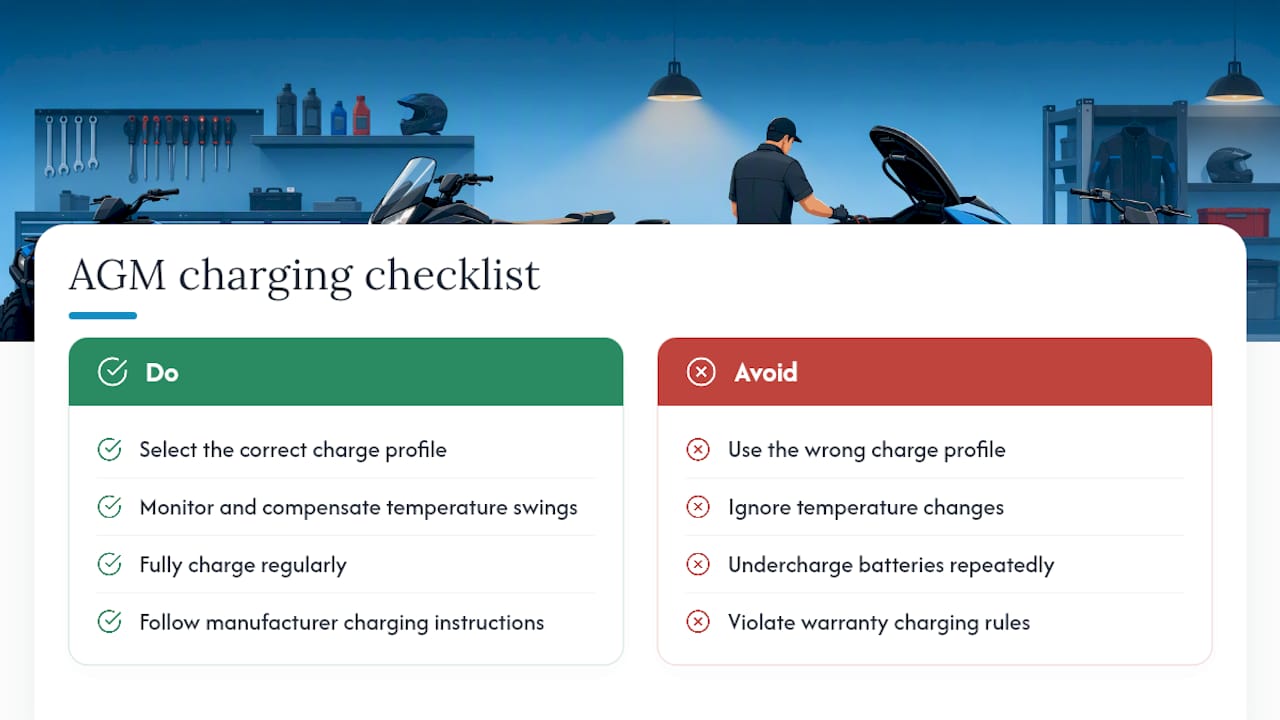
- Common mistakes include running a lithium charging profile on an AGM battery, leaving a battery parked at full float voltage in a hot environment, and chronic undercharging, which leads to sulfation over time.
- If a battery reads well below 12.6V after resting, a controlled low-current recharge sometimes recovers it. Persistent low readings after multiple charge attempts usually mean it’s time to replace the battery rather than keep nursing it. Bansheebatteries walks through recovery steps in its guide on safely desulfating an AGM battery.
What Banshee Batteries Has Learned From Two Decades of AGM Power
Some manufacturers have decades of experience building AGM and lithium batteries for powersports and marine use, noting that common charging mistakes include wrong profile selection, ignored temperature swings, and chronic undercharging. Warranties on AGM batteries commonly require proper charging practices for validity. For application-specific charging notes on powersport and marine setups, the AGM charging guide and the AGM charging FAQ cover scenarios this article doesn’t have room for.
Why Precise Settings Matter More Than People Think
Most AGM failures I’ve looked into trace back to a charger set wrong, not a battery that was doomed from the start. A float voltage left too high in summer heat, or a lithium profile run on a sealed lead-acid cell, does slow, invisible damage that only shows up as a no-start months later. The datasheet is boring. Read it anyway, and let a charger with real AGM and temperature-compensation modes do the rest.
— Donald
Get the Right Battery and Charger Setup From Bansheebatteries
Some AGM batteries are built with high lead content to better tolerate voltage swings and deep-discharge cycles common in powersports and marine applications, often supported by multi-year warranties.
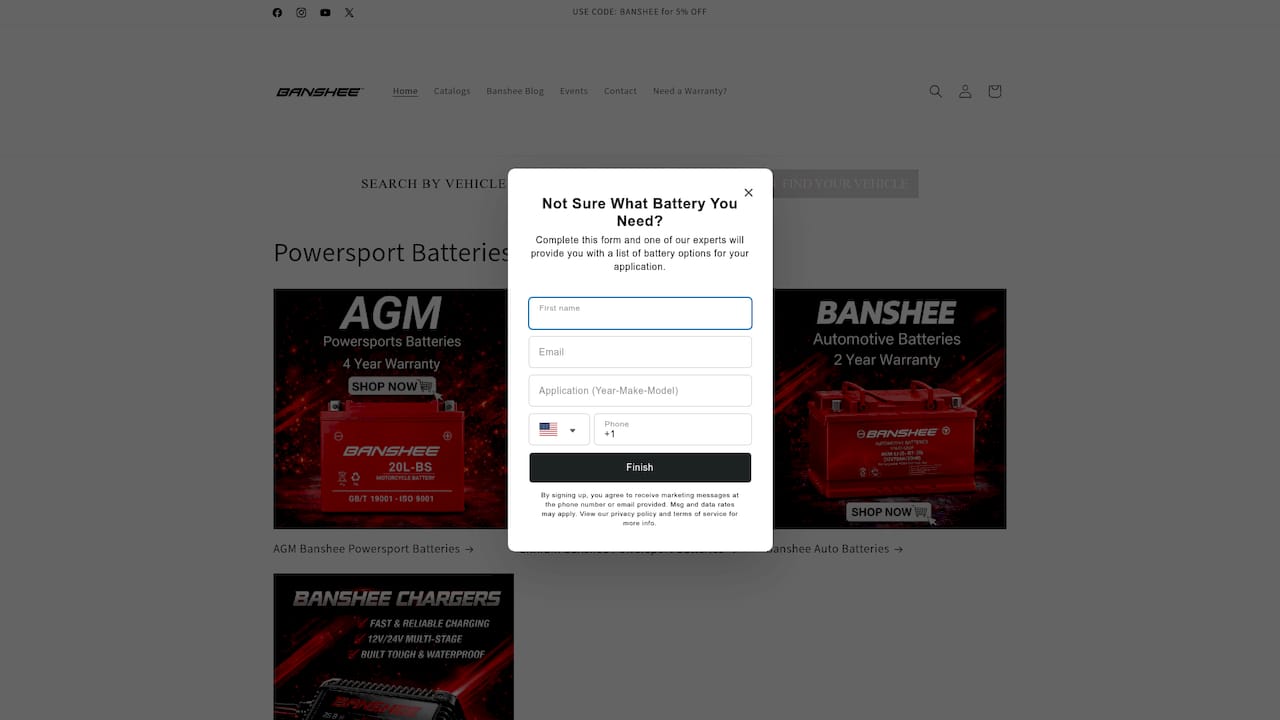
If you’re not sure which charger pairs correctly with your battery’s absorption and float requirements, the chargers and accessories collection lists units built with AGM-specific profiles and temperature compensation already dialed in. Marine owners running lithium setups can check the lithium marine battery lineup for pre-charged, installation-ready options instead. Whatever you’re riding or running, start at the main Bansheebatteries shop to match your vehicle to the right battery and charger combination, or reach out to customer support with your model number for a direct recommendation.
Sources
Before setting any charger, cross-reference CTEK’s AGM charging guidance, the Odyssey manual, and your battery’s own datasheet.
- Charging an AGM battery: settings, safety and best practice — CTEK
- ODYSSEY battery installation, operation and maintenance manual
- AGM and GEL battery datasheet excerpt (MasterSystems copy of manufacturer data)
- How to Charge an AGM Battery: A Step-by-Step Tutorial — Renogy
- AGM Battery Charge Voltage: Safe Ranges and Charging Tips — Large Battery
FAQ
What Is the Recommended Charging Cycle for an AGM Battery?
A full cycle moves through bulk, absorption, and float. Bulk delivers maximum current until voltage reaches the absorption setpoint of roughly 14.4–14.7V, absorption holds that voltage while current tapers, and float drops to 13.5–13.8V to maintain the charge without overcharging.
Is It Better to Charge an AGM Battery Fast or Slow?
Slower, controlled charging at or below about 0.2C protects battery life better than a fast charge. High current generates heat inside the case, and heat accelerates plate degradation and shortens the battery’s usable lifespan.
What Is the Best Amperage to Charge an AGM Battery?
The safe continuous rate is roughly 0.2C, meaning a 100Ah battery charges well around 20A or less. Maintenance charging for stored batteries works better at a lower 0.5–1.5A trickle rate.
What Does AGM Setting Mean on a Battery Charger?
The AGM setting tells the charger to use voltage and current profiles matched to sealed absorbed glass mat chemistry, rather than a flooded lead-acid or lithium profile. It typically targets 14.4–14.7V absorption and 13.5–13.8V float, and selecting it manually is safer than relying on automatic battery detection.
How Do You Know if an AGM Battery Is Fully Charged?
Check open-circuit voltage after letting the battery rest for about 12 hours without a load or charger connected. A reading between 12.6V and 12.8V confirms a full charge.