


Installer Tested AGM Venting Rules Backed by IEC and 20 Years
AGM batteries are valve-regulated and sealed for normal use, so most installations never need a dedicated vent. That changes fast under overcharge, high heat, internal faults, or when several batteries sit in a sealed cabinet or enclosure. The next sections walk through how the valves work, when you need external venting, and what to do if a battery starts gassing.
TL;DR:
- Most AGM batteries only vent during overcharge, high heat, or internal faults, making venting necessary mainly in sealed or multiple-battery setups.
- If installed in a sealed compartment or with multiple batteries, a remote vent system or forced ventilation is crucial to prevent hydrogen buildup and ensure safety.
- Hydrogen, the primary gas released, is flammable at concentrations above 4%, requiring proper outdoor venting and strict no-open-flame rules during gassing episodes.
- Proper installation includes verifying vent tube fittings, avoiding sealed boxes without ventilation, and ensuring airflow is unblocked and clearly labeled.
- Upgrading to lithium batteries eliminates most venting concerns due to the chemistry’s non-gassing nature and simplifies safety and installation requirements.
Table of Contents
- How AGM Battery Venting Actually Works
- When You Need External Venting or a Remote Vent System
- What Gases AGM Batteries Release and Why It Matters
- Best Practices for AGM Venting and Installation
- Recognizing Abnormal Gassing and What to Do Next
- What 20 Years of Powersports and Marine Builds Taught Us
- An Installer’s Honest Take on Common Venting Mistakes
- Choosing the Right AGM or Lithium Battery for Your Build
- Sources
How AGM Battery Venting Actually Works
An AGM battery is a valve-regulated lead-acid design, which is where the acronym VRLA comes from. Inside, the electrolyte is absorbed into a fiberglass mat instead of sitting as free liquid, and the case is sealed except for a pressure-relief valve built into the top.
That valve is the whole ballgame. During normal charging, oxygen and hydrogen recombine internally instead of escaping. A small amount of gas still forms, especially near the end of a charge cycle, but the recombination process handles it. The valve only cracks open when internal pressure climbs past a set threshold, usually because of overcharge, excessive heat, or a failing cell. Once pressure drops back down, the valve reseats itself. This is why Battery Skills notes that AGMs are sealed by design but will vent in real-world conditions like overcharging or cramped multi-battery setups.
Sealed does not mean airtight forever, and it does not mean “never gasses.” It means gas production is minimized and contained under normal conditions. Some AGM models, particularly certain powersports and motorcycle units, include a small vent tube or nipple specifically so that if the valve does open, gas has somewhere defined to go rather than pooling inside a battery box. Riders and boat owners on forums have flagged this repeatedly. One widely referenced BimmerForums thread points out that a battery with a vent hole should still be routed or vented, even though it is marketed as sealed.
When you install an AGM, check these points by following safe steps around your engine bay to protect your battery and surrounding components with ceramic protection.
- Confirm whether the battery has a vent tube fitting and whether your box or tray accommodates it.
- Look at the case for any swelling or deformation, which signals the valve has already worked overtime.
- Verify your charger matches AGM voltage specs rather than a flooded-cell profile.
- Note how tightly the battery sits in its compartment, since heat buildup accelerates gassing.
When You Need External Venting or a Remote Vent System
Most single-battery setups in an open engine bay or bilge never need extra hardware. Three situations change that math.
- Multiple batteries in a bank. Wiring batteries in series or parallel inside a cabinet, battery room, or enclosed box multiplies the gas volume if more than one valve opens at once. IEC-style guidance from ZVEI treats stationary VRLA banks as requiring calculated ventilation or a remote venting system (RVS), not casual air gaps.
- Sealed compartments with no air path. Boat lockers, RV underbelly boxes, and tight engine bays often block natural diffusion entirely. If a battery box has a lid with a gasket seal, hydrogen has nowhere to go except to accumulate.
- High-charge or fault-prone setups. Fast chargers, poorly matched charge controllers, or an aging battery nearing failure all raise the odds of sustained gassing. Any of these conditions inside a sealed box is the scenario where remote degassing tubing, routed to open air, stops being optional.
Pro Tip: If your battery box has a lid that seals tight enough to keep water out, assume it also seals gas in. That is exactly the box that needs a vent tube routed outside, not just a few drilled holes.
What Gases AGM Batteries Release and Why It Matters
When an AGM valve opens, it releases a mix of hydrogen and oxygen produced by electrolysis inside the cell, with hydrogen making up the larger and more dangerous share. This happens most during overcharge, when the battery has already recombined as much gas internally as it can and excess electrolysis has nowhere to go.
Hydrogen is flammable across a specific range, and the number that matters is the lower explosion limit, or LEL. FIAMM’s engineering manual puts hydrogen’s LEL at roughly 4% by volume in air. Below that concentration, a spark or flame source has nothing to ignite. Above it, even a small ignition source can trigger a flash fire in a confined space. The entire point of routing vent tubing outdoors, or ensuring airflow through a battery compartment, is keeping hydrogen concentration well under that 4% threshold rather than letting it build up in a sealed corner.
Practical safety rules that follow directly from this:
- No smoking, welding, or open flame anywhere near a battery bank that is charging or has recently vented.
- Avoid creating sparks near battery terminals, including from loose wiring or metal tools bridging posts.
- If a battery is actively venting, increase airflow immediately and isolate it from other equipment if you can do so safely.
- Never charge a suspect battery inside a fully sealed box without a vent path.
Occasionally in damaged or badly overcharged cells, you might smell something closer to rotten eggs rather than the odorless character of pure hydrogen, which points to trace hydrogen sulphide from internal breakdown. Treat that smell as a stronger warning sign, not a minor nuisance.
Best Practices for AGM Venting and Installation
Standards-based guidance keeps this simple: use natural ventilation wherever the installation allows it, and step up to forced ventilation or a remote vent system only when the compartment is genuinely sealed. The ZVEI degassing guidance frames this as a sizing problem: airflow needs to be calculated against the number of batteries and their charge rate, not guessed at.
In a small forced-air setup, that often means a fan wired to run whenever the charger is active, sometimes through a simple interlock so the fan can’t be left off during a charge cycle. FIAMM’s manual outlines minimum inlet and outlet opening sizes for exactly this reason.
Installation rules worth following on every build:
- Put inlet and outlet openings on opposite sides or ends of the compartment so air actually crosses the space instead of short-circuiting near the door.
- Keep any degassing hose free of kinks and sags where condensation or gas could pool instead of flowing outdoors.
- Label the vent outlet clearly so nobody blocks it during a future repair or accessory install.
- Route the exhaust end somewhere outdoors and away from air intakes, cabin vents, or ignition sources.
| Ventilation approach | Best suited for | Key requirement |
|---|---|---|
| Natural ventilation | Single battery, open engine bay or bilge | Unobstructed air gaps, no sealed lid |
| Forced ventilation | Multiple batteries, semi-enclosed box | Fan sized to charge rate, ideally interlocked to charger |
| Remote vent system (RVS) | Fully sealed cabinets, battery rooms | Sealed hose routed outdoors, secure fittings, no kinks |
Recognizing Abnormal Gassing and What to Do Next
Occasional light gassing near the end of a charge is normal. Abnormal gassing looks and behaves differently, and catching the difference early is what keeps a bad battery from becoming a bigger problem.
- Watch for physical warning signs. A swollen or bulging case, a persistent hiss from the valve, or a sulfur smell instead of the normal faint odorless venting all point to a battery under real stress. Unexpectedly high charger voltage readings, above what AGM specs call for, often mean the charger itself is the culprit.
- Act immediately if you catch it happening. Stop charging right away, open up airflow to the area, and move the battery outdoors if you can do so without risking a spark. Keep ignition sources clear until the smell and any visible gassing have fully cleared.
- Fix the root cause, not just the symptom. A PWM charger without temperature compensation running in a hot engine bay is a common trigger reported in field forums, and it will overcharge an AGM repeatedly if left in place. Swap to a charger with a proper AGM profile, and if the battery has already swollen once, replace it rather than returning it to service.
Pro Tip: Keep a simple log of charger voltage readings over a few weeks. A number that creeps upward on the same battery, in the same conditions, usually means the charger is drifting out of spec before the battery itself fails.
Our AGM battery charging guide breaks down the voltage ranges and charger types that keep gassing to a minimum, and our maintenance walkthrough covers the inspection habits that catch swelling before it becomes a failure.
What 20 Years of Powersports and Marine Builds Taught Us
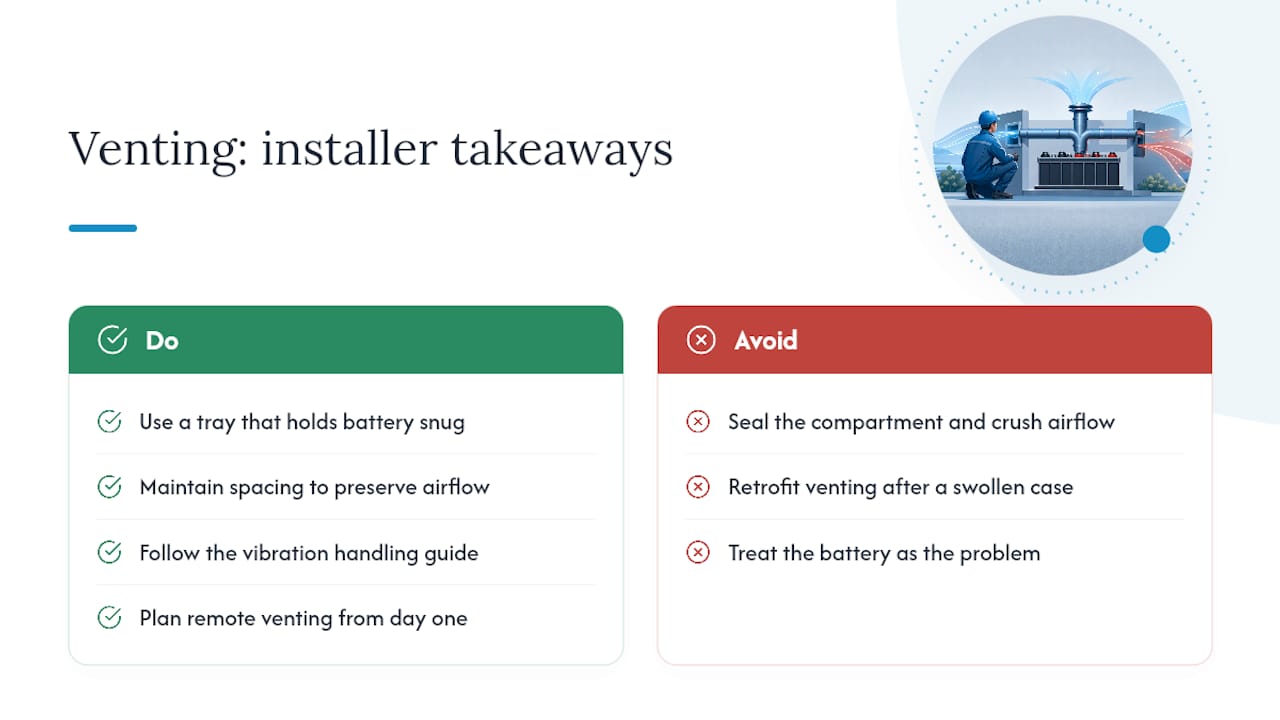
Bansheebatteries has built AGM and lithium batteries for powersports and marine use for over 20 years, and the venting question comes up constantly with installers cramming batteries into tight compartments. The recurring problem is not the battery. It’s the box.
Vibration-heavy builds like ATVs and UTVs need a tray that holds the battery snug without crushing airflow around it. Our vibration handling guide covers spacing that keeps a battery secure without turning its compartment into a sealed box. When a build truly requires a sealed enclosure, that’s the moment to plan for remote venting from day one rather than retrofitting it after a swollen case shows up.
An Installer’s Honest Take on Common Venting Mistakes
The mistakes repeat: a sealed battery box with no vent path, a charger set for flooded cells running on an AGM, or a tight bank of batteries with zero airflow between them. Each one is preventable.
Quick rules: match your charger to AGM specs, never seal a multi-battery box without a vent route, and treat any swelling or persistent smell as a signal to stop and check, not something to wait out.
— Donald
Choosing the Right AGM or Lithium Battery for Your Build
A battery that fits its compartment properly, with the right charger to match, is most of what prevents venting problems before they start. That’s the build philosophy behind every Bansheebatteries AGM and lithium pack: purpose-built dimensions for powersports and marine applications, backed by a 4-year warranty on AGM batteries and a 5-year warranty on lithium marine batteries.
If your current setup runs hot, gasses more than it should, or you’re planning a battery bank that needs real ventilation from the start, a lithium upgrade removes a lot of that risk since LiFePO4 chemistry doesn’t off-gas hydrogen the way AGM can under stress. Check our lithium marine battery lineup for deep-cycle options built for boats, or browse lithium powersport batteries if you’re rebuilding a motorcycle or ATV electrical system. Pair either with a charger sized correctly for the chemistry, and reach out to our support team with your compartment dimensions if you want a second opinion before you order.
Sources
- Information on degassing systems for VRLA batteries in stationary applications (ZVEI)
- Engineering manual - AGM (FIAMM)